Well Completion Equipment and Services Market Outlook:
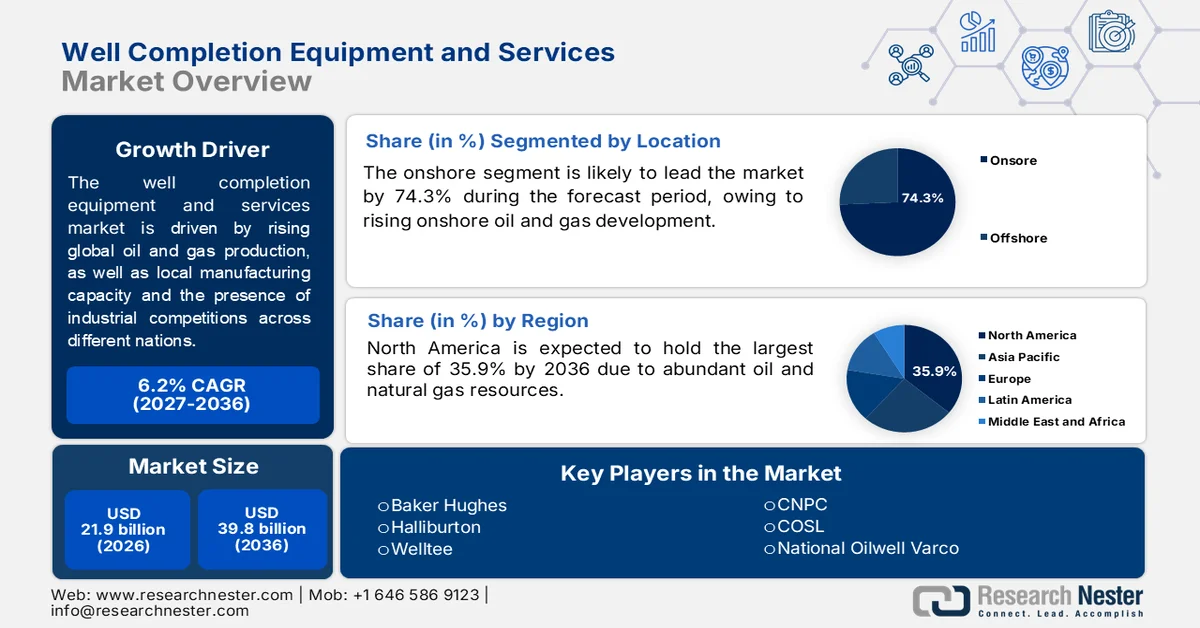
Well Completion Equipment and Services Market size was over USD 21.9 billion in 2026 and is anticipated to exceed USD 39.8 billion by the end of 2036, growing at over 6.2% CAGR during the forecast period i.e., between 2027-2036. In 2027, the industry size of well completion equipment and services is evaluated at USD 23.2 billion.
The worldwide well completion equipment and services market is readily shaped by different factors, including competitive industrial landscape, geopolitical conflicts, the localization of manufacturing capacity, and flexibility in oil and gas services. According to an article published by Energy Foresight in March 2026, global oil and gas production is steadily increasing, with crude oil production alone accounting for almost 4.6 billion tons, indicating a 2.7% year-on-year (YoY) increase. Meanwhile, natural gas production reached 4.5 trillion cubic meters, representing 2.9% growth. In addition, a surge in oil production originated from the Middle East and Latin America, increasing by 34.1 and 34.3 million tons, respectively. Likewise, Latin America is expected to gain the fastest growth in natural gas production, constituting 21.8%, while Brazil is witnessing an increase in output of 41.7 billion cubic meters, thereby positively driving the market’s growth and exposure globally.
Furthermore, the escalating penetration of completion systems, an increase in electric fracturing fleets, the migration of completion technology into geothermal wells, and the direct demand linkage of petroleum gases are a few trends that are responsible for bolstering the well completion equipment and services market globally. As per a data report published by the World Integrated Trade Solution (WITS) in 2024, India is considered the top-most exporting nation for petroleum gases, with a valuation of USD 406,277.0 thousand, along with a quantity of 528,958,000 kg of shipment. Likewise, the U.S. falls in the second position with a USD 403,868.9 thousand valuation and a quantity of 798,873,000 kg, followed by USD 386,771.9 thousand and 603,409,000 kg of shipment in Malaysia, USD 377,246.2 thousand in Nigeria, as well as USD 282,113 thousand and 388,472,000 kg in Netherlands. Meanwhile, there are other countries that significantly export such gases, thus positively fueling the market expansion globally.
Country-Wise Shipment-Based Export for Petroleum Gases, 2024
|
Country |
Valuation (USD 1,000) |
Quantity (kg) |
|
Brunei |
271,909.8 |
410,143,000 |
|
Turkey |
255,826.3 |
429,491,000 |
|
Poland |
184,693.9 |
268,410,000 |
|
Korea |
121,588.3 |
162,112,000 |
|
Sri Lanka |
120,304.1 |
192,067,000 |
|
Latvia |
95,335.9 |
197,978,000 |
|
Argentina |
89,281.1 |
234,751,000 |
|
Germany |
79,155.3 |
107,872,000 |
|
Canada |
61,982.0 |
84,144,000 |
|
Lithuana |
55,770.0 |
93,611,100 |
Source: WITS
Key Well Completion Equipment And Services Market Insights Summary:
Regional Highlights:
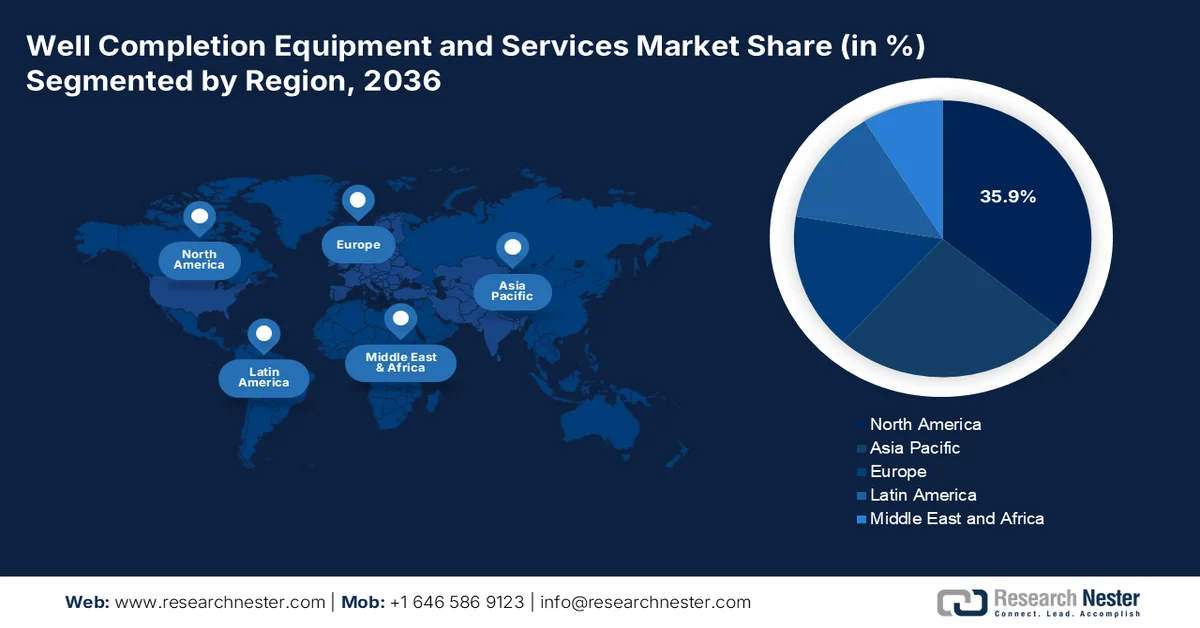
- North America is projected to command a 35.9% share by 2036 in the well completion equipment and services market, underpinned by operator capital pressures, rising demand for completion tools, lower carbon intensity and operating costs, and greater adoption of electric fracturing fleets
- Europe is poised for the fastest growth with a 15.9% share during the forecast period, fueled by mature offshore basins, decarbonization-focused regulatory policies, specialized providers, and ongoing energy security requirements
- The well completion equipment and services market in the U.S. accounts for 80.4% of the share in North America, which is driven by the presence of operators, along with artificial lift compatibility and suitable sand management services
Segment Insights:
- By 2036, the onshore sub-segment is projected to command a 74.3% share of the well completion equipment and services market, supported by the cost-effective and essential role of land-based oil and gas operations in economic stability and energy security
- The services sub-segment is forecast to secure a 46.5% share during the forecast period, propelled by comprehensive technical and operational support spanning well completion design, field execution, intervention, and re-completion activities
Key Growth Trends:
- Exploration into deepwater
- Increased demand in mature oilfields
Major Challenges:
- Technological complexity in harsh environments
- Supply chain and raw material constraints
Key Players: Schlumberger, Baker Hughes, Halliburton, Weatherford International, National Oilwell Varco, Welltec, Packers Plus, Forum Energy Technologies, CNPC, Wellcare Oil Tools, Schoeller-Bleckmann, Innovex Downhole Solutions, Yantai Jereh, COSL, Penguin Petroleum Services, Completion Oil Tools, Maximus OIGA.
Global Well Completion Equipment And Services Market Forecast and Regional Outlook:
Market Size & Growth Projections:
- 2026 Market Size: USD 21.9 billion
- 2027 Market Size: USD 23.2 billion
- Projected Market Size: USD 39.8 billion by 2036
- Growth Forecasts: 6.2% CAGR (2027-2036)
Key Regional Dynamics:
- Largest Region: North America (35.9% Share by 2036)
- Fastest Growing Region: Europe
- Dominating Countries: United States, Canada, China, Norway, Saudi Arabia
- Emerging Countries: Indonesia, Australia, Brazil, Guyana, Argentina
Last updated on : 28 September, 2026
Well Completion Equipment and Services Market - Growth Drivers and Challenges
Growth Drivers
- Exploration into deepwater: This particular exploration is responsible for witnessing a significant capital inflow in basins, including West Africa and Guyana. According to an article published by NLM in April 2023, the predicted 12-year average volume transport of the deepwater overflow, especially into the South China Sea, demonstrated a suitable and linear trend of 9%. Additionally, this is regarded as consistent with long-lasting modifications in satellite-based ocean bottom pressure. Besides, deep passages, such as Atlantis II Fracture Zone, Yap-Mariana Junction, Samoan Passage, Denmark Strait, Romanche Fracture Zone, and Vema Channel, are essential choke points, wherein deep circulations globally can be monitored, thereby making it suitable for positively driving the well completion equipment and services market expansion.
- Increased demand in mature oilfields: The presence of massive oilfields has successfully entered mid-to-late developmental changes, and a rise in natural decline rates has forced operators to increase investment. As stated in a data report published by the OEA Organization in 2026, the overall expenditure on fossil fuel supply is expected to reach more than USD 1 trillion in 2026. Besides, the conflict in the Middle East has readily highlighted increased economic vulnerabilities that are associated with dependency on exports from this region. Meanwhile, projections for suitable investments across various fuels effectively varied widely, with oil set for a subdued year. Moreover, generous investment in natural gas projects is ensuring capital outflows on fuels, which is proliferating the well completion equipment and services market.
Global Investment for Natural Gas Projects, 2016-2026e
|
Year |
Oil (USD Billion) |
Natural Gas (USD Billion) |
Coal (USD Billion) |
Low-Emission Fuels (USD Billion) |
|
2016 |
595 |
329 |
112 |
7 |
|
2017 |
600 |
306 |
122 |
- |
|
2018 |
625 |
299 |
122 |
7 |
|
2019 |
602 |
283 |
142 |
8 |
|
2020 |
472 |
245 |
132 |
10 |
|
2021 |
517 |
254 |
139 |
12 |
|
2022 |
539 |
276 |
156 |
13 |
|
2023 |
580 |
296 |
165 |
15 |
|
2024 |
545 |
300 |
172 |
19 |
|
2025 |
510 |
300 |
175 |
23 |
|
2026e |
496 |
331 |
183 |
28 |
Source: IEA Organization
Challenges
- Technological complexity in harsh environments: Deepwater, ultra-deepwater, high-pressure/high-temperature, and corrosive reservoir conditions demand completion equipment with extreme reliability and specialized metallurgy. Therefore, developing and qualifying such tools requires lengthy research cycles, costly testing infrastructure, and field-proven validation that few suppliers can sustain. Besides, failures in these environments carry catastrophic cost and safety consequences, raising the bar for entry. Moreover, as operators push into more challenging frontiers, the gap between capable and incapable suppliers widens, limiting competition and slowing deployment in the well completion equipment and services market globally.
- Supply chain and raw material constraints: The aspect of completion equipment depends on specialized alloys, elastomers, electronics, and precision-machined components, many of which come from limited supplier bases. Besides, geopolitical disruptions, export controls, and logistical bottlenecks can delay delivery of critical inputs. In addition, tariffs and trade restrictions further raise costs and complicate sourcing strategies. Based on these, building redundancy into these supply chains takes years and significant capital, leaving the well completion equipment and services market exposed to shocks that can halt equipment availability even when underlying demand remains strong.
Well Completion Equipment and Services Market Size and Forecast
| Report Attribute | Details |
|---|---|
|
Base Year |
2026 |
|
Forecast Year |
2027-2036 |
|
CAGR |
6.2% |
|
Base Year Market Size (2026) |
USD 21.9 billion |
|
Forecast Year Market Size (2036) |
USD 39.8 billion |
|
Regional Scope |
|
Well Completion Equipment and Services Market Segmentation:
Location Segment Analysis
The onshore sub-segment is anticipated to grab the largest share of 74.3% in the well completion equipment and services market by the end of 2036. The sub-segment’s upliftment is primarily fueled by the conduct of oil and gas operations on land compared to water, providing a cost-effective and fundamental foundation of worldwide economic stability and energy security. According to an article published by the Global Energy Monitor Organization in 2026, there was a rise in the development of worldwide oil and gas-based capacity by 8.5% within the first half of 2026, leading to the overall global capacity readily accounting for 1,136 GW. In this regard, the gas power development in the U.S. also increased by 50% during the same period, which effectively doubled the production by data centers to 189 GW, thus positively impacting the sub-segment’s growth.
Type Segment Analysis
During the forecast period, the services sub-segment under the type segment is predicted to account for the second-largest share of 46.5% in the well completion equipment and services market. The sub-segment’s growth is effectively fueled by covering the full range of technical and operational support required to complete a well and bring it into production. This includes completion design and engineering, where specialists model reservoir behavior and plan the completion architecture, as well as execution services such as perforating, fracturing, sand control, and packer installation carried out in the field. Additionally, this also encompasses intervention and re-completion work on existing wells to restore or enhance production, thereby boosting the sub-segment’s expansion.
Well Type Segment Analysis
The conventional well type segment is expected to garner a considerable share in the well completion equipment and services market by the end of the stipulated timeline. The segment’s development is highly propelled by completions that are performed in reservoirs with naturally adequate permeability and predictable production behavior, wherein hydrocarbons flow without requiring extensive stimulation. In addition, these wells typically use simpler completion designs, often cased hole with selective perforation, and rely on standard packers, control valves, and sand control tools where needed. Besides, operations are generally less technically demanding than unconventional completions, with shorter planning cycles and lower equipment intensity.
Our in-depth analysis of the well completion equipment and services market includes the following segments:
|
Segment |
Subsegments |
|
Location |
|
|
Type |
|
|
Well Type |
|
|
Well Completion Type |
|
|
Equipment Type |
|
|
Services Type |
|

Vishnu Nair
Head - Global Business DevelopmentCustomize this report to your requirements — connect with our consultant for personalized insights and options.
Well Completion Equipment and Services Market - Regional Analysis
North America Market Insights
North America well completion equipment and services market is anticipated to grab the highest share of 35.9% by the end of 2036. The market’s upliftment in the region is primarily attributed to capital pressure from operators, the demand for completion equipment tools, reduction in carbon intensity and operating expenses, and an increase in the adoption of electric fracturing fleets. According to a data report published by the Institute for Energy Research Organization in May 2024, total oil resources in the region accounted for 1.6 trillion barrels, which denotes a 15% surge from the estimate of technically recoverable oil. Likewise, total natural gas resources accounted for 4.0 quadrillion cubic feet, which indicates a 47% upsurge. Therefore, based on both oil and natural gas recoverable resources, the well completion equipment and services market is continuously expanding in the overall region.
The well completion equipment and services market in the U.S. is growing significantly, owing to gaining momentum in deepwater and offshore projects, the demand for innovative completion technologies, and an expansion in shale to ensure cost reduction and production improvement. As stated in an article published by the Strauss Center in 2026, the shale revolution resulted in the increased production of domestic oil and natural gas, especially from tight oil formations, which presently account for 36% of overall domestic crude oil production. Additionally, such formations also correlated with an upsurge in employment, with the oil and gas sector effectively adding 169,000 employment opportunities. Therefore, based on the revolution, the country is apparently emerged as the ultimate notable oil and gas producer, due to which the worldwide supply has effectively diverted from the Middle East, thus proliferating the market expansion.
The federal and provincial policy framework, improvement in climate investment, an accelerated development of unconventional resources, an expansion in export infrastructure, and the existence of a federal oil and gas emissions cap are certain factors that are bolstering the well completion equipment and services market in Canada. As per an article published by the Government of Canada in March 2025, Environment and Climate Change Canada issued a Regulatory Framework for an Oil and Gas Sector Greenhouse Gas Emissions Cap in December 2023 to enable government contributions. This led to the Government proposing oil and gas sector greenhouse gas emissions cap regulations as of November 2024. Besides, the cap enabled a restriction on greenhouse gas pollution, which resulted in generous investment opportunities by the industry to gain decarbonization, thereby making it suitable for boosting the market’s upliftment.
Europe Market Insights
Europe well completion equipment and services market is expected to emerge as the fastest-growing region with a share of 15.9% during the forecast period. The market’s development in the region is highly propelled by the presence of mature offshore basins, a regulatory policy for increasing orientation towards decarbonization, specialized providers, and sustained energy security imperatives. According to an article published by the Trans European Policy Studies Association (TEPSA) in July 2026, Norway effectively supplied almost 52% of the region’s natural gas imports as of 2025 in the gas form, which was followed by 17.4% in Algeria and 10.4% in Russia. Besides, the regional share of gas imports also increased from nearly 20% to almost 45% in the same year. In this regard, Russia remained the second-largest supplier of liquefied natural gas (LNG) at roughly 14%, thus positively contributing to the market’s development.
The well completion equipment and services market in Russia is gaining increased traction, owing to maximizing recovery from mature oil fields, along with import substitution through domestic research and development. As stated in a data report published by the Carnegie Endowment for International Peace in March 2026, the country effectively drilled 7,610 production wells as of 2024, with growth in average national well length from 3,473 meters to 3,993 meters in 2025. In addition, the nation also averages 8 to 10 fractional stages per multi-stage employment opportunity, in comparison to 16 in the U.S. Besides, the nation also has suitable accessibility to innovative equipment and technology, such as for the oil and gas industry. Therefore, with such an increase in well length, along with suitable job provision, there is a growth opportunity for the well completion equipment and services market in the country.
The effective development of the project pipeline and the increased focus on enhancing production efficiency are a few trends that are responsible for enhancing the well completion equipment and services market in Norway. As per a data report published by the ITA in May 2026, the petroleum industry readily accounts for 17% of the gross domestic product (GDP), along with 21% of overall investments, 25% of national revenues, and 41% of overall exports, excluding the supply and service sector. Besides, the country has successfully replaced Russia as the largest supplier in the overall regional natural gas industry, which resulted in exporting 124 billion standard cubic meters as of 2024. Meanwhile, the domestic gas sector also accounts for over 25% of the regional gas requirement, eventually supplying nearly 40% of the gas consumption in the UK, thus positively driving the market demand.
APAC Market Insights
The Asia Pacific well completion equipment and services market is predicted to account for a share of 25.8% by the end of the stipulated timeline. The market’s growth in the region is effectively driven by the offshore project pipeline, upstream investment push, and unconventional resource development. According to an article published by the ORF Organization in July 2026, Indonesia is considered a notable exporter of LNG, while Southeast Asia is the largest producer of oil. As a result, almost 25% of its crude imports are readily shipped through Hormuz, which demonstrated an upsurge in oil and gas imports in Indonesia by 70.7% YoY. Besides, the government effectively maintained fuel subsidies, absorbing 30% to 40% of diesel and petrol prices, with USD 22.5 billion that is significantly allocated for dual subsidies within the 2026 budget, which is further based on the USD 70 per barrel, thus proliferating the market growth.
The well completion equipment and services market in China is gaining increased exposure, owing to substantial government support, strong unconventional resource development, regulatory infrastructure for manufacturing capability, and the presence of oil organizations. Based on the March 2025 CGEP article, national oil organizations completed the nation’s 7-year action plan boosting the production and exploration of oil and natural gas. This particular plan was developed from an agreement between the National Energy Administration and NOC. This agreement resulted in a decline of oil output from 4.3 million barrels per day to 3.8 million, while the nation's reliance on imported oil increased from over 60% to more than 70%. Likewise, the natural gas production in the country also surged from 161 billion cubic meters to 246 billion cubic meters as of 2024, thereby bolstering the market’s growth and demand.
The aspects of generous government investment in oil and gas upstream, sustained demand for hydraulic services, a focus on sustainability, and reduction in carbon emissions are certain factors that positively uplift the well completion equipment and services market in India. As per a data report published by the PIB Government in August 2026, the country is the third-largest consumer of crude oil, with yearly imports of almost USD 1.4 billion. Besides, the domestic Cabinet has effectively approved Samudra Manthan, which is the National Offshore Exploration Scheme with an outlay of USD 8.7 million (₹84,084 crore). Additionally, this particular investment is focused on opening offshore acreage with the removal of over 99% of No-Go areas, along with modernizing the contractual regime, the existence of legislative reforms, new rule implementations, focus on exploration, and a uniform decision-making framework.
Key Well Completion Equipment and Services Market Players:
- Schlumberger (U.S./France)
- Baker Hughes (U.S.)
- Halliburton (U.S.)
- Weatherford International (U.S.)
- National Oilwell Varco (U.S.)
- Welltec (Denmark)
- Packers Plus (Canada)
- Forum Energy Technologies (U.S.)
- CNPC (China)
- Wellcare Oil Tools (India)
- Schoeller-Bleckmann (Austria)
- Innovex Downhole Solutions (U.S.)
- Yantai Jereh (China)
- COSL (China)
- Penguin Petroleum Services (India)
- Completion Oil Tools (India)
- Maximus OIGA (India)
- Company Overview
- Business Strategy
- Key Product Offerings
- Financial Performance
- Key Performance Indicators
- Risk Analysis
- Recent Development
- Regional Presence
- Schlumberger is one of the most comprehensive providers of well completion equipment and services, offering integrated solutions that span design, execution, and intervention across conventional and unconventional wells. Its strength lies in combining advanced downhole technology with engineering expertise, allowing it to serve complex deepwater and high-pressure or high-temperature projects worldwide.
- Baker Hughes manufactures a broad portfolio of completion equipment, including packers, sand control tools, and multistage systems, alongside completion design and execution services. The company is known for its emphasis on digital integration and remote monitoring, positioning itself as a technology-driven partner for operators seeking efficiency in completion operations.
- Halliburton is a leading provider of completion services and equipment, with particular strength in hydraulic fracturing, perforating, and multistage completion systems for unconventional reservoirs. Its competitive advantage rests on deep operational experience and a vertically integrated service model that allows it to execute large-scale completion programs efficiently.
- Weatherford International supplies a wide range of well completion equipment, including packers, liner hangers, flow control valves, and sand control tools, supported by intervention and re-completion services. The company differentiates itself through a focus on reliability and cost-effective solutions, serving both onshore and offshore operators across mature and emerging basins.
- National Oilwell Varco manufactures completion tools and downhole equipment, with a portfolio that includes packers, liner hangers, and multistage completion systems. The company leverages its broad oilfield equipment manufacturing base and global distribution network to serve operators seeking durable, field-proven completion hardware.
Here is a list of key players operating in the global well completion equipment and services market:
The global well completion equipment and services market is dominated by a concentrated group of integrated oilfield service providers, where the top five manufacturers, such as Schlumberger, Baker Hughes, Halliburton, Weatherford International, and National Oilwell Varco, collectively command the majority of global market share. These leaders differentiate through broad geographic reach, comprehensive product portfolios spanning packers to multistage fracturing tools, and deep integration with operator workflows. Besides, in January 2025, Varel Energy Solutions successfully acquired Ace Well Technology, which expanded Varel’s strong portfolio of primary cementing equipment. Therefore, with such organizational contributions, the well completion equipment and services industry is continuously experiencing growth and exposure.
Corporate Landscape of the Market:
Recent Developments
- In April 2026, Halliburton introduced the Volta™ all-electric control system, a part of SmartWell® intelligent completions, which effectively set a new standard for engineered reservoir management, optimization, and insight.
- In May 2025, SLB unveiled Electris™, which is a portfolio of digitally enabled electric well completions technologies that boost production and recovery while reducing the total cost of ownership of an asset.
- In February 2025, Viking Completion Technology expanded its services by effectively reflecting a continuous series of high-profile successes, particularly in Saudi Arabia, and also accomplishing 5 trial projects within 14 months.
- Report ID: 8771
- Published Date: Sep 28, 2026
- Report Format: PDF, PPT
- Explore a preview of key market trends and insights
- Review sample data tables and segment breakdowns
- Experience the quality of our visual data representations
- Evaluate our report structure and research methodology
- Get a glimpse of competitive landscape analysis
- Understand how regional forecasts are presented
- Assess the depth of company profiling and benchmarking
- Preview how actionable insights can support your strategy
Explore real data and analysis
Frequently Asked Questions (FAQ)
About this Report
Connect with our Expert


Report, 2027-2036



Copyright @ 2026 Research Nester. All Rights Reserved.
