VTOL UAV Market Outlook:
VTOL UAV Market size was valued at over USD 3.8 billion in 2025 and is expected to reach USD 23.4 billion by the end of 2035, growing at a CAGR of 22.4% during the forecast period, i.e., 2026-2035. In 2026, the industry size of VTOL UAV is estimated at USD 4.6 billion.
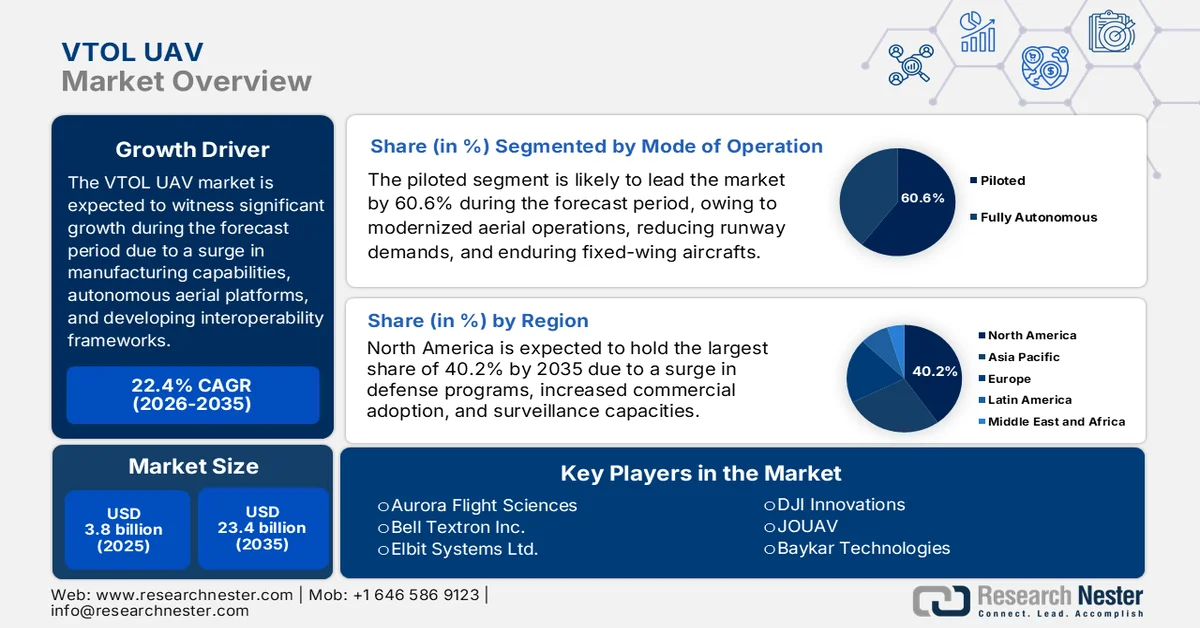
The worldwide VTOL UAV market is effectively shaped by indigenous manufacturing capabilities, the maturation of propulsion technologies and battery reaching performance thresholds, evolving commercial and consumer acceptance of autonomous aerial platforms, and establishing standardized interoperability frameworks. According to official statistics published by Applied Energy in November 2025, the cell-based specific energy of lithium-ion cells usually ranges from 90 to 260 Wh/kg, highly depending on the specific chemistry utilization. In addition, nickel-cobalt-aluminum oxide and nickel-manganese-cobalt oxide are the commonly utilized lithium-ion cathode battery materials, with an usual range between 220 and 300 Wh/kg. Moreover, the energy densities of these batteries account for an 800 WH/kg threshold, which is necessary for viable commercial aviation applications, thereby driving the VTOL UAV market growth.
2024 Lithium-Ion Batteries Export and Import Global Analysis
|
Countries/Components |
Export (USD) |
Import (USD) |
|
China |
68.1 billion |
- |
|
Poland |
7.1 billion |
- |
|
Hungary |
6.8 billion |
- |
|
U.S. |
- |
25.2 billion |
|
Germany |
- |
23.0 billion |
|
South Korea |
- |
4.7 billion |
|
Global Trade Valuation |
116 billion |
|
|
Global Trade Share |
0.51% |
|
|
Product Complexity |
1.32 |
|
Source: OEC
Furthermore, dual-use platform development, collaborative autonomy, swarm intelligence, hydrogen propulsion pathways, modular mission payload architectures, and additive manufacturing integration are certain trends that are fueling the VTOL UAV market globally. As per an article published by NLM in September 2025, the industrial size for the worldwide aerospace composite materials significantly surged from an estimated 829 million in 2023 and is further projected to increase to 3.6 billion by the end of 2032. In addition, this ongoing expansion reflects a strong yearly growth rate of 20.2%. Besides, the exploration by the Commercial Aircraft Corporation of China (COMAC) for large-scale primary load-bearing structures has taken into consideration the carbon fiber-reinforced poly composite, with a prototype of an 8.2-meter-long wing spar structure through the additive manufacturing technology, which is positively impacting the market expansion.
Key VTOL UAV Market Insights Summary:
Regional Highlights:
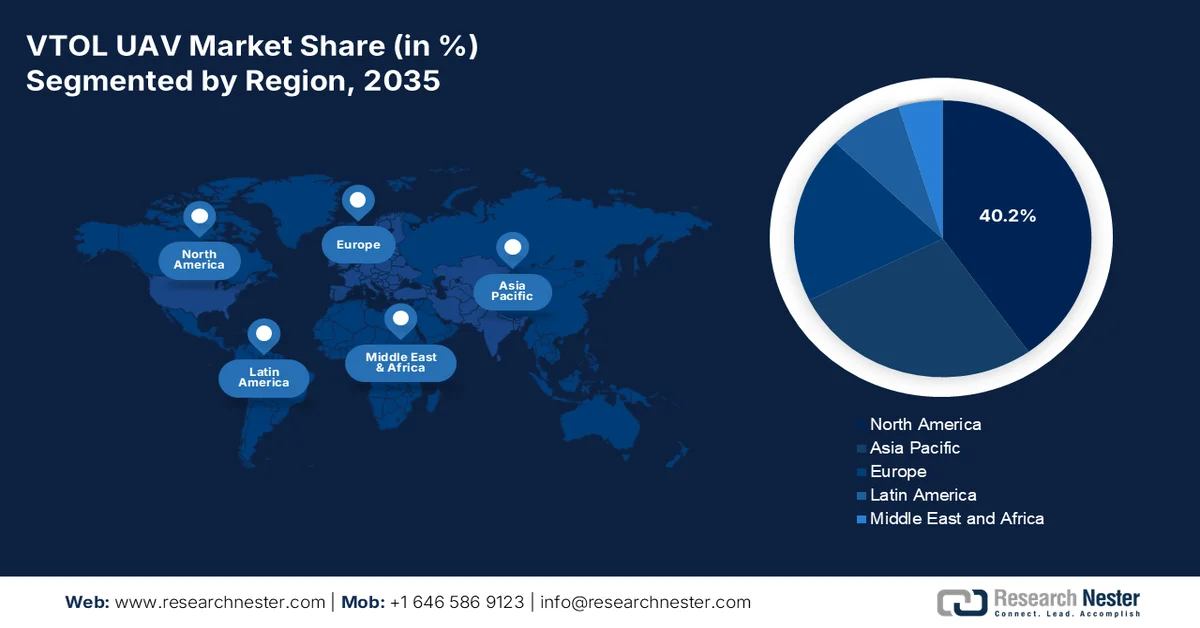
- North America vtol uav market is anticipated to hold a leading 40.2% share by 2035, driven by robust defense modernization programs, expanding commercial drone integration, and rising surveillance capabilities
- Europe is projected to be the fastest-growing region during 2026–2035, fueled by rapid expansion in the aerospace sector, strong sustainability mandates, and advancing urban air mobility initiatives
Segment Insights:
- Piloted sub-segment of the vtol uav market is projected to account for 60.6% share by 2035, driven by modern aerial operations combining helicopter flexibility with fixed-wing endurance and reduced runway dependency
- Hybrid-electric segment is anticipated to secure the second-largest share by 2035, propelled by declining aviation emissions, improved fuel efficiency, and reduced noise pollution through integrated electric and conventional systems
Key Growth Trends:
- Expansion in the maritime domain
- Increase in the urban logistics network development
Major Challenges:
- Skilled workforce and talent shortages
- Public perception and infrastructure deficits
Key Players:Northrop Grumman, Lockheed Martin, The Boeing Company, Textron Inc., AeroVironment Inc., Kratos Defense & Security Solutions Inc., Aurora Flight Sciences, Bell Textron Inc., Elbit Systems Ltd., Israel Aerospace Industries IAI, Airbus SE, Leonardo S.p.A., BAE Systems plc, Thales Group, SAAB AB, Aviation Industry Corporation of China AVIC, DJI Innovations, JOUAV, Baykar Technologies, HAL Hindustan Aeronautics Limited, AutoFlights, Odys Aviation, Jiby Aviation Inc.
Global VTOL UAV Market Forecast and Regional Outlook:
Market Size & Growth Projections:
- 2025 Market Size: USD 3.8 billion
- 2026 Market Size: USD 4.6 billion
- Projected Market Size: USD 23.4 billion by 2035
- Growth Forecasts: 22.4% CAGR (2026-2035)
Key Regional Dynamics:
- Largest Region: North America (40.2% Share by 2035)
- Fastest Growing Region: Europe
- Dominating Countries: United States, China, Germany, United Kingdom, France
- Emerging Countries: India, Japan, South Korea, Brazil, Australia
Last updated on : 27 March, 2026
VTOL UAV Market - Growth Drivers and Challenges
Growth Drivers
- Expansion in the maritime domain: The proliferation of the offshore energy infrastructure for expanding outstanding economic zones, demanding surveillance and the tactical repositioning of naval forces are fueling the substantial need for the VTOL UAV market globally. According to official statistics published by the UN Organization in September 2025, over 80% of global trade facilities take place through maritime transport, thereby enhancing VTOL platforms for continuous monitoring. Besides, as per an article published by the U.S. Department of State in September 2025, there has been the provision of the latest funding that is poised to advance interests and objectives in America over the Indo-Pacific in terms of USD 55 million as new maritime law enforcement funding for nations, including South Asia, the Pacific Islands, Malaysia, Indonesia, the Philippines, and Vietnam.
- Increase in the urban logistics network development: The establishment of dedicated urban drone logistics networks is significantly emerging as a suitable growth driver for the VTOL UAV market globally. As stated in an article published by the Observer Research Foundation in June 2024, ocean shipping is accountable for fueling 90% of traded goods. Moreover, the rise in urbanization ensures an increase in the concentration of economic activities, deliberately enhancing the demand for urban freight transport by 140% in the upcoming decade. In addition, the first- and last-mile freight movements, particularly in India, are readily accountable for 50% of the overall logistics expenses for e-commerce supply chains. Therefore, with all these developments, there is a huge growth opportunity for the market.
- Surge in asymmetric warfare adaptation: The non-state actor adoption of commercial drone technology has effectively compelled traditional military forces to escalate the VTOL UAV market procurement as a force protection and counter-measure capability. Besides, the proliferation of cost-effective drones, particularly in conflict locations, has resulted in the increased demand for neutralization, tracking, and detection systems, the majority of which cater to VTOL platforms. This growth driver is exceptionally distinct from conventional defense modernization since it demonstrates a reactive capability barrier, highly fueled by threat environments and tactical doctrine evolution, thus denoting an optimistic outlook for the market demand.
Challenges
- Skilled workforce and talent shortages: The rapid expansion of the VTOL UAV market has outpaced the availability of specialized talent across critical disciplines, including aerospace engineering, avionics software development, composite materials manufacturing, and systems integration. Besides, universities and technical training programs have not yet scaled to meet industry demand for graduates with expertise in unmanned systems, autonomous flight software, and electric propulsion architectures. The talent gap is particularly acute in specialized areas such as control systems engineering for beyond-visual-line-of-sight operations, sensor fusion algorithm development, and certification engineering, wherein experienced professionals command premium compensation and are subject to intense competition among manufacturers.
- Public perception and infrastructure deficits: The widespread adoption of VTOL UAV systems faces significant headwinds from public acceptance challenges and the absence of supporting ground infrastructure. Noise concerns associated with rotor-based takeoff and landing operations have emerged as a primary source of community opposition to drone operations and urban air mobility concepts, prompting stringent local restrictions that limit operational areas and flight windows. Privacy concerns regarding surveillance capabilities of advanced VTOL UAVs, particularly in defense and homeland security applications, generate regulatory scrutiny and public resistance that complicate deployment planning. Beyond regulatory frameworks, the physical infrastructure required for VTOL operations, including vertiports, charging stations, maintenance facilities, and communication networks, remains largely undeveloped, thereby negatively impacting the VTOL UAV market globally.
VTOL UAV Market Size and Forecast:
| Report Attribute | Details |
|---|---|
|
Base Year |
2025 |
|
Forecast Year |
2026-2035 |
|
CAGR |
22.4% |
|
Base Year Market Size (2025) |
USD 3.8 billion |
|
Forecast Year Market Size (2035) |
USD 23.4 billion |
|
Regional Scope |
|
VTOL UAV Market Segmentation:
Mode of Operation Segment Analysis
The piloted sub-segment, which is part of the mode of operation segment, is anticipated to garner the largest share of 60.6% in the VTOL UAV market by the end of 2035. The sub-segment’s upliftment is highly driven by modern aerial operations, owing to the aspect of combining the flexibility of helicopters with the endurance of fixed-wing aircraft and diminishing the demand for runways, while ensuring long-lasting ranges and high-endurance missions. According to official statistics published by NLM in December 2024, the rotor speed is usually reduced to an estimated half during high-speed flight, wherein lift rotors effectively contribute to supporting approximately 20% of the aircraft’s weight. Moreover, the adoption of chemical system lithium-ion batteries caters to 3% to 4% of the energy density, which is positively driving the sub-segment’s exposure globally.
Propulsion Segment Analysis
The hybrid-electric segment in the VTOL UAV market is projected to hold the second-largest share in the VTOL UAV market during the forecast period. The segment’s growth is attributed to diminishing transportation and aviation-based emissions, enhancing fuel efficiency, and lowering noise pollution through electric power and combined conventional systems. As stated in an article published by Next Sustainability in June 2025, hybrid-electric retrofits tend to reduce carbon dioxide emissions by almost 60% for short-haul operations. In addition, these can ensure fuel savings that usually span 10% to 60%, contingent on mission profile and hybridization level, along with a retrofitted parallel configuration gaining 17.6% in fuel savings. Therefore, with such benefits, there is a huge growth opportunity for the segment internationally.
Application Segment Analysis
By the end of the stipulated timeline, the military and defense sub-segment, which is part of the application segment, is expected to account for the third-largest share in the VTOL UAV market. The sub-segment’s development is extremely propelled by the accelerating global shift toward unmanned systems as force multipliers in modern warfare. Besides, defense establishments across North America, Europe, and the Asia Pacific region are increasingly prioritizing VTOL platforms for their unique ability to operate from austere environments, naval vessels, and contested airspace without requiring traditional runway infrastructure. This segment encompasses a broad spectrum of mission profiles, including intelligence, surveillance, and reconnaissance (ISR), tactical strike operations, anti-submarine warfare, electronic warfare, logistics resupply, and communications relay.
Our in-depth analysis of the VTOL UAV market includes the following segments:
|
Segment |
Subsegments |
|
Mode of Operation |
|
|
Propulsion |
|
|
Application |
|
|
Size |
|
|
Type |
|
|
System |
|

Vishnu Nair
Head - Global Business DevelopmentCustomize this report to your requirements — connect with our consultant for personalized insights and options.
VTOL UAV Market - Regional Analysis
North America Market Insights
North America in the VTOL UAV market is expected to account for the largest share of 40.2% by the end of 2035. The market’s growth is primarily driven by strong defense modernization programs, sustained commercial adoption, increased focus on surveillance capabilities, commercial drone integration initiatives, and regulatory changes. According to official statistics published by the Center for Strategic and International Studies in October 2025, there has been an increase in the investment for continental defense, amounting to a generous USD 38.6 billion for more than 20 years. This investment caters to modernizing the North America Aerospace Defense Command (NORAD), which is a crucial step in making defense advancements. Therefore, with such investment opportunities, the market is gradually proliferating in the overall region.
The VTOL UAV market in the U.S. is growing significantly, owing to an increase in urban infrastructure, implementation of autonomy and AI, generous national defense funding opportunities, rapid urbanization, the demand for innovative mobility solutions, and an escalation in regulatory pathways. As per an article published by the Arms Control Association in March 2026, the discretionary spending on domestic national defense, including atomic energy activities, is expected to increase by over 17 years by the end of 2026 to USD 1.0 trillion. Besides, this particular fund increase has been decided after the disorderly budget management, including USD 893 billion approval through nominal appropriations, along with money provision by a budget reconciliation act, further comprising USD 152.3 billion for the Pentagon and USD 3.9 billion for the Department of Energy nuclear weapons activities, thus fueling the market.
The transformative national defense strategy, distinct Arctic sovereignty imperatives, an increase in autonomous aircraft for their tactical importance for domestic development and production, persistent all-domain surveillance missions, and governmental fund allocation are certain trends that are uplifting the VTOL UAV market in Canada. As stated in an article published by the Government of Canada in March 2026, the National Research Council (NRC), under the country’s Defense Industrial Strategy, invested more than USD 900 million in developing aerospace defense capabilities that support domestic small and medium-sized enterprises (SMEs) to create technologies for military and civilian purposes. Moreover, reinforcing the country’s defense and aerospace industrial base and capabilities, the NRC has invested more than USD 500 million to make advancements in next-generation aerospace technologies and support the development of autonomous systems, thus driving the market expansion.
Europe Market Insights
Europe in the VTOL UAV market is expected to emerge as the fastest-growing region during the forecast period. The market’s development in the region is highly propelled by substantial expansion in the aerial systems industry, aggressive sustainability mandates, urban air mobility initiatives, and the presence of a dedicated certification framework. According to official statistics published by ASD Europe in December 2025, the regional defense and aerospace industries successfully reached record growth as of 2024, with a 10.1% rise in turnover, amounting to USD 377.2 billion, along with employment reaching 1.1 million jobs across 4,000 organizations. In addition, these industries supported almost 4.2 million jobs as well as provided USD 902.2 billion for economic activities across the overall region, thereby making it suitable for bolstering the market in the region.
The VTOL UAV market in Germany is gaining increased traction, owing to leading regional eVTOL manufacturers, the provision of private and public funding for commercialization, increased emphasis on domestic manufacturing of critical components, including avionics and propulsion systems, and a strong supply chain for semiconductor-grade materials. As per an article published by the Clean Energy Wire in March 2026, the finance minister readily proposed a tax reduction, ranging between USD 2.8 and USD 13.2 per flight per passenger, with the purpose of successfully strengthening the country’s struggling aviation industry. Moreover, the government is expecting that the tax reduction lead to a revenue shortfall of USD 214.2 million by the end of 2026, and further between USD 393.7 million and USD 411.1 million by the end of 2030, thus focusing on boosting the overall market.
The escalated expansion by combining proactive governmental policies, robust defense demand, post-Brexit regulatory flexibility, industry and academia partnerships, a wide-ranging public and private framework, and generous fund allocation by the Ministry of Defense are certain trends that are fueling the VTOL UAV market in the UK. Based on government estimates published by the ITA in January 2026, the domestic civil aerospace turnover totaled an estimated USD 38 billion, of which USD 25 billion has been exported. Besides, the aerospace industry is considered the crown jewel for exports, with 70% of domestic aerospace production exported as of 2023. Meanwhile, the defense industry turnover totaled roughly USD 35 billion, of which USD 12 billion has been exported, while the space industry turnover was USD 22 billion, with USD 7 billion allocated for export purposes, thus driving the market growth.
APAC Market Insights
The Asia Pacific in the VTOL UAV market is projected to witness considerable growth by the end of the stipulated timeline. The market’s growth in the region is effectively fueled by the existence of the comprehensive unmanned aerial vehicle industry, increased urbanization across megacities, suitable defense modernization programs, and proactive government strategies to support drone infrastructure and manufacturing. According to official statistics published by the IATA Organization in February 2025, there has been an increase in passenger numbers in the region by 7.9% in 2025, demonstrating the highest rate globally. This particular growth originates from optimizing economic conditions, government-based tourism campaigns, and competitive airfare. Moreover, the region’s long-lasting growth prospects are strong, with yearly growth in passenger numbers by 5.1%, thereby making it suitable for skyrocketing the market growth.
The VTOL UAV market in China is gaining increased exposure, owing to the government’s tactical designation of the low-altitude economy, organizations achieving significant milestones in commercialization and certification, suitable policies for supporting the domestic semiconductor supply chain, and the adoption of sustainability. As per an article published by the China Organization in March 2026, the country has set a GDP growth target of 4.5% to 5% for 2026, deliberately surpassing the January projection of 3.3%. Besides, the country’s economy has effectively grown at an average yearly rate of 5.4%, significantly contributing almost 30% to worldwide growth. Besides, the government is focused on developing a strong domestic industry by pledging concrete measures, including USD 36.3 billion in ultra-long special treasury bonds for consumer goods trade-in programs, along with USD 14.5 billion as a fiscal financial coordination fund to enhance the domestic demand, thus driving the market exposure.
The aspects of establishing drone startups, strong defense modernization programs, generous funding allocation for advanced materials research and semiconductor, governmental investment in specialty chemicals for aerospace applications, and the PLI scheme for drones and components are responsible for driving the VTOL UAV market in India. Based on government estimates published by the PIB Government in February 2026, the country has developed a regulated drone ecosystem with more than 38,500 registered drones, 39,890 DGCA-certified remote pilots, and 244 accepted training organizations. Moreover, under the SVAMITVA schemes, 320,000 villages have been readily surveyed by utilizing drones, and 27.6 million property cards have been significantly prepared for 182,000 villages across 31 states. Besides, 1,094 drones have been successfully distributed to women SHGs, which includes over 500 under the Namo Drone Didi initiative for enhancing livelihoods and farm productivity, thus bolstering the market growth.
Key VTOL UAV Market Players:
- Northrop Grumman (U.S.)
- Lockheed Martin (U.S.)
- The Boeing Company (U.S.)
- Textron Inc. (U.S.)
- AeroVironment, Inc. (U.S.)
- Kratos Defense & Security Solutions, Inc. (U.S.)
- Aurora Flight Sciences (U.S.)
- Bell Textron Inc. (U.S.)
- Elbit Systems Ltd. (Israel)
- Israel Aerospace Industries (IAI) (Israel)
- Airbus SE (France/Netherlands)
- Leonardo S.p.A. (Italy)
- BAE Systems plc (UK)
- Thales Group (France)
- SAAB AB (Sweden)
- Aviation Industry Corporation of China (AVIC) (China)
- DJI Innovations (China)
- JOUAV (China)
- Baykar Technologies (Türkiye)
- HAL (Hindustan Aeronautics Limited) (India)
- AutoFlights (China)
- Odys Aviation (U.S.)
- Jiby Aviation, Inc. (U.S.)
- Company Overview
- Business Strategy
- Key Product Offerings
- Financial Performance
- Key Performance Indicators
- Risk Analysis
- Recent Development
- Regional Presence
- Northrop Grumman leverages its extensive experience in autonomous systems to develop high-altitude, long-endurance VTOL platforms tailored for complex defense and surveillance missions. The company focuses on integrating advanced artificial intelligence and sensor fusion technologies to enhance the operational autonomy of its unmanned aerial systems.
- Lockheed Martin applies its deep expertise in rotary-wing and fixed-wing aircraft to deliver versatile VTOL UAV solutions for military and maritime applications. The company prioritizes modular design architectures that allow for rapid reconfiguration of payloads to meet evolving mission requirements.
- The Boeing Company utilizes its legacy in aerospace manufacturing to produce scalable VTOL UAV systems capable of heavy-lift logistics and autonomous carrier operations. The company emphasizes collaborative development with defense agencies to ensure its platforms integrate seamlessly into existing naval and ground force infrastructures.
- Textron Inc. focuses on the development of ruggedized VTOL UAVs that excel in expeditionary and ship-based environments. The company invests heavily in digital engineering and simulation to accelerate the prototyping and fielding of next-generation unmanned aircraft.
- AeroVironment, Inc. specializes in small, man-portable VTOL UAV systems designed for tactical reconnaissance and precision strike missions. The company maintains a strong focus on low-logistics-footprint solutions that enable rapid deployment by frontline ground forces and special operations units.
Here is a list of key players operating in the global VTOL UAV market:
The VTOL UAV market is characterized by a mix of large defense prime contractors and agile specialized manufacturers, resulting in a moderately fragmented competitive landscape. The top players leverage their expertise in aerospace systems and defense contracting to secure large-scale government programs, while innovators focus on electric propulsion and autonomous technologies for commercial applications. Strategic initiatives across the industry are increasingly centered on vertical integration of supply chains, particularly for batteries and avionics, pursuing strategic acquisitions to expand technology portfolios. For instance, in May 2024, AeroVironment (AV) partnered with the Defense Advanced Research Projects Agency (DARPA) to continue the development of its X-Plane design for the agency’s Advanced AirCraft Infrastructure-Less Launch and Recovery (ANCILLARY) program. The ultimate objective is to diminish operational burdens and ensure infrastructure-less and safe introduction and recovery in severe conditions, thus uplifting the VTOL UAV industry globally.
Corporate Landscape of the VTOL UAV Market:
Recent Developments
- In February 2026, AutoFlights introduced Matrix, which is the world’s first-ever 5-ton class electric vertical take-off and landing (eVTOL) aircraft. It successfully accomplished a publicly completed full transition flight demonstration at its very own low-altitude flight test facility.
- In October 2025, Odys Aviation secured a generous USD 26 million Series A funding round, which was led by Nova Threshold, along with an investment from Tuchen Ventures and notable insiders, for escalating the U.S.-based full-scale aircraft flight evaluation of its Laila aircraft and extending the team for its first-ever international launch operations.
- In November 2025, Joby Aviation, Inc. unveiled the upcoming 3 vertiports in Dubai’s electric air taxi network, along with Dubai’s Road and Transport Authority (RTA) and Skyports Infrastructure.
- Report ID: 8475
- Published Date: Mar 27, 2026
- Report Format: PDF, PPT
- Explore a preview of key market trends and insights
- Review sample data tables and segment breakdowns
- Experience the quality of our visual data representations
- Evaluate our report structure and research methodology
- Get a glimpse of competitive landscape analysis
- Understand how regional forecasts are presented
- Assess the depth of company profiling and benchmarking
- Preview how actionable insights can support your strategy
Explore real data and analysis
Frequently Asked Questions (FAQ)
About this Report
Connect with our Expert


Report, 2026-2035



Copyright @ 2026 Research Nester. All Rights Reserved.
