Vision Sensor Market Outlook:
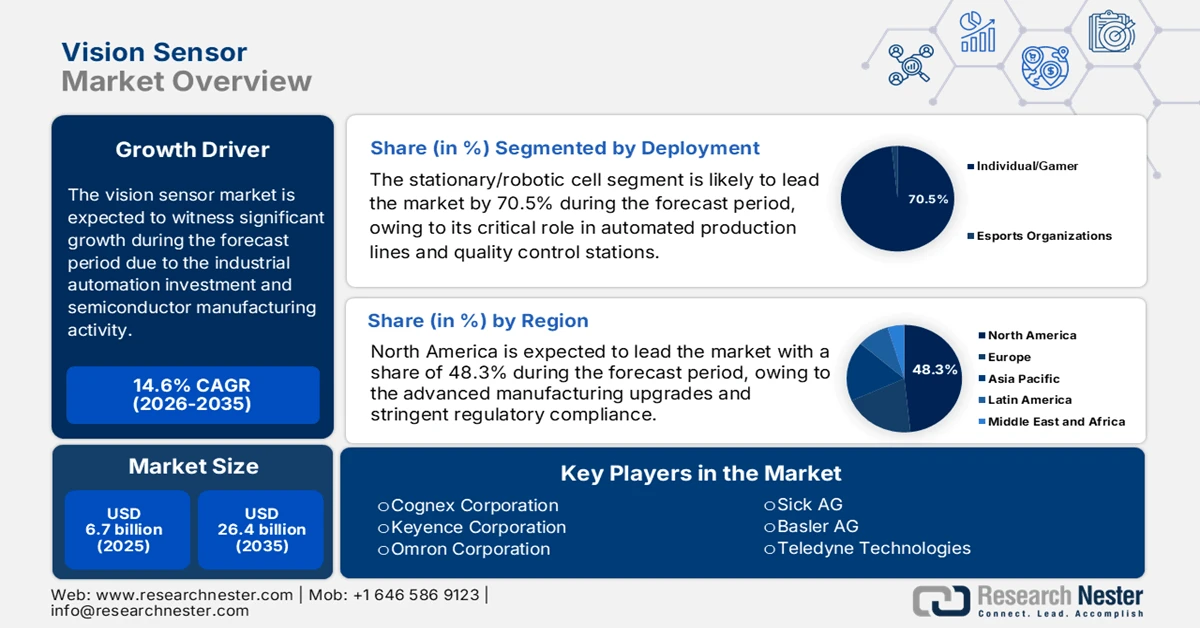
Vision Sensor Market size was valued at USD 6.7 billion in 2025 and is projected to reach USD 26.4 billion by the end of 2035, rising at a CAGR of 14.6% during the forecast period, i.e., 2026-2035. In 2026, the industry size of vision sensor is estimated at USD 7.7 billion.
The vision sensor market is closely tied to industrial automation investment, semiconductor manufacturing activity, and advanced manufacturing output across automotive electronics, logistics, and aerospace sectors. According to the National Institute of Standards and Technology in its October 2024 report, the U.S. private manufacturing fixed investment exceeded USD 2.3 trillion in 2023, with the durable goods and high-value equipment accounting for a major share, directly supporting the demand for the automated inspection and quality control systems. The report also states that the manufacturing of computer, electronic, and optical products/equipment reached USD 384 billion in the U.S., reinforcing the sustained requirements for inline inspection defect detection and process monitoring enabled by vision-based sensing. This capital investment drives the adoption of precision, sensor-based automation systems.
Computer, Electronic, and Optical Products/Equipment Manufacturing
|
Country |
Value (USD billion) |
|
U.S. |
384 |
|
Germany |
100 |
|
Europe |
220 |
|
China |
610 |
|
Japan |
125 |
Source: National Institute of Standards and Technology October 2024
The growth is further propelled by the need for stringent quality assurance and traceability across regulated sectors such as pharmaceuticals and automotive. Robust regulation in the U.S. focuses on the supply chain integrity and manufacturing quality via initiatives such as Quality 4.0, which implicitly supports the integration of automated inspection systems. The data from the International Federation of Robotics in June 2025 underscores this trend, reporting that the global stock of over 542,000 industrial robots was installed in 2024, with the vision-guided robots constituting a significant and growing portion. This expansion directly correlates with the deployment of vision sensors for tasks such as guidance and verification. Further, the International Society of Automation identifies the convergence of operational technology and information technology as a key driver where vision sensors act as critical data acquisition nodes for real-time process analytics and control, moving beyond simple inspection to enable predictive maintenance and adaptive manufacturing workflows.