Virtual Machine Market Outlook:
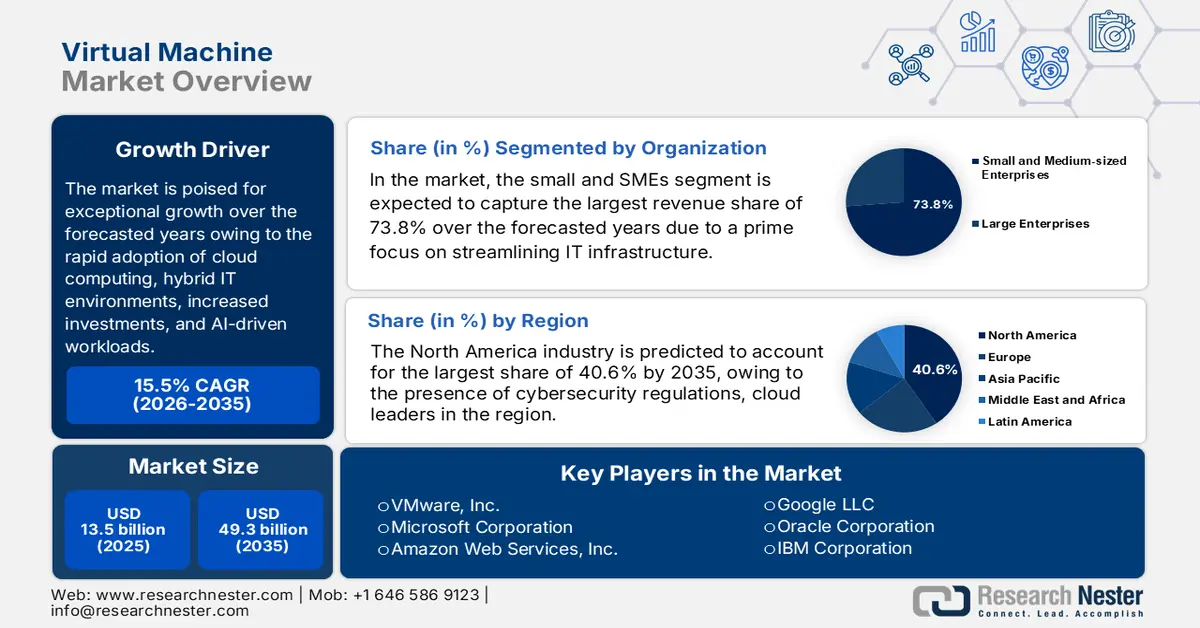
Virtual Machine Market size was valued at USD 13.5 billion in 2025 and is projected to reach USD 49.3 billion by the end of 2035, rising at a CAGR of 15.5% during the forecast period, i.e., 2026-2035. In 2026, the industry size of virtual machine is estimated at USD 15.5 billion.
The global virtual machine market is poised for exceptional growth over the forecasted years owing to the rapid adoption of cloud computing, hybrid IT environments, increased investments, and AI-driven workloads. In this regard, Arch in April 2025 announced that it has officially closed a USD 13 million Series A funding round, which was led by Pantera Capital, with participation from other strategic investors, to build Bitcoin’s programmable financial infrastructure. The company also mentioned that its ArchVM virtual machine enables Turing-complete smart contracts and complex off-chain computations directly on Bitcoin’s layer 1, without any bridges or custody risks. This funding will accelerate engineering, security audits, developer tooling, and ecosystem growth, whereas Arch aims to unlock Bitcoin’s full potential for DeFi, NFTs, DAOs, and other composable applications while maintaining its foundational security and liquidity.
Furthermore, enterprises rely on virtualization to optimize resource utilization, reduce hardware costs, and enable the deployment of applications across on-premises and cloud infrastructures. Simultaneously, the rise of multi-cloud and hybrid cloud strategies is also fueling market expansion. In December 2025, Amazon introduced Graviton5 processors, Trainium3 UltraServers, and an expanded Nova model family, boosting cloud performance, AI training speed, and energy efficiency at AWS re: Invent 2025. The event also introduced frontier agents' autonomous AI assistants for development, security, and DevOps, and new Bedrock and SageMaker AI capabilities for faster model customization. In addition, AWS AI factories enable enterprises to deploy high-performance AI infrastructure in their own data centers, combining AWS chips, networking, and services by meeting regulatory and data sovereignty requirements.