Unmanned Combat Aerial Vehicle (UCAV) Market Outlook:
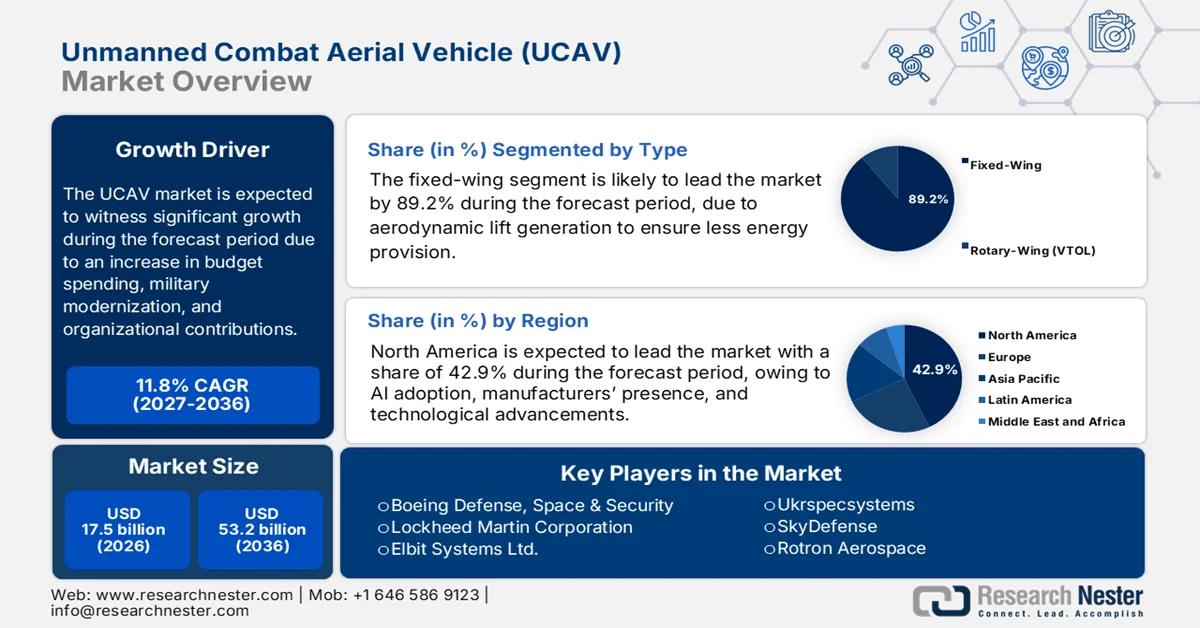
Unmanned Combat Aerial Vehicle (UCAV) Market size was over USD 17.5 billion in 2026 and is expected to reach USD 53.2 billion by the end of 2036, growing at around 11.8% CAGR during the forecast period, i.e., between 2027-2036. In 2027, the industry size of unmanned combat aerial vehicle is evaluated at USD 19.5 billion.
The worldwide unmanned combat aerial vehicle market is witnessing strong growth, which is underpinned by a confluence of factors, such as a rise in defense budgets, modernization in military arms, industrial partnerships, evolving battlefield demands, and a shift in production. According to an article published by the SIPRI Organization in April 2026, global military expenditure effectively reached USD 2,887 billion as of 2025, which indicated a surge of 2.9% since 2024. Based on this, military spending in Europe rose by 14%, along with 8.1% in Oceania and Asia. Besides, Russia, China, and the U.S. ensured a combined total amount of USD 1,480 billion, or 15% of the worldwide total. Therefore, all these expenditures have eventually led to a continuous shipment of military weapons in terms of exports across different nations, thus proliferating the market’s growth and exposure.
Military Weapons Shipment by Exports, 2021
|
Country |
Trade Value (USD 1,000) |
Quantity (Item) |
|
U.S. |
444,742.4 |
145,182 |
|
Norway |
57,639.4 |
600 |
|
Poland |
40,456.7 |
20,799 |
|
Switzerland |
23,161.1 |
19,906 |
|
Spain |
16,895.8 |
8,103 |
|
India |
16,112.3 |
36,192 |
|
Canada |
6,882.9 |
4,128 |
|
South Africa |
5,640.9 |
547 |
|
Slovak Republic |
5,487.9 |
4,325 |
|
Croatia |
4,715.9 |
3,698 |
Source: WITS
Furthermore, the integration of cybersecurity, a shift to industrial-scale production, cross-nation collaborations that are reshaping production, and an expansion in drone operations are other trends that are positively driving the UCAV market globally. For instance, in July 2026, the U.S. Department of War’s Office of Strategic Capital proclaimed a conditional loan provision of almost USD 820 million for performance drone works to readily establish high-volume domestic manufacturing capacity for severe drone components. Therefore, the administrative organization’s financing, along with additional private capital commitment, is focused on supplying the newest high-volume manufactured components across the drone industrial base, thus effectively fueling the market’s upliftment.
Key Unmanned Combat Aerial Vehicle Market Insights Summary:
Regional Highlights:
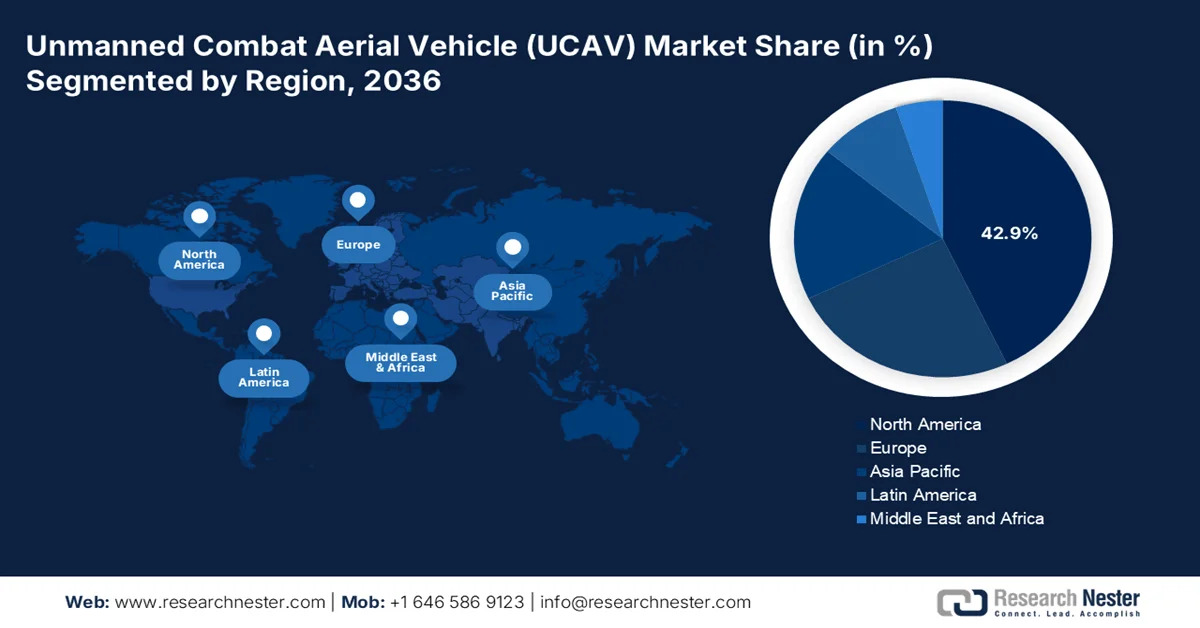
- North America UCAV market is projected to secure a 42.9% share by 2036, underpinned by strong technological innovation, AI-enabled decision-making, established manufacturers, and rising demand for collaborative combat aircraft
- Asia Pacific is poised to be the fastest-growing region during 2027-2036, fueled by military modernization, geopolitical tensions, indigenous development initiatives, and the adoption of cost-effective high-performance drones for mass deployment
Segment Insights:
- The fixed-wing sub-segment is projected to command an 89.2% share of the unmanned combat aerial vehicle market by 2036, supported by its energy-efficient aerodynamic lift, lighter carbon-fiber composite structures, and enhanced maneuverability
- The air force segment is expected to secure a 73.1% share during the forecast period, owing to the shift toward unmanned systems that reduce pilot exposure to high-threat environments and extend operational endurance
Key Growth Trends:
- Advanced and autonomy teaming
- Strategic defense programs
Major Challenges:
- Ethical and legal accountability dilemmas
- Technological maturity and reliability risks
Key Players: Lockheed Martin Corporation, Elbit Systems Ltd., Textron Inc., Kratos Defense and Security Solutions Inc., Dassault Aviation SA.
Global Unmanned Combat Aerial Vehicle Market Forecast and Regional Outlook:
Market Size & Growth Projections:
- 2026 Market Size: USD 17.5 billion
- 2027 Market Size: USD 19.5 billion
- Projected Market Size: USD 53.2 billion by 2036
- Growth Forecasts: 11.8% CAGR (2027-2036)
Key Regional Dynamics:
- Largest Region: North America (42.9% Share by 2036)
- Fastest Growing Region: Asia Pacific
- Dominating Countries: United States, China, Russia, Israel, France
- Emerging Countries: India, South Korea, Turkey, Japan, Australia
Last updated on : 1 September, 2026
Unmanned Combat Aerial Vehicle (UCAV) Market - Growth Drivers and Challenges
Growth Drivers
- Advanced and autonomy teaming: The urge to develop increased autonomous systems is considered a centralized growth driver for the unmanned combat aerial vehicle market globally. For instance, in October 2025, General Atomics Aeronautical Systems, Inc. (GA-ASI), Lockheed Martin, and L3Harris Technologies significantly collaborated on a flight evaluation that demonstrated Crewed-Uncrewed Teaming by utilizing a GA-ASI MQ-20 Avenger® unmanned jet and an F-22 Raptor fighter jet. This particular collaboration integrated L3Harris’ BANSHEE™ Advanced Tactical Datalinks with its Pantera software-defined radios (SDRs) through Lockheed Martin’s open radio architectures. Therefore, organizational collaborations play a huge role in developing innovative systems, thus positively boosting the unmanned combat aerial vehicle market globally.
- Strategic defense programs: The presence of long-lasting national and multinational defense frameworks serves as a cornerstone of sustained UCAV market expansion. Programs such as the Franco-German-Spanish Future Combat Air System (FCAS) and the UK-led Global Combat Air Programme (GCAP) formally embed unmanned platforms within next-generation air-power architectures. These tier-one initiatives transform UCAVs from ancillary assets into core combat elements, mandating continuous investment across development, testing, and production phases. Their multi-decade horizons provide manufacturers with predictable revenue streams and stable demand signals, while fostering cross-border industrial collaboration that accelerates technological maturation and ensures interoperability among allied forces.
Challenges
- Ethical and legal accountability dilemmas: The aspect of deploying lethal force through semi-autonomous or fully autonomous systems raises profound moral and juridical risks for the unmanned combat aerial vehicle market. When a UCAV makes targeting errors or causes unintended civilian casualties, assigning responsibility becomes legally unclear. Besides, international humanitarian law currently lacks clear provisions for algorithmic warfare, provoking fierce debates among policymakers, human rights groups, and military strategists. This ambiguity not only invites public backlash but also deters some nations from aggressive procurement, slowing widespread adoption. Moreover, until binding international treaties on autonomous weapons are established, ethical controversies will shadow every major market expansion.
- Technological maturity and reliability risks: Despite rapid advancements, platforms in the unmanned combat aerial vehicle market still grapple with sensor fusion errors, propulsion system failures, and degraded performance in adverse weather or electronic warfare environments. Meanwhile, autonomy algorithms, while impressive in controlled tests, often struggle in unpredictable combat scenarios that require split-second, context-aware decisions. Moreover, mechanical breakdowns over hostile territories can result in irreversible asset losses, as recovery missions are rarely feasible. Furthermore, integrating cutting-edge innovations, such as directed-energy weapons or swarm logic, introduces untested variables that compromise overall system robustness.
Unmanned Combat Aerial Vehicle (UCAV) Market Size and Forecast:
| Report Attribute | Details |
|---|---|
|
Base Year |
2026 |
|
Forecast Year |
2027-2036 |
|
CAGR |
11.8% |
|
Base Year Market Size (2026) |
USD 17.5 billion |
|
Forecast Year Market Size (2036) |
USD 53.2 billion |
|
Regional Scope |
|
Unmanned Combat Aerial Vehicle (UCAV) Market Segmentation:
Type Segment Analysis
By type segment, the fixed-wing sub-segment is anticipated to capture the largest share, at 89.2%, in the unmanned combat aerial vehicle market by the end of 2036. The sub-segment’s upliftment is primarily driven by the importance of the rigid wing design that utilizes forward motion for generating aerodynamic lift, further permitting it to remain aloft with less energy in comparison to rotary-wing craft. According to an article published by MDPI in February 2026, over 10 million unmanned aerial systems (UAS) were in operation globally, which increased to 20 million as of 2025, along with a yearly growth rate of 15%. Besides, optimization of aerodynamic shapes as well as the application of carbon-fiber composites tend to diminish the structural weight by almost 15%, which eventually improves the maneuverability of the aircraft, thereby positively impacting the sub-segment’s growth and exposure.
End user Segment Analysis
During the forecast period, the air force segment under end user is expected to account for the second-largest share of 73.1% in the unmanned combat aerial vehicle market. The segment’s growth is propelled by its historic reliance on manned aviation for strike, reconnaissance, and suppression missions. Besides, transitioning to unmanned systems allows these branches to reduce pilot casualties in high-threat environments while extending operational endurance beyond human physiological limits. However, institutional resistance from traditional aviator communities, coupled with the need to completely overhaul training curricula, maintenance workflows, and tactical doctrines, creates significant friction. Additionally, air forces must balance UCAV procurement with legacy fleet modernization, forcing difficult resource allocation decisions.
Altitude of Operation Segment Analysis
The below-30,000 ft platforms sub-segment under the altitude of operations segment is predicted to garner the third-largest share of 64.4% in the unmanned combat aerial vehicle market by the end of the stipulated timeline. The sub-segment’s development is highly fueled by encompassing the majority of tactical UCAV missions, including close air support, armed reconnaissance, and counter-insurgency operations. Therefore, operating below this threshold exposes platforms to dense airspace traffic, small-arms fire, man-portable air defenses, and adverse terrain-induced weather phenomena. Meanwhile, the atmospheric density at these levels affects aerodynamic performance, fuel efficiency, and sensor fidelity, demanding robust airframes and powerful propulsion systems. Furthermore, prolonged loitering at medium-to-low altitudes increases acoustic and visual signatures, undermining stealth objectives.
Our in-depth analysis of the unmanned combat aerial vehicle market includes the following segments:
|
Segment |
Subsegments |
|
Type |
|
|
End user |
|
|
Altitude of Operation |
|
|
Engine Type |
|
|
Range |
|
|
Endurance |
|

Vishnu Nair
Head - Global Business DevelopmentCustomize this report to your requirements — connect with our consultant for personalized insights and options.
Unmanned Combat Aerial Vehicle (UCAV) Market - Regional Analysis
North America Market Insights
North America UCAV market is anticipated to garner the highest share of 42.9% by the end of 2036. The market’s upliftment is primarily attributed to the robust emphasis on technological innovation, the existence of manufacturers, the adoption of AI for decision-making, and the demand for collaborative combat aircraft (CCA). Based on the November 2025 Congress Government data report, the administrative organization offered USD 678 million as compulsory funding as of the 2025 Reconciliation Act for standard CCA development. In addition, the Air Force readily requested USD 111.4 million as discretionary funding for CCA research, development, test, and evaluation (RDT&E). Therefore, based on these funding opportunities, there is a huge growth opportunity for the market’s upliftment in the region.
The unmanned combat aerial vehicle market in the U.S. is growing significantly, owing to tactical procurement shifts, the creation of trade policy and regulatory frameworks, and unprecedented budget provisions. As stated in an article published by Congress in July 2026, the Department of Defense (DOD) budget as of 2026 comprised USD 848.3 billion in terms of discretionary funding, along with USD 113.3 billion in compulsory funding. Additionally, of this total funding budget portion, DOD also initiated a combined total of USD 295.3 billion in RDT&E investment, which includes different amounts for weapon systems. This massive budget allocation is also coupled with a tactical pivot towards high-volume and cost-effective platforms, which are fueled by experiences from worldwide conflicts, thereby demonstrating an optimistic outlook for the market’s expansion in the country.
The initiative to develop national sovereignty, the necessity of critical weather operations, along with the adoption of uncrewed systems, and governmental investments are certain factors that are responsible for boosting the unmanned combat aerial vehicle market in Canada. As per an article published by the Government of Canada in May 2026, the Minister responsible for Prairies Economic Development Canada and the Minister of Emergency Management and Community Resilience declared a combined federal investment of over USD 9.3 million through the Regional Defense Investment Initiative (RDII). This particular funding is focused on generating economic activity for businesses in Alberta and expanding the overall nation’s domestic security and defense supply chain. Therefore, with such joint operations and generous budget allocations, the unmanned combat aerial vehicle market is continuously growing in the country.
APAC Market Insights
The Asia Pacific UCAV market is expected to emerge as the fastest-growing region during the forecast period. The market’s development in the region is highly attributed to modernization in the military, geopolitical tensions, the push for indigenous development, and the shift to high-performance and cheap drones to ensure mass deployment. According to an article published by the CSIS Organization in September 2025, China’s defense budget almost reached USD 247 billion as of 2025. In this regard, the Stockholm International Peace Research Institute (SIPRI) estimated that the country’s actual defense expenditure was nearly USD 318 billion in 2024. Therefore, the growth and scale of the national defense budget have ensured comprehensive investments in training, personnel, maintenance, and equipment, thus positively contributing to the market’s development in the region.
Estimated Defense Expenditure in China, 2014-2024
|
Year |
Amount (USD Billion) |
|
2014 |
184.7 |
|
2015 |
199.2 |
|
2016 |
210.6 |
|
2017 |
223.6 |
|
2018 |
236.7 |
|
2019 |
248.2 |
|
2020 |
259.9 |
|
2021 |
266.7 |
|
2022 |
278.5 |
|
2023 |
296.8 |
|
2024 |
317.6 |
Source: CSIS Organization
The unmanned combat aerial vehicle market in China is gaining increased traction, owing to its massive defense investments, the presence of an innovative indigenous industrial base, and strong production scaling. As per the data report published by the Texas National Security Review in June 2024, the country has spent over USD 232 billion (1.67 trillion yuan), which is more than its usual 2024 defense budget. Besides, the national defense spending is also equivalent to USD 700 billion, which is gradually approaching the U.S. level. Moreover, the country also spent roughly USD 471 billion on defense as of 2024, which is almost 36% in comparison to the U.S. of the total USD 1.3 trillion. Therefore, based on this spending and continuously approaching the U.S.-based level, the market is gradually developing in the country.
The aspects of the modernization imperative, a tactical pivot towards indigenous manufacturing, a huge anticipated increase in procurement volumes, and the government’s strong push for self-reliance in defense technology are a few trends that are responsible for driving the unmanned combat aerial vehicle market in India. Based on a data report published by the PIB Government in August 2026, defense spending in the country increased to USD 26.5 billion and is further expected to be worth USD 82.2 billion by the end of 2027. Meanwhile, the nation’s capital expenditure also surged from USD 9.8 billion and further to USD 22.9 billion by the same year. Based on these, defense production also reached a record USD 18.6 billion as of 2025, which accounted for 76% of production from public sector entities, along with 24% from the private sector, thus proliferating the market’s development in the country.
Europe Market Insights
Europe unmanned combat aerial vehicle market is projected to account for a considerable share by the end of the stipulated timeline. The market’s growth is effectively driven by a focus on autonomous combat systems, collaborative programs, the integration of next-generation manned fighter programs, and a surge in defense modernization approaches. According to a data report published by the European Commission in November 2025, USD 925.1 billion (€800 billion) has been generously provided by Member States with the objective of mobilizing to bolster defense expenditure and modernization. Likewise, this particular plan permitted Member States to boost defense spending, based on which a 1.5% gross domestic product (GDP) increase in defense budgets. This eventually tends to create almost USD 758 billion (€650 billion) for more than 4 years, thus enhancing the market growth.
The unmanned combat aerial vehicle market in the UK is gaining increased exposure, owing to the presence of an innovative industrial base, leadership in the Global Combat Air Programme (GCAP), commitment to maintaining technological superiority, and substantial defense budget. Based on the June 2026 UK Government data report, the government generously offered USD 20.4 billion (£15 billion), especially for the Defense Investment Plan between 2026 and 2027, as well as by the end of 2029 and 2030. In addition, the government is also focused on spending more than USD 81.7 billion (£60 billion) on defense for the upcoming 4 years. This particular initiative is progressing the country towards military modernization abilities and warfighting readiness. Meanwhile, the DIP data has also set out suitable funding in defense, which totaled USD 406.1 billion (£298 billion), thus positively impacting the market in the country.
Defense Investment Plan Spending in the UK, 2026-2030
|
Plan Type (USD Billion) |
2026-2027 |
2027-2028 |
2028-2029 |
2029-2030 |
Total |
|
Defense Investment Plan |
4.6 |
5.0 |
5.3 |
5.4 |
20.4 |
|
Total increase in Ministry of Defense budget by this Government |
17.0 |
21.9 |
22.7 |
23.5 |
85.2 |
|
Total Ministry of Defense Budget |
93.0 |
100.5 |
104.2 |
107.7 |
405.5 |
|
NATO spending as a percentage of Gross Domestic Product (%) |
2.6 |
27 |
2.7 |
2.7 |
- |
Source: UK Government
The strategic geographic position, suitable increase in defense expenditure, urgent defense improvement demands, heightened security concerns, and an escalation in procurement programs are certain trends that are responsible for fueling the UCAV market in Poland. Based on a data report published by ITA in April 2026, the Homeland Defense Act of 2022 readily consolidated defense regulations and enhanced the number of active personnel, which in turn increased defense expenditure to 3% of GDP as of 2023. In addition, this also resulted in successfully establishing the Armed Forces Support Fund as a suitable means to boost financing of defense modernization and expenditures. Based on the defense budget, military expenditures also reached 4.7% of GDP, thus positively creating a positive outlook for the market’s upliftment in the nation.
Defense Expenditure in Poland, 2019-2025
|
Year |
Defense Spending (PLN Billion) |
Defense Spending (USD Billion) |
GDP % |
|
2019 |
45.1 |
11.7 |
1.95 |
|
2020 |
53.4 |
13.7 |
2.26 |
|
2021 |
59.0 |
15.2 |
2.22 |
|
2022 |
68.3 |
15.3 |
2.20 |
|
2023 |
111.2 |
26.3 |
3.27 |
|
2024 |
151.2 |
38.0 |
4.15 |
|
2025 |
186.6 |
47.4 |
4.7 |
Source: ITA
Key Unmanned Combat Aerial Vehicle (UCAV) Market Players:
- General Atomics Aeronautical Systems, Inc. (U.S.)
- Northrop Grumman Corporation (U.S.)
- Israel Aerospace Industries (IAI) (Israel)
- Baykar Technologies (Turkey)
- Boeing Defense, Space & Security (U.S.)
- Lockheed Martin Corporation (U.S.)
- Elbit Systems Ltd. (Israel)
- Textron Inc. (U.S.)
- Kratos Defense and Security Solutions Inc. (U.S.)
- Dassault Aviation SA (France)
- China Aerospace Science and Technology Corporation (CASC) (China)
- Ukrspecsystems (Ukraine)
- SkyDefense (U.S.)
- Rotron Aerospace (UK)
- Company Overview
- Business Strategy
- Key Product Offerings
- Financial Performance
- Key Performance Indicators
- Risk Analysis
- Recent Development
- Regional Presence
- General Atomics Aeronautical Systems, Inc. is a premier U.S. prime contractor whose MQ-9 Reaper and MQ-9B SkyGuardian have set the global benchmark for medium-altitude, long-endurance combat drones. The company differentiates itself through continuous sensor and autonomy upgrades across its battle-proven product family, maintaining deep loyalty among Western allied forces.
- Northrop Grumman Corporation dominates the high-altitude, long-endurance UCAV segment with its RQ-4 Global Hawk and MQ-4C Triton platforms, which serve as strategic ISR and targeting nodes for major power militaries. Its competitive edge lies in integrating advanced stealth features, secure satellite communications, and large-payload capacities for complex multi-domain operations.
- Israel Aerospace Industries (IAI) is a global leader in combat-proven UCAV systems, with its Heron and Eitan families widely deployed by the Israeli Defense Forces and numerous export customers across Asia, Europe, and the Americas. The company leverages its operational experience in contested environments to deliver highly adaptable platforms with modular payloads and robust electronic warfare resilience.
- Baykar Technologies has emerged as a disruptive force in the unmanned combat aerial vehicle market, driven by the combat success of its Bayraktar TB2 platform in several recent regional conflicts, which has accelerated its global export momentum. The company's competitive positioning is built on offering cost-effective, combat-validated systems with rapid field upgrade cycles and a responsive, customer-centric development model.
- Boeing Defense, Space & Security is a major player in the naval UCAV segment, anchored by its MQ-25 Stingray program, which serves as the U.S. Navy's first carrier-based autonomous aerial refueling and strike-capable platform. The company's UCAV market influence derives from its extensive legacy in military aerospace, robust production infrastructure, and ability to integrate unmanned systems.
Here is a list of key players operating in the global unmanned combat aerial vehicle market:
The global unmanned combat aerial vehicle market is characterized by a moderately consolidated competitive landscape dominated by established U.S. prime contractors and emerging regional champions from Turkey, Israel, and China. Simultaneously, General Atomics and Northrop Grumman maintain leadership through battle-proven platforms, such as the MQ-9 Reaper and RQ-4 Global Hawk, leveraging decades of operational data and established end-user relationships. Meanwhile, Israeli players such as IAI and Elbit Systems compete through technologically sophisticated, export-friendly systems. Besides, in February 2026, Honeywell effectively signed a memorandum of understanding with LIG Nex1 for exploring suitable opportunities for collaboration in the future to develop and commercialize solutions for both UCAVs and CCAs, thus positively boosting the UCAV industry globally.
Corporate Landscape of the Market:
Recent Developments
- In August 2026, NexTech Solutions successfully acquired BOOMSLANG Aerospace, with the intention of strengthening NTS UAS and C-UAS portfolio and expanding options for consumers across airborne, defeat, and detection missions.
- In August 2026, Archer Aviation Inc. and Boeing Company significantly signed a definitive agreement for acquiring Boeing’s Wisk Aero, SkyGrid, and Insitu subsidiaries and combining complementary capabilities in autonomy, electric vertical takeoff and landing (eVTOL) aircraft and UAS.
- In August 2023, General Atomics Aeronautical Systems, Inc. expanded its services by advancing its capability to operationalize the UCAV ecosystem by combining innovative autonomy and government-based human-machine interface hardware.
- Report ID: 8749
- Published Date: Sep 01, 2026
- Report Format: PDF, PPT
- Explore a preview of key market trends and insights
- Review sample data tables and segment breakdowns
- Experience the quality of our visual data representations
- Evaluate our report structure and research methodology
- Get a glimpse of competitive landscape analysis
- Understand how regional forecasts are presented
- Assess the depth of company profiling and benchmarking
- Preview how actionable insights can support your strategy
Explore real data and analysis
Frequently Asked Questions (FAQ)
About this Report
Connect with our Expert


Report, 2027-2036



Copyright @ 2026 Research Nester. All Rights Reserved.
