Thermal Interface Materials Market Outlook:
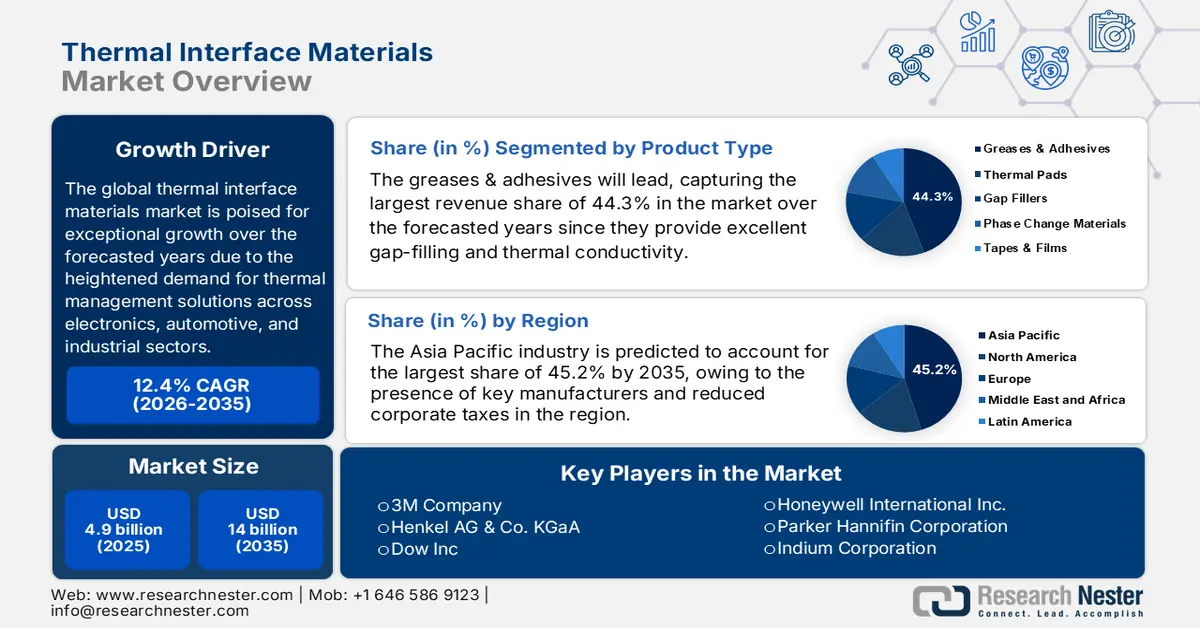
Thermal Interface Materials Market size was valued at USD 4.9 billion in 2025 and is projected to reach USD 14 billion by the end of 2035, expanding at a CAGR of 12.4% during the forecast period, i.e., 2026-2035. In 2026, the industry size of thermal interface materials is estimated at USD 5.5 billion.
The global thermal interface materials market is poised for exceptional growth over the forecasted years due to the heightened demand for thermal management solutions across electronics, automotive, and industrial sectors. The rising power densities in high-performance computing, AI accelerators, 5G infrastructure, and electric vehicles are efficiently fueling the need for TIMs that enhance heat dissipation. TDK Ventures, in January 2025, announced its investment in NovoLINC, which is developing advanced thermal interface materials for next-generation AI computing. Also, the NovoLINC’s proprietary materials system and nanomechanical design deliver exceptionally low thermal resistance, supporting the industry’s shift from air to liquid cooling in high-density GPUs and CPUs. The technology has been incubated through ARPA-E’s COOLERCHIPS program and NSF funding, with strong backing from M Ventures, Foothill Ventures, and TDK Ventures to scale thermal solutions for data centers and semiconductor applications.
Furthermore, innovation in materials such as metal alloys, carbon nanotubes, graphene, and phase-change composites is reshaping competitive dynamics in the thermal interface materials market by enabling performance gains for most applications. In October 2024, the University of Texas at Austin reported that its researchers developed a novel thermal interface material combining liquid metal and aluminum nitride to enhance heat dissipation in high-powered electronics and data centers. It also mentions that the material can remove 2,760 watts of heat from a 16 cm² area, by reducing cooling pump energy by 65% and cutting overall data center energy use by 5%. In addition, this mechanochemically synthesized material addresses the gap between theoretical and real-world TIM performance, supporting sustainable cooling for kilowatt-level devices and enabling higher processing densities. The team is scaling up synthesis and collaborating with industry partners to integrate the technology into practical data center applications, hence positively impacting market growth.