Textile Films Market Outlook:
Textile Films Market size was over USD 7.9 billion in 2025 and is projected to reach USD 14.6 billion by the end of 2035, growing at a CAGR of 7.1% during the forecast timeline, i.e., 2026-2035. In 2026, the industry size of textile films is assessed at USD 8.4 billion.
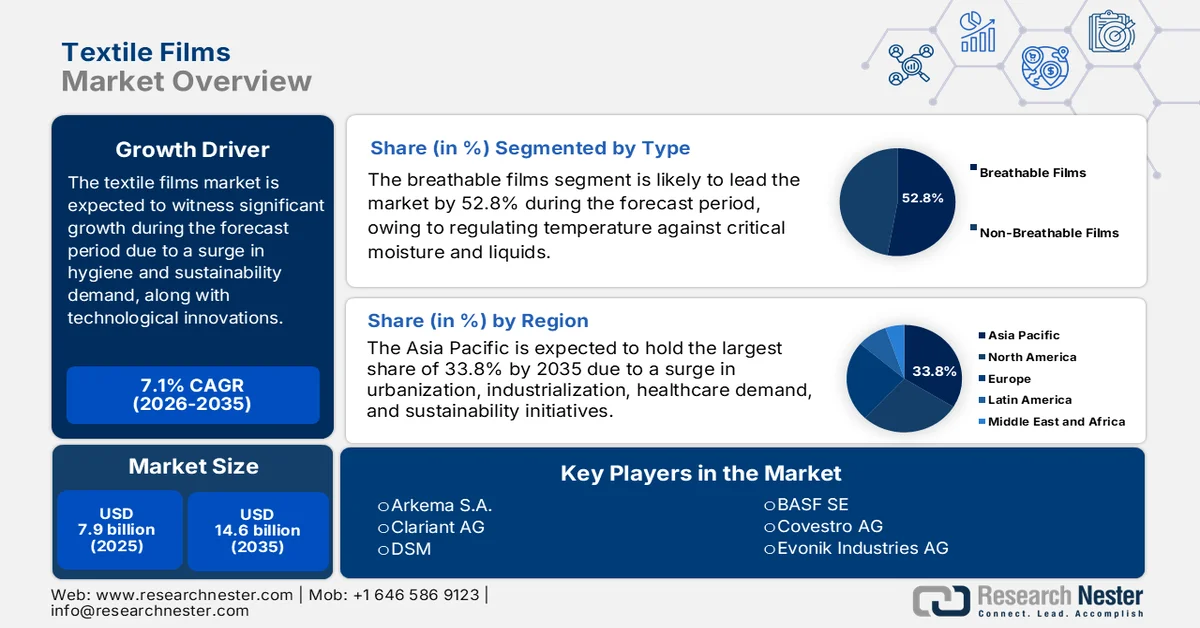
The worldwide textile films market is rapidly gaining increased exposure, owing to not only conventional factors, such as sustainability and hygiene demand, but also to the latest regulatory, consumer, and technological dynamics. According to official statistics published by NLM in September 2023, the fashion and textiles industries remain at the center of sustainable development goals as well as under the Europe Commission’s Green New Deal, since it is worth 2% of the global GDB. In addition, it generates over 1.2 billion tons of carbon dioxide emissions, along with 22 million tons of microfibers, and 21 billion tons of waste, of which 20% are severely toxic wastewater effluent from dye houses. Moreover, 1% of textiles are significantly recycled, denoting overproduction by 25% of the newest garments remaining to be unsold, thereby enhancing sustainability for the market growth and expansion.
Furthermore, the integration of smart textiles, circular economy adoption, digital automation and manufacturing are a few trends that are responsible for bolstering the textile films market across different locations. As per an article published by NLM in October 2022, electronic devices can be evidently controlled by a highly conductive yarn woven into a touch-sensitive sleeve with a consistent 95% recognition rate after 30,000 swipes. Besides, as stated in an article published by NLM in January 2023, the industry for e-textiles has been rapidly growing and is expected to grow to USD 5 billion by the end of 2027. Meanwhile, the industrial size of wearable e-textiles is predicted to expand at a growth rate of over USD 1.3 billion every year by the end of 2031. Therefore, with this continuous growth in both industries, there is a huge growth opportunity for the market internationally.
Key Textile Films Market Insights Summary:
Regional Highlights:
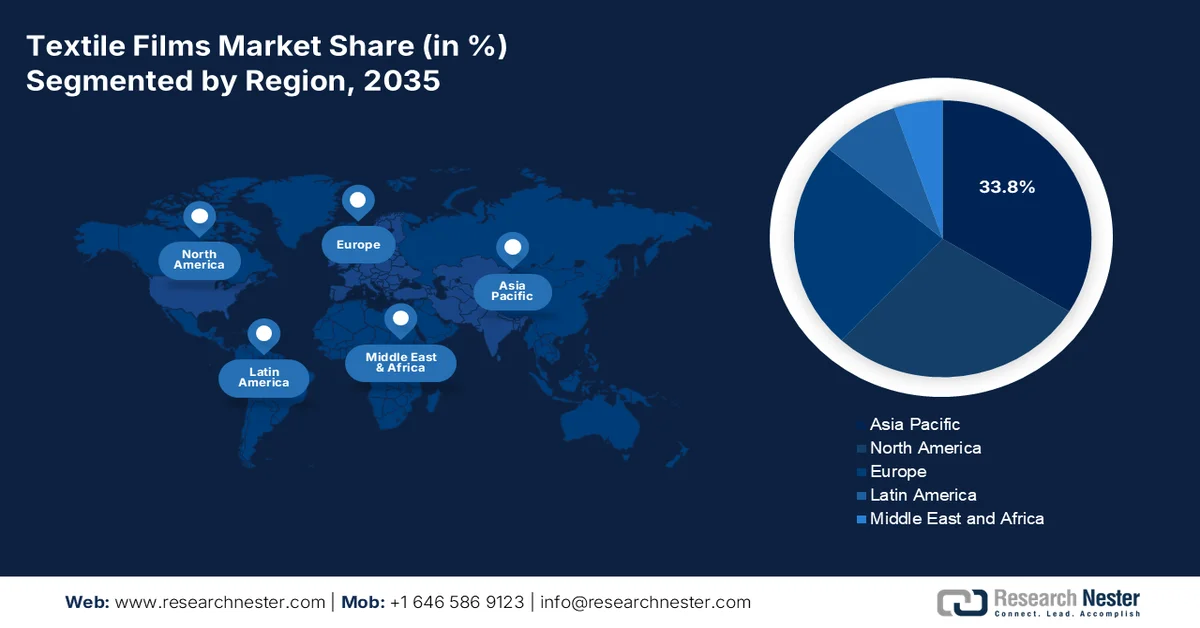
- Asia Pacific in the textile films market is projected to command a 33.8% share by 2035, bolstered by expanding healthcare investments, sustainability initiatives, and rapid industrialization across emerging economies
- Europe is poised to experience notable expansion through 2035, stimulated by rising healthcare demand, packaging innovations, and stringent sustainability regulations promoting eco-friendly materials
Segment Insights:
- The breathable films sub-segment of the textile films market is projected to capture a 52.8% share by 2035, attributed to its ability to regulate temperature, block liquids, and effectively manage moisture while allowing vapor permeability
- The hygiene products segment is anticipated to secure the second-largest share over 2026–2035, supported by escalating demand for diapers, sanitary napkins, adult incontinence items, and feminine hygiene products requiring breathable moisture-resistant films
Key Growth Trends:
- Expansion of e-commerce packaging
- Increased investments in healthcare facilities
Major Challenges:
- Raw material price volatility
- Environmental regulations and sustainability pressure
Key Players: 3M Company, Avery Dennison Corporation, Teijin Limited, SKC Co., Ltd., LG Chem Ltd., Kolon Industries, Inc., Reliance Industries Limited, SRF Limited, Garware Technical Fibres Ltd., Indorama Ventures Public Company Limited, Lotte Chemical Corporation, BASF SE, Covestro AG, Evonik Industries AG, Arkema S.A., Clariant AG, DSM, SABIC, ExxonMobil Chemical, Chevron Phillips Chemical Company LLC
Global Textile Films Market Forecast and Regional Outlook:
Market Size & Growth Projections:
- 2025 Market Size: USD 7.9 billion
- 2026 Market Size: USD 8.4 billion
- Projected Market Size: USD 14.6 billion by 2035
- Growth Forecasts: 7.1% CAGR (2026-2035)
Key Regional Dynamics:
- Largest Region: Asia Pacific (33.8% Share by 2035)
- Fastest Growing Region: Europe
- Dominating Countries: - United States, China, Germany, Japan, South Korea
- Emerging Countries: - India, Brazil, Vietnam, Indonesia, Thailand
Last updated on : 5 March, 2026
Textile Films Market - Growth Drivers and Challenges
Growth Drivers
- Expansion of e-commerce packaging: The upsurge in online retail is significantly driving the demand for the textile films market, which is extremely durable, lightweight, and protective in packaging. Based on government estimates published by the Census Government in December 2025, the retail e-commerce sales for the third quarter of 2025 amounted to USD 310.3 billion, denoting an increase of 1.9% from the second quarter of 2025. In addition, the third quarter sales have been estimated to be worth USD 1,893.6 billion, demonstrating an increase by 1.5%. Likewise, there has been an increase in the third-quarter sales by 5.1%, while the overall retail sales upsurged by 4.1% within the same duration, thereby making it suitable for bolstering the market growth across different countries.
- Increased investments in healthcare facilities: Governments are extending healthcare facilities, which in turn is increasing the need for breathable films and medical textiles, especially for wound care, drapes, and gowns. This particular growth driver is significantly reinforced by pandemic preparedness programs, which are positively impacting the textile films market globally. According to official statistics published by the World Health Organization (WHO) in October 2024, each and every dollar invested in this organization has delivered a return of USD 35, which tends to contribute to saving 40 million lives over the next 4 years. Besides, complete sustainable funding by the WHO enables nations to develop stronger, healthier, and more prosperous communities, thus uplifting the market’s growth.
- Transition towards consumer lifestyle: The aspect of rising popularity of performance and athleisure wear is deliberately fueling the demand for flexible and breathable films in sportswear, which is driving the textile films market. According to official statistics published by NLM in April 2022, sports clothing comprised of synthetic, chemically, and naturally treated fabrics has been demonstrated during 15 to 120 minutes of durations, which is followed by 20% to 70% of intensities, along with an array of climatic conditions, including 18 to 40 degrees Celsius with 20% to 60% of relative humidity. Besides, cotton textile-based sportswear is one of the most suitable methods to enhance body cooling even at a humid temperature of 32.2 degrees Celsius, with 70% relative humidity, thus proliferating the market’s growth.
Challenges
- Raw material price volatility: The textile films market is heavily dependent on petrochemical-derived raw materials such as polyethylene, polypropylene, and polyurethane. Fluctuations in crude oil prices directly impact the cost of these polymers, creating uncertainty for manufacturers. For example, geopolitical tensions and supply chain disruptions can cause sudden spikes in oil prices, leading to higher production costs. This volatility makes it difficult for companies to forecast expenses and maintain stable profit margins. Smaller manufacturers are particularly vulnerable, as they lack the financial resilience to absorb cost shocks compared to larger players. Additionally, the push toward sustainable and bio-based alternatives adds another layer of complexity, as these materials are often more expensive and not yet available at scale.
- Environmental regulations and sustainability pressure: Governments worldwide are tightening regulations on plastics and chemical-based materials, directly affecting textile films. Europe’s single-use plastics directive and similar policies in North America and Asia are pushing manufacturers to adopt recyclable and biodegradable alternatives. While this shift aligns with global sustainability goals, it poses significant challenges for the textile films industry. Besides, developing eco-friendly films requires advanced R&D, new production technologies, and higher costs, which can strain profitability. Moreover, compliance with environmental standards involves extensive testing, certification, and reporting, adding administrative burdens, thus negatively impacting the textile films market globally.
Textile Films Market Size and Forecast:
| Report Attribute | Details |
|---|---|
|
Base Year |
2025 |
|
Forecast Year |
2026-2035 |
|
CAGR |
7.1% |
|
Base Year Market Size (2025) |
USD 7.9 billion |
|
Forecast Year Market Size (2035) |
USD 14.6 billion |
|
Regional Scope |
|
Textile Films Market Segmentation:
Type Segment Analysis
The breathable films sub-segment, which is part of the type segment, is anticipated to garner the highest share of 52.8% in the textile films market by the end of 2035. The sub-segment’s upliftment is highly driven by its importance in its ability to regulate temperature, offer a barrier against liquids, and manage moisture, while permitting vapor to pass through. In hygiene products, breathable films improve skin health by reducing moisture buildup, a critical factor in diapers and sanitary products. Meanwhile, in medical applications, they are used in surgical gowns and drapes, ensuring both protection and breathability. The sportswear industry has also embraced breathable films, integrating them into performance apparel to meet consumer demand for lightweight, moisture-wicking fabrics, thereby making it suitable for bolstering the sub-segment’s exposure globally.
Application Segment Analysis
The hygiene products segment in the textile films market is projected to hold the second-highest share during the forecast period. The segment’s growth is highly fueled by rising demand for diapers, sanitary napkins, adult incontinence products, and feminine hygiene solutions, all of which rely on breathable and moisture-resistant films for comfort and functionality. The segment benefits from demographic trends such as aging populations in North America and Europe, coupled with increasing birth rates and urbanization in the Asia Pacific, which fuel the consumption of disposable hygiene products. Moreover, government initiatives further strengthen this segment. For instance, the U.S. Department of Health & Human Services emphasizes maternal and child health programs that indirectly boost demand for advanced hygiene materials.
Material Segment Analysis
By the end of the stipulated timeline, the polyethylene segment as part of the material is expected to account for the third-highest share in the textile films market. The segment’s development is highly propelled by offering waterproofing, optimizing manufacturing efficiency, and enhancing durability through specialty emulsions. According to official statistics published by NLM in October 2023, 1.5% of overall plastic production is evidently part of the small bioplastics industry. Besides, the waste management and recycling of polyethylene has resulted in weight loss, ranging from 1% to 47%. Moreover, the global plastics production accounted for 390.7 million tons, of which 90.2% originated from fossil fuels, 8.3% from recycled, and just 1.5% from bio-based plastics, thereby catering to the polyethylene production.
Our in-depth analysis of the textile films market includes the following segments:
|
Segment |
Subsegments |
|
Type |
|
|
Application |
|
|
Material |
|
|
End user |
|
|
Technology |
|
|
Treatment |
|

Vishnu Nair
Head - Global Business DevelopmentCustomize this report to your requirements — connect with our consultant for personalized insights and options.
Textile Films Market - Regional Analysis
APAC Market Insights
The Asia Pacific in the textile films market is anticipated to garner the largest share of 33.8% by the end of 2035. The market’s upliftment in the region is highly propelled by government-funded sustainability programs, healthcare demand, and rapid industrialization. According to official statistics published by NLM in February 2023, a meager proportion of an estimated 4% to 7% of the overall gross domestic product (GDP) has been generously invested in the healthcare industry in the majority of Asia-based nations. Besides, as per the October 2024 The Lancet Global Health article, the South Asia region is home to 1.7 billion people, which effectively corresponds to 22% of the overall worldwide population. The overall region increasingly faces changing epidemiology, which readily affects health outcomes, thus making it suitable for bolstering the market growth in the overall region.
The textile films market in China is significantly growing, owing to the presence of industrial sectors, hygiene, and huge packaging industries. As per an article published by Packnode Organization in November 2025, the e-commerce industry in the country handles more than 100 billion parcels every year, with packaging waste emerging as one of the major environmental concerns. However, the sustainability initiative by the Ministry of Industry and Information Technology (MIIT) is predicted to combat packaging-based carbon dioxide emissions by more than 20 million tons every year and significantly position the country as one of the worldwide leaders in green e-commerce logistics. Therefore, based on the initiative and the projection, the market is gradually gaining increased exposure in the overall country.
The rapid growth in medical, sportswear, and hygiene textiles, along with the Ministry of Chemicals and Fertilizers and Department of Science & Technology (DST) reporting government-based investments, is eventually boosting the textile films market in India. Based on government estimates published by Invest India in September 2025, textiles, including handicrafts, tend to remain one of the country’s exports, accounting for almost 8.2% of overall exports between 2023 and 2024. Besides, the country alone supplies 3.9% of overall worldwide textiles, especially to developed economies, such as the U.S. and Europe. Moreover, the nation’s global textile and apparel exports are also deliberately responsible for bolstering the market demand.
Global Textile and Apparel, Including Handicrafts Export Analysis in India (2022-2025)
|
Commodity |
2022-2023 (USD Million) |
2023-2024 (USD Million) |
2024-2025 (USD Million) |
|
Readymade Garment |
16,190.9 |
14,532.1 |
15,989.3 |
|
Cotton Textiles |
11,084.8 |
12,258.1 |
12,298.9 |
|
Man-Made Textiles |
5,411.9 |
5,080.6 |
5,294.6 |
|
Wool and Woolen Textiles |
204.7 |
192.4 |
160.2 |
|
Silk Products |
94.5 |
119.2 |
162.0 |
|
Handloom Products |
182.5 |
140.4 |
141.9 |
Source: PIB Government
Europe Market Insights
Europe in the textile films market is expected to emerge as the fastest-growing region during the forecast period. The market’s development in the region is highly propelled by healthcare demand, packaging advancements, and sustainability regulations. Moreover, regional administrative organizations have emphasized stringent compliance with eco-friendly materials, thus pushing manufacturers toward breathable and recyclable films. According to official statistics published by Eurostat in October 2023, the region deliberately generated 188.7 kg of packaging waste per inhabitant, as well as an additional 10.8 kg per person. Besides, the region also generated 84 million tons of packaging waste, of which 40.3% were cardboard and paper. Based on this, plastic represented 19.05, glass 18.5%, wood 17.1%, and metal 4.9%, thereby denoting the textile films market’s growth in the overall region.
The textile films market in Germany is gaining increased traction, owing to a robust demand in industrial, hygiene, and packaging textiles, along with the Federal Ministry for Economic Affairs and Climate Action significantly prioritizing sustainable packaging innovation by allocating generous funds towards eco-friendly packaging solutions. As per an article published by the MDPI in June 2024, packaging waste from snack and meal boxes in the country amounted to nearly 120,000 tons, which effectively corresponds to almost 329 tons of waste per day from takeaway catering. Therefore, this considerable amount of waste significantly prompted the country to unveil compulsory reusable packaging from January 2023. This included Section 33 of the Packaging Act, based on which restaurants and catering businesses in the country are presently obliged to provide reusable packaging, thus proliferating the market’s exposure.
The aspects of food and hygiene packaging applications, sustainable packaging solutions, as well as a rise in the demand for eco-friendly films in consumer goods, are a few factors that are responsible for bolstering the textile films market in Spain. As stated in an article published by the Food Packaging Forum in April 2022, Congress has established the national objective of diminishing total wastage by 13% in the country as of 2025, and further by 15% by the end of 2030. Besides, for single-use plastics, the objective is extremely stringent, denoting that 50% reduction in the weight of single-use plastics is expected to be achieved by the end of 2026, which is further followed by a 70% reduction by the end of 2030. Besides, at the end of 2025, overall polyethylene terephthalate (PET) bottles comprised at least 25% of recycled plastic, which is further projected to contain 30% recycled PET by 2030, thus positively impacting the market’s growth.
North America Market Insights
North America in the textile films market is projected to witness a considerable share by the end of the stipulated timeline. The market’s growth in the region is highly driven by a robust demand for protective apparel, medical textiles, and hygiene, along with the governmental emphasis on advanced manufacturing, sustainability, and chemical safety. Based on government estimates published by the EPA Government in October 2025, textile generation in the U.S. accounted for 17 million tons, demonstrating 5.8% of overall municipal solid waste. Besides, the recycling rate for domestic textiles was 14.7%, with 2.5 million tons accounting for recycling. Within this, the EMA estimated that the recycling rate for textiles in the country for footwear and clothing was 13%, and meanwhile, it was 15.8% for pillowcases and sheets, thereby enhancing the market’s growth in the overall region.
The textile films market in the U.S. is gaining increased exposure, owing to an increase in the demand for hygiene and healthcare, a surge in industrial applications, and a focus on regulation and sustainability. According to official statistics published by the ITA in 2026, the textile industry in the country readily employed more than 500,000 people and comprised an overall shipment of USD 64.8 billion as of 2023. Besides, the country is regarded as the second-largest exporter of textile-based products internationally, with more than USD 29 billion in exports. Moreover, the total shipments in the textile mills sector amounted to USD 25.3 billion in 2023, along with an employment of 89,300 employees in the middle of 2024. Meanwhile, in 2022, there has been 1,786 establishments in the domestic industry, thereby making it suitable for boosting the market’s exposure in the country.
The increased awareness regarding consumer and hygiene, sustainable manufacturing, and industrial exports and growth are certain factors that are enhancing the demand for the textile films market in Canada. As per an article published by the Government of Canada in December 2025, the manufacturing industry accounts for roughly USD 174 billion of the nation’s GDP, thereby representing 10% of the country’s overall GDP. In addition, domestic manufacturers effectively export over USD 354 billion every year, demonstrating 68% of all the country’s merchandise exports. This significantly adds up to 1.7 million quality-based, well-paid, and full-time employment opportunities. Besides, the industry has readily modernized, with manufacturers emerging as high-tech and advanced by depending on a knowledgeable and highly skilled workforce, which is positively impacting the market’s growth.
Key Textile Films Market Players:
- 3M Company (U.S.)
- Avery Dennison Corporation (U.S.)
- Teijin Limited (Japan)
- SKC Co., Ltd. (South Korea)
- LG Chem Ltd. (South Korea)
- Kolon Industries, Inc. (South Korea)
- Reliance Industries Limited (India)
- SRF Limited (India)
- Garware Technical Fibres Ltd. (India)
- Indorama Ventures Public Company Limited (Thailand)
- Lotte Chemical Corporation (South Korea)
- BASF SE (Germany)
- Covestro AG (Germany)
- Evonik Industries AG (Germany)
- Arkema S.A. (France)
- Clariant AG (Switzerland)
- DSM (Netherlands)
- SABIC (Saudi Arabia)
- ExxonMobil Chemical (U.S.)
- Chevron Phillips Chemical Company LLC (U.S.)
- Company Overview
- Business Strategy
- Key Product Offerings
- Financial Performance
- Key Performance Indicators
- Risk Analysis
- Recent Development
- Regional Presence
- 3M Company leverages its expertise in advanced materials to produce textile films that enhance durability and performance in medical and protective applications. The company’s 2025 global impact report highlights sustainability initiatives, including circularity and climate-focused innovations, which directly influence its textile film portfolio.
- Avery Dennison Corporation has partnered with TEXAID to integrate digital identification technologies into textile recycling, improving film-based apparel sorting and reuse. The company is innovating in heat transfer films, supporting customization in the sportswear and fashion industries while focusing on sustainability.
- Teijin Limited has introduced next-generation multifunctional textiles for sports and outdoor apparel, integrating advanced film technologies. The company emphasizes sustainability through solvent-based recycling processes, producing high-quality resins that support eco-friendly textile films.
- SKC Co., Ltd. pioneered polyester film development in Korea in 1977, establishing itself as a leader in specialty films. The company continues to expand into advanced polyimide and specialty films, supporting industrial and protective textile applications.
- LG Chem Ltd. collaborates with Reifenhäuser to develop recyclable MDO-PE films, enhancing sustainability in textile and packaging applications. The company’s 2024 sustainability report outlines its commitment to advancing eco-friendly materials and reducing environmental impact.
Here is a list of key players operating in the global textile films market:
The international textile films market is highly competitive, with global leaders such as Berry Global, Toray Industries, BASF, and Reliance Industries driving innovation through sustainability initiatives, advanced polymer technologies, and strategic mergers. Moreover, companies are increasingly investing in eco-friendly films, recyclable materials, and breathable film technologies to meet rising demand in hygiene, medical, and sportswear applications. Strategic partnerships with healthcare and apparel manufacturers, coupled with government-backed sustainability programs, are reshaping the industry. For instance, in September 2025, Shell Polymers and ISOFlex successfully entered into a commercial collaboration that has enabled the utilization of ISCC PLUS-certified circular polyethylene, particularly for food-grade flexible packaging, thereby making it suitable for boosting the textile films market globally.
Corporate Landscape of the Textile Films Market:
Recent Developments
- In May 2025, AE Global and rePurpose Global introduced plastic-neutral and plastic-negative packaging certification badges for product packaging, based on which participating brands tend to display official on-pack icons that clearly signal plastic recovery impact.
- In January 2024, DuPont unveiled specialty print and signage by offering a suitable opportunity to network with industrial professionals and explore the latest business prospects, and readily discover the newest technologies.
- In March 2022, Emerald Packaging Inc. notified that it has emerged as a signatory to the Ellen MacArthur Foundation's New Plastics Economy Global Commitment, resulting in the company making organizational commitments to diminish plastic utilization by integrating objectives in line with developing a circular economy.
- Report ID: 8414
- Published Date: Mar 05, 2026
- Report Format: PDF, PPT
- Explore a preview of key market trends and insights
- Review sample data tables and segment breakdowns
- Experience the quality of our visual data representations
- Evaluate our report structure and research methodology
- Get a glimpse of competitive landscape analysis
- Understand how regional forecasts are presented
- Assess the depth of company profiling and benchmarking
- Preview how actionable insights can support your strategy
Explore real data and analysis
Frequently Asked Questions (FAQ)
About this Report
Connect with our Expert


Report, 2026-2035



Copyright @ 2026 Research Nester. All Rights Reserved.
