Tarsal Tunnel Syndrome Drugs Industry - Regional Synopsis
North America Market Forecast
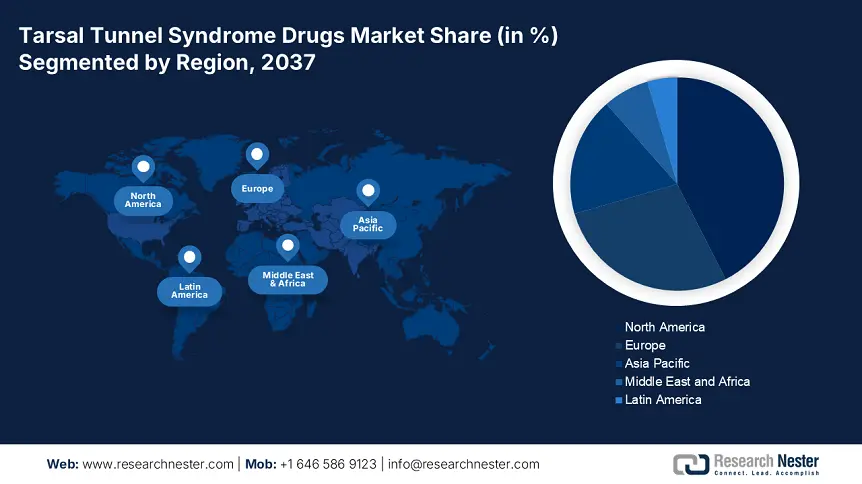
North America is expected to show dominance over the global tarsal tunnel syndrome drugs market with a share of 42.5% over the discussed period. The region’s leadership is highly attributable to the heightening of medical expenses, improving reimbursement policies, and predominant captivity in the field of drug discovery. For instance, in 2023, the Federal budget allocation in this category surpassed USD 3.4 billion in Canada. Additionally, the high volume of patient pools across the region is also fostering a lucrative business environment for leaders in this sector. In this regard, the National Institute of Neurological Disorders and Stroke (NINDS) reported that the majority of the patient pool, approximately 65.3%, is concentrated in high-income Western regions, including North America.
The augmentation of the U.S. tarsal tunnel syndrome drugs market is majorly influenced by financial support from the government and rising demand for advanced medicines. Additionally, the expanding coverage of nationwide reimbursement policies, such as Medicare and Medicaid, is ensuring enhanced patient access while backing pharmaceutical companies with incentives. For instance, in 2024, around 75.3% of the TTS medications, authorized by the FDA, were subsidized by both of these service providers. Similarly, as per the Federal budget allocations in the U.S., the spending from Medicare and Medicaid reached USD 800.4 million and USD 1.4 billion in 2024, influenced by the surge in corticosteroid injections and advanced biologics.
APAC Market Forecast
Asia Pacific is poised to become the fastest-growing region in the global tarsal tunnel syndrome drugs market by the end of 2037. This landscape’s propagation is majorly fueled by magnifying healthcare investments and frequent government initiatives. For instance, medical spending by the Government of Japan rose by USD 3.5 billion in 2024 from 2022, as per the Ministry of Health and Labor Welfare (MHLW). Similarly, the Indian Ministry of Health revealed that the annual expenditure on this field in India increased up to USD 2.0 billion in 2023. Besides, the continuously enlarging patient population, escalated local API production, and adoption of advanced diagnostic and monitoring solutions to detect and track disease progression are accumulatively upscaling revenue generation.
Malaysia is emerging as a reliable trading base for the regional tarsal tunnel syndrome drugs market and is presenting the untapped potential of favoring a greater profit margin. The ongoing enlargement in the patient pool, doubling from 2013 to 2023, raised public healthcare spending on neurological ailments, including TTS, by 20.4%. Additionally, 1 in every 5 diabetic patients in this country develops neuropathic complications, which is magnifying TTS drug imports by the national private medical industry by 15.2%. Furthermore, the increasing priority of chronic pain management influenced the National Strategic Plan for Non-Communicable Diseases to dedicate USD 34.7 million to neuropathy treatments.