Subsea Flowlines Market Outlook:
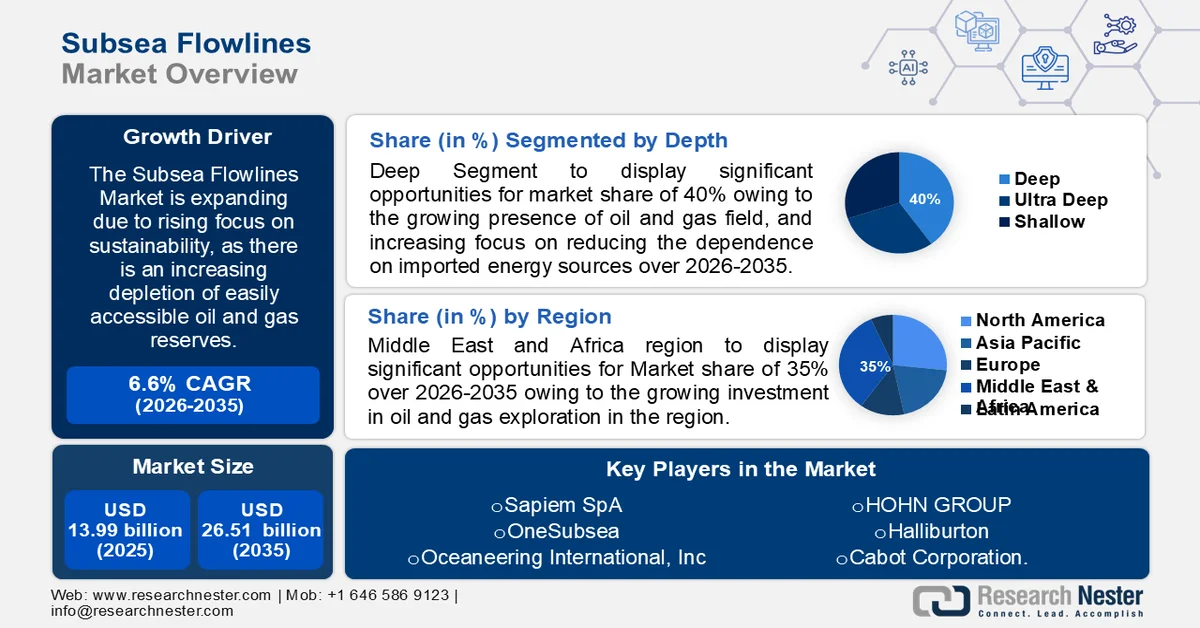
Subsea Flowlines Market size was valued at USD 13.99 billion in 2025 and is expected to reach USD 26.51 billion by 2035, expanding at around 6.6% CAGR during the forecast period i.e., between 2026-2035. In the year 2026, the industry size of subsea flowlines is evaluated at USD 14.82 billion.
The growth of the market has been driven by rising demand for oil and gas, supported by increased exploration and production activities at deep and shallow water depths. For example, in 2020, oil and gas producers in Alaska increased significantly the volume of proved natural gas reserves according to a report published in January 2022. In 2020, the proven natural gas reserves in Alaska increased by 27 trillion cu m, quadrupling the state total from 9 TCF to 36TCF.
The latest trend in the subsea flowlines market is an increase in the automation of oil and gas operations. Digital technologies, which can help energy producers compete better in global markets, are playing an increasing role in the exploration of oil and gas reserves. Improvements in drilling efficiency have already been achieved, such as multi-well pad drilling and improved design of wells and pipelines. In order to extract more oil and gas in a shorter period of time, producers are using fewer drilling rigs, thus reducing costs.
Key Subsea Flowlines Market Insights Summary:
Regional Highlights:
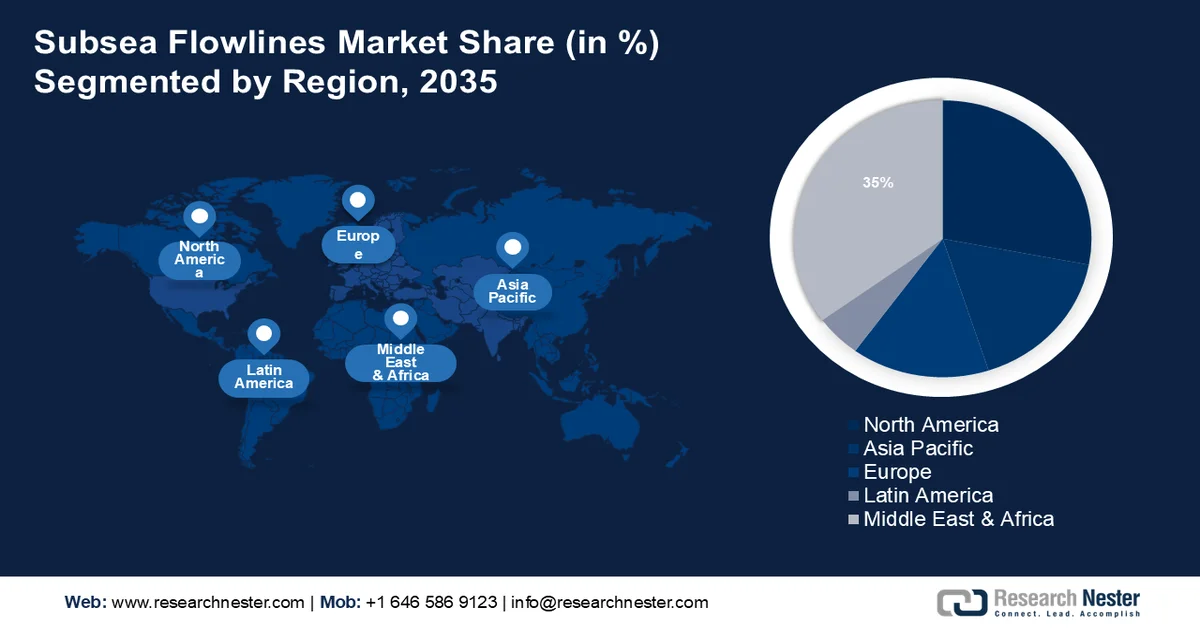
- Middle East and Africa is expected to capture the largest revenue share of 35% by 2035, owing to substantial investments in oil and gas exploration.
- North America is projected to hold a 28% share in the subsea flowlines market during 2026–2035, impelled by technical innovations in drilling and subsea engineering.
Segment Insights:
- Based on depth, the deep segment is projected to account for a 40% share by 2035, owing to the presence of oil and gas fields and increasing fuel production.
- In terms of product type, the flowline segment in the subsea flowlines market is expected to hold a 50% share by 2035, propelled by rising demand for oil and gas exploration applications.
Key Growth Trends:
- Growing focus on sustainability
- Advancement in subsea production system
Major Challenges:
- Cost limitations
- Supply chain issues are expected to hinder the market growth in the near future.
Key Players: Microsoft Azure, Amazon Web Series, Alibaba Cloud, Google Cloud Platform, Oracle Cloud Infrastructure, IBM Cloud, Dell Technology, Huawei Technologies, VMware, Cisco Systems, OVHcloud, HCL Technologies Limited, and Datadog, Inc.
Global Subsea Flowlines Market Forecast and Regional Outlook:
Market Size & Growth Projections:
- 2025 Market Size: USD 13.99 billion
- 2026 Market Size: USD 14.82 billion
- Projected Market Size: USD 26.51 billion by 2035
- Growth Forecasts: 6.6% CAGR (2026-2035)
Key Regional Dynamics:
- Largest Region: Middle East and Africa (35% Share by 2035)
- Fastest Growing Region: Middle East & Africa
- Dominating Countries: United States, Norway, United Kingdom, China, Brazil
- Emerging Countries: United States, Saudi Arabia, United Arab Emirates, Norway, China
Last updated on : 25 February, 2026
Subsea Flowlines Market - Growth Drivers and Challenges
Growth Drivers
- Growing focus on sustainability - In line with the depletion of easily accessible oil and gas reserves, the cost-effective development of small satellite fields, using existing infrastructure to minimize the need for new installations, is aligned with the depletion of easily accessible oil and gas reserves. The paradigm is shifting toward exploration and extraction of hydrocarbons The landscape of the subsea flowlines industry is being transformed by deep water and deep-water fields. The business dynamics will be influenced by the adoption of standardized components, modular designs, and developments in installation and maintenance procedures. In addition, the outlook for the subsea flowline industry is expected to be positively influenced by an increased focus on sustainability and environmental responsibility, including the development of eco-friendly paints, the adoption of energy-efficient designs, and the integration of renewable energy sources.
- Advancement in subsea production system - The market is expected to be driven by rapid developments in subsea production systems. There are various categories or types in each segment of the Subsea Flowline System. In order to avoid the need to install a riser externally, umbilicals are now available in combination with risers.
Challenges
-
Cost limitations - The oil and gas industry has been volatile and capital expenditure for subsea projects can be high. Looking for cost-effective solutions for flowline production and installation is significant.
- Supply chain issues are expected to hinder the market growth in the near future.
- Deepwater exploration is another significant factor hindering the growth of the market in future times.
Subsea Flowlines Market Size and Forecast:
| Report Attribute | Details |
|---|---|
|
Base Year |
2025 |
|
Forecast Year |
2026-2035 |
|
CAGR |
6.6% |
|
Base Year Market Size (2025) |
USD 13.99 billion |
|
Forecast Year Market Size (2035) |
USD 26.51 billion |
|
Regional Scope |
|
Subsea Flowlines Market Segmentation:
Depth Segment Analysis
Based on depth, the deep segment is set to hold the highest share of 40% by the end of 2035. The presence of oil and gas fields, as well as the production of fuels, is driving the segment growth during the studied period. The positive outlook for the industry will be significantly enhanced by increasing investments in deep and ultra-deep oil fields, as well as by increasing emphasis on the production of petrochemical products to meet rising demand. In addition, the shift in focus towards reducing dependence on imported energy sources and a surge of investment in deep offshore oil fields complement an improving outlook for the sector.
Product Type Segment Analysis
In terms of product type, the flowline segment is predicted to hold the largest subsea flowlines market share of 50% during the projected timeframe. This can be attributed to the increasing demand for oil and gas exploration applications. Flowlines are used to move fluids from or into the host and can be classified as submarine pipelines. They are used to transport the production of oil and gas, and petroleum from offshore.
Basically, a floating production unit on the seabed is part of subsea production systems which can help operators to obtain a good return from oil extraction and other activities. Russia is estimated to have the largest new construction capital expenditure of approximately USD 78.8 billion for the period from 2018 to 2022, according to an Oilfield Technology report published in October 2018. It is expected to commence operations in November 2022, covering a planned length of 6,000 km.
Our in-depth analysis of the global market includes the following segments:
|
Depth |
|
|
Product Type |
|

Vishnu Nair
Head - Global Business DevelopmentCustomize this report to your requirements — connect with our consultant for personalized insights and options.
Subsea Flowlines Market - Regional Analysis
Middle East and Africa Market Insights
Middle East and Africa industry is likely to account for largest revenue share of 35% by 2035, due to rising substantial investments in oil and gas exploration in the region. Increasing investments in the exploration of newly discovered oil reserves, oilfield services, and a favorable outlook for unconventional resource development are driving the market growth in the region. For example, in May 2022, ADNOC announced three important discoveries at Bu Hasa, Abu Dhabi's largest inland oil field with a capacity to produce 650,000 barrels of crude per day. From an exploratory well in the field, the discovery at Bu Hasa contains 500 million barrels of oil.
North American Market Insights
The subsea flowlines market in the North America region is predicted to hold a share of 28 % during the forecast period 2026-2035. The demand for subsea flowline systems in the region is further driven by technical innovation in drilling and subsea engineering, which allow effective extraction of hydrocarbons from challenging underwater environments. In order to ensure safety and compliance, the adoption of advanced subsea technology is necessary because of stringent regulatory frameworks and environmental standards that contribute to regional industry development.
Subsea Flowlines Market Players:
- Aker Solutions
- Company Overview
- Business Strategy
- Key Product Offerings
- Financial Performance
- Key Performance Indicators
- Risk Analysis
- Recent Development
- Regional Presence
- SWOT Analysis
- Allseas
- ArcelorMittal Energy Projects
- Baker Hughes Company
- Cabot Corporation
- Halliburton
- DrilQuip, Inc.,
- HOHN GROUP.
- Oceaneering International, Inc.
- OneSubsea
- Sapiem SpA
Recent Developments
- Saipem SpA, In September 2023 has been signed with Eni Céte d'Ivoire and Petroci, its partner for the provision of subsea umbilicals, flowlines and risers to support the Baleine Phase 2 project development offshore Cte d Ivoire at an ocean depth of 1,200 meters. The overall scope of works covers the engineering, procurement, construction and installation activities for approximately 20 km of rigid cables, 10 km of flexi risers & jumpers as well as 15 km of umbilicals attached to a dedicated float unit. It is planned that the installation will be carried out using Saipem construction vessels and will be completed in 2024.
- DrilQuip, Inc., collaboration with global control technology company Proserv, successfully installed two 15,000psi horizontal bore trees in the Woodside Shenzi North oil and gas field in the Gulf of Mexico. 15,000psi Horizontal Bourne Tree, developed by DrilQuip, is the most recent and flexible design of subsea production systems that offers flexibility in order to accommodate a variety of completion configurations.
- Report ID: 6009
- Published Date: Feb 25, 2026
- Report Format: PDF, PPT
- Explore a preview of key market trends and insights
- Review sample data tables and segment breakdowns
- Experience the quality of our visual data representations
- Evaluate our report structure and research methodology
- Get a glimpse of competitive landscape analysis
- Understand how regional forecasts are presented
- Assess the depth of company profiling and benchmarking
- Preview how actionable insights can support your strategy
Explore real data and analysis
Frequently Asked Questions (FAQ)
About this Report
Connect with our Expert


Report, 2026-2035



Copyright @ 2026 Research Nester. All Rights Reserved.
