Steam Autoclaves Market Outlook:
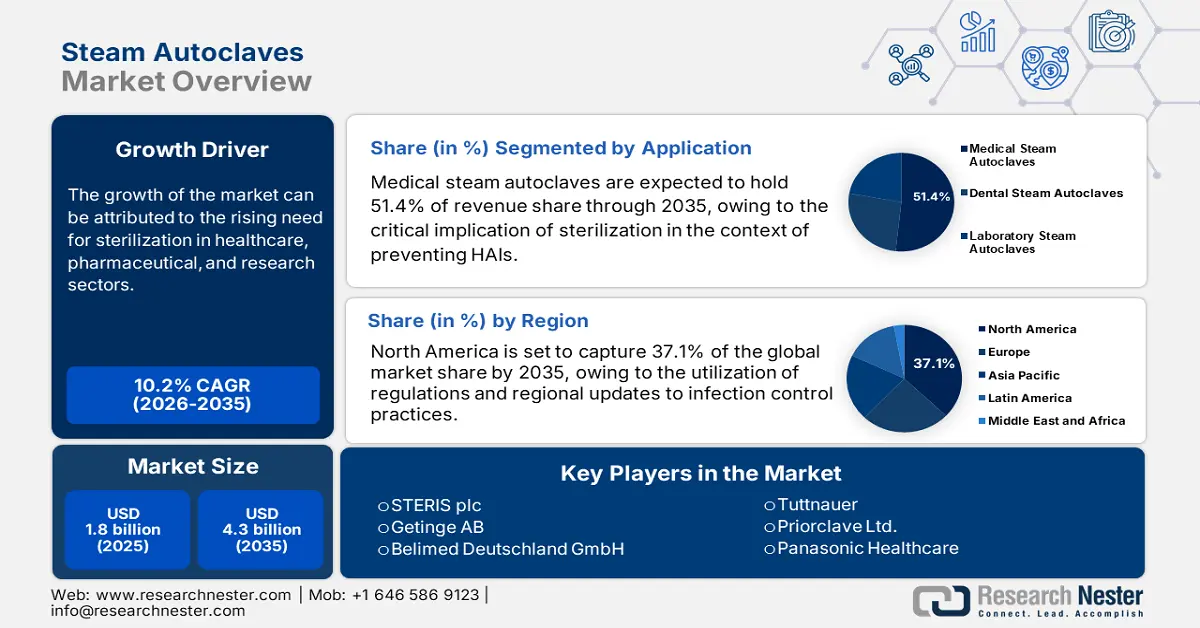
Steam Autoclaves Market size was valued at USD 1.8 billion in 2025 and is projected to reach USD 4.3 billion by the end of 2035, rising at a CAGR of 10.2% during the forecast period, i.e., 2026-2035. In 2026, the industry size of steam autoclaves is evaluated at USD 1.9 billion.
The steam autoclaves market is growing explosively on account of the increasing demand for contamination control solutions across healthcare, pharmaceutical, and food processing industries. As a result, the necessity of sterilization and ensuring product safety became a critical growth factor in this sector. Particularly, the increasing cases and severity of healthcare-associated infections (HAIs) are pushing medical systems to adopt more of these devices. In this regard, the World Health Organization (WHO) revealed that, till 2023, approximately 136 million incidence of antibiotic-resistant HAIs were being recorded worldwide every year. Another 2022 report from the WHO established that 70% of the acquired infections can be prevented through good hygiene practices, where steam autoclaves are a crucial asset.
The payers’ pricing standards and trends in the steam autoclaves market are increasingly being shaped by cost-containment pressures, reimbursement policies, and the total cost of ownership considerations. As government health systems, insurance providers, and large institutional buyers prioritize transparency in equipment pricing, tighter margins, and stricter evaluation of lifecycle costs, manufacturers in this sector are pushed to develop greater value-based models to cope with the evolving financial dynamics. Based on this, in 2022, a comparative cost analysis of single-use sterile (SK) versus reprocessed distal radius volar plate sets (RS) was published by the NLM, which underscored that the average cost of sterilization for each surgery stood at USD 39.0 for RS, which was more cost-effective than SK.