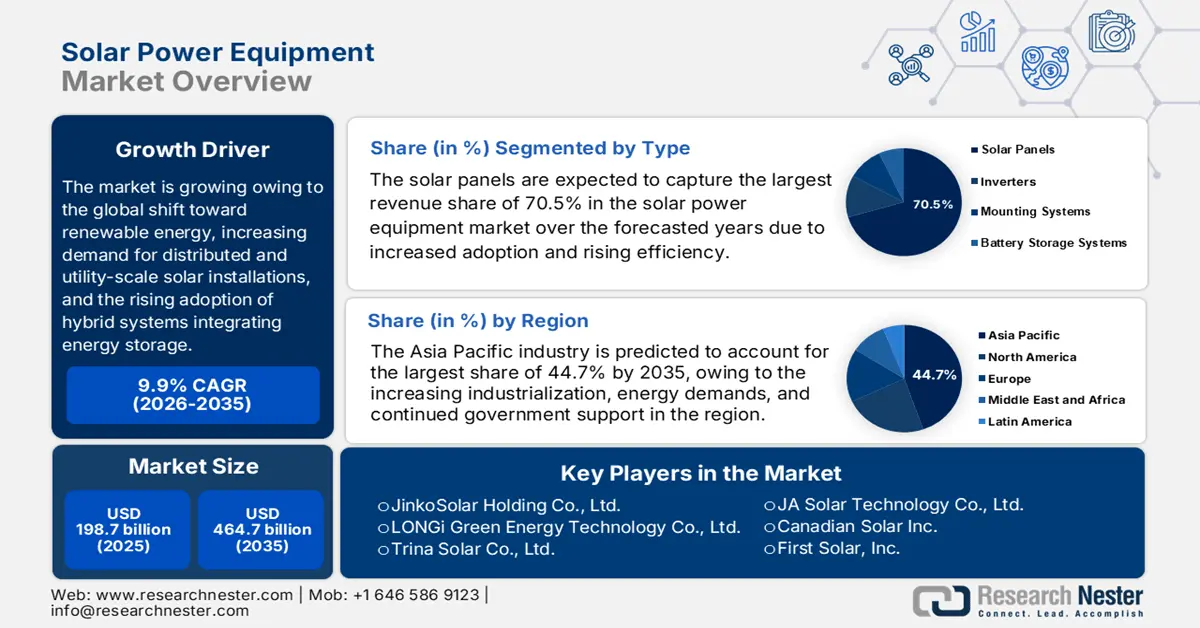
Solar Power Equipment Market Outlook:
Solar Power Equipment Market size was valued at USD 198.7 billion in 2025 and is projected to reach USD 464.7 billion by the end of 2035, rising at a CAGR of 9.9% during the forecast period, i.e., 2026-2035. In 2026, the industry size of solar power equipment is evaluated at USD 218.3 billion.
The international solar power equipment market is poised for extensive growth in the years ahead, owing to the global shift toward renewable energy, increasing demand for distributed and utility-scale solar installations, and the rising adoption of hybrid systems integrating energy storage. In this regard, the U.S. Department of Energy in September 2024 disclosed that its loan programs office is actively supporting domestic solar PV manufacturing, wherein around 50 GWdc of annual solar manufacturing capacity has been announced under the Inflation Reduction Act, with more than 35 operational factories producing modules, inverters, trackers, and balance-of-system components. The report also mentioned that domestic PV module capacity is expected to reach 40 GW by 2026, by supplying up to 80% of projected demand. Simultaneously, the projects, such as Qcells’ USD 1.45 billion Cartersville facility, will produce ingots, wafers, cells, and panels, reshoring production from China and Southeast Asia, hence enhancing supply chain resiliency and supporting both distributed and utility-scale projects across the U.S.
Furthermore, the U.S. solar power equipment market benefits from technological advancements, federal and state incentives, and increasing demand for utility- and residential-scale solar systems. Testifying to this, Congress.gov in November 2024 reported that over the last decade, the U.S. solar photovoltaics sector has rapidly expanded, in which the domestic manufacturing capacity for key PV components such as polysilicon, wafers, cells, and modules has increased substantially, though imports remain essential to meet overall demand. It also stated that federal incentives such as the Inflation Reduction Act and trade policies have spurred investments in domestic production, thereby enhancing supply chain resilience and workforce development. In addition to continued policy support and growing utility-scale, residential, and commercial installations, the solar power equipment market is poised for sustained growth.
U.S. Solar Photovoltaic Manufacturing Capacity: 2023-2024 and Planned Additions by Stage (GWDC)
|
Stage |
2023 |
2024 |
Planned Additions (GW) |
|
Silicon/Polysilicon (GWDC) |
1.3 |
34.5 |
8.0 |
|
Ingots (GWDC) |
n/a |
n/a |
5.0 |
|
Wafers (GWDC) |
0 |
n/a |
16.0 |
|
Cells (GWDC) |
0 |
n/a |
33.2 |
|
Modules (GWDC) |
2.7 |
33.9 |
19.5 |
Source: Congress.gov