Solar EPC Market Outlook:
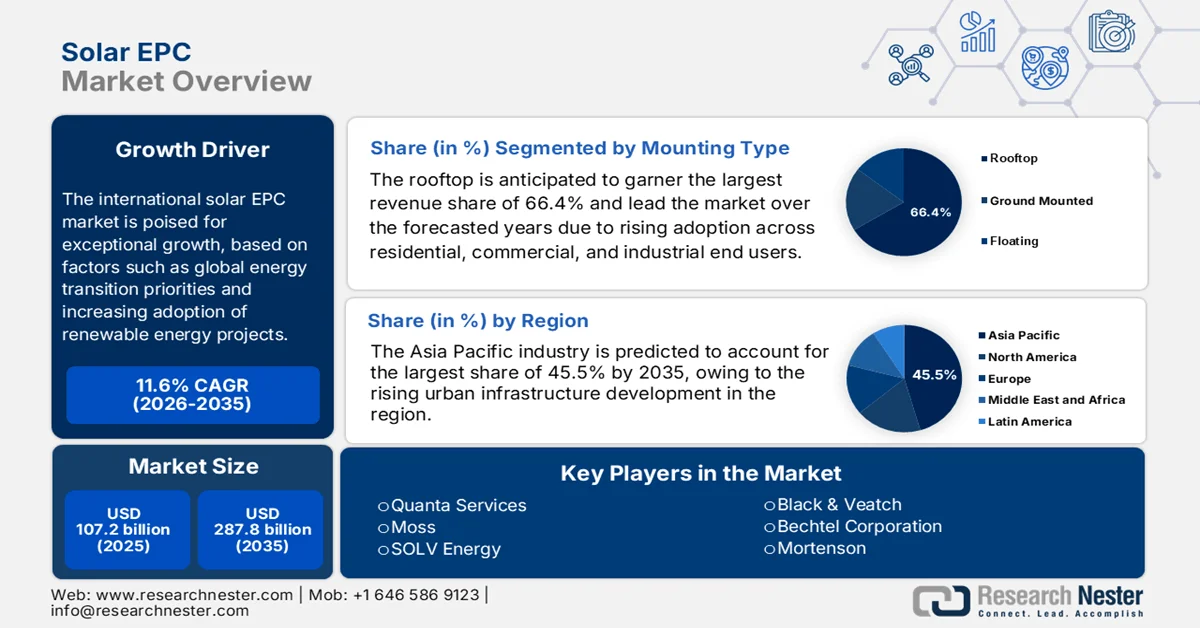
Solar EPC Market size was valued at USD 107.2 billion in 2025 and is projected to reach USD 287.8 billion by the end of 2035, rising at a CAGR of 11.6% during the forecast period, i.e., 2026-2035. In 2026, the industry size of solar EPC is estimated at USD 119.6 billion.
The global solar Engineering, Procurement, and Construction (EPC) industry is poised for exceptional growth, based on factors such as global energy transition priorities and increasing adoption of renewable energy projects. Governments across major economies are introducing supportive policies, incentives, and regulatory frameworks that accelerate project approvals and the deployment of large-scale solar installations. Based on the government data from the U.S., which was published in April 2024, the Biden-Harris Administration, through the EPA, announced a total amount of USD 7 billion in solar grants to deliver residential solar to over 900,000 low-income and disadvantaged households across the nation. It was funded by the Inflation Reduction Act and President Biden’s Investing in America agenda, thereby increasing the growth potential of the solar EPC market.
Furthermore, the solar EPC market hosts a dynamic and evolving supply chain, which is an integration of technology providers, module manufacturers, and construction service firms to ensure proper project deliveries. Besides rising solar PV capacity, investment, and policy support, it directly boosts demand for EPC contractors to design, build, and install utility-scale and distributed solar projects. As of the February 2025 report from the IEA, the solar PV generation reached 1,600 TWh in 2023, which is up by 25%, and is continuing on track with 2030 net zero emissions scenarios. In addition, this capacity is expected to more than double between 2025 and 2030, highly attributable to low costs, faster permitting, strong policy support, and private sector adoption, especially in China, the U.S., Europe, and India. The global solar PV investment surpassed USD 480 billion in 2023, which was efficiently supported by technological innovation, distributed systems, and international collaboration.