Secure Digital Card Market Outlook:
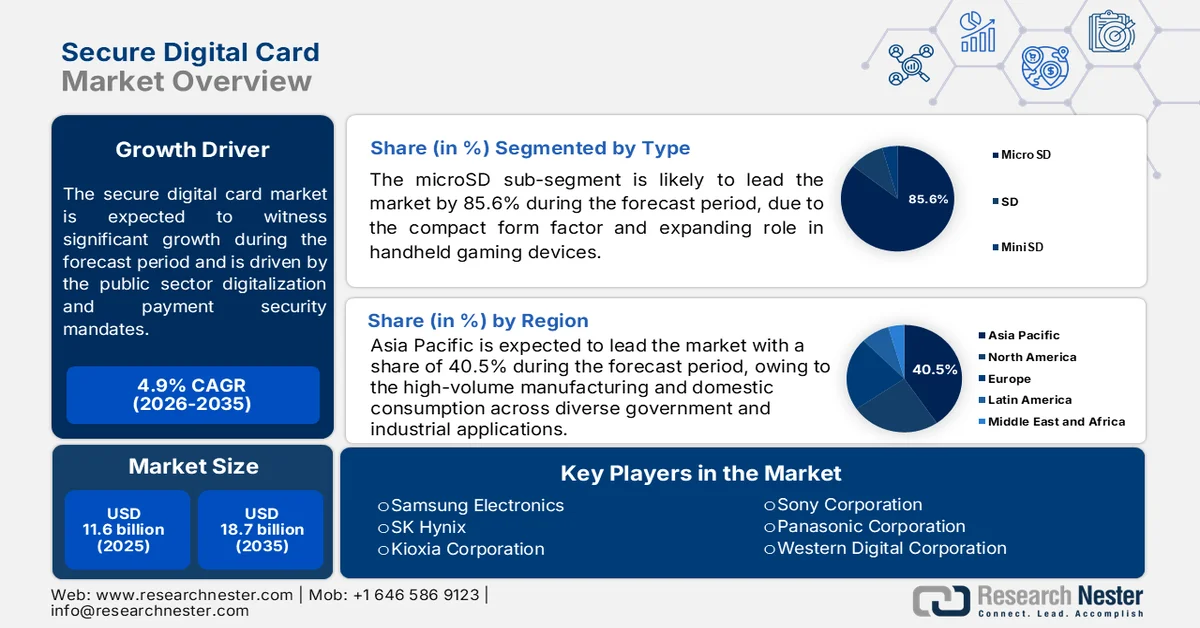
Secure Digital Card Market size was valued at USD 11.6 billion in 2025 and is projected to reach USD 18.7 billion by 2035, rising at a CAGR of 4.9% during the forecast period, i.e., 2026-2035. In 2026, the industry size of secure digital card is evaluated at USD 12.1 billion.
Public-sector digitization programs and payment security mandates are increasing enterprise demand for secure digital card platforms across various sectors. The World Bank's February 2023 data reported that more than 850 million people globally obtained official identification via digital ID programs over the last decade, creating a broader infrastructure base for the digital credentialing and secure card-based authentication in financial and citizen service ecosystems. In the U.S., the Federal Trade Commission's March 2025 data recorded consumer fraud losses exceeding USD 12.5 billion, up significantly from prior years, with identity theft and unauthorized transactions remaining major concerns for financial institutions and service providers. This operating environment is pushing the issuers and enterprises toward tokenized card issuance, biometric verification, mobile credentialing, and encrypted digital access systems to reduce fraud exposure and improve compliance readiness. Government-backed cybersecurity initiatives are also supporting deployment.
The U.S. Cybersecurity and Infrastructure Security Agency continues to promote phishing-resistant multifactor authentication and credential security frameworks across public and private infrastructure, accelerating investment in secure authentication-linked digital cards for workforce access, payments, and citizen identity programs. According to the ITA 2023 data, global mobile internet users surpassed 5.4 billion, representing nearly 67% of the world’s population, strengthening the addressable base for mobile-linked secure card services. At the institutional level, healthcare systems, transit authorities, and educational organizations are increasingly integrating secure digital cards into centralized identity management and access control frameworks to streamline authentication while meeting data protection requirements.
Key Secure Digital Card Market Insights Summary:
Regional Highlights:
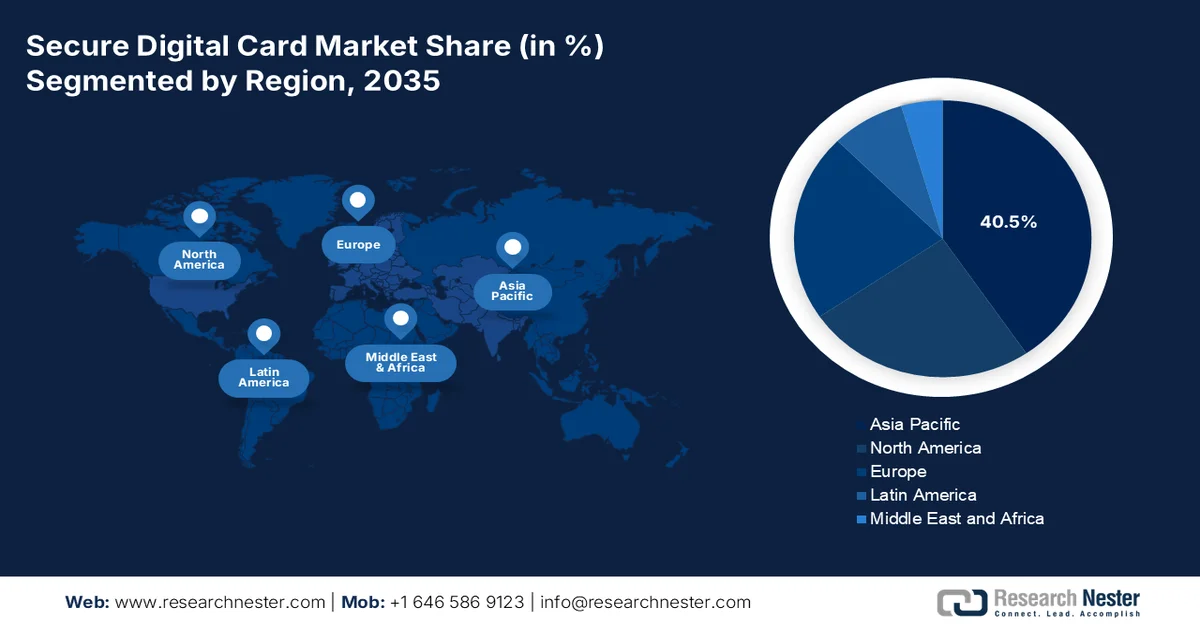
- In the secure digital card market, Asia Pacific is projected to capture 40.5% of the regional revenue share by 2035, bolstered by its concentration of NAND flash manufacturing facilities and extensive deployment across government, industrial, and public-sector applications
- North America is anticipated to witness the fastest growth during 2026-2035, fueled by rising demand from defense, public safety, healthcare, and transportation infrastructure sectors requiring high-endurance and secure storage solutions
Segment Insights:
- In the secure digital card market, the microSD segment is anticipated to command 85.6% of the market share by 2035, reinforced by its compact form factor and widening adoption in handheld gaming devices
- By 2035, the consumer electronics segment is expected to retain the largest share of the market, supported by growing demand from smartphones, digital cameras, drones, and gaming handhelds requiring expandable storage for media-rich content
Key Growth Trends:
- Expansion of national digital identity programs
- Rising government cybersecurity expenditure
Major Challenges:
- Rapid technological obsolescence
- Intellectual property and licensing barriers
Key Players: Samsung Electronics, SK Hynix, Kioxia Corporation, Sony Corporation, Panasonic Corporation, Western Digital Corporation, Micron Technology, Transcend Information, Kingston Technology, Phison Electronics, Silicon Power, Greenliant Systems, Delkin Devices, Swissbit, ATP Electronics, Shenzhen Longsys Electronics, Biwin Storage Technology, Matica Fintec, CLEAR, Euronet.
Global Secure Digital Card Market Forecast and Regional Outlook:
Market Size & Growth Projections:
- 2025 Market Size: USD 11.6 billion
- 2026 Market Size: USD 12.1 billion
- Projected Market Size: USD 18.7 billion by 2035
- Growth Forecasts: 4.9%% CAGR (2026-2035)
Key Regional Dynamics:
- Largest Region: Asia Pacific (40.5% Share by 2035)
- Fastest Growing Region: North America
- Dominating Countries: China, Japan, United States, South Korea, Germany
- Emerging Countries: India, Indonesia, Vietnam, Malaysia, Thailand
Last updated on : 3 June, 2026
Secure Digital Card Market - Growth Drivers and Challenges
Growth Drivers
- Expansion of national digital identity programs: Governments are increasing funding for secure citizen authentication systems, directly supporting demand for secure digital cards in banking, healthcare, transportation, and public administration. The European Commission's March 2025 data indicated that it has allocated more than USD 1.49 billion under the Digital Europe Programme for the cybersecurity, digital identity, and digital public infrastructure initiatives. Secure digital card platforms are integrated into these frameworks to support authenticated access to the public services and cross-border identification. Enterprises supplying tokenized credentials, secure issuance platforms, and the encryption infrastructure are benefiting from the long-term procurement opportunities linked to national identity modernization programs. Vendors with interoperability capabilities and compliance with government authentication standards are positioned to gain institutional contracts across financial services and public administration ecosystems.
- Rising government cybersecurity expenditure: Public sector cybersecurity budgets are increasing as governments attempt to reduce credential theft, payment fraud, and infrastructure breaches. The White House 2025 data the U.S. government approved the budget proposal, which included USD 13 billion for civilian cybersecurity investments, covering identity protection, zero trust architecture, and secure access management. These investments create downstream demand for secure digital cards used in workforce authentication facility access and digitally verified transactions. Enterprises are therefore prioritizing digital cards with embedded encryption, biometric support, and dynamic authentication capabilities. Suppliers capable of aligning with zero-trust frameworks and the public sector procurement requirements are expected to benefit from multi-year modernization contracts tied to national cybersecurity resilience initiatives.
Challenges
- Rapid technological obsolescence: Speed class standards, bus interfaces, and form factors evolve quickly, often every two to three years. A manufacturer developing a new SD card may find its product obsolete before it reaches volume production as the industry moves from UHS-I to UHS-II to SD Express. New entrants lack the R&D resources to simultaneously support multiple generations of technology. Additionally, controller chips must be redesigned for each new standard, requiring specialized engineering talent.
- Intellectual property and licensing barriers: Manufacturing and selling secure digital cards requires navigating a complex web of patents, trademarks, and licensing agreements. Key technologies, including the exFAT file system, SD bus architecture, and controller communication protocols, are protected by intellectual property held by the SD Association, Microsoft, and various semiconductor firms. New entrants must pay royalty fees for each card shipped, which reduces already-thin margins.
Secure Digital Card Market Size and Forecast:
| Report Attribute | Details |
|---|---|
|
Base Year |
2025 |
|
Forecast Year |
2026-2035 |
|
CAGR |
4.9% |
|
Base Year Market Size (2025) |
USD 11.6 billion |
|
Forecast Year Market Size (2035) |
USD 18.7 billion |
|
Regional Scope |
|
Secure Digital Card Market Segmentation:
Type Segment Analysis
Under the type segment, the microSD sub-segment is dominating within the secure digital card market and is poised to hold the share value of 85.6% by the end of 2035. The segment is driven by its compact form factor and expanding role in handheld gaming devices. SanDisk’s in September 2025 announced an exclusive microSD memory card officially licensed for the ASUS ROG Ally X and ROG Ally, exemplifying this trend. These microSD cards are optimized for high-speed game loading and extended storage on Windows handhelds, addressing the limited internal SSD capacity of such devices. As portable gaming consoles increasingly rely on expandable storage, microSDXC cards that often leverage UHS-I and UHS-II interfaces become critical for user experience.
Application Segment Analysis
Within the application segment, consumer electronics hold the largest share in the market, driven by smartphones, digital cameras, drones, and gaming handhelds requiring expandable storage for media-rich content. As device manufacturers continue to offer hybrid SIM slots and SD card support in mid-range devices, the reliance on removable storage remains robust. According to the USITC 2021 data, the U.S. electronics export reached USD 572,004 million, incorporating removable flash memory slots such as action cameras and portable gaming devices, increased by 10.3% from past year. This trend solidifies consumer electronics as the primary revenue generator for SD cards.
End user Segment Analysis
The end user segment is led by professional content creators, including photographers, videographers, and live streamers. This sub-segment commands the largest revenue share in the market because these users require high-capacity, high-speed SD cards to reliably capture RAW photo bursts and lengthy real-time broadcasts. Unlike general consumers who may rely on cloud storage or internal device memory, professionals demand frequent card swaps, extreme write endurance, and fast data offload speeds to meet production deadlines. The rise of freelance media production, YouTube content creation, and independent filmmaking has expanded this user base significantly.
Our in-depth analysis of the secure digital card includes the following segments:
|
Segment |
Subsegments |
|
Type |
|
|
Application |
|
|
End user |
|
|
Distribution Chanel |
|
|
Speed Class |
|
|
Capacity Range |
|

Vishnu Nair
Head - Global Business DevelopmentCustomize this report to your requirements — connect with our consultant for personalized insights and options.
Secure Digital Card Market - Regional Analysis
APAC Market Insights
The Asia Pacific is dominating the secure digital card market and is expected to hold the regional revenue share of 40.5% by the end of 2035. The market is characterized by a dual structure: high-volume manufacturing and domestic consumption across diverse government and industrial applications. Countries such as Japan, South Korea, and China house the world's primary NAND flash fabrication facilities and SD card assembly operations, making the region the global supply hub. Government demand stems from public safety body-worn cameras, smart city surveillance networks, and transportation tolling systems requiring removable storage. India and Indonesia deploy SD card based diagnostic devices in rural healthcare programs where internet connectivity is unreliable. Australia and Malaysia utilize SD cards for environmental monitoring stations and defense data loggers. Suppliers benefit from shorter supply chains but face intense pricing pressure from local manufacturers.
Strong digital payment growth, government-backed electronics manufacturing, and rising demand for secure portable storage across consumer and enterprise applications are shaping the market in India. According to the Invest India May 2023 data, the digital payment transactions in India surpassed 10 trillion, reflecting continued growth in digitally connected financial ecosystems that require secure data storage and authentication support. Additionally, the electronics production rise has been supported by production-linked incentive programs and domestic semiconductor initiatives. Increasing smartphone penetration, connected automotive systems, and industrial digitization are prompting the wider adoption of secure microSD and SD storage technologies across banking, surveillance, healthcare, and mobility applications.
The Japan secure digital card market is expected to grow from USD 1.28 billion in 2025 to USD 1.72 billion by the end of 2035 at a CAGR of 3.3%. The market is projected to reach USD 1.29 billion in 2026. The region is growing steadily due to expanding semiconductor investments and rising adoption of connected consumer electronics. According to Divadeo 2025, the country allocated more than USD 26.3 billion in semiconductor and digital industry support measures to strengthen domestic electronics manufacturing and supply chain resilience. Increased deployment of high-performance digital devices is continuing to drive demand for reliable SD and microSD storage solutions.
North America Market Insights
The North America is projected to emerge rapidly during the assessed period, 2026 to 2035, in the market. The market is driven by the demand from the defense, public safety, healthcare, and transportation infrastructure sectors. Government agencies at federal, state, and provincial levels procure industrial-grade SD cards for body-worn cameras, drone surveillance payloads, portable medical imaging devices, and roadside traffic monitoring systems. Unlike consumer markets driven by capacity and price, the North America public sector prioritizes write endurance, temperature tolerance, physical write protect switches, and FIPS-validated encryption. The market also sees steady replacement cycles for evidence storage cards in law enforcement and data logging cards in utility grid monitoring equipment.
The increasing digital payment adoption, cybersecurity investments, and connected device growth across enterprise and public sector environments are driving the secure digital card market in the U.S. According to the Federal Reserve's November 2024 data, U.S. consumers made 84% growth in noncash payments with cards, highlighting continued reliance on the secure digital payment infrastructure. Additionally, the Federal Communications Commission (FCC) reported in 2024 that fixed broadband service reached over 95% of the U.S. population, strengthening access to cloud-connected digital credentials and storage ecosystems. Growth is further supported by enterprise demand for encrypted removable storage in defense, healthcare, automotive, and industrial applications, where secure data portability and authenticated access remain operational priorities.
Federal digital infrastructure investments, rising cybersecurity requirements, and expanding connected device usage across commercial sectors are driving the market in Canada. The Government of Canada reported in December 2023 that over 93.5% of households had access to high-speed internet services, strengthening the ecosystem for secure digital authentication and portable encrypted storage applications. Additionally, the Canadian Centre for Cyber Security stated that cybercrime reports affecting businesses and public institutions continued to increase, prompting greater enterprise investment in secure data handling and credential protection technologies. Demand is particularly rising in healthcare, automotive systems, industrial automation, and public administration, where organizations require secure removable data storage solutions that support compliance, operational continuity, and protected information exchange.
Europe Market Insights
The public safety mandates transportation infrastructure and environmental monitoring programs across member states, which is driving the secure digital card market in Europe. National governments procure industrial-grade SD cards for police body-worn cameras, border surveillance systems, and railway event data recorders. The European Commission's push for interoperable evidence storage has increased demand for tamper-evident SD cards with physical write-protect switches. Nordic countries deploy SD card-based weather stations and wildlife cameras in remote Arctic regions requiring extended temperature tolerance. Germany and France lead in automotive data logging for fleet management and tolling systems. Suppliers must navigate multiple national procurement frameworks and meet CE certification standards. The market also sees steady replacement cycles for public sector surveillance and medical imaging devices across the United Kingdom and continental Europe.
The secure digital card market in Germany is benefiting from the country’s strong ICT and enterprise technology ecosystem. Germany remains one of the world’s largest ICT markets. As per the ITA August 2025 data, nearly 100,000 IT companies are employing around 1.189 million people, creating sustained demand for secure data storage and portable memory solutions across industrial and commercial applications. In 2024, the Germany ICT market generated approximately USD 240.9 billion in turnover and is projected to reach nearly USD 252 billion in 2025, reflecting continued expansion in digital infrastructure and enterprise computing. Growing adoption of cloud systems, AI-enabled devices, industrial automation, and connected automotive technologies is increasing demand for high-capacity and high-speed secure SD and microSD solutions across Germany.
The UK secure digital card market is growing steadily due to increasing digital infrastructure investments and rising enterprise cybersecurity requirements. According to the UK Department for Science, Innovation and Technology, the government committed GBP 2.5 billion to support the National Semiconductor Strategy and the advanced digital technologies ecosystem. Additionally, the Ofcom 2022 data reported that approximately 94% of people used the internet daily increasing demand for secure portable storage across connected devices and enterprise systems. Expanding adoption of digital healthcare, financial technologies, surveillance systems, and automotive electronics is continuing to strengthen demand for secure SD and microSD storage solutions in the country.
Key Secure Digital Card Market Players:
- Samsung Electronics (South Korea)
- SK Hynix (South Korea)
- Kioxia Corporation (Japan)
- Sony Corporation (Japan)
- Panasonic Corporation (Japan)
- Western Digital Corporation (U.S.)
- Micron Technology (U.S.)
- Transcend Information (Taiwan)
- Kingston Technology (U.S.)
- Phison Electronics (Taiwan)
- Silicon Power (Taiwan)
- Greenliant Systems (U.S.)
- Delkin Devices (U.S.)
- Swissbit (Switzerland)
- ATP Electronics (Taiwan)
- Shenzhen Longsys Electronics (China)
- Biwin Storage Technology (China)
- Matica Fintec (Germany)
- CLEAR (U.S.)
- Euronet (U.S.)
- Company Overview
- Business Strategy
- Key Product Offerings
- Financial Performance
- Key Performance Indicators
- Risk Analysis
- Recent Development
- Regional Presence
- SWOT Analysis
- Samsung Electronics is a dominant player in the secure digital card market, leveraging its vertically integrated semiconductor manufacturing to produce high-performance SD cards, including the PRO Plus and EVO Plus series. The company has driven market advancements by introducing cards with read speeds catering to professionals in photography, gaming, and mobile devices.
- SK Hynix plays a crucial role in the market primarily as a supplier of NAND flash memory used in SD cards produced by other brands, though it also offers its own consumer SD card lineup. The company has strategically invested in advanced lithography to improve density and reduce power consumption in SD cards. In 2025, the company has made a net profit of USD 31.3 billion.
- Kioxia Corporation, formerly Toshiba Memory, is a pioneer in the market, having co-invented NAND flash memory and SD card technology. The company manufactures a wide range of SD cards from standard UHS I to high-end UHS-II and SD Express models targeting professional imaging and embedded applications. The company has made revenue of USD 11.8 billion
- Sony Corporation holds a unique position in the market, offering premium SD cards known for ultra-fast write speeds optimized for its own Alpha mirrorless cameras and professional camcorders. The company has leveraged its expertise in the media and entertainment to drive the adoption of high-capacity SD cards.
- Panasonic Corporation is a longstanding participant in the secure digital card market, offering SD cards renowned for durability, including industrial-grade models with wide temperature ranges and shock resistance. The company’s strategic focus lies in the niche segments such as automotive dashcams, medical devices, and public safety equipment, where data integrity is critical.
Here is a list of key players operating in the global market:
The global secure digital card market is highly consolidated and dominated by Asia semiconductor and memory giants with limited manufacturing presence. Key players focus on vertical integration and diversification into high-capacity, high-speed cards for professional imaging, automotive, and industrial IoT. Strategic initiatives include capacity expansion for 1TB+ cards, energy-efficient designs, and partnerships with device OEMs. For example, in September 2025, Matica Fintec announced the acquisition of Panini. Japan and South Korea firms lead in memory technology; on the other hand, Malaysia and China facilities handle high-volume assembly. Price competition remains intense, pushing laggards toward niche, ruggedized, or value-segment cards.
Corporate Landscape of the Market:
Recent Developments
- In March 2026, CLEAR announced a partnership with Samsung Electronics America to launch Samsung ID with CLEAR. The companies are providing a safe, secure, and free mobile digital ID designed to simplify users' busy lives – available directly in Samsung Wallet.
- In July 2025, Euronet announced the acquisition of CoreCard. This expansion has expanded the company’s U.S. footprint and access to global markets.
- In July 2024, Samsung Electronics announced the release of its 1-terabyte (TB) high-capacity EVO Plus and microSD cards PRO Plus. By adopting Samsung’s eighth-generation V-NAND (V8) technology, the PRO Plus and EVO Plus boast enhanced performance and high capacity.
- Report ID: 8603
- Published Date: Jun 03, 2026
- Report Format: PDF, PPT
- Explore a preview of key market trends and insights
- Review sample data tables and segment breakdowns
- Experience the quality of our visual data representations
- Evaluate our report structure and research methodology
- Get a glimpse of competitive landscape analysis
- Understand how regional forecasts are presented
- Assess the depth of company profiling and benchmarking
- Preview how actionable insights can support your strategy
Explore real data and analysis
Frequently Asked Questions (FAQ)
About this Report
Connect with our Expert


Report, 2026-2035



Copyright @ 2026 Research Nester. All Rights Reserved.
