RF GaN (Gallium Nitride) Market Outlook:
RF GaN (Gallium Nitride) Market size was over USD 2.8 billion in 2025 and is anticipated to reach USD 16.2 billion by the end of 2035, growing at around 19.4% CAGR during the forecast period, i.e., 2026-2035. In 2026, the industry size of RF GaN (Gallium Nitride) is estimated at USD 3.3 billion.
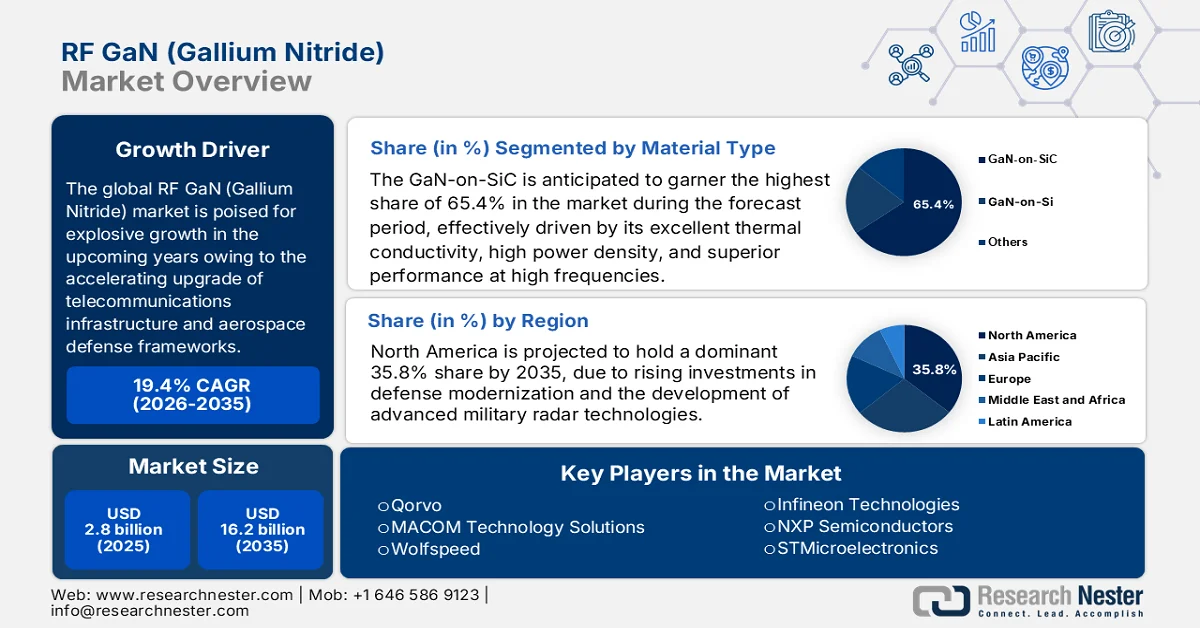
The global RF GaN (Gallium Nitride) market is positioned for solid growth, effectively fueled by the accelerating upgrade of telecommunications infrastructure and aerospace defense frameworks. The market’s supply chain aspect is influenced by a shift toward localized sourcing, which is rapidly fostering regional manufacturing hubs that protect chipmakers from unexpected global disruptions. Increased industry collaboration is standardizing larger wafer sizes, which drastically improves production yields and lowers material waste across the network. In June 2026, Legal Clarity Organization reported that China dominates global gallium production, accounting for about 750 metric tons in 2024, which is around 99% of the world’s total output of 760 metric tons. All other producing countries contribute only small amounts, whereas the U.S. produces no primary gallium and depends entirely on imports. In addition, export controls and diversification efforts are encouraging other nations to build alternative supply sources.
Global Gallium Production by Country 2024: World Supply Chain Breakdown
|
Country |
Production (metric tons) |
Approximate Share of Global Output |
|
China |
750 |
98.7% - 99% |
|
Russia |
6 |
0.8% |
|
Japan |
3 |
0.4% |
|
South Korea |
3 |
0.4% |
|
United States |
- |
- |
|
World Total |
760 |
100% |
Source: Legal Clarity Organization
Furthermore, the worldwide expansion of advanced 5G networks and pioneering 6G development increasingly depends on GaN technology to deliver higher data speeds, broader bandwidths, and superior energy efficiency. At the same time, military sectors are integrating these high-power components into next-generation radar systems, electronic warfare technology, and satellite communication networks, boosting growth in the overall RF GaN (Gallium Nitride) market. In October 2023, Ericsson announced the launch of its India 6G research program by setting up a dedicated 6G Research Team at its Chennai R&D Center, expanding its work across radio, networks, AI, and cloud technologies. The initiative is highly focused on building foundational 6G capabilities such as hybrid beamforming, low-energy networks, integrated sensing and communication, edge computing, and trustworthy AI-based autonomous systems, thus elevating the growth potential of the RF GaN (Gallium Nitride) market.
Key RF GaN (Gallium Nitride) Market Insights Summary:
Regional Highlights:
- North America is poised to capture 35.8% of the rf gaN (gallium nitride) market by 2035, reinforced by heavy investments in defense modernization and advanced military radar systems
- Asia Pacific is projected to witness the fastest expansion in the market throughout 2026-2035, bolstered by rising urbanization and government initiatives supporting semiconductor production
Segment Insights:
- The GaN-on-SiC segment is forecast to account for 65.4% of the rf gaN (gallium nitride) market by 2035, underpinned by its excellent thermal conductivity, high power density, and superior high-frequency performance
- RF power amplifiers are expected to secure a considerable share during 2026-2035, catalyzed by their widespread adoption in high-frequency, high-power applications including 5G base stations, radar systems, and satellite communications
Key Growth Trends:
- 5G infrastructure deployment
- Aerospace and defense modernization
Major Challenges:
- Technical and reliability hurdles
- Geopolitical and supply chain vulnerabilities
Key Players: Qorvo (U.S.),MACOM Technology Solutions (U.S.),Wolfspeed (U.S.),Infineon Technologies (Germany),NXP Semiconductors (Netherlands),STMicroelectronics (Switzerland),Sumitomo Electric (Japan),imec (Belgium),Ampleon (Netherlands).
Global RF GaN (Gallium Nitride) Market Forecast and Regional Outlook:
Market Size & Growth Projections:
- 2025 Market Size: USD 2.8 billion
- 2026 Market Size: USD 3.3 billion
- Projected Market Size: USD 16.2 billion by 2035
- Growth Forecasts: 19.4% CAGR (2026-2035)
Key Regional Dynamics:
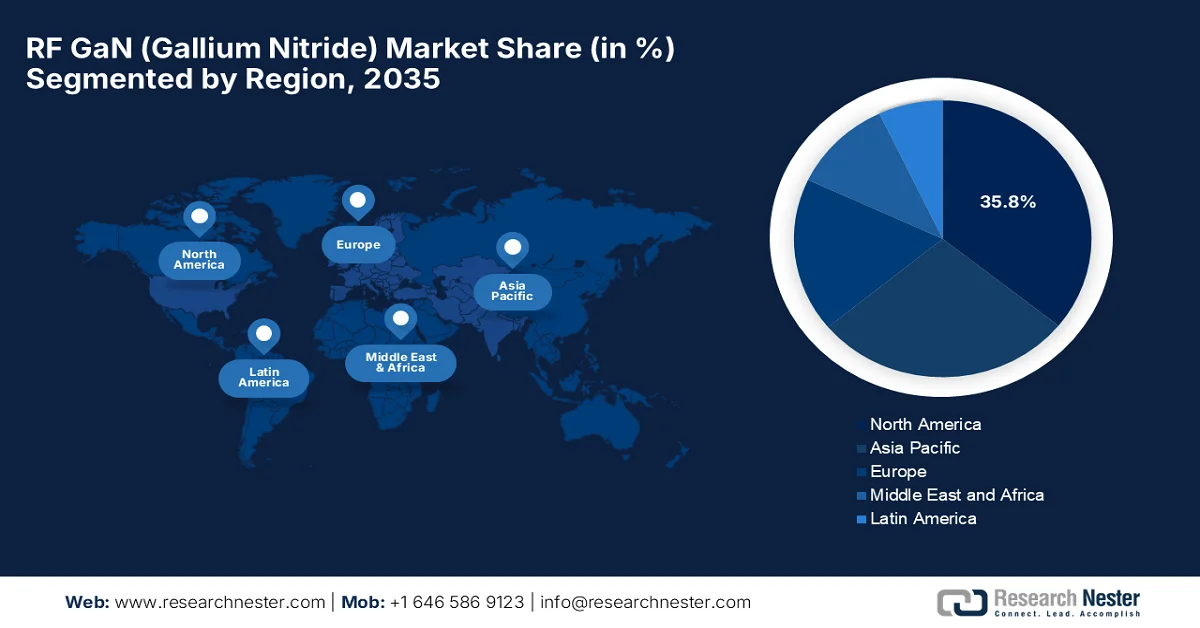
- Largest Region: North America (35.8% Share by 2035)
- Fastest Growing Region: Asia Pacific
- Dominating Countries: United States, China, Japan, South Korea, Germany
- Emerging Countries: Taiwan, India, France, United Kingdom, Netherlands
Last updated on : 1 July, 2026
RF GaN (Gallium Nitride) Market - Growth Drivers and Challenges
Growth Drivers
- 5G infrastructure deployment: Globally, 5G networks are on the rise, and it fuels RF GaN adoption since it requires massive MIMO technology and higher frequency bands. GaN power amplifiers deliver the necessary high-power density and efficiency at elevated frequencies. This makes them superior to silicon solutions for modern base stations. According to an article published by the International Telecommunication Union (ITU) in 2025, currently 3G, 4G, and 2G mobile networks together cover about 98% of the world's population, wherein 4G/LTE reached over 90% coverage in 2025. By 2030, satellite broadband users are projected to exceed 500 million, expanding connectivity through global coverage and integration with 5G systems. The article also mentions that the inclusion of satellite networks in 5G standards enables broadband services directly to smartphones, thus expanding the RF GaN (Gallium Nitride) market.
- Aerospace and defense modernization: Military applications necessitate certain radar, electronic warfare, and secure communication systems. In this context, RF GaN technology offers exceptional reliability and high-power output even under harsh conditions, whereas governments are making heavy investments in upgrading their defense hardware. This continuous modernization propels a steady demand in the RF GaN (Gallium Nitride) market. As stated by the Press Information Bureau (PIB) in December 2023, the innovations for the Defense Excellence initiative achieved a major milestone, i.e., signing its 300th contract for the indigenous design and development of advanced GaN semiconductors, which is a critical technology for next-generation defense systems such as radars and electronic warfare equipment. Besides, this project aims to reduce import dependence and strengthen India's self-reliance in terms of defense technology.
Challenges
- Technical and reliability hurdles: Long-term reliability in case of harsh operational environments is considered to be a technical roadblock for the RF GaN (Gallium Nitride) market. This particular material is highly susceptible to trapping effects, in which electrons get trapped in crystal defects, causing transient power degradation, which is known as current collapse. This phenomenon severely compromises signal linearity and limits the device's high-frequency performance over time. On the other hand, a mismatch in the thermal expansion coefficients between GaN and foreign substrates introduces structural lattice strain that in turn leads to microcracks during extended operation. Developing precise testing methodologies to accurately predict a device's lifetime under continuous high-power RF stress is incredibly difficult, causing hindrance to the market’s expansion.
- Geopolitical and supply chain vulnerabilities: The RF GaN (Gallium Nitride) market is extremely vulnerable to intensifying geopolitical conflicts and strict export controls due to its dual-use nature. GaN is important for military radar, electronic warfare, and secure satellite communications, due to which governments across different nations impose restrictions on the cross-border transfer of manufacturing technology and raw materials. The supply chain is dangerously consolidated, wherein critical raw materials such as gallium and specialized processing equipment are controlled by a handful of countries. Trade restrictions, such as export quotas on raw gallium, threaten to trigger sudden material shortages and volatile price spikes for global chipmakers, thus causing hurdles to logistics.
RF GaN (Gallium Nitride) Market Size and Forecast:
| Report Attribute | Details |
|---|---|
|
Base Year |
2025 |
|
Forecast Year |
2026-2035 |
|
CAGR |
19.4% |
|
Base Year Market Size (2025) |
USD 2.8 billion |
|
Forecast Year Market Size (2035) |
USD 16.2 billion |
|
Regional Scope |
|
RF GaN (Gallium Nitride) Market Segmentation:
Material Type Segment Analysis
The GaN-on-SiC material type is anticipated to garner the highest share of 65.4% in the RF GaN (Gallium Nitride) market during the forecast period. The segment’s dominance is effectively driven by its excellent thermal conductivity, high power density, and superior performance at high frequencies, making it well suited for demanding applications. In addition, its high reliability under extreme operating conditions also strengthens its position as the leading material platform in the market. In August 2024, HRL Laboratories and Boeing demonstrated an advanced 40-nm Gallium Nitride on Silicon Carbide (GaN-on-SiC) technology that delivers higher power, efficiency, bandwidth, and reliability for satellite communications, radar, electronic warfare, and emerging 5G/6G applications. It was developed with support from DARPA and the U.S. Department of Defense; the technology enhances high-frequency transmit/receive performance across Ka to W bands.
Device Type Segment Analysis
The RF power amplifiers, which are under the device type segment, are expected to grow with a considerable share in the RF GaN (Gallium Nitride) market during the discussed timeframe. The widespread use of RF power amplifiers in high-frequency, high-power applications, including 5G base stations, radar systems, and satellite communications, is driving the segment’s leadership. Their ability to deliver superior power density and excellent linearity makes them indispensable for next-generation wireless communication as well as advanced defense systems. For instance, in February 2023, Richardson RFPD, which is an Arrow Electronics company, announced the availability of Wolfspeed GaN RF devices, including the CMPA5259050S and CMPA5259080S power amplifiers and the CGHV59350F transistor, which are especially designed for C-band (5.0–5.9 GHz) radar systems. These GaN-on-SiC components deliver high efficiency, high gain, and strong power performance in compact, high-voltage packages.
Application Segment Analysis
On the basis of application, the radar systems segment is projected to hold a notable share in the RF GaN (Gallium Nitride) market by the end of 2035. The growth of the segment is largely propelled by increasing defense spending and the growing demand for advanced, high-resolution radar technologies. RF GaN’s superior power output and energy efficiency make it highly suitable for next-generation radar applications across land, sea, and air platforms. In this context, RTX, through its Raytheon business, in September 2023 delivered the first active electronically scanned array radar for the B-52 Radar Modernization Program to Boeing for U.S. Air Force integration, testing, and verification. This system is based on advanced AESA technologies derived from the AN/APG-79 radar, whereas the upgrade replaces the B-52’s legacy 1960s-era radar, significantly improving navigation and detection range.
Our in-depth analysis of the RF GaN (Gallium Nitride) market includes the following segments:
|
Segment |
Subsegments |
|
Material Type |
|
|
Device Type |
|
|
Application |
|

Vishnu Nair
Head - Global Business DevelopmentCustomize this report to your requirements — connect with our consultant for personalized insights and options.
RF GaN (Gallium Nitride) Market - Regional Analysis
North America Market Insights
North America RF GaN (Gallium Nitride) market is anticipated to lead with a total share of 35.8% during the forecast period. The region’s market is dominating due to heavy investments in defense modernization and advanced military radar systems. In addition, a robust aerospace sector and a strong presence of leading semiconductor manufacturers fuel continuous technological innovation and local supply chain maturity. In this context, the U.S. Department of Defense in March 2023 stated that its FY 2024 budget of USD 842 billion is the largest strategy-driven defense request in recent years, which strengthens integrated deterrence across all domains. It includes record investments in RDT&E, which is a total of USD 145 billion, and procurement of USD 170 billion to modernize capabilities and sustain military superiority, thus elevating the growth potential of the market.
The rapid rollout of advanced telecommunications infrastructure, i. e., the deployment of 5G base stations, increased domestic manufacturing initiatives backed by government funding are certain trends boosting the overall U.S. RF GaN (Gallium Nitride) market. In addition, the rising integration of electronic warfare and satellite communication systems, coupled with ongoing R&D, is optimizing manufacturing yields. In May 2024, the article published by the Center for Strategic & International Studies stated that the U.S. currently leads in GaN research and innovation, but faces growing strategic competition from China, which dominates much of the gallium raw material supply and a significant share of GaN manufacturing and epitaxy capacity. To maintain leadership, the U.S. needs to make efforts in expanding domestic GaN epitaxy and manufacturing infrastructure, along with continued research investment.
U.S. Gallium Shipments and Trade Statistics 2021 - 2025: Imports, Consumption, Prices, and Supply Chain Data
|
Category |
2021 |
2022 |
2023 |
2024 |
2025 |
|
Imports for consumption - Metal (kg) |
8,890 |
11,400 |
11,400 |
11,000 |
25,000 |
|
Imports - GaAs wafers (gross weight, kg) |
306,000 |
424,000 |
163,000 |
152,000 |
110,000 |
|
Consumption (reported, kg) |
17,100 |
19,700 |
17,800 |
18,700 |
19,000 |
|
Average import price (USD/kg) |
277 |
432 |
365 |
439 |
580 |
|
Consumer stocks (year-end, kg) |
2,810 |
2,780 |
3,340 |
3,410 |
3,400 |
|
Net import reliance (%) |
100 |
100 |
100 |
100 |
100 |
Source: USGS
In Canada, the RF GaN (Gallium Nitride) market has a strong opportunity to grow in the years ahead owing to the modernization of national telecommunications networks. The country's transition toward widespread 5G infrastructure deployment acts as a primary catalyst for the market to grow. In addition, the market also benefits from a strong ecosystem of domestic technology firms and research institutions that are collaborating to advance compound semiconductor innovation. Based on the government data published in October 2023, research such as the GaN500 technology developed by the National Research Council Canada demonstrates that GaN-based circuits can function reliably in harsh conditions, wherein digital logic circuits operating above 400°C and voltage reference circuits remain stable up to 550°C, thus evidently reshaping market dynamics.
APAC Market Insights
Asia Pacific RF GaN (Gallium Nitride) market is projected to grow at the quickest rate from 2026 to 2035. The region’s growth in this field is mainly attributable to the rising urbanization and government initiatives that support semiconductor production. Countries such as China, Japan, South Korea, and Taiwan are driving substantial demand as they accelerate the installation of advanced base stations and macrocells that require the high-power density, thermal stability, and efficiency of GaN technology. In November 2023, Mitsubishi Electric, Shonan Institute of Technology, and NEDO (New Energy and Industrial Technology Development Organization) declared the development of a world-first GaN-based amplifier for post-5G base stations that uses AI-based digital control to optimize high-frequency input signals. This system achieves a wide 4000 MHz operating bandwidth while maintaining industry-standard signal quality (ACLR −45 dBc) and over 40% efficiency.
The country has registered itself as the world's largest consumer and manufacturer of communication equipment, and it utilizes RF GaN components to power high-density base stations, 5G infrastructure, and macrocells. The China RF GaN (Gallium Nitride) market is being influenced by national initiatives which are aimed at achieving semiconductor self-reliance, and this has catalyzed extensive domestic research, development, and manufacturing capabilities, reducing dependence on foreign supply chains. Based on the government data, published in October 2023, China has rapidly expanded its 5G infrastructure by building about 3.19 million 5G base stations, and it has significantly boosted digital transformation across industries. It also mentions that with roughly 22.6 base stations per 10,000 people, the country has integrated 5G into around 70% of its economic sectors, thus improving efficiency in areas such as mining, energy, and manufacturing, thus denoting a positive market outlook.
A strong government push for domestic electronics manufacturing is accelerating growth in the RF GaN (Gallium Nitride) market in India. Besides, the country’s strategic focus on self-reliance in defense and aerospace is accelerating the adoption of GaN technology for advanced radar systems, electronic warfare, and satellite communications. As stated by the Press Information Bureau (PIB) in May 2026, India’s India Semiconductor Mission has approved two new semiconductor projects with a combined investment of about USD 470 million to USD 475 million. These include the country’s first commercial Mini/Micro-LED display facility based on GaN technology and a semiconductor packaging unit. The projects in Gujarat involve Crystal Matrix Limited, which will build a GaN-based compound semiconductor and Mini/Micro-LED fabrication facility, and Suchi Semicon and will set up an OSAT (assembly and testing) plant producing over 1 billion chips annually for automotive, industrial, and consumer uses.
Europe Market Insights
Europe RF GaN (Gallium Nitride) market has acquired a prominent position in the global landscape owing to a strong concentration in defense, aerospace, and secure telecommunications. At the same time, GaN-on-Si is gaining gradual traction in telecom infrastructure and active antenna systems as regional operators and OEMs focus on scalable and energy-efficient network upgrades, particularly for advanced 5G deployments and future 6G readiness. As of the government data, the EU-funded ALL2GaN project has a total budget of about USD 66.5 million. The European Union contribution is about USD 17.5 million, and the project’s duration is May 2023 to October 2026. The project is coordinated by INFINEON TECHNOLOGIES AUSTRIA AG, and it is focused on developing advanced Gallium Nitride (GaN) integration technologies for more energy-efficient power electronics. It brings together 46 partners across 12 countries under the Horizon Europe programme.
The country's prominent position in terms of industrial automation and advanced automotive engineering is responsible for uplifting the overall Germany RF GaN (Gallium Nitride) market. The country’s automotive manufacturers, along with tier-one suppliers, are integrating RF GaN components to optimize vehicle-to-everything (V2X) communication networks and autonomous driving sensors, which in turn require rapid, high-frequency data transmission. In October 2023, Infineon Technologies AG reported the completion of the acquisition of GaN Systems for about USD 830 million to strengthen its position as a global leader in Gallium Nitride (GaN) power semiconductor technology. This particular deal significantly expanded Infineon’s GaN capabilities, thereby adding GaN Systems’ portfolio of power conversion solutions and application expertise, thus positively benefiting the country’s market.
The UK RF GaN (Gallium Nitride) market has gained immense exposure over recent years due to the country's expertise in academic semiconductor research and intellectual property design. Apart from this, the country’s market is influenced by the nation's targeted National Semiconductor Strategy, which prioritizes domestic prototyping, packaging, and testing capabilities. Based on the government data published in July 2023, the UK Ministry of Defense awarded a total of USD 1.1 billion in a five-year contract to BAE Systems and Leonardo UK to upgrade the RAF Typhoon’s radar with the advanced European Common Radar System (ECRS) Mk2. This upgrade will significantly enhance the aircraft’s ability to detect, track, and counter multiple air and ground threats using next-generation electronic warfare capabilities, thus denoting a positive market outlook.
Key RF GaN (Gallium Nitride) Market Players:
- Qorvo (U.S.)
- MACOM Technology Solutions (U.S.)
- Wolfspeed (U.S.)
- Infineon Technologies (Germany)
- NXP Semiconductors (Netherlands)
- STMicroelectronics (Switzerland)
- Sumitomo Electric (Japan)
- imec (Belgium)
- Ampleon (Netherlands)
- Company Overview
- Business Strategy
- Key Product Offerings
- Financial Performance
- Key Performance Indicators
- Risk Analysis
- Recent Development
- Regional Presence
- SWOT Analysis
- Qorvo is one of the most dominant players in the RF GaN (Gallium Nitride) market that benefits from a strong leadership position in high-performance RF front-end modules and GaN-on-SiC power amplifiers. The company has been supplying critical components for radar systems, satellite communications, and wireless base stations.
- MACOM Technology Solutions is yet another dominant force in the sector that has a strong focus on GaN-based high-power amplifiers for defense and aerospace applications. The company has built a niche leadership position in terms of radar, electronic warfare, and mission-critical communication systems, where performance and reliability are essential.
- Wolfspeed is a foundational player in the GaN ecosystem, which is primarily known for its leadership in GaN-on-SiC materials and wafer manufacturing. The firm has been historically strong in SiC for power electronics. Wolfspeed also plays a critical role in enabling RF GaN device production through substrate supply and device technology development.
- Infineon Technologies has strengthened its position in the RF GaN (Gallium Nitride) market, followed by a strategic expansion into compound semiconductors. In addition, the company’s strategic advantage lies in its manufacturing scale, strong regional defense ecosystem presence, and leadership in energy-efficient semiconductor solutions.
- NXP Semiconductors is a major global semiconductor supplier with a strong footprint in terms of RF power solutions for automotive, industrial, and communication infrastructure markets. In RF GaN, NXP is highly focused on high-power amplifier solutions, which are used in 5G base stations, radar systems, and aerospace communication platforms.
Here is a list of key players operating in the global RF GaN (Gallium Nitride) market:
The RF GaN (Gallium Nitride) market is moderately consolidated, hosting a small group of global semiconductor manufacturers which are dominating high-power RF device production for defense, aerospace, and 5G infrastructure applications. The competitive landscape is being led by vertically integrated players with strong GaN-on-SiC fabrication capabilities and long-term defense supply contracts. Companies in this field dominate in terms of power density, efficiency, frequency range, and reliability in harsh environments. Apart from this, North America-based firms hold a significant technological advantage, whereas Asia- and Europe-specific players are rapidly expanding capacity, thus encouraging more players to establish their footprint in the country. In December 2025, onsemi announced a strategic collaboration with GlobalFoundries in order to develop next-generation 650V GaN power devices using a 200mm GaN-on-silicon e-mode process, targeting AI data centers, electric vehicles, aerospace, and industrial systems. This partnership is focused on improving power density and efficiency for high-growth electrification markets.
Corporate Landscape of the RF GaN (Gallium Nitride) Market:
Recent Developments
- In May 2026, STMicroelectronics introduced new 700V PowerGaN gallium nitride semiconductors, which are aimed at improving energy efficiency and power density in high-demand systems such as AI servers, robotics, industrial equipment, and advanced consumer electronics.
- In June 2025, imec demonstrated a record-breaking GaN-on-Si enhancement-mode MOSHEMT, which is aimed at next-generation 6G RF power amplifiers, achieving 27.8 dBm output power and 66% power-added efficiency at 13 GHz and 5V supply.
- Report ID: 8649
- Published Date: Jul 01, 2026
- Report Format: PDF, PPT
- Explore a preview of key market trends and insights
- Review sample data tables and segment breakdowns
- Experience the quality of our visual data representations
- Evaluate our report structure and research methodology
- Get a glimpse of competitive landscape analysis
- Understand how regional forecasts are presented
- Assess the depth of company profiling and benchmarking
- Preview how actionable insights can support your strategy
Explore real data and analysis
Frequently Asked Questions (FAQ)
About this Report
Connect with our Expert


Report, 2026-2035



Copyright @ 2026 Research Nester. All Rights Reserved.
