Recycled Lead Market Outlook:
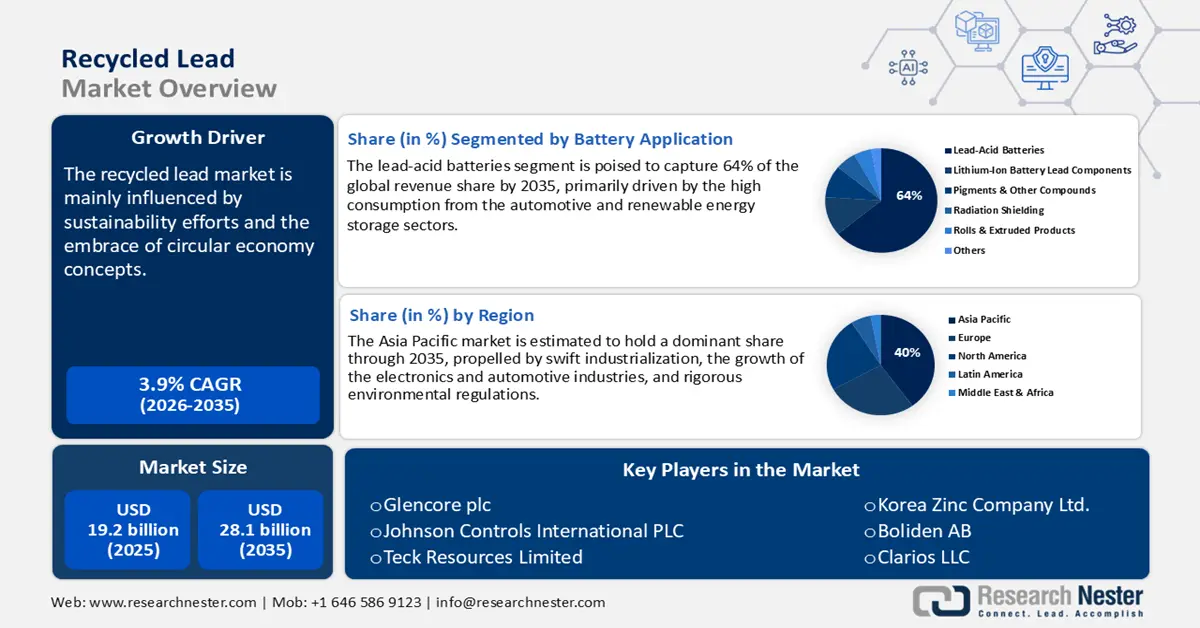
Recycled Lead Market size was valued at USD 19.2 billion in 2025 and is projected to reach USD 28.1 billion by 2035, growing at a CAGR of 3.9% during the forecast period from 2026 to 2035. In 2026, the industry size of recycled lead is estimated at USD 19.9 billion.
The global market for recycled lead is mainly influenced by sustainability efforts and the embrace of circular economy concepts. Governments across the globe are enacting policies to encourage lead recycling, to minimize environmental effects, and to preserve natural resources. For example, the Circular Economy Action Plan of the European Union, which is a component of the European Green Deal, seeks to enhance the utilization of recycled materials in various industries, including the lead sector. The European Commission aims to achieve a 60% recycling rate for municipal waste by the year 2030, highlighting the significance of recycling initiatives. Such initiatives are likely to accelerate the production and commercialization of recycled lead.
The supply chain for recycled lead is defined by the gathering of lead-containing waste, including used lead-acid batteries, cable sheathing, and lead pipes. In 2023, the U.S. exported around USD 110 million worth of scrap lead, while India imported approximately USD 200 million of scrap lead, according to the Observatory of Economic Complexity (OEC). This reflects a robust trade of recycled lead. Manufacturing capabilities are expanding worldwide, with countries such as China and India enhancing their recycling infrastructure to satisfy increasing domestic demand. These advancements are bolstered by investments in recycling technologies and compliance with environmental regulations, ensuring a consistent supply of recycled lead for various sectors.
|
Scrap Lead World Trade, 2023 |
|||
|
Country |
Export in USD Million |
Country |
Import in USD Million |
|
U.S. |
110 |
India |
200 |
|
Australia |
93 |
Spain |
89.4 |
|
U.K. |
83.6 |
South Korea |
66.5 |
|
France |
78.9 |
Belgium |
41.6 |
|
Netherlands |
36.6 |
Germany |
38.8 |
Source: OEC