Proactive Security Market Outlook:
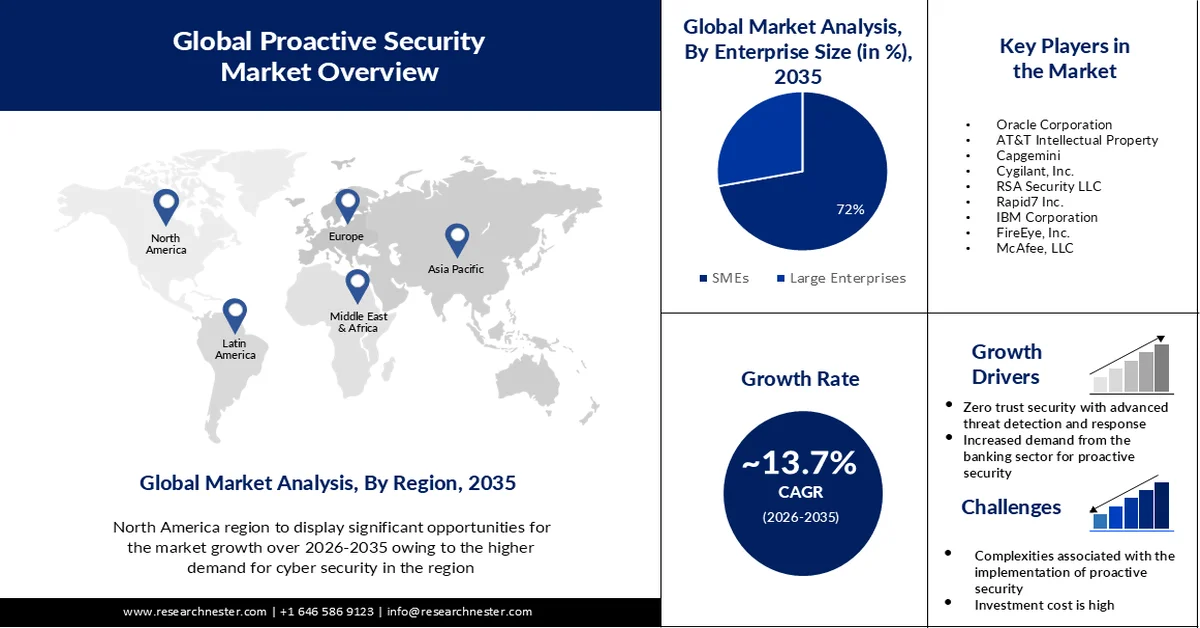
Proactive Security Market size was valued at USD 35.11 billion in 2025 and is likely to cross USD 126.78 billion by 2035, registering more than 13.7% CAGR during the forecast period i.e., between 2026-2035. In the year 2026, the industry size of proactive security is assessed at USD 39.44 billion.
The growth of the market is due to the demand for proactive security that will be intensified, followed by an increased use of cloud technology. By reducing costs, while increasing company alertness, cloud-based identity verification solutions make it possible to reduce the cost. In order to protect their IT systems against cyber-attacks and data breaches, businesses are modernizing with cloud computing. By 2025 200 billion bits of data will be stored in the cloud. There are 60% of the world's corporate data stored in the cloud. A multi-cloud infrastructure has been adopted by 90% of large companies.
In addition, governments have put in place strict policies and regulations, e.g. GDPR, PCI or DSS, demanding companies change the way they do business and invest in preventive security measures. Furthermore, proactive security solutions have been adopted by businesses to cope with the increasing number of cyber-attacks and malicious software as it has increased market demand for proactive security solutions.
Key Proactive Security Market Insights Summary:
Regional Highlights:
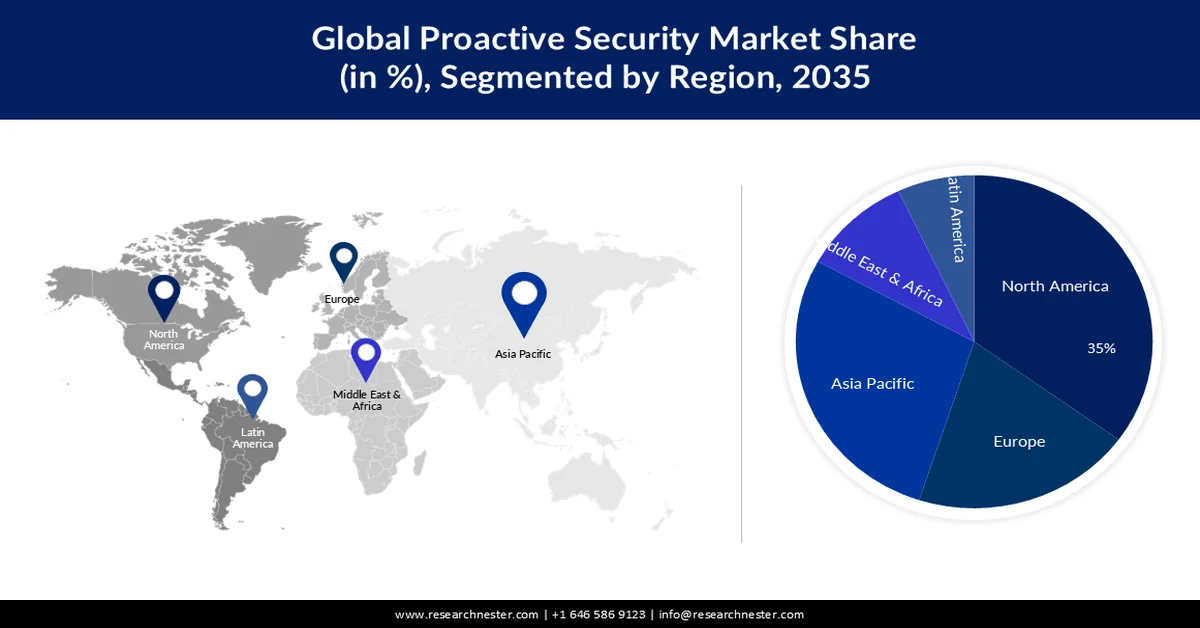
- The North America market is projected to capture a 35% share by 2035, owing to rising reliance on data protection and compliance with stringent government regulations.
- The Asia Pacific market is expected to hold a 28% share by 2035, propelled by government-driven digitalization initiatives and growing adoption of preventive security solutions.
Segment Insights:
- The SMEs segment is projected to account for a 72% share by 2035, driven by heightened exposure to data breaches and the need for comprehensive security solutions.
- The BFSI segment is expected to hold a 42% share during the forecast period, propelled by stringent regulatory requirements and increasing cyberattack threats.
Key Growth Trends:
- Cyberattacks are increasing, which is broadening the market
- Increased demand from the banking sector for proactive security
Major Challenges:
- Complexities associated with the implementation of proactive security
- The adoption of proactive security systems or solutions in the forecast period may be hindered by a lack of awareness about their benefits.
Key Players: The Dow Chemical Company, Symbolic Pharma, Shanghai Rich Chemicals, Sharon laboratories, Mani Agro Chemicals, Sai Supreme Chemicals, BQ Technology (HK) Company, Wuhan Fortuna Chemical, BASF SE, Fujian Shaowu Yongfei Chemical Co., Ltd., Gayathri Chemicals and Agencies.
Global Proactive Security Market Forecast and Regional Outlook:
Market Size & Growth Projections:
- 2025 Market Size: USD 35.11 billion
- 2026 Market Size: USD 39.44 billion
- Projected Market Size: USD 126.78 billion by 2035
- Growth Forecasts: 13.7% CAGR (2026-2035)
Key Regional Dynamics:
- Largest Region: North America (35% Share by 2035)
- Fastest Growing Region: Asia Pacific
- Dominating Countries: United States, United Kingdom, China, Germany, Japan
- Emerging Countries: India, Brazil, Mexico, Indonesia, Vietnam
Last updated on : 25 February, 2026
Proactive Security Market - Growth Drivers and Challenges
Growth Drivers
- Cyberattacks are increasing, which is broadening the market- The demand for an active security regime is expected to increase with the growing number of cyber-attacks, security breaches, and other cyber threats. Businesses have been encouraged to shift towards proactive safety solutions as a result of data breach developments that can lead to high recovery costs and an increase in connected devices within enterprises because of the implementation of the Internet of Things (IoT). In 2022, the number of global internet of things connections increased by 18% to 14.3 billion active endpoints. In 2023, IoT Analytics forecasts that the number of connected Internet of Things devices will grow by 16% to 16.7 billion active endpoints.
- Increased demand from the banking sector for proactive security- BFSI is one of the fastest-growing sectors in the proactive security market because of the strict regulatory and legal compliance of BFSI companies with information security. Financial services providers may be inclined to enhance their security solutions by using proactive protection in view of the fact that cyber-attacks have an immediate impact on market growth.
- Zero trust security with advanced threat detection and response- The adoption of the Zero Trust Security Model, which is based upon the assumption that no one can be trusted in or out of the network, gives businesses opportunities to provide solutions and services for ensuring rigorous access controls as well as continuously verifying the identity and security posture of users and devices. Developing and improving AI-driven threat detection and response systems that instantly identify and respond to advanced threats is an important opportunity. This includes analyzing behavior patterns and detecting anomalies that can give rise to a cyberattack using techniques such as Machine Learning, which is driving the market's growth.
Challenges
- Complexities associated with the implementation of proactive security- The most important factor that is likely to hinder the growth of the active protection market is the complexity of the implementation of preventive security measures. Getting a good overview of all your assets, and having accurate connections between security solutions and numerous other things are the main challenges. The growth of the market in this period could be hindered by these factors.
- This investment cost is an issue for a number of enterprises, including SMEs. In addition, the costs of innovation are still substantial in order to strengthen and improve security; a large number of organizations perceive budget constraints as an obstacle preventing them from adopting active safety solutions and services.
- The adoption of proactive security systems or solutions in the forecast period may be hindered by a lack of awareness about their benefits. As a result, teams are better able to organize tasks and reduce risks much more rapidly due to the benefits of proactive security systems. As a consequence, it is expected that the growth of the market will be hampered by these factors.
Proactive Security Market Size and Forecast:
| Report Attribute | Details |
|---|---|
|
Base Year |
2025 |
|
Forecast Year |
2026-2035 |
|
CAGR |
13.7% |
|
Base Year Market Size (2025) |
USD 35.11 billion |
|
Forecast Year Market Size (2035) |
USD 126.78 billion |
|
Regional Scope |
|
Proactive Security Market Segmentation:
Enterprise Size Segment Analysis
Proactive security market from the SMEs segment is attributed to hold the largest share of about 72% by the end of 2035. As SMEs are more exposed to data breaches inside and outside of the company, this segment gains a high degree of traction in the market. Organizations can keep and protect their most important data in the event of a data breach if they adopt effective security solutions. Proactive security solutions provide organizations with a holistic view of their security infrastructure and help them to make better use of safety vulnerabilities, as well as monitor all products in the area from one single platform. The Accenture cyber-crime study found that almost 40% of attacks on SMEs were carried out by hackers. Only 14% of these accounted SMBs are prepared to face such an attack. Small and medium-sized businesses are spending an average of USD 826 on cybersecurity incidents, which is USD 653,587. SMEs are still implementing proactive security measures, given that they're facing malware based or DNS based cyber-attacks.
Industry Vertical Segment Analysis
The BFSI segment in the proactive security market is dominating the segment with about 42% during the forecast period. Since, BFSI businesses must adhere to strict legal and regulatory requirements regarding information security, the BFSI sector of the market is the one that is expanding at the fastest rate. Small and medium-sized businesses (SMEs) continue to implement preventative security measures as they come under more and more cyberattacks focused on malware and DNS.
Our in-depth analysis of the global proactive security market includes the following segments:
|
Component |
|
|
Enterprises Size |
|
|
Product |
|
|
Industry Vertical |
|

Vishnu Nair
Head - Global Business DevelopmentCustomize this report to your requirements — connect with our consultant for personalized insights and options.
Proactive Security Market - Regional Analysis
North America Market Insights
The proactive security market in the North America region is predicted to have the largest revenue share of about 35% during the forecast period. The market in the region is projected to increase as organizations become more reliant on data protection against advanced cyber-attacks and address strict government regulations. Security providers throughout the North American Region offer proactive security solutions by using Analytics, Audit and Management Platforms, Safety Monitoring, Attack Simulations, Security Optimization as well as Risk & Vulnerability Management. With the increasing frequency of data security breaches in the last 5 years, organizations have increased their investment in IT security so they are better able to deal with emerging threats. In 2021, 1 in 2 US internet users had their accounts compromised. Insurance against a cyber-attack is not available to about 1 in 10 US organizations. In the first half of 2022, 53,35 million Americans were exposed to cyber-crime.
APAC Market Insights
The Asia pacific is anticipated to hold 28% share of the global proactive security market by the end of 2035. The growth of the market is because of the emergence of new economies like India, China, and Japan which have been focusing their governments on digitalization. In addition, the growth of the market is also expected to be boosted by a growing interest in preventive security solutions and services from different industry sectors.
Proactive Security Market Players:
- Cisco Systems Inc.
- Company Overview
- Business Strategy
- Key Product Offerings
- Financial Performance
- Key Performance Indicators
- Risk Analysis
- Recent Development
- Regional Presence
- SWOT Analysis
- Oracle Corporation
- AT&T Intellectual Property
- Capgemini
- Cygilant, Inc.
- RSA Security LLC
- Rapid7 Inc.
- IBM Corporation
- FireEye, Inc.
- McAfee, LLC
Recent Developments
- RSA unveiled the newest version of its market-leading SIEM, RSA Net Witness Platform, which features machine learning models based on deep endpoint observations to rapidly detect anomalies in user's behavior to uncover evolving threats. This announcement furthers RSA's strategy to help customers take a unified, phased approach to manage digital risk, an ever-increasing challenge faced by organizations with ambitious digital transformation initiatives.
- Cygilant announced that it has joined the AT&T Cybersecurity Partner Program to help AlienVault USM Anywhere customers with managed security services. As a part of AT&T Cybersecurity’s program, Cygilant assigns dedicated Cybersecurity Advisors who become familiar with a customer’s systems, processes, compliance requirements, and security goals.
- Report ID: 5352
- Published Date: Feb 25, 2026
- Report Format: PDF, PPT
- Explore a preview of key market trends and insights
- Review sample data tables and segment breakdowns
- Experience the quality of our visual data representations
- Evaluate our report structure and research methodology
- Get a glimpse of competitive landscape analysis
- Understand how regional forecasts are presented
- Assess the depth of company profiling and benchmarking
- Preview how actionable insights can support your strategy
Explore real data and analysis
Frequently Asked Questions (FAQ)
About this Report
Connect with our Expert


Report, 2026-2035



Copyright @ 2026 Research Nester. All Rights Reserved.
