Global Polypropylene Compound Market
- An Outline of the Global Polypropylene Compound Market
- Market Definition and Segmentation
- Study Assumptions and Abbreviations
- Research Methodology & Approach
- Primary Research
- Secondary Research
- Data Triangulation
- SPSS Methodology
- Executive Summary
- Growth Drivers
- Major Roadblocks
- Opportunities
- Prevalent Trends
- Government Regulation
- Growth Outlook
- Competitive White Space Analysis – Identifying Untapped Market Gaps
- Risk Overview
- SWOT
- Technological Advancement
- Technology Maturity Matrix for Polypropylene Compound Market Recent News
- Regional Demand
- Global Polypropylene Compound by Geography – Strategic Comparative Analysis
- Strategic Segment Analysis: Polypropylene Compound Demand Landscape
- Polypropylene Compound Demand Trends Driven by Sustainability, Recycling & Circular Economy, and Technological Advancements (2026-2036)
- Root Cause Analysis (RCA) for discovering problems of the Polypropylene Compound Market
- Porter Five Forces
- PESTLE
- Comparative Positioning
- Global Polypropylene Compound – Key Player Analysis (2036)
- Competitive Landscape: Key Suppliers/Players
- Competitive Model: A Detailed Inside View for Investors
- Company Market Share, 2036 (%)
- LyondellBasell Industries Holdings B.V
- SABIC
- Repsol
- Sumitomo Chemical
- Borealis GmbH
- GS Caltex Corporation
- LOTTE Chemical CORPORATION
- TotalEnergies
- LG Chem
- Asahi Kasei Corporation
- Tasnee
- Mitsui Chemicals
- Mitsubishi Chemical Group
- Global Polypropylene Compound Market Outlook
- Market Overview
- Market Revenue by Value (USD Thousand), Volume (Thousand Tons), and Compound Annual Growth Rate (CAGR)
- Polypropylene Compound Market Segmentation Analysis (2026-2036)
- By Product
- Mineral-filled PP compounds, Market Value (USD Million), Volume (Thousand Tons), CAGR & Y-o-Y Growth Trend, 2026-2036F
- Compounded TPO, Market Value (USD Million), Volume (Thousand Tons), CAGR & Y-o-Y Growth Trend, 2026-2036F
- Compounded TPV, Market Value (USD Million), Volume (Thousand Tons), CAGR & Y-o-Y Growth Trend, 2026-2036F
- Glass fiber reinforced, Market Value (USD Million), Volume (Thousand Tons), CAGR & Y-o-Y Growth Trend, 2026-2036F
- Talc-filled, Market Value (USD Million), Volume (Thousand Tons), CAGR & Y-o-Y Growth Trend, 2026-2036F
- Flame Retardant, Market Value (USD Million), Volume (Thousand Tons), CAGR & Y-o-Y Growth Trend, 2026-2036F
- Others, Market Value (USD Million), Volume (Thousand Tons), CAGR & Y-o-Y Growth Trend, 2026-2036F
- By Polymer Type
- Homopolymer, Market Value (USD Million), Volume (Thousand Tons) CAGR & Y-o-Y Growth Trend, 2026-2036F
- Random Copolymer, Market Value (USD Million), Volume (Thousand Tons) CAGR & Y-o-Y Growth Trend, 2026-2036F
- Impact Copolymer, Market Value (USD Million), Volume (Thousand Tons) CAGR & Y-o-Y Growth Trend, 2026-2036F
- By End Use
- Automotive, Market Value (USD Million), Volume (Thousand Tons) CAGR & Y-o-Y Growth Trend, 2026-2036F
- Packaging, Market Value (USD Million), Volume (Thousand Tons) CAGR & Y-o-Y Growth Trend, 2026-2036F
- Medical & Healthcare, Market Value (USD Million), Volume (Thousand Tons) CAGR & Y-o-Y Growth Trend, 2026-2036F
- Electrical & Electronics, Market Value (USD Million), Volume (Thousand Tons) CAGR & Y-o-Y Growth Trend, 2026-2036F
- Appliances, Market Value (USD Million), Volume (Thousand Tons) CAGR & Y-o-Y Growth Trend, 2026-2036F
- Furniture & Fixtures, Market Value (USD Million), Volume (Thousand Tons) CAGR & Y-o-Y Growth Trend, 2026-2036F
- Agriculture & Horticulture, Market Value (USD Million), Volume (Thousand Tons) CAGR & Y-o-Y Growth Trend, 2026-2036F
- Others, Market Value (USD Million), Volume (Thousand Tons) CAGR & Y-o-Y Growth Trend, 2026-2036F
- Regional Synopsis, Value (USD Thousand), 2026-2036
- North America, Market Value (USD Million), Volume (Thousand Tons) CAGR & Y-o-Y Growth Trend, 2026-2036F
- Europe, Market Value (USD Million), Volume (Thousand Tons) CAGR & Y-o-Y Growth Trend, 2026-2036F
- Asia Pacific Excluding Japan, Market Value (USD Million), Volume (Thousand Tons) CAGR & Y-o-Y Growth Trend, 2026-2036F
- Japan, Market Value (USD Million), Volume (Thousand Tons) CAGR & Y-o-Y Growth Trend, 2026-2036F
- Latin America, Market Value (USD Million), Volume (Thousand Tons) CAGR & Y-o-Y Growth Trend, 2026-2036F
- Middle East & Africa, Market Value (USD Million), Volume (Thousand Tons) CAGR & Y-o-Y Growth Trend, 2026-2036F
- By Product
- Market Overview
- North America Market
- Overview
- Market Value (USD Thousand), Current and Future Projections, 2026-2036
- Increment $ Opportunity Assessment, 2026-2036
- Segmentation (USD Thousand), 2026-2036, By
- By Product
- Mineral-filled PP compounds, Market Value (USD Million), Volume (Thousand Tons), CAGR & Y-o-Y Growth Trend, 2026-2036F
- Compounded TPO, Market Value (USD Million), Volume (Thousand Tons), CAGR & Y-o-Y Growth Trend, 2026-2036F
- Compounded TPV, Market Value (USD Million), Volume (Thousand Tons), CAGR & Y-o-Y Growth Trend, 2026-2036F
- Glass fiber reinforced, Market Value (USD Million), Volume (Thousand Tons), CAGR & Y-o-Y Growth Trend, 2026-2036F
- Talc-filled, Market Value (USD Million), Volume (Thousand Tons), CAGR & Y-o-Y Growth Trend, 2026-2036F
- Flame Retardant, Market Value (USD Million), Volume (Thousand Tons), CAGR & Y-o-Y Growth Trend, 2026-2036F
- Others, Market Value (USD Million), Volume (Thousand Tons), CAGR & Y-o-Y Growth Trend, 2026-2036F
- By Polymer Type
- Homopolymer, Market Value (USD Million), Volume (Thousand Tons) CAGR & Y-o-Y Growth Trend, 2026-2036F
- Random Copolymer, Market Value (USD Million), Volume (Thousand Tons) CAGR & Y-o-Y Growth Trend, 2026-2036F
- Impact Copolymer, Market Value (USD Million), Volume (Thousand Tons) CAGR & Y-o-Y Growth Trend, 2026-2036F
- By End Use
- Automotive, Market Value (USD Million), Volume (Thousand Tons) CAGR & Y-o-Y Growth Trend, 2026-2036F
- Packaging, Market Value (USD Million), Volume (Thousand Tons) CAGR & Y-o-Y Growth Trend, 2026-2036F
- Medical & Healthcare, Market Value (USD Million), Volume (Thousand Tons) CAGR & Y-o-Y Growth Trend, 2026-2036F
- Electrical & Electronics, Market Value (USD Million), Volume (Thousand Tons) CAGR & Y-o-Y Growth Trend, 2026-2036F
- Appliances, Market Value (USD Million), Volume (Thousand Tons) CAGR & Y-o-Y Growth Trend, 2026-2036F
- Furniture & Fixtures, Market Value (USD Million), Volume (Thousand Tons) CAGR & Y-o-Y Growth Trend, 2026-2036F
- Agriculture & Horticulture, Market Value (USD Million), Volume (Thousand Tons) CAGR & Y-o-Y Growth Trend, 2026-2036F
- Others, Market Value (USD Million), Volume (Thousand Tons) CAGR & Y-o-Y Growth Trend, 2026-2036F
- Country Level Analysis, Value (USD Thousand)
- U.S. Market Value (USD Thousand) and CAGR & Y-o-Y Growth Trend, 2026-2036F
- Canada Market Value (USD Thousand) and CAGR & Y-o-Y Growth Trend, 2026-2036F
- By Product
- Overview
- Europe Market
- Overview
- Market Value (USD Thousand), Current and Future Projections, 2026-2036
- Increment $ Opportunity Assessment, 2026-2036
- Segmentation (USD Thousand), 2026-2036, By
- By Product
- Mineral-filled PP compounds, Market Value (USD Million), Volume (Thousand Tons), CAGR & Y-o-Y Growth Trend, 2026-2036F
- Compounded TPO, Market Value (USD Million), Volume (Thousand Tons), CAGR & Y-o-Y Growth Trend, 2026-2036F
- Compounded TPV, Market Value (USD Million), Volume (Thousand Tons), CAGR & Y-o-Y Growth Trend, 2026-2036F
- Glass fiber reinforced, Market Value (USD Million), Volume (Thousand Tons), CAGR & Y-o-Y Growth Trend, 2026-2036F
- Talc-filled, Market Value (USD Million), Volume (Thousand Tons), CAGR & Y-o-Y Growth Trend, 2026-2036F
- Flame Retardant, Market Value (USD Million), Volume (Thousand Tons), CAGR & Y-o-Y Growth Trend, 2026-2036F
- Others, Market Value (USD Million), Volume (Thousand Tons), CAGR & Y-o-Y Growth Trend, 2026-2036F
- By Polymer Type
- Homopolymer, Market Value (USD Million), Volume (Thousand Tons) CAGR & Y-o-Y Growth Trend, 2026-2036F
- Random Copolymer, Market Value (USD Million), Volume (Thousand Tons) CAGR & Y-o-Y Growth Trend, 2026-2036F
- Impact Copolymer, Market Value (USD Million), Volume (Thousand Tons) CAGR & Y-o-Y Growth Trend, 2026-2036F
- By End Use
- Automotive, Market Value (USD Million), Volume (Thousand Tons) CAGR & Y-o-Y Growth Trend, 2026-2036F
- Packaging, Market Value (USD Million), Volume (Thousand Tons) CAGR & Y-o-Y Growth Trend, 2026-2036F
- Medical & Healthcare, Market Value (USD Million), Volume (Thousand Tons) CAGR & Y-o-Y Growth Trend, 2026-2036F
- Electrical & Electronics, Market Value (USD Million), Volume (Thousand Tons) CAGR & Y-o-Y Growth Trend, 2026-2036F
- Appliances, Market Value (USD Million), Volume (Thousand Tons) CAGR & Y-o-Y Growth Trend, 2026-2036F
- Furniture & Fixtures, Market Value (USD Million), Volume (Thousand Tons) CAGR & Y-o-Y Growth Trend, 2026-2036F
- Agriculture & Horticulture, Market Value (USD Million), Volume (Thousand Tons) CAGR & Y-o-Y Growth Trend, 2026-2036F
- Others, Market Value (USD Million), Volume (Thousand Tons) CAGR & Y-o-Y Growth Trend, 2026-2036F
- Country Level Analysis, Value (USD Thousand)
- UK Market Value (USD Thousand) and CAGR & Y-o-Y Growth Trend, 2026-2036F
- Germany Market Value (USD Thousand) and CAGR & Y-o-Y Growth Trend, 2026-2036F
- France Market Value (USD Thousand) and CAGR & Y-o-Y Growth Trend, 2026-2036F
- Italy Market Value (USD Thousand) and CAGR & Y-o-Y Growth Trend, 2026-2036F
- Spain Market Value (USD Thousand) and CAGR & Y-o-Y Growth Trend, 2026-2036F
- Netherlands Market Value (USD Thousand) and CAGR & Y-o-Y Growth Trend, 2026-2036F
- Russia Market Value (USD Thousand) and CAGR & Y-o-Y Growth Trend, 2026-2036F
- Switzerland Market Value (USD Thousand) and CAGR & Y-o-Y Growth Trend, 2026-2036F
- Poland Market Value (USD Thousand) and CAGR & Y-o-Y Growth Trend, 2026-2036F
- Belgium Market Value (USD Thousand) and CAGR & Y-o-Y Growth Trend, 2026-2036F
- Rest of Europe Market Value (USD Thousand) and CAGR & Y-o-Y Growth Trend, 2026-2036F
- By Product
- Overview
- Asia Pacific Market Excluding Japan
- Overview
- Market Value (USD Thousand), Current and Future Projections, 2026-2036
- Increment $ Opportunity Assessment, 2026-2036
- Segmentation (USD Thousand), 2026-2036, By
- By Product
- Mineral-filled PP compounds, Market Value (USD Million), Volume (Thousand Tons), CAGR & Y-o-Y Growth Trend, 2026-2036F
- Compounded TPO, Market Value (USD Million), Volume (Thousand Tons), CAGR & Y-o-Y Growth Trend, 2026-2036F
- Compounded TPV, Market Value (USD Million), Volume (Thousand Tons), CAGR & Y-o-Y Growth Trend, 2026-2036F
- Glass fiber reinforced, Market Value (USD Million), Volume (Thousand Tons), CAGR & Y-o-Y Growth Trend, 2026-2036F
- Talc-filled, Market Value (USD Million), Volume (Thousand Tons), CAGR & Y-o-Y Growth Trend, 2026-2036F
- Flame Retardant, Market Value (USD Million), Volume (Thousand Tons), CAGR & Y-o-Y Growth Trend, 2026-2036F
- Others, Market Value (USD Million), Volume (Thousand Tons), CAGR & Y-o-Y Growth Trend, 2026-2036F
- By Polymer Type
- Homopolymer, Market Value (USD Million), Volume (Thousand Tons) CAGR & Y-o-Y Growth Trend, 2026-2036F
- Random Copolymer, Market Value (USD Million), Volume (Thousand Tons) CAGR & Y-o-Y Growth Trend, 2026-2036F
- Impact Copolymer, Market Value (USD Million), Volume (Thousand Tons) CAGR & Y-o-Y Growth Trend, 2026-2036F
- By End Use
- Automotive, Market Value (USD Million), Volume (Thousand Tons) CAGR & Y-o-Y Growth Trend, 2026-2036F
- Packaging, Market Value (USD Million), Volume (Thousand Tons) CAGR & Y-o-Y Growth Trend, 2026-2036F
- Medical & Healthcare, Market Value (USD Million), Volume (Thousand Tons) CAGR & Y-o-Y Growth Trend, 2026-2036F
- Electrical & Electronics, Market Value (USD Million), Volume (Thousand Tons) CAGR & Y-o-Y Growth Trend, 2026-2036F
- Appliances, Market Value (USD Million), Volume (Thousand Tons) CAGR & Y-o-Y Growth Trend, 2026-2036F
- Furniture & Fixtures, Market Value (USD Million), Volume (Thousand Tons) CAGR & Y-o-Y Growth Trend, 2026-2036F
- Agriculture & Horticulture, Market Value (USD Million), Volume (Thousand Tons) CAGR & Y-o-Y Growth Trend, 2026-2036F
- Others, Market Value (USD Million), Volume (Thousand Tons) CAGR & Y-o-Y Growth Trend, 2026-2036F
- Country Level Analysis, Value (USD Thousand)
- China Market Value (USD Thousand) and CAGR & Y-o-Y Growth Trend, 2026-2036F
- India Market Value (USD Thousand) and CAGR & Y-o-Y Growth Trend, 2026-2036F
- South Korea Market Value (USD Thousand) and CAGR & Y-o-Y Growth Trend, 2026-2036F
- Australia Market Value (USD Thousand) and CAGR & Y-o-Y Growth Trend, 2026-2036F
- Indonesia Market Value (USD Thousand) and CAGR & Y-o-Y Growth Trend, 2026-2036F
- Malaysia Market Value (USD Thousand) and CAGR & Y-o-Y Growth Trend, 2026-2036F
- Vietnam Market Value (USD Thousand) and CAGR & Y-o-Y Growth Trend, 2026-2036F
- Thailand Market Value (USD Thousand) and CAGR & Y-o-Y Growth Trend, 2026-2036F
- Singapore Market Value (USD Thousand) and CAGR & Y-o-Y Growth Trend, 2026-2036F
- New Zealand Market Value (USD Thousand) and CAGR & Y-o-Y Growth Trend, 2026-2036F
- Rest of Asia Pacific Excluding Japan Market Value (USD Thousand) and CAGR & Y-o-Y Growth Trend, 2026-2036F
- By Product
- Overview
- Japan Market
- Overview
- Market Value (USD Thousand), Current and Future Projections, 2026-2036
- Increment $ Opportunity Assessment, 2026-2036
- Segmentation (USD Thousand), 2026-2036, By
- By Product
- Mineral-filled PP compounds, Market Value (USD Million), Volume (Thousand Tons), CAGR & Y-o-Y Growth Trend, 2026-2036F
- Compounded TPO, Market Value (USD Million), Volume (Thousand Tons), CAGR & Y-o-Y Growth Trend, 2026-2036F
- Compounded TPV, Market Value (USD Million), Volume (Thousand Tons), CAGR & Y-o-Y Growth Trend, 2026-2036F
- Glass fiber reinforced, Market Value (USD Million), Volume (Thousand Tons), CAGR & Y-o-Y Growth Trend, 2026-2036F
- Talc-filled, Market Value (USD Million), Volume (Thousand Tons), CAGR & Y-o-Y Growth Trend, 2026-2036F
- Flame Retardant, Market Value (USD Million), Volume (Thousand Tons), CAGR & Y-o-Y Growth Trend, 2026-2036F
- Others, Market Value (USD Million), Volume (Thousand Tons), CAGR & Y-o-Y Growth Trend, 2026-2036F
- By Polymer Type
- Homopolymer, Market Value (USD Million), Volume (Thousand Tons) CAGR & Y-o-Y Growth Trend, 2026-2036F
- Random Copolymer, Market Value (USD Million), Volume (Thousand Tons) CAGR & Y-o-Y Growth Trend, 2026-2036F
- Impact Copolymer, Market Value (USD Million), Volume (Thousand Tons) CAGR & Y-o-Y Growth Trend, 2026-2036F
- By End Use
- Automotive, Market Value (USD Million), Volume (Thousand Tons) CAGR & Y-o-Y Growth Trend, 2026-2036F
- Packaging, Market Value (USD Million), Volume (Thousand Tons) CAGR & Y-o-Y Growth Trend, 2026-2036F
- Medical & Healthcare, Market Value (USD Million), Volume (Thousand Tons) CAGR & Y-o-Y Growth Trend, 2026-2036F
- Electrical & Electronics, Market Value (USD Million), Volume (Thousand Tons) CAGR & Y-o-Y Growth Trend, 2026-2036F
- Appliances, Market Value (USD Million), Volume (Thousand Tons) CAGR & Y-o-Y Growth Trend, 2026-2036F
- Furniture & Fixtures, Market Value (USD Million), Volume (Thousand Tons) CAGR & Y-o-Y Growth Trend, 2026-2036F
- Agriculture & Horticulture, Market Value (USD Million), Volume (Thousand Tons) CAGR & Y-o-Y Growth Trend, 2026-2036F
- Others, Market Value (USD Million), Volume (Thousand Tons) CAGR & Y-o-Y Growth Trend, 2026-2036F
- By Product
- Overview
- Latin America Market
- Overview
- Market Value (USD Thousand), Current and Future Projections, 2026-2036
- Increment $ Opportunity Assessment, 2026-2036
- Year-on-Year Growth Forecast (%)
- Segmentation (USD Thousand), 2026-2036, By
- By Product
- Mineral-filled PP compounds, Market Value (USD Million), Volume (Thousand Tons), CAGR & Y-o-Y Growth Trend, 2026-2036F
- Compounded TPO, Market Value (USD Million), Volume (Thousand Tons), CAGR & Y-o-Y Growth Trend, 2026-2036F
- Compounded TPV, Market Value (USD Million), Volume (Thousand Tons), CAGR & Y-o-Y Growth Trend, 2026-2036F
- Glass fiber reinforced, Market Value (USD Million), Volume (Thousand Tons), CAGR & Y-o-Y Growth Trend, 2026-2036F
- Talc-filled, Market Value (USD Million), Volume (Thousand Tons), CAGR & Y-o-Y Growth Trend, 2026-2036F
- Flame Retardant, Market Value (USD Million), Volume (Thousand Tons), CAGR & Y-o-Y Growth Trend, 2026-2036F
- Others, Market Value (USD Million), Volume (Thousand Tons), CAGR & Y-o-Y Growth Trend, 2026-2036F
- By Polymer Type
- Homopolymer, Market Value (USD Million), Volume (Thousand Tons) CAGR & Y-o-Y Growth Trend, 2026-2036F
- Random Copolymer, Market Value (USD Million), Volume (Thousand Tons) CAGR & Y-o-Y Growth Trend, 2026-2036F
- Impact Copolymer, Market Value (USD Million), Volume (Thousand Tons) CAGR & Y-o-Y Growth Trend, 2026-2036F
- By End Use
- Automotive, Market Value (USD Million), Volume (Thousand Tons) CAGR & Y-o-Y Growth Trend, 2026-2036F
- Packaging, Market Value (USD Million), Volume (Thousand Tons) CAGR & Y-o-Y Growth Trend, 2026-2036F
- Medical & Healthcare, Market Value (USD Million), Volume (Thousand Tons) CAGR & Y-o-Y Growth Trend, 2026-2036F
- Electrical & Electronics, Market Value (USD Million), Volume (Thousand Tons) CAGR & Y-o-Y Growth Trend, 2026-2036F
- Appliances, Market Value (USD Million), Volume (Thousand Tons) CAGR & Y-o-Y Growth Trend, 2026-2036F
- Furniture & Fixtures, Market Value (USD Million), Volume (Thousand Tons) CAGR & Y-o-Y Growth Trend, 2026-2036F
- Agriculture & Horticulture, Market Value (USD Million), Volume (Thousand Tons) CAGR & Y-o-Y Growth Trend, 2026-2036F
- Others, Market Value (USD Million), Volume (Thousand Tons) CAGR & Y-o-Y Growth Trend, 2026-2036F
- Country Level Analysis, Value (USD Thousand)
- Brazil Market Value (USD Thousand) and CAGR & Y-o-Y Growth Trend, 2026-2036F
- Argentina Market Value (USD Thousand) and CAGR & Y-o-Y Growth Trend, 2026-2036F
- Mexico Market Value (USD Thousand) and CAGR & Y-o-Y Growth Trend, 2026-2036F
- Rest of Latin America Market Value (USD Thousand) and CAGR & Y-o-Y Growth Trend, 2026-2036F
- By Product
- Overview
- Middle East & Africa Market
- Overview
- Market Value (USD Thousand), Current and Future Projections, 2026-2036
- Increment $ Opportunity Assessment, 2026-2036
- Year-on-Year Growth Forecast (%)
- Segmentation (USD Thousand), 2026-2036, By
- By Product
- Mineral-filled PP compounds, Market Value (USD Million), Volume (Thousand Tons), CAGR & Y-o-Y Growth Trend, 2026-2036F
- Compounded TPO, Market Value (USD Million), Volume (Thousand Tons), CAGR & Y-o-Y Growth Trend, 2026-2036F
- Compounded TPV, Market Value (USD Million), Volume (Thousand Tons), CAGR & Y-o-Y Growth Trend, 2026-2036F
- Glass fiber reinforced, Market Value (USD Million), Volume (Thousand Tons), CAGR & Y-o-Y Growth Trend, 2026-2036F
- Talc-filled, Market Value (USD Million), Volume (Thousand Tons), CAGR & Y-o-Y Growth Trend, 2026-2036F
- Flame Retardant, Market Value (USD Million), Volume (Thousand Tons), CAGR & Y-o-Y Growth Trend, 2026-2036F
- Others, Market Value (USD Million), Volume (Thousand Tons), CAGR & Y-o-Y Growth Trend, 2026-2036F
- By Polymer Type
- Homopolymer, Market Value (USD Million), Volume (Thousand Tons) CAGR & Y-o-Y Growth Trend, 2026-2036F
- Random Copolymer, Market Value (USD Million), Volume (Thousand Tons) CAGR & Y-o-Y Growth Trend, 2026-2036F
- Impact Copolymer, Market Value (USD Million), Volume (Thousand Tons) CAGR & Y-o-Y Growth Trend, 2026-2036F
- By End Use
- Automotive, Market Value (USD Million), Volume (Thousand Tons) CAGR & Y-o-Y Growth Trend, 2026-2036F
- Packaging, Market Value (USD Million), Volume (Thousand Tons) CAGR & Y-o-Y Growth Trend, 2026-2036F
- Medical & Healthcare, Market Value (USD Million), Volume (Thousand Tons) CAGR & Y-o-Y Growth Trend, 2026-2036F
- Electrical & Electronics, Market Value (USD Million), Volume (Thousand Tons) CAGR & Y-o-Y Growth Trend, 2026-2036F
- Appliances, Market Value (USD Million), Volume (Thousand Tons) CAGR & Y-o-Y Growth Trend, 2026-2036F
- Furniture & Fixtures, Market Value (USD Million), Volume (Thousand Tons) CAGR & Y-o-Y Growth Trend, 2026-2036F
- Agriculture & Horticulture, Market Value (USD Million), Volume (Thousand Tons) CAGR & Y-o-Y Growth Trend, 2026-2036F
- Others, Market Value (USD Million), Volume (Thousand Tons) CAGR & Y-o-Y Growth Trend, 2026-2036F
- Country Level Analysis, Value (USD Thousand)
- Saudi Arabia Market Value (USD Thousand) and CAGR & Y-o-Y Growth Trend, 2026-2036F
- UAE Market Value (USD Thousand) and CAGR & Y-o-Y Growth Trend, 2026-2036F
- Israel Market Value (USD Thousand) and CAGR & Y-o-Y Growth Trend, 2026-2036F
- Qatar Market Value (USD Thousand) and CAGR & Y-o-Y Growth Trend, 2026-2036F
- Kuwait Market Value (USD Thousand) and CAGR & Y-o-Y Growth Trend, 2026-2036F
- Oman Market Value (USD Thousand) and CAGR & Y-o-Y Growth Trend, 2026-2036F
- South Africa Market Value (USD Thousand) and CAGR & Y-o-Y Growth Trend, 2026-2036F
- Rest of Middle East & Africa Market Value (USD Thousand) and CAGR & Y-o-Y Growth Trend, 2026-2036F
- By Product
- Overview
- Global Economic Scenario
- World Economic Outlook
- About Research Nester
- Our Global Clientele
- We Serve Clients Across World
Polypropylene Compounds Market Outlook:
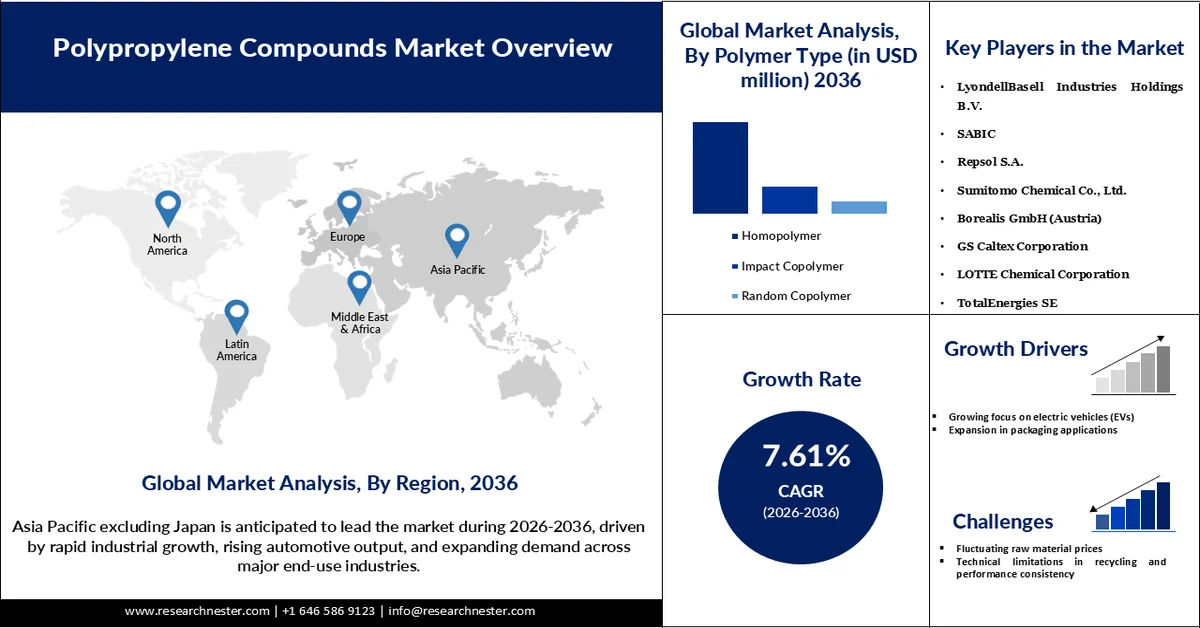
Polypropylene Compounds Market is valued at USD 22.25 billion in 2025 and is anticipated to surpass USD 49.64 billion by 2036, expanding at a CAGR of 7.61% during the forecast period, i.e., 2026 to 2036. In 2026, the industry size of polypropylene compounds is evaluated at USD 23.83 billion.
The global polypropylene compounds market is gaining momentum as industries increasingly adopt materials that support both lightweight design and reliable performance. In the automotive sector, manufacturers are placing strong emphasis on reducing vehicle weight to meet tightening fuel-efficiency requirements and stricter limits on carbon emissions. According to the U.S. Department of Energy’s Annual Merit Review Presentations, reducing vehicle weight by 10% can improve fuel economy by 6%–8%, highlighting lightweighting as a key efficiency strategy for OEMs. Replacing cast iron and conventional steel with lightweight, high-performance materials such as high-strength steel, magnesium (Mg) alloys, aluminum (Al) alloys, carbon fiber, and advanced polymer composites can lower body and chassis mass by up to 50%. As a result, polypropylene compounds are gaining wider acceptance as replacements for metal and heavier plastic materials in components such as bumpers, interior panels, and under-the-hood parts. Their ability to considerably reduce component weight while maintaining strength, flexibility in design, and recyclability makes them a practical material choice for modern vehicles. By lowering the weight of parts by nearly 30–40% and still supporting adaptable designs and sustainable use, polypropylene compounds are increasingly favored in today’s automotive manufacturing. This shift is strengthening the role of polypropylene compounds in automotive material selection and supporting the steady expansion of the polypropylene compounds market.
Meanwhile, stricter policies promoting the use of recycled plastics are reshaping material selection in the packaging sector. For instance, in February 2025, the European Commission confirmed the implementation of the Packaging and Packaging Waste Regulation (PPWR), which mandates that plastic packaging contain 10–35% recycled content by 2030, varying by application. Polyolefins—particularly polypropylene—are widely preferred because they can be recycled efficiently and produced at a large scale. Across Europe, there has been an increased interest in recycled polypropylene (rPP) compounds. To address regulatory pressures, many packaging companies are moving away from virgin plastics and adopting recycled polypropylene (rPP) compounds. This transition also supports packaging redesign and helps maintain access to tightly regulated markets. Owing to its recyclability, compatibility with mono-material packaging systems, and reliable strength, polypropylene is becoming a preferred material for sustainable packaging in the food, personal care, and consumer goods sectors.
Global Shipment of Polypropylene (Top 6 Countries) -2023
|
Importing Region/Country |
Import Value (USD Thousand) |
Import Quantity (Kg) |
|
China |
2,792,875.67 |
2,697,210,000 |
|
Turkey |
2,249,309.43 |
2,035,500,000 |
|
European Union |
1,643,896.92 |
1,297,870,000 |
|
India |
1,375,622.38 |
1,327,210,000 |
|
Germany |
1,327,747.06 |
821,521,000 |
|
Italy |
1,271,443.58 |
1,008,750,000 |
Source: WITS
The substantial imports of primary polypropylene indicate robust global demand for raw materials used in compounding. Major industrial economies, including China, Turkey, India, and the European Union, import these materials in large quantities to meet the needs of automotive, packaging, and construction industries. This trend highlights the growing worldwide consumption of polypropylene-based products. As demand for polypropylene resin rises, manufacturers are scaling up their compounding operations to produce specialized grades.
Key Polypropylene Compounds Market Insights Summary:
Regional Highlights:
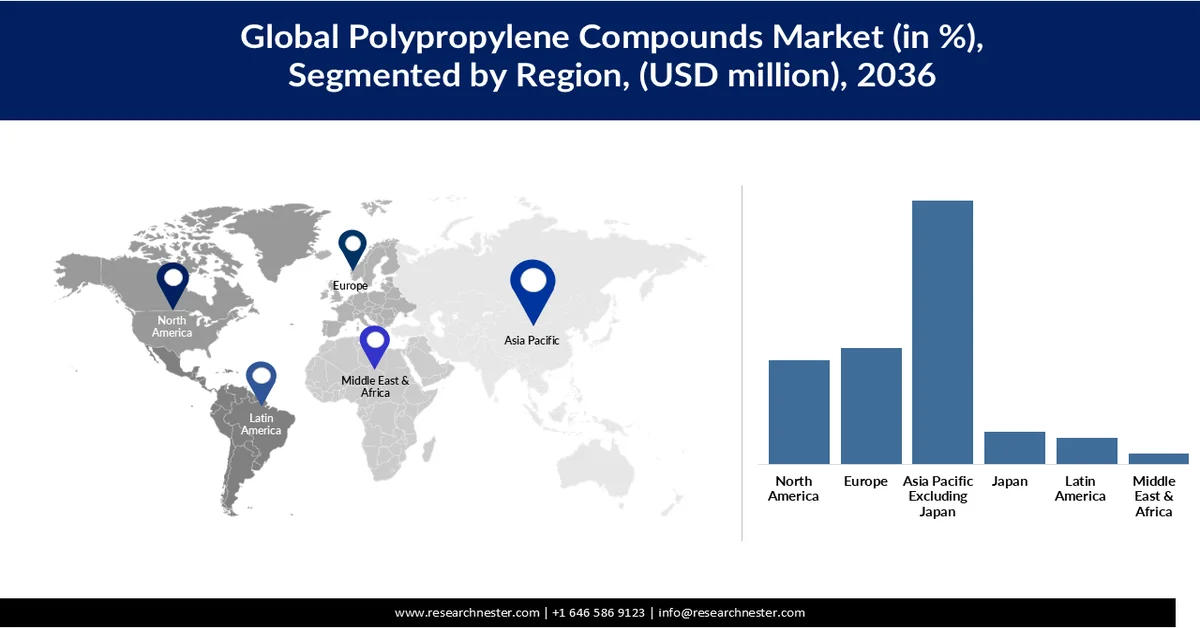
- Asia Pacific excluding Japan is projected to capture 47.41% share of the polypropylene compounds market by 2036, propelled by rapid industrial growth, rising automotive output, and expanding demand across major end-use industries
- Europe is anticipated to hold 20.99% share by 2036, supported by stricter sustainability regulations and increasing adoption of recycled polypropylene materials
Segment Insights:
- Homopolymer segment is projected to account for 68.63% share of the polypropylene compounds market by 2036, driven by its combination of mechanical reliability, cost efficiency, and wide-ranging usability across industries
- Mineral-filled PP compounds segment is expected to hold 41.81% share by 2036, fueled by enhanced stiffness, durability, and thermal stability offered by mineral reinforcements
Key Growth Trends:
- Growing focus on electric vehicles (EVs)
- Expansion in packaging applications
Major Challenges:
- Fluctuating raw material prices
- Technical limitations in recycling and performance consistency
Key Players: LyondellBasell Industries Holdings B.V. (U.S.), SABIC (Saudi Arabia), Repsol S.A. (Spain), Sumitomo Chemical Co., Ltd. (Japan), Borealis GmbH (Austria), GS Caltex Corporation (South Korea), LOTTE Chemical Corporation (South Korea), TotalEnergies SE (France), LG Chem Ltd. (South Korea), Asahi Kasei Corporation (Japan), Tasnee (Saudi Arabia), Mitsui Chemicals, Inc. (Japan), Mitsubishi Chemical Group Corporation (Japan).
Global Polypropylene Compounds Market Forecast and Regional Outlook:
Market Size & Growth Projections:
- 2025 Market Size: USD 22.25 billion
- 2026 Market Size: USD 23.83 billion
- Projected Market Size: USD 49.64 billion by 2036
- Growth Forecasts: 7.61% CAGR (2026-2036)
Key Regional Dynamics:
- Largest Region: Asia Pacific excluding Japan (47.41% Share by 2036)
- Fastest Growing Region: North America
- Dominating Countries: China, United States, Germany, Japan, India
- Emerging Countries: Vietnam, Indonesia, Brazil, Mexico, Thailand
Last updated on : 20 March, 2026
Polypropylene Compounds Market - Growth Drivers and Challenges
Growth Drivers
- Growing focus on electric vehicles (EVs): With the surge in EV production, automakers are seeking materials that are lightweight but robust, as this directly enhances energy efficiency and driving range. Polypropylene compounds are well-suited for this purpose because they can be manufactured at scale in a cost-effective way while allowing designers to create complex and customized parts. Automakers are increasingly incorporating recycled polypropylene in vehicle parts to advance sustainability efforts and reduce emissions. Owing to its durability, lightweight nature, and adherence to industry requirements, polypropylene compounds are now widely used across multiple automotive components. With vehicle production on the rise and automotive technologies advancing, the demand for polypropylene compounds is set to grow consistently, positioning the automotive industry as a key driver of the polypropylene compounds market.
- Expansion in packaging applications: Polypropylene compounds find wide use in packaging applications such as rigid containers, caps, closures, bottles, and films because they are tough, resistant to chemicals, and lightweight. The growing global demand for packaging in the food, beverage, and consumer goods industries is driving increased use of these materials. With growing awareness of environmental issues, manufacturers are increasingly using recycled polypropylene to reduce their ecological footprint while maintaining product quality. Advances in automated packaging and the drive for higher production efficiency are fueling greater demand for strong, dependable polypropylene compounds. Coupled with the growth of e-commerce and the trend toward ready-to-eat foods, these factors are expanding the overall need for packaging materials.
- Adoption of green building practices: The push for environmentally friendly construction practices has significantly increased the use of recycled and compounded polypropylene (PP) materials. These compounds are widely applied in piping, insulation panels, roofing, flooring, and wall cladding due to their chemical resistance, UV stability, thermal insulation, and long-term durability. Their lightweight nature also reduces structural loads, eases installation, and cuts maintenance expenses, making them highly suitable for contemporary building projects. These trends support government regulations and global initiatives aimed at boosting energy efficiency, reducing carbon emissions, and promoting responsible sourcing, with certifications like LEED and BREEAM setting industry benchmarks. As cities expand, smart city developments progress, and infrastructure spending rises across Europe, Asia-Pacific, and North America, the need for durable and sustainable construction materials continues to grow steadily.
Challenges
- Fluctuating raw material prices: The polypropylene compounds industry is vulnerable to fluctuations in raw material costs, especially propylene, which comes from crude oil and natural gas. According to the U.S. Energy Information Administration (EIA), average U.S. refinery propylene prices experienced significant fluctuations between Q1 2024 and Q1 2025, largely due to refinery outages and volatility in crude oil. These price swings directly affect the cost structures of polypropylene resins and compounds, limiting predictable polypropylene compounds market growth. Significant price jumps in these feedstocks can raise manufacturing costs and squeeze profits. This instability also impacts pricing in downstream industries such as automotive, packaging, and consumer goods, making long-term planning more difficult. In addition, disruptions in the global supply chain due to geopolitical conflicts, natural disasters, or logistical challenges can intensify raw material shortages and drive up costs. Manufacturers must manage this by careful sourcing, maintaining inventories, and controlling expenses, yet the uncertainty of feedstock prices remains a significant obstacle to market growth.
- Technical limitations in recycling and performance consistency: Recycled polypropylene (rPP) is seeing increased use due to the emphasis on eco-friendly practices, but achieving consistent quality and performance remains difficult. rPP often exhibits variations in color, mechanical strength, and heat tolerance, which can restrict its use in sectors demanding high performance, such as automotive and electronics. In October 2025, Jairaj Ancillaries Private Limited, an Indian manufacturer of precision plastic components and assemblies for automotive, aerospace, defence, and industrial applications, noted that polypropylene’s limited continuous service temperature (99–121 °C) restricts its use in high‑heat applications. Temperatures above this range lead to mechanical degradation, making PP compounds unsuitable replacements for polyamide or PBT in under‑hood, electrical, and industrial components. Moreover, contaminants and degradation during recycling can further reduce its reliability, requiring the use of specialized additives or blending approaches. These additional steps increase production costs and complexity, making large-scale adoption more difficult. Finding the right balance between performance consistency and environmental advantages remains a significant challenge for the polypropylene compounds market.
Polypropylene Compounds Market Size and Forecast:
| Report Attribute | Details |
|---|---|
|
Base Year |
2025 |
|
Forecast Year |
2026-2036 |
|
CAGR |
7.61% |
|
Base Year Market Size (2025) |
USD 22.25 billion |
|
Forecast Year Market Size (2036) |
USD 49.64 billion |
|
Regional Scope |
|
Polypropylene Compounds Market Segmentation:
Polymer Type Segment Analysis
The homopolymer segment is expected to hold 68.63% of the polypropylene compounds market share. Homopolymers are favored for their combination of mechanical reliability, economic advantage, and wide-ranging usability. Its highly crystalline structure delivers excellent strength and stiffness, making it well-suited for load-bearing and structural uses in automotive, packaging, consumer products, nonwoven materials, and industrial applications. In line with this, in April 2025, Heartland Polymers, a Canada-based polypropylene manufacturer, introduced homopolymer PP grades from its newly operational integrated PDH-PP facility, aimed at converters serving nonwoven and industrial markets. Compared to specialized copolymers or blends, homopolymers are more cost-effective, providing an economical option for high-volume manufacturing without sacrificing quality. They also resist moderate heat and chemicals, which broadens their range of applications. Furthermore, homopolymers can be easily combined with fillers, reinforcements, and additives to modify their mechanical and thermal characteristics, giving manufacturers the flexibility to meet specific requirements. This mix of strength, versatility, and cost efficiency keeps homopolymers at the forefront of the polypropylene compounds market.
Product Segment Analysis
The mineral-filled PP compounds segment is expected to hold a 41.81% polypropylene compounds market share by 2036. These materials are valued for their high performance, affordability, and adaptability. Minerals like talc, mica, and calcium carbonate increase stiffness, durability, and shape retention, making them ideal for structural uses. They also improve heat resistance and limit expansion under temperature changes. Lightweight yet cost-effective compared with metals, these fillers are widely used in cars, electronics, appliances, and construction, which keeps demand strong.
End Use Segment Analysis
The automotive segment is expected to grow at a polypropylene compounds market share of 38.13% by 2036, driven by the strong demand for lightweight, strong, and cost-efficient materials. Polypropylene compounds help lower vehicle weight, enhancing fuel efficiency and reducing emissions, while providing excellent impact resistance for parts such as bumpers, dashboards, door panels, and interior trims. For example, in March 2025, Italian plastics manufacturer Rialti S.p.A. launched new polypropylene compound grades containing recycled materials, specifically designed for structural automotive components, highlighting the company’s focus on sustainable product development. The rise of electric and hybrid cars is increasing demand for lightweight, strong materials. At the same time, tighter safety and environmental regulations are encouraging automakers to switch from metals and heavier plastics to reinforced polypropylene compounds. These materials are easy to work with, maintain their strength at high temperatures, and are widely used for both interior and exterior vehicle components, supporting continued growth in the segment.
Our in-depth analysis of the polypropylene compounds market includes the following segments:
|
Segments |
Subsegments |
|
Product |
|
|
Polymer Type |
|
|
End Use |
|

Vishnu Nair
Head - Global Business DevelopmentCustomize this report to your requirements — connect with our consultant for personalized insights and options.
Polypropylene Compounds Market - Regional Analysis
Asia Pacific Excluding Japan Market Insights
Asia Pacific excluding Japan is expected to dominate the polypropylene compounds market, accounting for 47.41% of the total share by 2036, fuelled by rapid industrial growth, rising automotive output, and expanding demand across major end-use industries. Countries such as China, India, and Southeast Asian nations are seeing strong demand for sturdy yet lightweight materials for use in vehicles, electronics, packaging, and construction. With low production costs, abundant raw materials, and growing industrial infrastructure, the region has emerged as a central hub for both the production and use of PP compounds. Increasing urbanization, an expanding middle-class population, and higher consumer demand are fuelling greater adoption of PP products, helping the region retain its leading market position through 2036.
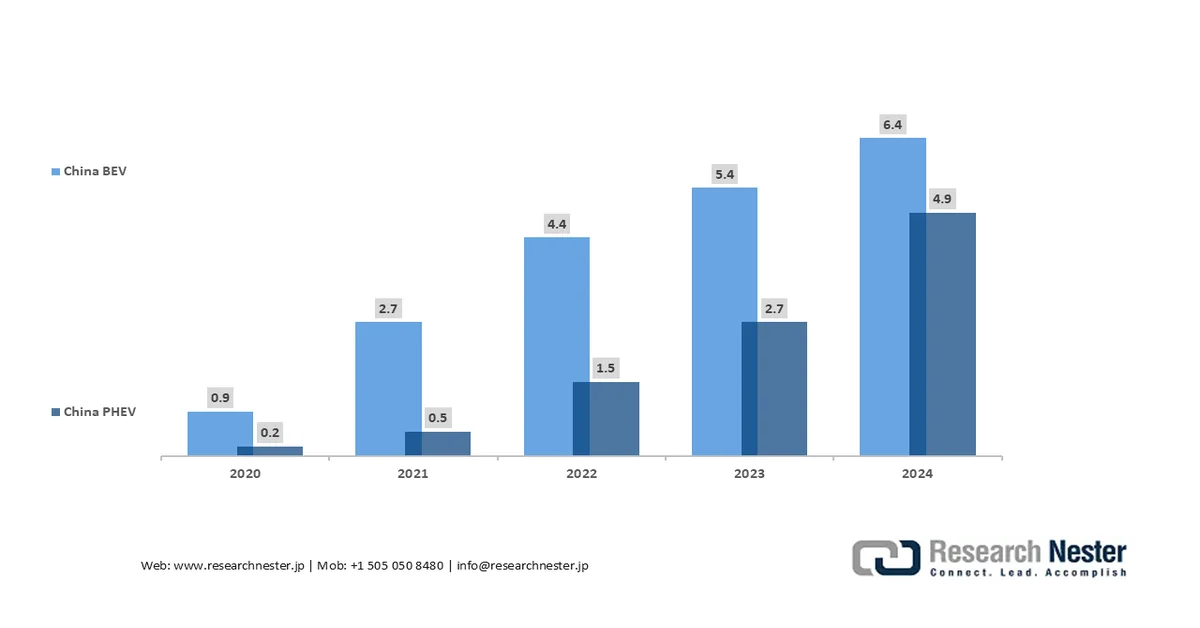
China is projected to maintain a dominant share in the polypropylene compounds market, driven by fast industrial growth, high levels of manufacturing output, and strong demand from end-use industries. Being a global hub for automotive and electronics production, China requires substantial amounts of durable, lightweight materials, including PP compounds. Building on this, in June 2024, LyondellBasell announced the start‑up of an additional polypropylene compounding line at its Advanced Polymer Solutions (APS) facility in Dalian, China, aimed at expanding its presence and capacity in the region. The new line, with an annual output of 20,000 tonnes, will roughly double the site’s existing production of high‑performance PP compounds, primarily for the automotive sector, helping the company better meet strong polypropylene compounds market demand. China’s large-scale production of polypropylene compounds is facilitated by low production costs, plentiful raw materials, and a mature chemical manufacturing base. Together with accelerating urbanization, rising household incomes, and government efforts to promote industrial sustainability, these factors ensure that China retains its top position globally. Moreover, rapid growth in China's electric vehicle industry is increasing demand for lightweight automotive materials, thereby boosting the use of polypropylene compounds in components such as bumpers, dashboards, and battery housings. Further, as China expands EV production, manufacturers are using more polypropylene compounds to reduce vehicle weight, improve efficiency, and support large-scale automotive manufacturing.
China Electric Car Sales, 2020-2024, Units in Million Cars
Source: IEA
India’s polypropylene compounds market is on the rise, backed by growing requirements from the automotive, electronics, construction, packaging, and consumer goods sectors. The increasing production of vehicles, especially electric cars, is promoting the use of lightweight and durable materials for interiors, bumpers, dashboards, and engine components. Rapid urban development and expansion in infrastructure projects are adding to construction-related demand, while the plastics processing industry is turning to value-added, high-performance PP compounds. Access to sufficient polypropylene feedstock, efficient manufacturing, and increasing utilization of recycled and specialty compounds are driving growth, positioning India as a top emerging market. To illustrate, in 2025, Bharat Petroleum Corporation Limited (BPCL) commissioned the Integrated Refinery Expansion Project (IREP) at its Kochi Refinery to boost refining capacity and enhance the production of value-added products, including propylene. The project is designed to improve efficiency, increase output, and meet growing domestic and international demand for petroleum derivatives.
Europe Market Insights
The polypropylene compounds market in Europe is anticipated to hold a share of 20.99% by 2036. The market is driven by shifts in plastics consumption, which are being driven by stricter regulations on sustainability and recycled content. Policies promoting packaging reuse, recycling, and the reduction of single-use plastics are raising demand for recycled polypropylene, encouraging processors to embrace circular feedstocks and modern compounding techniques. For example, in January 2026, INEOS Olefins & Polymers Europe introduced a new Recycl‑IN hybrid polypropylene grade featuring 70% recycled content, specifically designed for contact-sensitive cosmetics packaging. The rPP1025C resin delivers stiffness, heat resistance, and ease of processing comparable to virgin polypropylene, while reducing the carbon footprint by approximately 35%. It is ideal for manufacturing thin-walled caps, jars, spray heads, and other cosmetic components. Simultaneously, manufacturers in the automotive, packaging, and consumer goods sectors are seeking high-performance compounds that meet both regulatory standards and environmental expectations. Growing consumer interest in eco-friendly products, corporate commitments to sustainability, and government support for circular economy practices are further accelerating the move toward recycled and specialty PP materials, opening up new avenues for product innovation and market growth.
The polypropylene compounds market in Germany is set to grow strongly, led by the automotive sector’s rising use of lightweight, high-strength PP materials for dashboards, bumpers, and engine components. Growing environmental and sustainability requirements are fuelling demand for recycled and bio-based polypropylene, especially in the packaging and consumer products segments. With advanced chemical manufacturing, cutting-edge compounding techniques, and circular economy programs, Germany is emerging as a leading market for high-quality, regulation-compliant PP compounds across automotive, electronics, construction, and healthcare sectors.
The UK polypropylene compounds market for polypropylene compounds is poised for strong growth as demand rises in industries like automotive, packaging, and consumer products, where materials that are light, durable, and recyclable are increasingly preferred. Innovations in high-performance and tailor-made polypropylene compounds are widening their range of uses, while environmental targets and government regulations in the UK encourage the adoption of recyclable plastics. Factors such as urbanization, changing buying patterns, and the preference for lightweight components in cars and electronics are playing a key role in driving market growth.
North America Market Insights
North America's polypropylene compounds market will grow with a market share of 18.82% by 2036, propelled by the presence of a large and mature automotive industry where manufacturers increasingly use polypropylene compounds to make lighter, more fuel‑efficient vehicle parts. This boosts the consumption of engineered and specialty compound grades. The need for polypropylene is rising in packaging, consumer goods, construction, and electronics due to its strength, recyclability, and cost-effectiveness. In September 2025, the U.S.-based Formosa Plastics Corporation, owned by Taiwan’s Formosa Plastics Group, unveiled North America’s largest horizontal polypropylene reactor, featuring an annual capacity of 550 million pounds, at its Point Comfort, Texas site. Continuous innovation, strong R&D efforts, and a rising emphasis on recycled and eco-friendly materials are reinforcing North America’s market position and sustaining its sizable share of the global polypropylene compounds market.
Demand for polypropylene compounds in the U.S. is rising across multiple sectors, driving significant market growth. The automotive industry is at the forefront, using these compounds to create lightweight, resilient components that improve vehicle efficiency and electric vehicle range. Packaging applications also benefit from their durability, resistance to moisture, and design flexibility. Construction and infrastructure applications, including pipes, insulation, and fittings, are seeing growth due to active development projects. At the same time, innovations in material formulations and a push for sustainable, recyclable solutions are supporting wider acceptance of these compounds.
In Canada, the need for polypropylene compounds is increasing as industries, including automotive, packaging, construction, and consumer goods, rely more heavily on these materials. The packaging industry remains the main driver, while automotive applications are growing quickly owing to the benefits of lightweight, durable components. Rising construction activity also contributes to higher demand for polypropylene in pipes and insulation. At the same time, growth in domestic manufacturing and advances in compounding technology are providing a dependable supply of advanced polypropylene for specialized applications.
Key Polypropylene Compounds Market Players:
- LyondellBasell Industries Holdings B.V. (U.S.)
- SABIC (Saudi Arabia)
- Repsol S.A. (Spain)
- Sumitomo Chemical Co., Ltd. (Japan)
- Borealis GmbH (Austria)
- GS Caltex Corporation (South Korea)
- LOTTE Chemical Corporation (South Korea)
- TotalEnergies SE (France)
- LG Chem Ltd. (South Korea)
- Asahi Kasei Corporation (Japan)
- Tasnee (Saudi Arabia)
- Mitsui Chemicals, Inc. (Japan)
- Mitsubishi Chemical Group Corporation (Japan)
- Company Overview
- Business Strategy
- Key Product Offerings
- Financial Performance
- Key Performance Indicators
- Risk Analysis
- Recent Development
- Regional Presence
- SWOT Analysis
- LyondellBasell Industries Holdings B.V. is considered one of the leading producers of polypropylene compounds globally due to its large production capacity, advanced technologies, and strong global presence in the petrochemical industry. The company operates extensive polypropylene manufacturing and compounding facilities across North America, Europe, and Asia, enabling it to supply large volumes to multiple markets. It also invests heavily in research and development, allowing it to produce high-performance polypropylene compounds tailored for industries such as automotive, packaging, construction, and consumer goods.
- SABIC is a major player in the polypropylene compounds market due to its large-scale petrochemical production capacity, global manufacturing network, and strong focus on material innovation. The company produces a wide range of polypropylene compounds used in automotive, packaging, electrical, and consumer applications. Its continuous investment in research and development enables the development of high-performance and specialty polypropylene grades. In addition, SABIC’s extensive distribution network and partnerships with global manufacturers allow it to supply materials efficiently to customers worldwide, strengthening its position in the polypropylene compounds market.
- Repsol S.A. has established a strong presence in the polypropylene compounds market through its integrated petrochemical operations, advanced polymer production technologies, and continuous product innovation. The company manufactures a broad portfolio of polypropylene compounds designed for automotive, packaging, construction, and consumer applications. By investing in research and development and expanding its polymer production capabilities, Repsol has been able to develop high-performance and specialty grades that meet evolving industry requirements. Its well-established distribution network and collaborations with industrial customers further strengthen its position in the global polypropylene compounds market.
- Sumitomo Chemical Co., Ltd. is a key player in the global polypropylene compounds market due to its strong expertise in advanced polymer technologies and a broad portfolio of high-performance materials. The company produces specialized polypropylene compounds widely used in automotive, electronics, packaging, and industrial applications. Continuous investment in research and development enables it to create innovative materials with improved strength, durability, and heat resistance. In addition, its global production network and partnerships with major manufacturers help ensure consistent supply and strengthen its presence in the polypropylene compounds market.
Below is the list of the key players operating in the global polypropylene compounds market:
Prominent companies in the polypropylene compounds industry are supporting the market growth by strengthening production capabilities and securing a stable supply of high-quality materials. Many producers are introducing specialized formulations, including lightweight, heat-tolerant, and flame-resistant grades, which allow these materials to be used in a wider range of industries such as automotive, packaging, construction, and industrial manufacturing. Partnerships with manufacturers and end users also help companies design products that meet specific application requirements, strengthening their market position. In addition, firms are extending their presence into developing markets to reach new customers. Increased focus on recyclable and environmentally friendly materials is also promoting wider adoption of polypropylene compounds, contributing to ongoing polypropylene compounds market growth.
Corporate Landscape of the Global Polypropylene Compounds Market:
Recent Developments
- In September 2025, Borealis GmbH announced an investment of more than USD 118.53 million to establish a new polypropylene compounding line at its Schwechat facility in Austria. The unit is expected to start operations in the second half of 2026 and will add several tens of kilotons of production capacity. This expansion is also aimed at strengthening the company’s circular polypropylene compounds portfolio by incorporating post-consumer recycled materials.
- In December 2024, LG Chem Ltd. and Gevo expanded their agreement for the supply of bio-based propylene, reinforcing their partnership in advancing sustainable propylene sourcing and developing lower-carbon polymer solutions.
- Report ID: 8453
- Published Date: Mar 20, 2026
- Report Format: PDF, PPT
- Explore a preview of key market trends and insights
- Review sample data tables and segment breakdowns
- Experience the quality of our visual data representations
- Evaluate our report structure and research methodology
- Get a glimpse of competitive landscape analysis
- Understand how regional forecasts are presented
- Assess the depth of company profiling and benchmarking
- Preview how actionable insights can support your strategy
Explore real data and analysis
Frequently Asked Questions (FAQ)
About this Report
Connect with our Expert


Report, 2026-2036



Copyright @ 2026 Research Nester. All Rights Reserved.
