Green Polypropylene Market Outlook:
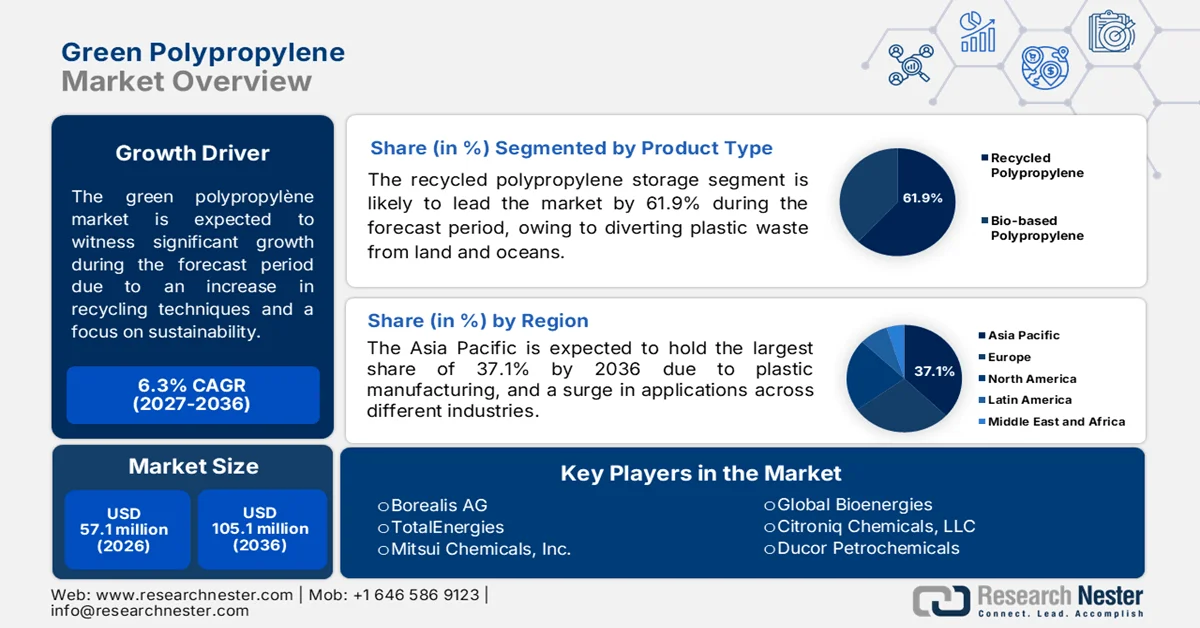
Green Polypropylene Market size was valued at USD 57.1 million in 2026 and is projected to cross USD 105.1 million by the end of 2036, expanding at more than 6.3% CAGR during the forecast period, i.e., 2027-2036. In 2027, the industry size of green polypropylene is estimated at USD 60.7 million.
The worldwide green polypropylene market is witnessing strong growth since industries are gradually moving towards sustainable materials to meet evolving customer demands and environmental regulations. This particular transformation is driven by renewable sources, plastic production, and suitable recycling processes. According to a data report published by the Center for Sustainable Systems in 2026, the global plastic shipment-based utilization effectively grew from 20 million tons to 460 million tons, and is further projected to reach 1,231 million tons by the end of 2060. Based on this, North America constitutes the highest yearly per capita plastic utilization at 139 kg, which represents 19% of global production and 21% of total utilization. Therefore, this increased plastic utilization and shipment have created a huge growth opportunity for the market’s exposure.
Country-Wise Plastic Export and Import, 2023
|
Country |
Export (USD Thousand) |
Import (USD Thousand) |
|
U.S. |
133,726,554.8 |
106,022,232.6 |
|
China |
85,325,769.5 |
141,309,848.2 |
|
Germany |
67,525,699.8 |
97,552,637.4 |
|
UK |
42,862,830.1 |
16,804,091.6 |
|
Mexico |
41,039,330.9 |
16,896,966.5 |
|
France |
37,180,569.6 |
30,176,914.0 |
|
Italy |
31,453,154.1 |
32,225,092.7 |
|
Canada |
29,020,719.3 |
21,055,006.4 |
|
India |
27,973,603.8 |
11,331,699.4 |
Source: WITS
Furthermore, the geopolitical supply chain reconfiguration, rapid commercialization of drop-in feedstock solutions, sustainable packaging transformation, institutional investments, and an escalation in chemical recycling facilities are a few trends that are responsible for driving the green polypropylene market’s growth. As stated in an article published by NLM in October 2022, 2% of plastic packaging materials are significantly recycled as packaging materials globally. In addition, 30% of plastic-specific packaging products are either too small or too complex to recycle, such as wrappers, small sachets, and multi-layered materials. Meanwhile, packaging materials are a suitable part of regular lives, owing to increased utilization in pharmaceuticals, restaurants, supermarkets, and grocery stores. Therefore, based on all these aspects, the market is continuously expanding across different nations.
Key Green Polypropylene Market Insights Summary:
Regional Highlights:
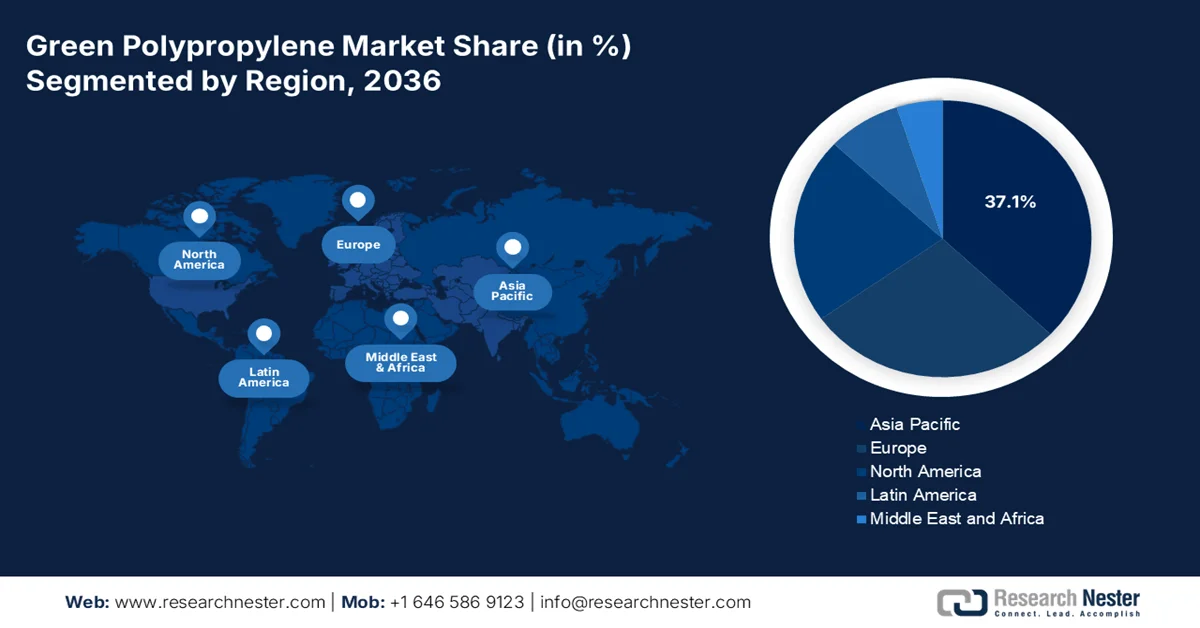
- Asia Pacific is projected to command a 37.1% share of the green polypropylene market by 2036, reinforced by its strong plastic manufacturing base, expanding consumer products, automotive, and packaging sectors, and advancing sustainability and recycling technologies
- North America is poised for the fastest growth with a 21.8% share during 2027-2036, underpinned by industry players, financial assistance programs, government incentives, and growing emphasis on sustainable chemical production and biomanufacturing
Segment Insights:
- Recycled polypropylene is projected to secure the leading 61.9% share of the green polypropylene market by 2036, supported by its importance in diverting durable plastic waste from oceans and landfills and conserving fossil fuels used in new plastic production
- Consumer goods are expected to account for a 49.1% share by 2036, propelled by mounting consumer awareness and shifting purchasing preferences toward sustainable household products
Key Growth Trends:
- Increase in bio-based plastics
- Expansion in automotive sector
Major Challenges:
- Complex and fragmented regulatory landscape
- Consumer skepticism and end-of-life ambiguity
Key Players: Mitsui Chemicals, Inc., Global Bioenergies, Citroniq Chemicals, LLC, Ducor Petrochemicals.
Global Green Polypropylene Market Forecast and Regional Outlook:
Market Size & Growth Projections:
- 2026 Market Size: USD 57.1 million
- 2027 Market Size: USD 60.7 million
- Projected Market Size: USD 105.1 million by 2036
- Growth Forecasts: 6.3% CAGR (2027-2036)
Key Regional Dynamics:
- Largest Region: Asia Pacific (37.1% Share by 2036)
- Fastest Growing Region: North America
- Dominating Countries: China, United States, Japan, Germany, South Korea
- Emerging Countries: India, Brazil, Canada, Australia, Singapore
Last updated on : 25 August, 2026
Green Polypropylene Market - Growth Drivers and Challenges
Growth Drivers
- Increase in bio-based plastics: The worldwide bioplastics production capacity is continuously expanding, which is positively driving the green polypropylene market’s growth. According to the 2026 Plastics Industry Association article, the global bioplastics industry accounts for more than 0.5% of 489 million tons of plastic production. Besides, the U.S.-based bioplastic resin production readily accounted for 0.7% of overall plastic production as of 2023, which is equivalent to 0.8 billion pounds of the total 125.5 billion pounds, making the country the second-largest worldwide producer of bioplastic resin. Simultaneously, the worldwide production of bioplastics is expected to increase by 48% yearly, and further reach 7.4 million tons by the end of 2028, thus positively driving the market growth.
- Expansion in automotive sector: The green polypropylene market is continuously gaining increased importance in the sector, especially in under-the-hood components, exterior parts, and interior components. Based on a data report published by the OICA in April 2026, there was a surge in global vehicle production from 92.7 million units as of 2024 to 96.4 million in 2025, indicating an increase of 3.9%. Likewise, global sales upsurged from 95.3 million units to 99.8 million units, demonstrating a 4.7% growth. Therefore, the sector’s upliftment is highly driven by meeting strict environmental regulations and lowering vehicle weight, based on which the plastics application is continuously expanding, thus demonstrating a huge growth and expansion opportunity for the market.
Challenges
- Complex and fragmented regulatory landscape: Navigating global sustainability certifications, standards, and labeling requirements presents a formidable challenge for the green polypropylene market. Besides, different jurisdictions enforce divergent definitions for what constitutes green, bio-based, or recycled, complicating cross-border trade and marketing strategies. The lack of harmonized life-cycle assessment methodologies often leads to accusations of greenwashing, eroding consumer and corporate trust. Additionally, producers must constantly monitor shifting regulatory frameworks regarding waste import bans and chemical safety thresholds. This regulatory fragmentation imposes hefty compliance costs and administrative burdens, diverting valuable resources away from research and product development.
- Consumer skepticism and end-of-life ambiguity: A profound lack of clarity persists among consumers and downstream brands regarding the actual environmental end-of-life of the green polypropylene market. Often, buyers are uncertain whether these materials are truly biodegradable, economically recyclable, or merely destined for the same incineration or landfill fate as conventional plastics. This genuine confusion breeds skepticism, undermining the perceived value proposition and willingness to pay a premium. Furthermore, the absence of dedicated recycling streams for these novel polymers frequently means that even well-intentioned products fail to complete their circularity loop. Moreover, without clear, universally understood disposal guidance, the environmental credibility of green polypropylene remains perpetually in question.
Green Polypropylene Market Size and Forecast:
| Report Attribute | Details |
|---|---|
|
Base Year |
2026 |
|
Forecast Year |
2027-2036 |
|
CAGR |
6.3% |
|
Base Year Market Size (2026) |
USD 57.1 million |
|
Forecast Year Market Size (2036) |
USD 105.1 million |
|
Regional Scope |
|
Green Polypropylene Market Segmentation:
Product Type Segment Analysis
Based on product type, the recycled polypropylene segment is anticipated to garner the highest share of 61.9% in the green polypropylene market by the end of 2036. The segment’s upliftment is primarily fueled by its importance in diverting various tons of durable plastic waste from oceans and landfills, and conserving the required fossil fuels for creating new plastic. As per an article published by NLM in June 2025, there was an increase in worldwide plastics production, indicating an estimated 400 million metric tons generated as of 2022, of which polypropylene accounted for almost 19% of overall output. Besides, the need for plastic materials remained high, especially in packaging, which accounted for 36.5% of total plastic consumption as of 2023. Additionally, in the same year, approximately 267.7 metric tons of plastic waste was produced, and only 9% was recycled, and the remaining was mismanaged, landfilled, and incinerated, thereby boosting the segment’s demand globally.
End user Segment Analysis
The consumer goods segment under end user is predicted to grab the second-highest share of 49.1% in the green polypropylene market by the end of the stipulated timeline. The segment’s development is highly propelled by mounting consumer awareness and shifting purchasing preferences toward sustainable household products. This end-user category encompasses a vast array of items, including storage containers, kitchenware, toys, luggage, and personal care packaging, all of which increasingly demand eco-friendly material alternatives. Moreover, brand owners across the consumer goods space are actively reformulating their product portfolios to incorporate recycled or bio-based polypropylene, responding to both regulatory pressures and evolving retail requirements. The segment benefits from the direct visibility of sustainability claims to end-consumers, who are progressively willing to prioritize environmentally responsible choices.
Application Segment Analysis
During the forecast period, the packaging application segment is expected to account for the third-highest share of 35.2% in the green polypropylene market. The segment’s growth is effectively driven by the aspect of protecting products from severe damage during transit, preserving freshness, communicating crucial ingredients and utilization information, along with acting as the most powerful marketing tool for attracting buyers. Based on an article published by the Journal of Cleaner Production in April 2024, the packaging sector significantly contributes to nearly 46% of plastic waste. This is owing to the prevalence of single-use plastics as packaging materials, with a short lifespan of less than 5 years. Meanwhile, the industry is considered India’s fifth-largest economic sector, which grew at a 26.7% yearly growth rate as of 2025, thus creating a huge growing opportunity for the segment.
Our in-depth analysis of the green polypropylene market includes the following segments:
|
Segment |
Subsegments |
|
Product Type |
|
|
End user |
|
|
Application |
|
|
Grade |
|
|
Production Process |
|

Vishnu Nair
Head - Global Business DevelopmentCustomize this report to your requirements — connect with our consultant for personalized insights and options.
Green Polypropylene Market - Regional Analysis
APAC Market Insights
The Asia Pacific green polypropylene market is anticipated to garner the highest share of 37.1% by the end of 2036. The market’s upliftment in the region is primarily attributed to the presence of plastic manufacturing sectors, rapid expansion of different end users, such as consumer products, automotive, and packaging, as well as sustainability promotion and recycling technologies. According to a data report published by OECD in July 2025, China presently accounts for almost 70% of the regional plastic utilization. Besides, the ASEAN Plus Three (APT) average plastic utilization per capita constitutes 67 kg, and this eventually ranges from only 29 kg, particularly in Indonesia, to more than 100 kg in Korea and Japan. Likewise, Singapore, Korea, and Japan tend to collect over 95% of municipal solid waste, thus proliferating the market’s growth in the region.
Plastic Utilization Per Capita in Asia, 2022
|
Location |
Plastics Use Per Capita (kg/cap) |
Plastic Intensity (kg/kUSD in PPP) |
GDP Per Capita (kUSD in PPP/cap) |
|
Thailand |
84 |
4.9 |
17 |
|
Rest of ASEAN (HIC & UMIC) |
132 |
3.4 |
39 |
|
Indonesia |
29 |
2.2 |
13 |
|
Rest of ASEAN (HIC) |
34 |
4.3 |
8 |
|
Japan |
102 |
2.5 |
41 |
|
Korea |
106 |
2.5 |
42 |
|
China |
73 |
3.8 |
19 |
|
ASEAN Average |
43 |
3.3 |
13 |
|
Plus Three Average |
77 |
3.5 |
24 |
|
APT Average |
67 |
3.5 |
19 |
|
World Average |
63 |
3.6 |
18 |
Source: OCED
The green polypropylene market in China is growing significantly, owing to the plastic production capacity, carbon neutrality objectives, strong waste-to-resource policies, substantial investment in chemical recycling, and the expansion of large-scale green production facilities. As stated in an article published by Environmental Science and Ecotechnology in May 2026, greenhouse gas emissions neutrality demands a 100% elimination of energy-based carbon dioxide emissions, in comparison to a 92% reduction under carbon dioxide neutrality. Moreover, non-carbon dioxide emissions need to be reduced by 60% despite 50%, while the technical requirement for carbon capture needs to be expanded from 1.3 to 1.9 gigatons of carbon dioxide. Therefore, to reach this particular target, there is the requirement for a 15% reduction in overall greenhouse gas emissions by the end of 2035 as well as an 85% reduction by 2050, thus positively impacting market growth.
The aspects of rapid industrialization, an increase in the demand for plastics, a surge in urbanization, and continuous growth in the middle class are gradually fueling the green polypropylene market in India. As per an article published by Plastics for Change Organization in September 2024, the country has significantly emerged as the highest contributor to plastic pollution, accounting for about 20% of total worldwide plastic waste. In addition, the nation’s contribution to the environmental catastrophe is larger compared to other nations, with 9.3 million tons of yearly plastic waste generation. Besides, of this, 3.5 million tons of plastic waste are readily leaked into the environment every year and mismanaged, which has surpassed other major polluters, including 2.8 metric tons in China, followed by 3.4 metric tons in Indonesia, and 3.5 metric tons in Nigeria, thus boosting the market exposure.
North America Market Insights
North America green polypropylene market is anticipated to emerge as the fastest-growing region, accounting for a 21.8% share during the forecast period. The market’s development is highly propelled by the presence of players, financial assistance programs, government incentives, and a focus on sustainable chemical production and biomanufacturing. As per the June 2024 National Association of Manufacturers article, the bioeconomy industry, especially in the U.S., effectively supports 644,000 national employment opportunities, which significantly contribute USD 210 billion to the gross national product, eventually driving USD 49 billion in wages. Meanwhile, biomanufacturing has gained importance in Minnesota, Nebraska, California, Iowa, and Illinois, thereby demonstrating a huge growth and expansion opportunity for the market in the overall region.
The green polypropylene market is gaining increased traction in the U.S., owing to robust recycling infrastructure, corporate sustainability commitments, outstanding breakthroughs in innovative recycling technologies, and the presence of stringent state-level regulatory policies. As stated in an article published by the Pennsylvania Chemical Industry Council in January 2026, the Recycling Technology Innovation Act is focused on amending the Clean Air Act to permit a few chemical recyclers as part of a petition to ensure a solid waste incineration unit, which is to be excluded from operations. Besides, the Federal Bill has aimed to reclassify the chemical recycling facility to ensure consistent regulatory processes throughout the country. In addition, this particular bill is also aligned with ACC-based reforms across 25 states for identifying chemical recycling as manufacturing.
The aspects of provincial and federal government funding and tactical investments, along with food-grade recycling, the integration of brand differentiation and sustainable practices, and generous funding in advanced manufacturing are a few trends that are bolstering the green polypropylene market in Canada. According to the September 2025 Government of Canada report, the Minister of Environment and Climate Change declared the provision of over USD 640,000 for supporting localized government research and capacity-building strategies for diminishing the amount of organic and food waste that is sent to landfills. Moreover, under the Waste Prevention and Diversion: Research and Capacity Building Fund, 5 cities in the country successfully received almost USD 150,000 for such projects, thereby making it suitable for fueling the market demand.
Europe Market Insights
Europe green polypropylene market is expected to garner a considerable share of 28.1% by the end of the stipulated timeline. The market’s growth in the region is effectively driven by consumer preference for eco-friendly products, stringent environmental regulations, sustainable chemical production, and generous investments in innovative recycling technologies and bioplastics. Based on an article published by NLM in August 2025, the plastic sector has aimed to increase recycling to 25% to 27% by the end of 2o3o. In addition, Plastics Europe is also focused on targeting a 46% recycling rate by 2040. Meanwhile, the bio-based product industry effectively employs 17.4 million people and also generates USD 684 billion. Therefore, with such growth in recycling and ensuring employment opportunities, there is a huge growing capacity for the market in the region.
The green polypropylene market in Germany is gaining increased exposure, owing to the existence of the largest chemical manufacturing facilities, government funds, partnerships between research institutions and industry, strong industrial infrastructure, and the commitment to reducing carbon emissions. According to an article published by the Carbon Brief Organization in February 2025, the adoption of the Fit for 55 package constitutes the ultimate target for lowering emissions to 55% by the end of 2030. Meanwhile, the European Commission has also proposed a 2040 target of reducing emissions to 90%. Moreover, the country has unveiled the Federal Climate Action Act, which is the first-ever national climate law, and includes a net-zero objective for 2045, thereby denoting a huge expansion opportunity for the market’s upliftment in the country.
The provision of ambitious government approaches, robust industrial collaborations, the promotion of energy efficiency, circular economy projects, focus on decarbonization, regulatory support, and tactical funding opportunities are a few factors for boosting the green polypropylene market in Spain. Based on an article published by ITA in July 2024, the country’s overall installed energy capacity surged by 4.9% as of 2022 and reached 119 GW. This particular increase is highly fueled by renewable energy, which witnessed a 9.1% increase in installed capacity. Besides, in terms of renewable capacity, photovoltaic energy observed the greatest increase, which grew by more than 22%, equivalent to 4.4 GW as of 2022. Simultaneously, wind has also gained importance by adding 4.95 GW of capacity, which positively contributes to market development.
Power Capacity Installation in Spain, 2022
|
Energy Type |
Capacity (MW) |
|
Wind |
29,994 |
|
Combined Cycle |
26,250 |
|
Solar PV |
19,785 |
|
Hydro |
17,094 |
|
Nuclear |
7,117 |
|
Cogeneration |
5,643 |
|
Fuel and Gas |
2,408 |
|
Solar Thermal |
2,304 |
|
Other Renewables |
1,093 |
|
Non-Renewable Waste |
426 |
|
Renewable Waste |
170 |
|
Hydro-Wind |
11 |
|
Total Renewable |
70,452 |
|
Total Non-Renewable |
48,639 |
|
Total |
119,091 |
Source: ITA
Key Green Polypropylene Market Players:
- Braskem (Brazil)
- LyondellBasell Industries N.V. (Netherlands)
- SABIC (Saudi Arabia)
- Borealis AG (Austria)
- TotalEnergies (France)
- Mitsui Chemicals, Inc. (Japan)
- Global Bioenergies (France)
- Citroniq Chemicals, LLC (U.S.)
- Ducor Petrochemicals (Netherlands)
- Company Overview
- Business Strategy
- Key Product Offerings
- Financial Performance
- Key Performance Indicators
- Risk Analysis
- Recent Development
- Regional Presence
- SWOT Analysis
- Braskem stands as a pioneering force in the green polypropylene market, leveraging its proprietary technology to produce bio-based polypropylene from renewable sugarcane feedstock. The company's portfolio has positioned it as a leader in sustainable polymer solutions, with strong market penetration across packaging, automotive, and consumer goods applications.
- LyondellBasell Industries N.V. competes aggressively in the green polypropylene space through its Circulen family of circular polymer solutions. The company differentiates itself through its extensive global manufacturing footprint and its ability to offer integrated circular solutions across multiple end-use sectors, including rigid packaging and automotive components.
- SABIC has established a robust presence in the green polypropylene market through its comprehensive TRUCIRCLE™ portfolio, which offers certified circular and renewable polymer solutions to diverse end-user industries. The company leverages its vast petrochemical infrastructure and strategic partnerships with upstream feedstock providers to scale sustainable polypropylene production for packaging, healthcare, and construction applications.
- Borealis AG positions itself as a key Europe-based player in the green polypropylene market, offering its Bornewables™ portfolio of renewable polypropylene. The company focuses on delivering high-performance circular polymer solutions to demanding sectors such as automotive, healthcare, and consumer products, leveraging its extensive research and development capabilities.
- TotalEnergies has strategically entered the green polypropylene market through its renewable product line, offering bio-based polypropylene grades that address growing demand for sustainable materials across Europe and beyond. The company combines its integrated energy and chemical expertise to develop renewable polymer solutions that serve packaging, automotive, and industrial end-markets.
Here is a list of key players operating in the global market:
The global green polypropylene market features a moderately consolidated competitive landscape, with large petrochemical conglomerates and specialized sustainability-focused manufacturers vying for market share. In addition, established multinationals leverage their extensive production infrastructure and global distribution networks to scale green polypropylene output, while specialized players differentiate themselves through proprietary bio-based feedstock technologies and niche market focus. Besides, in November 2025, Ducor Petrochemicals and Blue Circle Olefins effectively signed an agreement with the intention of co-marketing and producing segregated carbon recycled polypropylene and bio-polypropylene, thereby enhancing the green polypropylene industry’s growth and demand.
Corporate Landscape of the Market:
Recent Developments
- In January 2026, INEOS Olefins and Polymers Europe introduced the newest Recycl-IN hybrid polymer grade, which contains 70% of recycled material, specifically designed to bolster the sustainability of contract-based cosmetics packaging.
- In March 2025, Rialti unveiled the latest compound grades containing both post-consumer recycled (PCR) and post-industrial recycled (PIR) to offer a comprehensive alternative to primary materials.
- In April 2023, Lummus Technology and Citroniq Chemicals effectively signed a letter of intent (LOI) for the development of Citroniq’s green polypropylene projects, especially in North America.
- Report ID: 5957
- Published Date: Aug 25, 2026
- Report Format: PDF, PPT
- Explore a preview of key market trends and insights
- Review sample data tables and segment breakdowns
- Experience the quality of our visual data representations
- Evaluate our report structure and research methodology
- Get a glimpse of competitive landscape analysis
- Understand how regional forecasts are presented
- Assess the depth of company profiling and benchmarking
- Preview how actionable insights can support your strategy
Explore real data and analysis
Frequently Asked Questions (FAQ)
About this Report
Connect with our Expert


Report, 2027-2036



Copyright @ 2026 Research Nester. All Rights Reserved.
