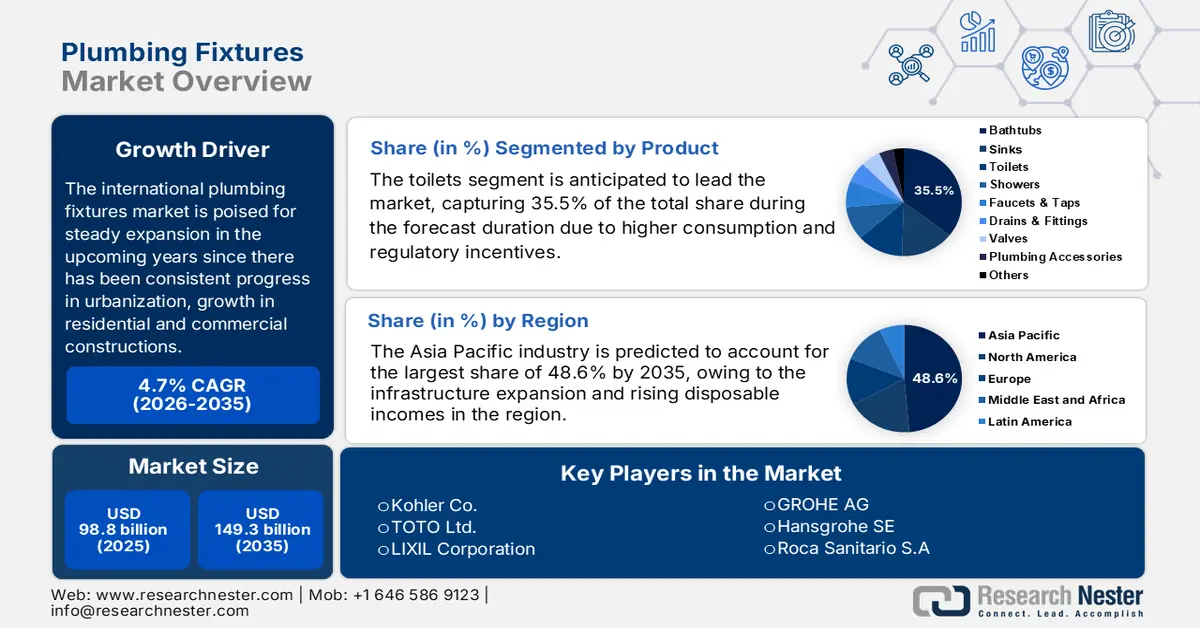
Plumbing Fixtures Market size was valued at USD 98.8 billion in 2025 and is projected to reach USD 149.3 billion by the end of 2035, rising at a CAGR of 4.7% during the forecast period, i.e., 2026-2035. In 2026, the industry size of plumbing fixtures is evaluated at USD 103.4 billion.
The international plumbing fixtures market is poised for steady expansion in the upcoming years since there has been consistent progress in urbanization, growth in residential and commercial constructions. In this context, the U.S. Census Bureau in September 2025 disclosed that in August 2025, privately-owned housing units authorized by building permits in the U.S. were at an annual rate of 1,312,000, which is seasonally adjusted, wherein the single-family authorizations were at 856,000, and units in buildings with five or more units were at 403,000. It also underscored that privately-owned housing starts surpassed 1,307,000 in August, which also includes 890,000 single-family starts and 403,000 multi-unit starts, and housing completions were reported at 1,608,000. Hence, these figures reflect continued robust construction activity across both single-family and multi-unit housing segments, supporting ongoing demand for residential infrastructure services such as plumbing fixtures.
Furthermore, the adoption of water-efficient and eco-friendly plumbing products is yet another trend that is rearranging the growth dynamics of the market. Governments, manufacturers, and consumers are progressively aligning with sustainability practices, thereby boosting the penetration of low-flow faucets, efficient toilets, and fixtures. As of June 2025, data from the U.S. Environmental Protection Agency, WaterSense is a voluntary label for water-efficient products, homes, and programs that use at least 20% less water while maintaining performance. It also partners with manufacturers, retailers, homebuilders, and utilities to promote water conservation and encourage innovation in manufacturing. In addition, the adoption of WaterSense-labeled fixtures and irrigation systems, both consumers and communities can reduce infrastructure strain and improve resilience against water shortages.