Photosensitive Polyimide Market Outlook:
Photosensitive Polyimide Market size was over USD 566.21 million in 2025 and is anticipated to cross USD 4.31 billion by 2035, growing at more than 22.5% CAGR during the forecast period i.e., between 2026-2035. In the year 2026, the industry size of photosensitive polyimide is assessed at USD 680.87 million.
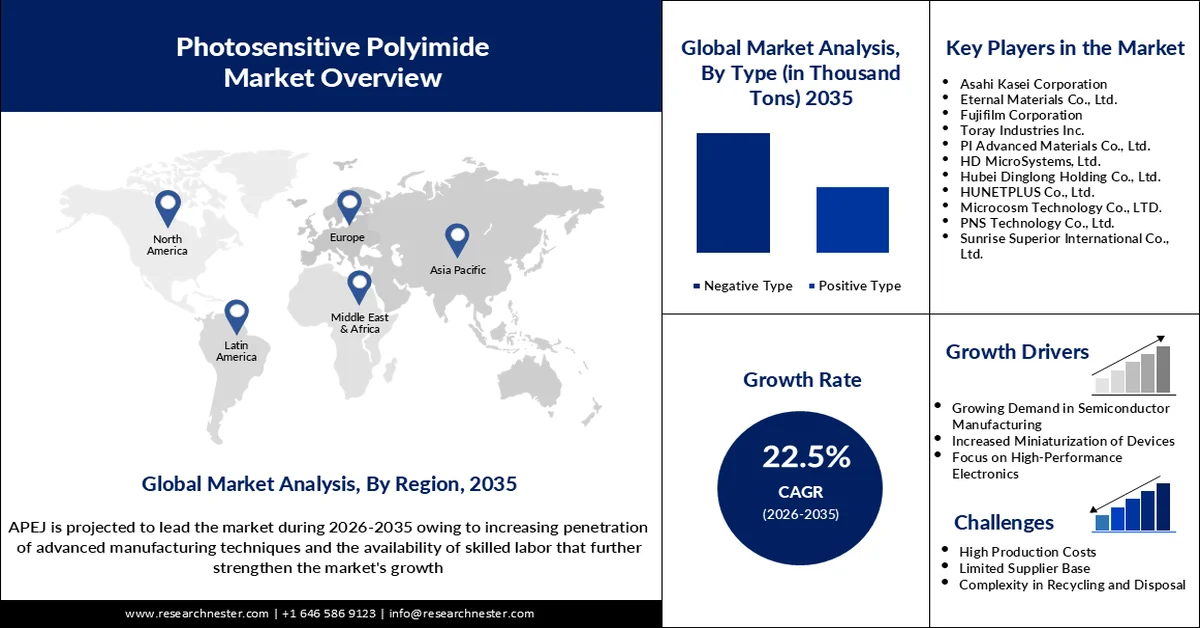
The photosensitive polyimide (PSPI) market is recording a significant growth rate due to the development of the electronics and semiconductor industries. These materials are crucial in developing flexible displays, chip packaging, and high-performance circuit boards. In June 2023, Arkema acquired a majority stake in PI Advanced Materials Co., Ltd., further strengthening its position in the sector. This acquisition marks the increasing demand for photosensitive polyimides in flexible displays and semiconductor applications. Governments around the world are also investing in technological advancements that enhance manufacturing processes, thus aiding market growth.
Other factors that might potentially give a considerable boost to the growth of the PSPI market include advanced material developments intended for 5G infrastructure and next-generation electronic device platforms. For instance, in December 2022, Taimide Tech developed value-added photosensitive polyimide film with SKC for flexible PCB applications. Such collaborations between the firms represent the urge to leverage innovation by responding to rising demand pressures. Also, regional initiatives pursued under governmental authority and support focus on boosting national production related to superior performance materials, solidifying the market's growth trajectory.
Key Photosensitive Polyimide (PSPI) Market Insights Summary:
Regional Highlights:
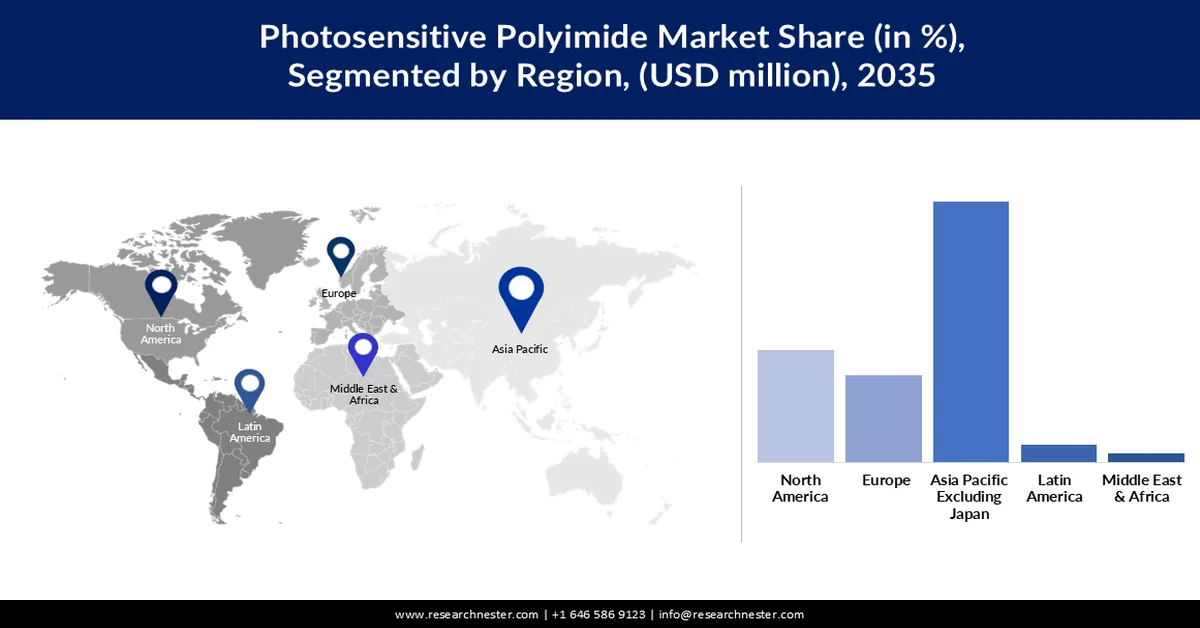
- The Asia Pacific photosensitive polyimide market is projected to command the largest share by 2035, impelled by rapid industrialization, rising investments in the semiconductor sector, and surging demand for flexible displays.
- North America is anticipated to witness growth of more than 10% during 2024-2035, attributable to growing demand for high-performance materials in electronics and the expansion of 5G infrastructure.
Segment Insights:
- The negative type segment of the photosensitive polyimide market is projected to reach 537 thousand tons by 2035, propelled by miniaturization and precision in manufacturing advanced electronics.
- The printed circuit boards segment is anticipated to attain around 396.6 thousand tons by 2035, driven by the growing demand from the automotive and consumer electronics sectors.
Key Growth Trends:
- Growing demand for flexible electronics
- Advances in semiconductor manufacturing
Major Challenges:
- Stringent regulatory requirements
- Inadequate manufacturing infrastructure in developing regions
Key Players: INES Oxide, The Dow Chemical Company, Ningbo Titan Unichem Co., Ltd., MOLBASE, Oxford Polymers, Devtaar GmbH, Merck KGaA, CHEMOS GmbH & Co. KG, Exxon Mobil Corporation, Fraunhofer-Gesellschaft.
Global Photosensitive Polyimide (PSPI) Market Forecast and Regional Outlook:
Market Size & Growth Projections:
- 2025 Market Size: USD 566.21 million
- 2026 Market Size: USD 680.87 million
- Projected Market Size: USD 4.31 billion by 2035
- Growth Forecasts: 22.5% CAGR (2026-2035)
Key Regional Dynamics:
- Largest Region: Asia Pacific
- Fastest Growing Region: North America
- Dominating Countries: United States, China, Japan, South Korea, Germany
- Emerging Countries: China, Taiwan, South Korea, Japan, Singapore
Last updated on : 25 February, 2026
Photosensitive Polyimide (PSPI) Market - Growth Drivers and Challenges
Growth Drivers
-
Growing demand for flexible electronics: With the increasing demand for flexible displays, wearable devices, and miniaturization of electronic gadgets, there has also been a growth in the need for photosensitive polyimide films. Excellent optical transparency, along with the thermal stability and flexibility of these films, makes them popular in advanced electronic applications. IST Corporation introduced a highly flexible polyimide film into the market to address the growing demand, especially for flexible printed circuits, in January 2023. This development is in line with the thrust towards lighter, smaller, and relatively compact electronic devices through innovation in flexible electronics and gives a further boost to the adoption of polyimide films.
- Advances in semiconductor manufacturing: The rapidly growing demand for high-performance materials due to advancements in semiconductor packaging continues to increase significantly. This includes photosensitive polyimides that improve precision and durability of semiconductor components as required in modern electronics. In December 2022, Toray Industries presented a polyimide coating material for increasing accuracy in processes related to semiconductors. This development underlines how photosensitive polyimides are at the heart of any progress in semiconductor technology. The segment has continued to increase its growth driven by innovation for the need of more effective and reliable electronic materials.
- 5G and high-frequency application growth: As the demand rises, so does the development and deployment of 5G networks. This demands suitable polyimide film products with various applications in high-frequency circuits. These films demonstrate better heat resistance and good signal integrity. These attributes have been of paramount importance to the 5G millimeter wave technology. In November 2020, Kaneka Corporation launched a super heat-resistant polyimide film called Pixeo IB that can be used for 5G technology. It exemplifies the increasing requirement for advanced materials to continue the development of wireless communication. As a result, with the increased speed of 5G adoption, the use of photosensitive polyimides in high-frequency applications becomes more prevalent, thus driving the market growth.
Challenges
-
Stringent regulatory requirements: Stringent regulatory requirements for environmental safety pose a serious threat to photosensitive polyimide market players. These regulations make the players follow strict standards on material usage and how production processes are carried out, including waste management. As a result, such measures complicate and raise manufacturing costs, especially for small players. The regulatory scrutiny involved with the development of new products and the pace at which companies can expand into newer markets is slowed down by all these hurdles limiting market growth.
- Inadequate manufacturing infrastructure in developing regions: The absence of significant advanced manufacturing infrastructure is a barrier to the adoption of high-performance photosensitive polyimides in several emerging markets. Most of these materials need highly sophisticated equipment and technical expertise, which is not necessarily available in developing regions. This condition limits the competitiveness of companies at the local level to compete in the global market and meet the increasing demand. Besides this, the high initial investment for establishing production facilities further restricts the growth of the market in these regions. These challenges reflect the gap in technological capabilities between developed and emerging markets, which further narrows the potential contribution of the latter to the global polyimide market.
Photosensitive Polyimide (PSPI) Market Size and Forecast:
| Report Attribute | Details |
|---|---|
|
Base Year |
2025 |
|
Forecast Year |
2026-2035 |
|
CAGR |
22.5% |
|
Base Year Market Size (2025) |
USD 566.21 million |
|
Forecast Year Market Size (2035) |
USD 4.31 billion |
|
Regional Scope |
|
Photosensitive Polyimide (PSPI) Market Segmentation:
Type Segment Analysis
The negative type segment is expected to dominate the photosensitive polyimide market and garner a value of 537 thousand tons by 2035, due to miniaturization and precision in manufacturing advanced electronics. Excellent chemical resistance and superior thermal stability have promoted the applications of negative type polyimides in semiconductor fabrications. In February 2023, UBE Industries launched a chemical-resistant polyimide film that can be used in high-performance semiconductor applications. This new launch depicts the increasing application of negative-type polyimides in newer technologies and strengthens their importance in the market.
Application Segment Analysis
The printed circuit boards segment in photosensitive polyimide (PSPI) market is projected to reach a value of around 396.6 thousand tons by the end of the forecast period due to the growing demand from the automotive and consumer electronics sectors. Among these, flexible PCBs are highly in demand because of their flexibility and the facilitation of compact electronic designs. Furthermore, the increased demand for lightweight and long-lasting materials in next-generation devices further supports segment growth. In May 2022, DuPont expanded its Kapton production facilities to meet the growing demand for flexible PCBs, underlining the usage of photosensitive polyimides in this application. The market for the PCB continues to head towards further growth as industries seek innovation and higher efficiency in electronic components.
Our in-depth analysis of the global photosensitive polyimide market includes the following segments:
|
Type |
|
|
Application |
|
|
End use Industry |
|

Vishnu Nair
Head - Global Business DevelopmentCustomize this report to your requirements — connect with our consultant for personalized insights and options.
Photosensitive Polyimide (PSPI) Market - Regional Analysis
Asia Pacific Market Insights
The Asia Pacific photosensitive polyimide market is set to account for largest share by 2035, due to rapid industrialization, rising investments in the semiconductor sector, and a surge in demand for flexible displays. Strong electronics manufacturing hubs and favorable government initiatives to promote local production in APAC support its dominance. Due to its stronghold over global supply chains, the region will continue to dominate the market.
India is the fastest-growing market for photosensitive polyimide, mainly due to the government's support in terms of policy initiatives such as Make in India with regard to encouraging domestic electronics manufacturing. Significant opportunities arise because of the booming domestic semiconductor and display manufacturing industry. The establishment of manufacturing facilities by global companies through partnerships further accelerated market growth in India. These are some major reasons why India stands as a significant contributor to the regional market, fulfilling both the demand in domestic consumption and export demand.
China dominates the APAC photosensitive polyimide (PSPI) market due to its massive electronics manufacturing ecosystem coupled with substantial investments across advanced technologies. In September 2022, PI Advanced Materials decided to extend its production in South Korea, which indirectly benefits supply chain in China. China is leading due to flexible display production and rising efforts to integrate polyimide solutions into high-tech applications. Because of strong government support and infrastructure, China remains very important in the global marketplace.
North America Market Insights
In photosensitive polyimide market, North America region is poised to exhibit growth of more than 10% between 2024 and 2035, with growing demand for high-performance material in electronics and the development of 5G infrastructure. Innovation and local manufacturing strategies ensure that the region can compete on a global scale. Increasing investments in R&D and production capacity are also key drivers, reflecting the commitment of North America toward meeting the rising demand in various applications like semiconductors and flexible displays.
The U.S. leads the North America photosensitive polyimide market due to its strong electronics and semiconductor industries. Companies like DuPont contribute significantly to market growth by making considerable investments in their production facilities. In February 2021, DuPont announced USD 220 million as part of expanding its production facility manufacturing Kapton polyimide. This acts as proof that the country lays high emphasis on next-generation technologies for electronics and telecommunication. The U.S. also leads owing to a robust ecosystem for research and collaboration with key industry players across the globe.
Canada photosensitive polyimide (PSPI) market is anticipated to be lucrative for players due to a rising focus on conserving ecological balance and bringing sustainability to electronic products by developing sophisticated materials. The country's emphasis on building its manufacturing ecosystem, aligned with the global trend, allows domestic players to gain a foothold in value applications. Joint efforts by companies in Canada and other countries drive the market forward. While much smaller in scale compared to the U.S., Canada accounts for an important share of the North America photosensitive polyimide market, particularly with respect to new applications such as flexible electronics.
Key Photosensitive Polyimide (PSPI) Market Players:
- Asahi Kasei Corporation
- Company Overview
- Business Strategy
- Key Product Offerings
- Financial Performance
- Key Performance Indicators
- Risk Analysis
- Recent Development
- Regional Presence
- SWOT Analysis
- Eternal Materials Co., Ltd.
- Fujifilm Corporation
- Toray Industries Inc.
- PI Advanced Materials Co., Ltd.
- HD MicroSystems, Ltd.
- Hubei Dinglong Holding Co., Ltd.
- HUNETPLUS Co., Ltd.
- Microcosm Technology Co., LTD.
- PNS Technology Co., Ltd.
- Sunrise Superior International Co., Ltd.
The PSPI market is highly competitive with leading vendors such as Asahi Kasei Corporation, Fujifilm Corporation, Toray Industries Inc., and PI Advanced Materials Co., Ltd. These companies are making serious R&D investments in the development of various advanced material variants that cater to the emergence of technologies supporting flexible electronics and semiconductors. Strategic collaborations, acquisitions, and product expansion are some of the strategies employed by leading players in the market aimed at retaining respective positions. Furthermore, this competitive scenario is becoming all the more driven on account of growing demand related to 5G infrastructures and display technologies in recent years.
In June 2023, Arkema acquired a majority stake in PI Advanced Materials, consolidating its strategic position in high-growth electronics markets regarding flexible displays and semiconductor applications. The deal also underlines the competitive dynamics in the industry, as companies use acquisitions to enhance their technology offerings. This investment also underlines the need to be at the forefront of material science to meet the demands of constantly changing markets. Moreover, such steps demonstrate the increasing demand for photosensitive polyimides within advanced electronic applications.
Here are some leading companies in the PSPI market:
Recent Developments
- In February 2024, IST Corporation unveiled TORMED, a new photosensitive polyimide film tailored for applications in flexible electronic products and high-precision circuitry boards. The innovation addresses the growing need for lightweight, durable, and high-performance materials in next-generation electronics. The film’s enhanced photosensitivity ensures optimal patterning capabilities for complex designs.
- In March 2023, DuPont expanded its photosensitive polyimide film production capacity in Japan to meet growing demand from the electronics and automotive industries. The expansion will ensure a stable supply of high-quality films for applications such as OLED displays, advanced packaging, and flexible circuits.
- Report ID: 6790
- Published Date: Feb 25, 2026
- Report Format: PDF, PPT
- Explore a preview of key market trends and insights
- Review sample data tables and segment breakdowns
- Experience the quality of our visual data representations
- Evaluate our report structure and research methodology
- Get a glimpse of competitive landscape analysis
- Understand how regional forecasts are presented
- Assess the depth of company profiling and benchmarking
- Preview how actionable insights can support your strategy
Explore real data and analysis
Frequently Asked Questions (FAQ)
About this Report
Connect with our Expert


Report, 2026-2035



Copyright @ 2026 Research Nester. All Rights Reserved.
