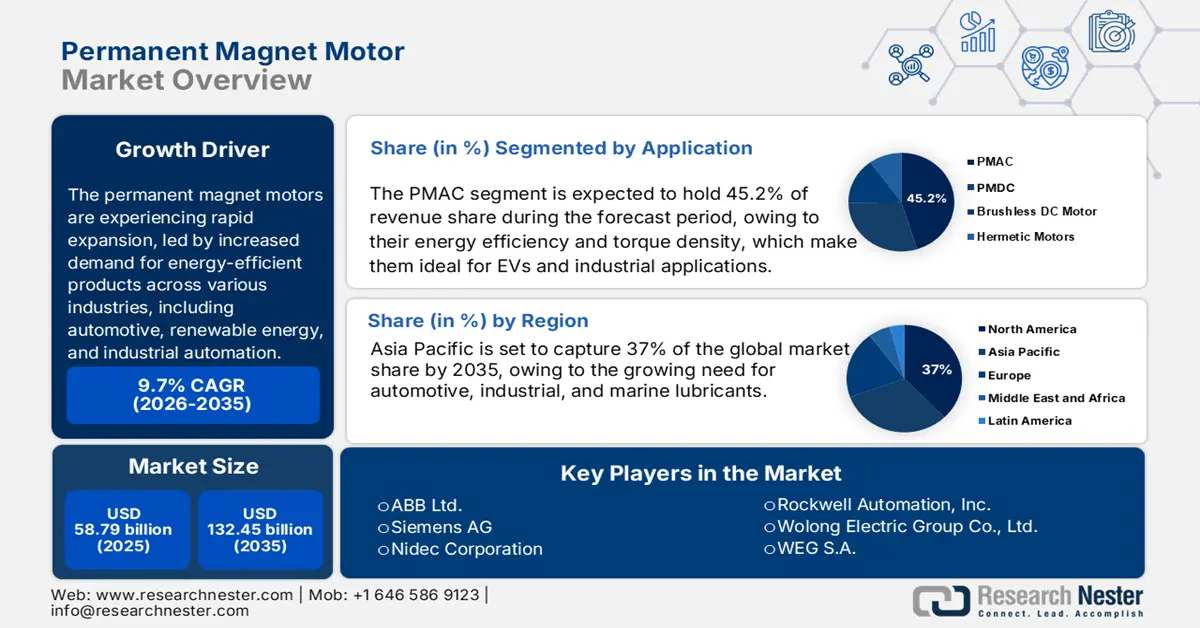
Permanent Magnet Motor Market Outlook:
Permanent Magnet Motor Market size was valued at USD 58.79 billion in 2025 and is projected to reach USD 132.45 billion by the end of 2035, rising at a CAGR of 9.7% during the forecast period, i.e., 2026-2035. In 2026, the industry size of permanent magnet motor is assessed at USD 61.80 billion.
The global market for permanent magnet motors (PMMs) is experiencing rapid growth, driven by increasing demand for energy-efficient products across various industries, including automotive, renewable energy, and industrial automation. PMMs depend on a supply chain that utilizes rare-earth elements such as neodymium and dysprosium, among others, which are typically sourced from China. For instance, China imports rare earths from other nations and processes them, producing 60% of the world's rare earths while processing roughly 90% of them. A recent U.S. Department of Commerce report indicates a pressing national security issue with the level of import dependency due to the manufacture of neodymium-iron-boron (NdFeB) magnets in the U.S. The United States imported 75% of its supply of sintered NdFeB magnets from China in 2021. This has prompted the U.S. government to provide funding for domestic magnet production and the sourcing of recycling technology.
The import and export nature of PMM also has a significant effect. For instance, the U.S. heavily imports NdFeB magnets from China, which dominates the global market partly due to the availability of raw materials. Furthermore, global trade shapes the growth of industries in areas that seek to expand businesses to address the necessity of supply chain disruptions or shortages following the COVID pandemic. Forecasts indicate U.S. domestic production of NdFeB magnets could meet as much as 51% of national demand by 2026. Investments in technology development are considerable, with the U.S. supporting programs to develop NdFeB magnet production and human capital development for materials scientists and production line workers.