Permanent Magnet Motor - Regional Analysis
North America Market Insights
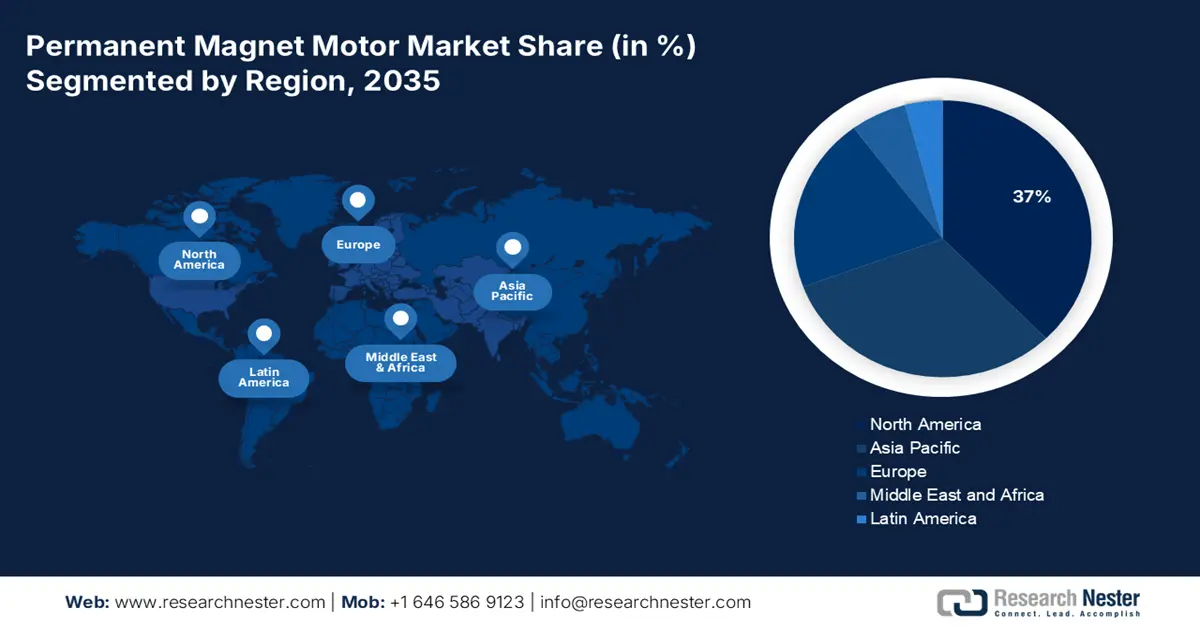
The North American market is poised to hold a revenue share of 37% by 2035, led by the government initiatives that support digital infrastructure and clean energy. The National Telecommunications and Information Administration (NTIA) indicated that around USD 42.45 billion was set aside in the Portioning Explain and Ladder your Path (BEAD) program for extending digital infrastructure until 2030. These initiatives indirectly drive the demand for PMM systems due to increased workloads that develop in data centers, 5G towers, and smart grid systems. Furthermore, the rising number of electric vehicles (EVs) also contributes to market expansion.
Additionally, demand for permanent magnet motors has been increasing in the U.S. due to investments in smart infrastructure and a targeted federal funding approach. The deployment of fiber optic broadband conduit infrastructure has increased the application of PMMs in that area. The Federal Communications Commission (FCC) has also indicated that deployment of spectrum under the planning 5G initiatives will increase the application of PMMs in connectivity technology with respect to cooling systems, antenna actuators, and telecom modules. Furthermore, the U.S. Department of Energy has made investments to ensure PMM growth in the U.S. while promoting domestic production of components pertaining to EV motors through the use of the Advanced Technology Vehicles Manufacturing Loan Program.
The growth of Canada's permanent magnet motor sector is attributed to increased investment in renewable energy projects, the electric car market, and advances in smart manufacturing. Federal clean energy policies, as well as incentivizing programs at the provincial level, help to accelerate the uptake of energy-efficient motors across industrial sectors. Local research collaboration paired with the avoidance of reliance on rare-earth materials is being explored to mitigate supply-chain risk. The increasing uptake of automation in several sectors, such as mining, forestry, and transportation, continues to drive demand, while collaboration with U.S. technology vendors supports innovation and sustainable development of permanent magnet motor applications.
Asia Pacific Market Insights
The Asia Pacific permanent magnet motor market is poised to hold a revenue share of 31% throughout the forecast period. The growth is driven by the increased adoption of electric vehicles (EVs) and large-scale investment in information and communication technologies (ICT). China held over 92% of the world market for NdFeB magnets and magnet alloys in 2020. With roughly 58% of the rare earth mining industry, 89% of the oxide separation market, and 90% of the metallization market, China also controlled the 2020 upstream value chain phases. As of 2023, millions of businesses had made PMM-integrated technologies available within their business plans.
India is predicted to emerge as the region with the highest CAGR in the Asia Pacific permanent magnet motor market. Growth in this sector can be attributed to the expansion of digital infrastructure and strong government support. NFTDC’s advanced rare-earth materials expertise and MAM’s strengths in mining, powder metallurgy, e-mobility, and financing drive a TRL-9 plant targeting 500 TPY magnets, scaling to 5,000 TPA by 2030 for self-reliance. The Smart Cities Mission has implemented PMM-based heating, ventilation, and air conditioning (HVAC) and transport automation in more than 90 cities. Several government initiatives, including Digital India and the Production Linked Incentive (PLI) scheme, support local PMM manufacturing and R&D. India is expected to see market growth, additionally, based on the significant expansion of the local electric vehicle market and a noted contribution from NASSCOM in AI-optimized PMM-driven data centers.
The permanent magnet motor market in China has flourished due to its manufacturing base and advanced development in the electronics sector. As electric vehicle output grows, renewable energy projects expand, and industrial automation progresses, demand for permanent magnet motors will grow as well. China's proportion of worldwide electric car sales surged in 2024, with sales of electric cars rising by about 40% year over year. China sold half of the world's electric cars in 2021, and by 2024, that number had increased to over two-thirds. The country's institutional support, robust research capabilities, and large-scale infrastructure development will enable an ongoing cycle of technological advancement, which will further consolidate China's role as a global leader in the production and application of permanent magnet motors.
Europe Market Insights
The European permanent magnet motor market is poised to hold a significant share throughout the forecast period. The European permanent magnet motor market is aided by high industrial automation, renewable energy sources, and electric mobility initiatives. Supporting EU policies focusing on energy efficiency and reducing carbon emissions incentivizes adoption for the manufacturing, automotive, and robotics sectors. An increase in the demand for high-performance motors in wind energy applications and HVAC applications will build demand for a growing market. It is forecasted that increasing R&D collaboration and regional expertise in precision engineering will cultivate opportunities in more sophisticated motor technologies and foster ongoing market growth across a diverse range of applications.
In Germany, the robust automotive, industrial automation, and renewable energy industries drive the demand for permanent magnet motor technologies. The government's commitment to energy efficiency and electrification will open up space for innovation and new products in the field of high-performance motors. As well, Germany's extensive engineering experience and the sustainability agenda provided by the government indicate that new applications of PM motors in electric vehicles, robotics, and advanced manufacturing will be drafted. Germany ended its €4,500 EV subsidy in December 2023, causing a 4-point market share drop in 2024, prompting new corporate EV tax incentives from July 2024 to 2028.
The market for permanent magnet motors in the UK is growing through government initiatives to support the electrification of transportation, offshore wind projects, and improvements in industrial efficiencies. Government policy supports low-carbon technologies and advanced manufacturing that drives permanent magnet motors across the transportation sector (automotive, aerospace, and marine). An innovation ecosystem composed of research collaboration as well as start-up activity supports the development of high-efficiency motors. Sales of electric cars increased from 24% in 2023 to approximately 30% in the UK, the second-largest automobile market in Europe. The Vehicle Emissions Trading Scheme was first implemented in 2024, requiring 22% of all new registrations to be fuel cell electric vehicles (FCEVs) or BEVs.