Patient Lateral Transfer Market Outlook:
Patient Lateral Transfer Market size was valued at USD 394 million in 2025 and is anticipated to grow to USD 794.2 million by 2035, registering a CAGR of 8.1% during the forecast period, i.e., from 2026 to 2035. In 2026, the industry size of patient lateral transfer is assessed at USD 425.9 million.
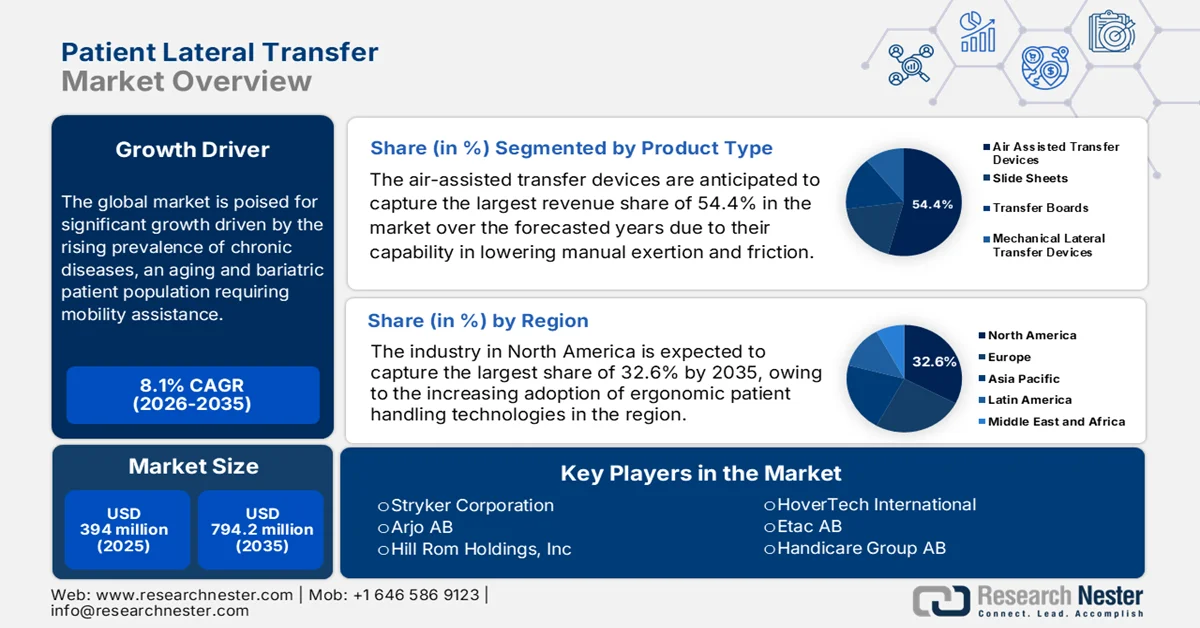
The patient lateral transfer market is projected to witness noteworthy growth driven by the rising prevalence of chronic diseases, an aging and bariatric patient population requiring mobility assistance. According to the article published by the World Health Organization in October 2025, global population ageing is accelerating, and the portion of people aged 60 and older is expected to double by 2050, especially in low- and middle-income countries. The report states that ageing brings both opportunities and challenges, as physical and mental capacities vary and health outcomes are influenced by social, economic, and environmental factors. Besides the common age-related conditions, such as chronic diseases and geriatric syndromes, highlight the importance of supportive environments to maintain functional ability, denoting a huge opportunity for the market’s growth and exposure.
As healthcare facilities continue investing in advanced lateral transfer equipment to enhance the quality of care and meet safety compliance, the patient lateral transfer market is expected to remain dynamic, with ongoing product development and regional uptake, which are reshaping future demand trends. In February 2023, Bruyère Health adopted Able Innovations’ ALTA Platform, which is a robotic patient transfer device especially designed to ease the burden of lateral transfers in complex care units. The technology is developed by Canada-based entrepreneurs, and it automates one of healthcare’s most labor-intensive tasks, reducing staff strain and improving patient comfort. Hence, such instances underscore a clear trend toward automation and ergonomics-driven solutions, denoting a lucrative opportunity for the market to grow in the upcoming years.
Key Patient Lateral Transfer Market Insights Summary:
Regional Highlights:
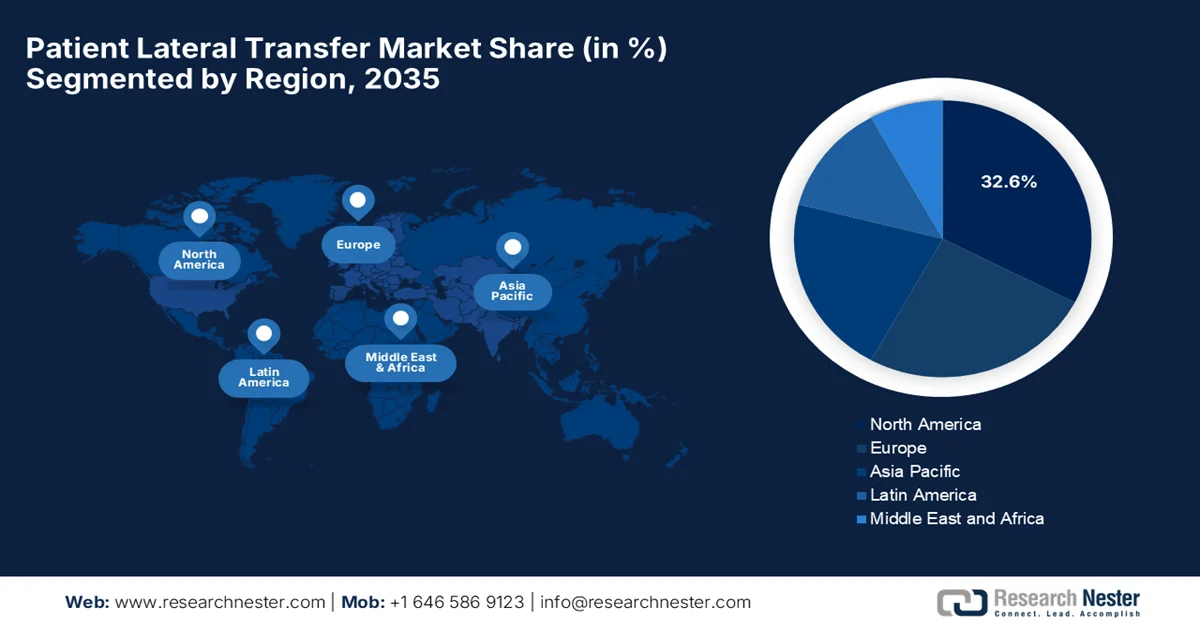
- North America patient lateral transfer market is projected to hold a dominant 32.6% share by 2035, attributed to advanced healthcare infrastructure and increasing adoption of ergonomic patient handling technologies
- Asia Pacific is poised to witness the fastest growth in the forecast period 2026–2035, fueled by a rapidly aging population and expanding healthcare infrastructure in emerging economies
Segment Insights:
- Air-assisted transfer devices segment in the patient lateral transfer market is expected to account for a 54.4% share by 2035, propelled by their ability to reduce manual exertion and friction
- Reusable devices segment is anticipated to secure a considerable share by 2035, owing to rising preference for long-term cost efficiency and durability in high-volume clinical environments
Key Growth Trends:
- Growth of healthcare infrastructure
- Bariatric & high‑need patient groups
Major Challenges:
- Patient safety concerns
- Maintenance and durability issues
Key Players: Stryker Corporation (U.S.), Arjo AB (Sweden), Hill-Rom Holdings, Inc. (U.S.), HoverTech International (U.S.), Etac AB (Sweden), Handicare Group AB (Sweden), Getinge AB (Sweden), McAuley Medical, Inc. (U.S.), Drive DeVilbiss Healthcare (U.S.), Patient Positioning Systems LLC (U.S.), EZ Way, Inc. (U.S.), Invacare Corporation (U.S.), Blue Chip Medical Products, Inc. (U.S.), Haines Medical Australia Pty Ltd (Australia), Samarit Medical AG (Switzerland), Airpal, Inc. (U.S.), Air-Matt, Inc. (U.S.), Benson Medical (U.S.), The Patient Company (U.S.), Karma Healthcare Ltd. (India), Wellell (Taiwan), Prism Medical Ltd. (UK).
Global Patient Lateral Transfer Market Forecast and Regional Outlook:
Market Size & Growth Projections:
- 2025 Market Size: USD 394 million
- 2026 Market Size: USD 425.9 million
- Projected Market Size: USD 794.2 million by 2035
- Growth Forecasts: 8.1% CAGR (2026-2035)
Key Regional Dynamics:
- Largest Region: North America (32.6% Share by 2035)
- Fastest Growing Region: Asia Pacific
- Dominating Countries: United States, Germany, Japan, United Kingdom, Canada
- Emerging Countries: China, India, South Korea, Brazil, Mexico
Last updated on : 26 March, 2026
Patient Lateral Transfer Market - Growth Drivers and Challenges
Growth Drivers
- Growth of healthcare infrastructure: The rapidly expanding hospital networks, rehabilitation centers, and home healthcare demand in emerging economies contribute to the widespread adoption of patient lateral transfer solutions. In this context, the article published by WHO in October 2023 stated that investing in modern, safe, and environmentally friendly health infrastructure is highly essential to achieve universal health coverage. Such investments strengthen trust in public services, improve resilience to epidemics and climate hazards, and promote economic sustainability. On the other hand, policymakers need to plan for retrofitting and maintaining facilities by aligning with workforce development to meet the extensive future demands. Strategic infrastructure planning ensures health systems are responsive and capable of adapting to technological and demographic changes, thus driving the overall patient lateral transfer market.
- Bariatric & high‑need patient groups: The rising burden of obesity, along with bariatric care needs, is efficiently boosting demand for patient transfer products that can support higher weight capacities safely and effectively. According to an article published by WHO in December 2025, one out of every eight were living with obesity in 2022, whereas in the adult age group, the obesity rates have doubled from the previous three decades. In addition, the article also stated that 2.5 billion adults, i.e., 18 and above, were overweight, whereas 890 million were living with obesity. On the other hand, childhood obesity is surging, wherein 35 million children who were below the age of 5 were overweight in 2024, thus reflecting a huge growth potential for the global patient lateral transfer market.
- Rising hospitalization & surgical admissions: The burgeoning hospitalization rates, such as increased acute care admissions, necessitate patient repositioning and transfers more frequently, which are sustaining equipment demand. International Federation for the Surgery and Other Therapies for Obesity reported that in 2023, more than 500,000 metabolic and bariatric surgeries were performed across 24 countries and 2 regional registries, covering 81.4% of known registries, thus reflecting the global rise in surgical interventions for obesity. Besides, this data showcases increasing patient diversity, evolving procedure types, and improved access to care, indicating the presence of safer and more standardized practices when compared to historical techniques. Hence, with these growing surgical volumes, the patient lateral transfer market is expected to witness unprecedented growth in the years ahead.
Challenges
- Patient safety concerns: This is the major obstacle that is responsible for hindering the expansion of the patient lateral transfer market. The aspects of improper use and functionality issues in the equipment can strain the elderly or immobile patients. Also, a few patients experience discomfort during the transfers, which reduces compliance there by complicating care routines. In this context, hospitals need to adopt strict measures on risk and safety protocols, which include regular inspection and staff certification programs. Therefore, the extensive need to minimize liability and maintain high standards of care ultimately slows adoption, especially in facilities that lack safety infrastructure. Furthermore, addressing safety concerns through design improvements, training, and rigorous standards is highly essential for the patient lateral transfer market to expand.
- Maintenance and durability issues: The patient lateral transfer devices require proper maintenance and inspection for a safe and effective operation. These devices, since they are used frequently, may experience wear and tear, leading to functionality issues or downtime. Also, the aspect of replacement parts can be expensive and sometimes have long lead times, particularly for imported devices. Failure to maintain equipment properly increases the risk of patient and staff injuries. Hospitals need to implement maintenance schedules and train biomedical staff to handle repairs efficiently. In this context, the need for continued technical support and replacement parts is again expensive, and that can create hesitation among small-scale healthcare facilities from investing in the patient lateral transfer market.
Patient Lateral Transfer Market Size and Forecast:
| Report Attribute | Details |
|---|---|
|
Base Year |
2025 |
|
Forecast Year |
2026-2035 |
|
CAGR |
8.1% |
|
Base Year Market Size (2025) |
USD 394 million |
|
Forecast Year Market Size (2035) |
USD 794.2 million |
|
Regional Scope |
|
Patient Lateral Transfer Market Segmentation:
Product Type Segment Analysis
The air-assisted transfer devices sub-segment is anticipated to capture the largest revenue share of 54.4% in the patient lateral transfer market over the forecasted years. Their capability in lowering manual exertion and friction is the main factor that is driving this dominance. In April 2022, AliMed introduced its PPS glide air-assisted lateral transfer system, which is especially designed to reduce pull force and allow safe patient transfers with only two staff members, thereby minimizing injury risk and improving patient comfort. The device utilizes air-assisted technology that creates a cushion of low-pressure air, enabling smoother transfers for patients up to 1,200 lbs. Hence, such innovation addresses staffing shortages and rising workplace injuries in healthcare, making lateral transfers safer and less physically demanding, particularly in terms of high-risk areas such as operating and emergency rooms.
Usage Type Segment Analysis
In terms of usage type, the reusable devices are expected to grow with a considerable share in the patient lateral transfer market by 2035. The segment’s growth is largely attributable to rising preference in high-volume clinical environments for their long-term cost efficiency and durability. As per the official press release, from 2023 to 2024, Xodus Medical expanded its reusable patient lateral transfer solutions with the Pink Pad Air-Assist and its new variations in order to address the high-BMI and complex surgical positioning needs. These lift-free devices are designed for repeated use, improving patient safety, staff ergonomics, and long-term cost efficiency in high-volume clinical environments. Hence, with such innovative approaches, the segment is positioned for strong growth globally since there has been an increased adoption in healthcare facilities for a reliable patient transfer solution.
End user Segment Analysis
Hospitals, which are a part of the end user segment, are predicted to grow with a significant revenue share in the patient lateral transfer market during the stipulated timeframe. Hospitals have the highest frequency of patient transfers who require ergonomic and safety-compliant devices, positioning themselves at the forefront of revenue generation in this sector. Also, these facilities handle most of the patient populations, including high-BMI and mobility-impaired individuals, which creates a continuous demand for reliable and reusable transfer devices. Moreover, hospitals are adopting devices that efficiently reduce the risk of musculoskeletal injuries, thereby aligning with occupational health guidelines. On the other hand, the integration of lift-free and reusable devices deliberately supports cost-effective operations, making hospitals a key driver of market growth.
Our in-depth analysis of the patient lateral transfer market includes the following segments:
|
Segment |
Subsegments |
|
Product Type |
|
|
Usage Type |
|
|
End user |
|
|
Technology |
|

Vishnu Nair
Head - Global Business DevelopmentCustomize this report to your requirements — connect with our consultant for personalized insights and options.
Patient Lateral Transfer Market - Regional Analysis
North America Market Insights
The North America patient lateral transfer market is predicted to dominate by capturing the largest share of 32.6% during the discussed timeframe. The region benefits from advanced healthcare infrastructure and the rising adoption of ergonomic patient handling technologies. Technological innovations, i.e., powered, hybrid, and lift-free manual transfer systems, are being widely integrated to improve workflow efficiency and reduce staff injuries. For instance, in March 2023, Saint-Vincent Hospital in Ottawa adopted Able Innovation’s ALTA robotic patient transfer platform, which enables hands-free transfers, efficiently reducing staff injury risk and improving patient dignity. It has been developed with funding from OBIO and AGE-WELL, and the platform allows one staff member to move patients who previously required up to eight members, thereby aiming to become a standard of care in hospitals and home settings.
A highly rigorous regulatory environment and a shift toward safe patient handling protocols are responsible for uplifting the patient lateral transfer market in the U.S. To mitigate high rates of musculoskeletal disorders among nurses and caregivers, facilities in the country have broadly implemented no-lift policies that mandate the use of mechanical aids over manual lifting. In this context, the May 2024 article published by the Centers for Disease Control and Prevention (CDC) noted that Safe Patient Handling and Mobility (SPHM) programs efficiently help reduce injuries and musculoskeletal disorders among healthcare workers by replacing manual lifting with proper assistive devices. Besides, it also underscored that employers can support safety by providing equipment, training, and policies, whereas workers can protect themselves by following procedures and utilizing efficacious ergonomic tools, hence positively impacting market growth in the overall country.
In Canada, the patient lateral transfer market is growing, which is effectively by a strong emphasis on occupational health and safety and the widespread adoption of safe patient handling within provincial healthcare systems. Growth in the country is largely driven by a publicly funded healthcare model that prioritizes long-term cost savings by reducing high rates of caregiver injuries and musculoskeletal disorders among nursing staff. In June 2023, Able Innovations joined the CAN Health Network with a main goal to advance patient care through its ALTA Platform, which is a robotic device that enables safe, automated lateral transfers with a single caregiver. The organization notes that this platform reduces physical strain and injury risk for staff, completing transfers in just three minutes with motorized height and tilt adjustments, hence, enhancing both caregiver safety and patient experience.
APAC Market Insights
The Asia Pacific patient lateral transfer market is expected to grow at the fastest rate from 2026 to 2035. The region benefits from a rapidly aging population and a massive expansion of healthcare infrastructure in emerging economies. Patient lateral transfer market growth is also supported by a rising preference for air-assisted mattresses and sliding sheets that improve patient comfort while enhancing infection control protocols in different clinical environments. As stated by ARXIV in December 2024, humanoid robot RHP Friends introduces a social humanoid robot that is designed for assistive tasks in human-centered environments, particularly in the case of nursing. This robot was demonstrated at IREX 2023 Japan, where it successfully performed patient transfers and operated a circuit breaker, showcasing its versatility in combining autonomy with remote human assistance.
A rising aging population and significant government and private investment in healthcare infrastructure are responsibly supporting the patient lateral transfer market in China. On the other hand, the presence of domestic and global manufacturers focusing on sliding sheets and air-assisted transfer mattresses creates a favorable business ecosystem in the country. Based on the government data published in October 2024, China’s aging population, people aged 60 and above, reached around 297 million in 2023, accounting for almost 21.1% of the total population. Of these, 216.76 million were aged 65 and above, which makes up 15.4% of the population. In this context, the government is expanding pension coverage, home-based care, and integrated medical-elderly institutions, denoting a huge growth opportunity for patient lateral transfer solutions in China.
The modernization of private healthcare infrastructure is fueling the growth of the patient lateral transfer market in India. Growth is also propelled by a rise in the significant bariatric patient population, which necessitates the use of mechanical aids to prevent musculoskeletal injuries among nursing staff. As per the article published by Press Information Bureau (PIB) in October 2025, India’s elderly population is projected to reach 230 million by 2036 and nearly 319 million by 2050, wherein southern states like Kerala are expected to lead this demographic shift. The government has introduced multiple supportive schemes, such as NPHCE and Ayushman Bharat PMJAY, to support senior citizens. It mentioned that technology-driven solutions such as telemedicine, wearables, and smart homes are helping bridge gaps, hence suitable for bolstering overall market growth in the country.
Europe Market Insights
The Europe patient lateral transfer market is considered to be one of the most mature and regulated landscapes, driven by stringent occupational health and safety mandates and the widespread implementation of safe patient handling and mobility protocols. In this context, the European Agency for Safety and Health at Work in October 2025 stated that manual handling of patients, heavy workloads, and insufficient training are major risk factors contributing to musculoskeletal disorders among healthcare workers. It stated that in a span of five years, establishments reporting repetitive hand or arm movements rose from 51% to 66%, whereas those citing risks from lifting or moving people or heavy loads grew from 54% to 57%. Therefore, these trends highlight the growing prevalence of manual handling and musculoskeletal hazards in healthcare settings, reflecting the heightened demand for safe patient handling practices and staff training to reduce workplace injuries.
In Germany, the patient lateral transfer market is mainly propelled by a robust social insurance system and tactical initiatives adopted by the global leaders. The country’s market also benefits from a high standard for infection control, leading to an increasing shift toward single-patient-use disposables in acute care settings in order to meet rigorous national hygiene protocols. For instance, in September 2024, Arjo AB announced the acquisitions of Tech Med and GerroMed with the main goal of strengthening its positions in diagnostics and patient care solutions, particularly in pressure injury prevention. These acquisitions expand Arjo’s presence in France and Germany, thereby leveraging long-standing collaborations and specialized rental services for hospital and geriatric care. From a strategic perspective, such instances are expected to drive the market by enhancing the availability and adoption of advanced patient handling solutions, and promoting wider use of ergonomic and infection‑control‑compliant equipment.
The mandates on the use of mechanical aids and friction-reducing devices are responsible for driving the patient lateral transfer market in the UK. The country’s market is positively influenced by NHS procurement frameworks that prioritize long-term value and the reduction of high litigation costs that are associated with caregiver back injuries and patient pressure ulcers. In February 2026, Whipps Cross Hospital introduced the Atle 180, which is a patient transfer device mainly aimed at improving safety, dignity, and efficiency during lateral transfers, particularly for CT scans. This device reduces musculoskeletal strain on staff by minimizing heavy lifting, allowing transfers to be completed by fewer caregivers while improving patient comfort. Hence, such technologies represent a significant step forward in modernizing patient care across hospital departments in the UK.
Key Patient Lateral Transfer Market Players:
- Stryker Corporation (U.S.)
- Arjo AB (Sweden)
- Hill‑Rom Holdings, Inc. (U.S.)
- HoverTech International (U.S.)
- Etac AB (Sweden)
- Handicare Group AB (Sweden)
- Getinge AB (Sweden)
- McAuley Medical, Inc. (U.S.)
- Drive DeVilbiss Healthcare (U.S.)
- Patient Positioning Systems LLC (U.S.)
- EZ Way, Inc. (U.S.)
- Invacare Corporation (U.S.)
- Blue Chip Medical Products, Inc. (U.S.)
- Haines Medical Australia Pty Ltd (Australia)
- Samarit Medical AG (Switzerland)
- Airpal, Inc. (U.S.)
- Air‑Matt, Inc. (U.S.)
- Benson Medical (U.S.)
- The Patient Company (U.S.)
- Karma Healthcare Ltd. (India)
- Wellell (Taiwan)
- Prism Medical Ltd. (UK)
- Company Overview
- Business Strategy
- Key Product Offerings
- Financial Performance
- Key Performance Indicators
- Risk Analysis
- Recent Development
- Regional Presence
- SWOT Analysis
- Stryker Corporation is a major global medical technology company that is best known for patient handling and safety solutions, along with surgical, orthopaedic, and neurotechnology equipment. The company’s products in patient and caregiver safety technologies are included in clinical workflows to reduce injury risk and improve outcomes.
- Arjo AB is a prominent player in this field, which is focused on improving patient mobility and hygiene in care environments. The firm manufactures a wide portfolio of patient handling equipment, medical beds, pressure ulcer prevention systems, and transfer aids to support care in acute and long‑term facilities across the globe.
- Getinge AB is producing and distributing a wide range of healthcare equipment and systems. Through its Surgical Workflows division and subsidiaries such as Maquet, the company develops patient transfer systems, motorized transporters, and workflow solutions that facilitate safe and efficient movement of patients within hospitals.
- Invacare Corporation is a central player that is highly focused on mobility and safe patient handling products, i.e., lifters, hoists, and transfer aids. Besides, the company’s extensive distribution network and years of experience underscore its leadership in ergonomic patient transfer equipment.
- Prism Medical Ltd. is a UK‑based provider of patient mobility, handling, and transfer products, which include ceiling track hoists, mobile hoists, slings, and stand aids. The company is highly focused on comfort and safety for both patients and caregivers, offering solutions that are suitable for a range of care environments.
Below is the list of some prominent players operating in the global patient lateral transfer market:
The global patient lateral transfer market is witnessing intense domination from firms based in North America and Europe. These firms are focused on extensive R&D, product diversification, and ergonomic innovations with a primary goal to improve patient safety and caregiver efficiency. Mergers & acquisitions, partnerships, and expanded service offerings to strengthen global footprint and technology portfolios are a few of the tactical strategies adopted by the leading players. On the other hand, companies such as HoverTech and Etac are focused on specialized solutions such as air‑assisted transfer systems, whereas regional players such as Karma Healthcare develop cost‑competitive alternatives. In addition, collaborations with healthcare systems and adherence to safety standards also drive differentiation in this competitive and rapidly evolving landscape.
Corporate Landscape of the Patient Lateral Transfer Market:
Recent Developments
- In January 2026, Etac AB showcased its full range of patient handling, air-assisted transfer, and mobility solutions at the World Health Expo 2026 in Dubai, highlighting products that support safe, dignified, and person-centered care across all ages.
- In July 2025, The Patient Company secured a national group purchasing agreement with Premier, Inc. for its simpull patient transfer device, which also received Premier’s breakthrough technology designation for improving patient safety, clinical outcomes, and operational efficiency.
- In April 2025, Arjo announced the launch of its Maxi Move 5 patient floor lift, which is the latest generation of its mobile lift designed to reduce caregiver injuries and improve efficiency in hospitals and long-term care settings.
- Report ID: 4305
- Published Date: Mar 26, 2026
- Report Format: PDF, PPT
- Explore a preview of key market trends and insights
- Review sample data tables and segment breakdowns
- Experience the quality of our visual data representations
- Evaluate our report structure and research methodology
- Get a glimpse of competitive landscape analysis
- Understand how regional forecasts are presented
- Assess the depth of company profiling and benchmarking
- Preview how actionable insights can support your strategy
Explore real data and analysis
Frequently Asked Questions (FAQ)
About this Report
Connect with our Expert


Report, 2026-2035



Copyright @ 2026 Research Nester. All Rights Reserved.
