p-Hydroxycinnamic Acid Market Outlook:
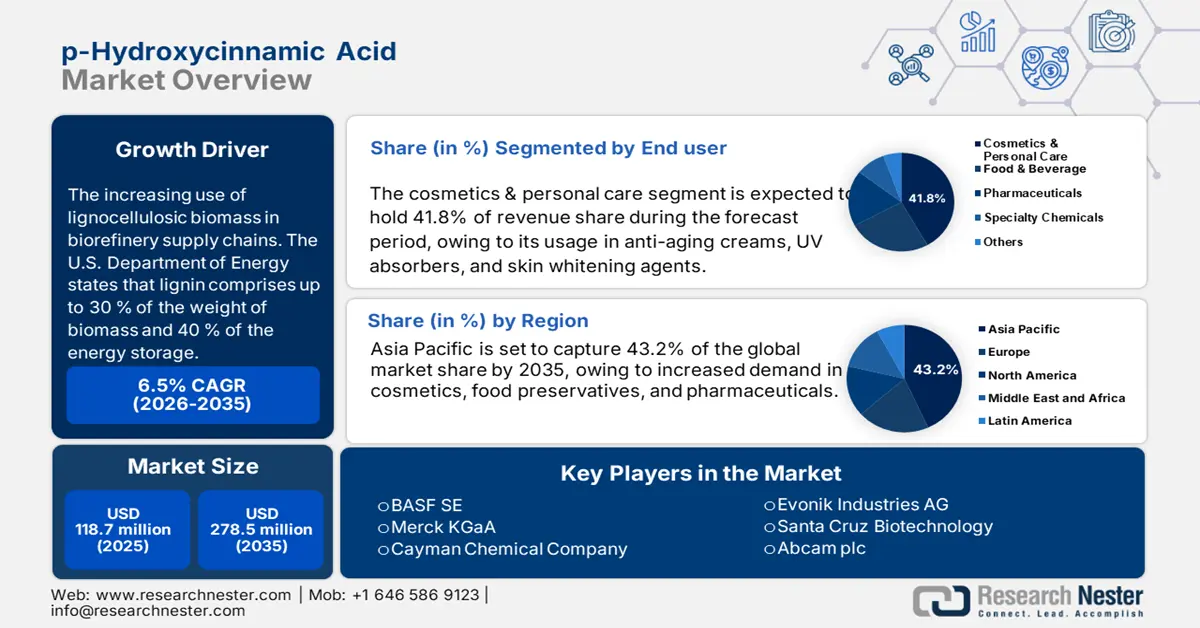
p-Hydroxycinnamic Acid Market size was estimated at USD 118.7 million in 2025 and is expected to surpass USD 278.5 million by the end of 2035, rising at a CAGR of 6.5% during the forecast period, i.e., 2026-2035. In 2026, the industry size of p-hydroxycinnamic acid is assessed at USD 126.3 million.
The primary catalyst for the p-hydroxycinnamic acid market is the increasing use of lignocellulosic biomass in biorefinery supply chains. The U.S. Department of Energy states that lignin comprises up to 30 % of the weight of biomass and 40 % of the energy storage; therefore, there is enough supply of lignin for all of the aromatics that can be produced from pHCA. Alkaline pretreatment waste streams are now yielding hydroxycinnamic acids, and pilot studies producing tens to hundreds of grams per liter demonstrate that further expansion of production could be possible. Historically, the DOE has invested RDD funding into membrane fractionation and catalytic separation approaches since 2020, now with the potential to commercialize.
The market for raw material supply is fundamentally based on agricultural residues that utilize biorefinery facilities and are processed as biorefineries. There is documentation from U.S. integrated facilities demonstrating the fractionation of lignin streams with pHCA precursor recovery on-site. Expansion of manufacturing capacity is occurring through adaptive laboratory evolution methods; e.g., Pseudomonas strain can tolerate 20 g/L pHCA and can be used to modify fermenters to produce higher yields. HTS codes for pHCA currently do not allow for the isolation of pHCA specifically, nor can documentation on any formal export or import volumes be found. It appears that RDD revenue support is still available from sector funding to develop pilot-scale assembly line processes for lignin use or valorization.