Optoelectronic Transistor Market Outlook:
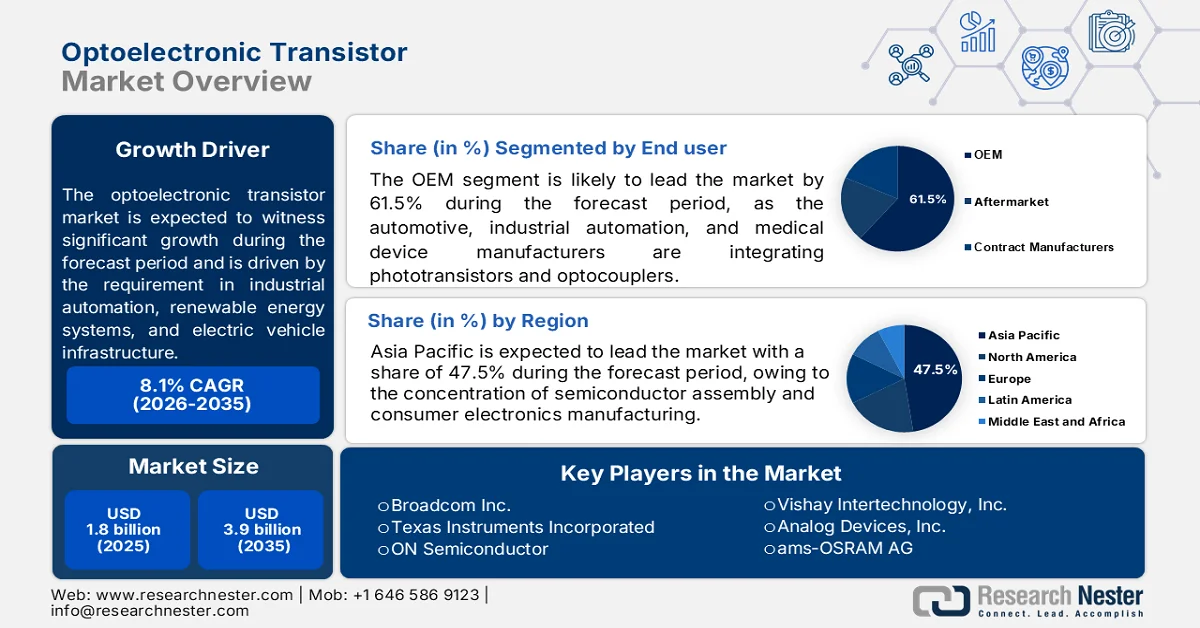
Optoelectronic Transistor Market size was valued at USD 1.8 billion in 2025 and is expected to cross USD 3.9 billion by the end of 2035, registering more than 8.1% CAGR during the forecast period i.e., 2026-2035. In 2026, the industry size of optoelectronic transistor is estimated at USD 1.9 billion.
The global optoelectronic transistor market is concentrated in industrial automation, renewable energy systems, and electric vehicle infrastructure. According to the International Energy Agency (IEA), June 2023 data, the global annual solar photovoltaic capacity additions reached approximately 450 GW, with each large-scale inverter requiring multiple optocoupler and phototransistor isolation circuits. The 2026 Clean Energy Ministerial reports that industrial motor drives account for over 40% of global electricity consumption, and safety standards under the International Electrotechnical Commission mandate galvanic isolation in variable frequency drives, directly driving demand for transistor output optocouplers. Moreover, the National Institute of Standards and Technology continues to fund research into silicon photonic integration for automotive and industrial end-users.
Solar PV Manufacturing Capacity by Region and Component, 2022-2023
|
|
U.S. (GW) |
India (GW) |
Europe (GW) |
|
Integrated |
9.0 |
37.5 |
- |
|
Thinfilm |
6.1 |
3.4 |
- |
|
Modules |
191 |
0.5 |
11.2 |
|
Cells/Modules |
3.3 |
7.4 |
7.8 |
|
Wafers/Ingots |
11.5 |
- |
- |
|
Polysilicon |
7.5 |
- |
- |
Source: IEA May 2023
Besides, the regional manufacturing patterns shape the optoelectronic transistor market supply landscape. The U.S. Department of Commerce, through the CHIPS for America program, has allocated direct funding incentives for domestic semiconductor production, including mature node facilities that produce silicon phototransistors and optocouplers for automotive and defense applications. On the other hand, the Climate Analytics 2026 data shows that cumulative wind and solar capacity is projected to reach 1400 TWh of solar and 1600 TWh of wind by 2030, of which a certain percentage is currently served by optoelectronic transistors. The U.S. Department of Energy January 2024 data notes that electric vehicle sales reached 1.4 million units in the U.S., with each onboard charger containing optocouplers for primary-secondary side isolation. These data show an active market growth globally.