Optical Transceiver Market Outlook:
Optical Transceiver Market size was valued at USD 15.7 billion in 2025 and is projected to reach USD 55.4 billion by the end of 2035, rising at a CAGR of 13.4% during the forecast period, i.e., 2026-2035. In 2026, the industry size of optical transceiver is estimated at USD 17.8 billion.
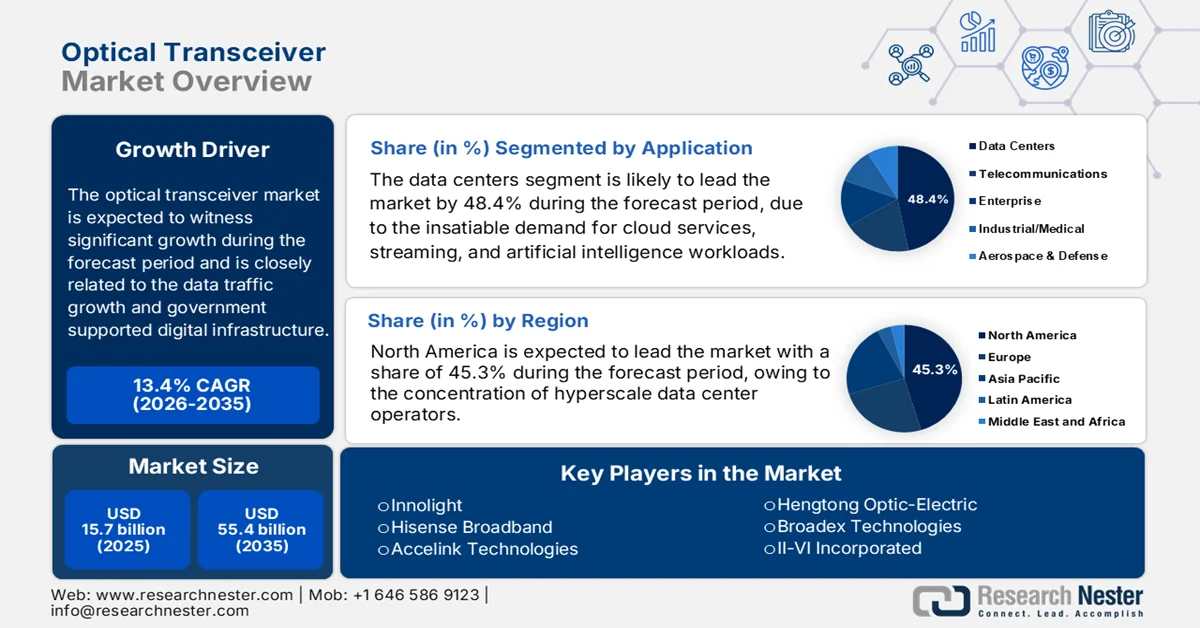
Government-supported digital infrastructure expansion and data traffic growth are the key drivers supporting the demand for the optical transceivers market across telecom networks and data centers. According to the International Telecommunication Union, October 2023 data, the global internet usage reached 5.4 billion people in 2023, representing about 67% of the global population, compared with 4.7 billion users in 2022, reflecting sustained expansion in data consumption that requires higher-capacity optical networking equipment. Moreover, the public investments in broadband are also surging the fiber network deployments that rely on the optical modules. The U.S. Department of Commerce data in September 2024 depicts that the BEAD program administered by the National Telecommunications and Information Administration allocates USD 42.45 billion to expand high-speed, broadband infrastructure nationwide, with the large portions directed toward fiber optic backbone and access networks that integrate optical transceivers for high-speed signal transmission.
Moreover, the data center traffic growth is another important factor influencing the deployment volumes of the optical transceivers market in high-capacity switching environments. According to the IEA July 2023 data, the global data center electricity consumption represented around 1% to 1.3% of global electricity demand, highlighting the scale of digital infrastructure supporting the cloud computing and hyperscale data services. The December 2024 U.S. Data Center Energy Usage Report indicates that the data center electricity use accounted for 73 billion kWh, reflecting large server clusters and high-speed interconnected networks that rely heavily on optical modules for short-reach and long-reach data transmission. These public infrastructure programs and traffic growth indicators point to sustained procurement of optical networking hardware across telecom operators, cloud infrastructure providers, and public research networks.
Key Optical Transceiver Market Insights Summary:
Regional Highlights:
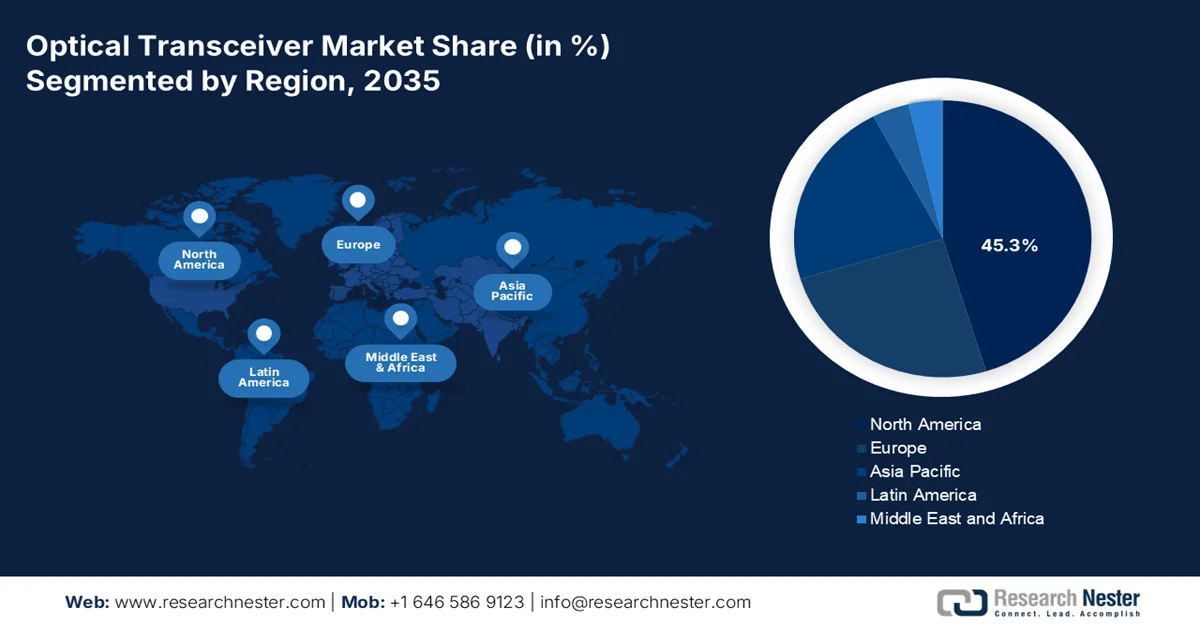
- North America optical transceiver market is anticipated to command a leading share of 45.3% by 2035, impelled by strong presence of hyperscale data centers and expanding government-backed broadband infrastructure initiatives
- Asia Pacific is forecasted to register the fastest growth in the market during 2026–2035 with a CAGR of 11.5%, fueled by rising government investments in digital infrastructure and semiconductor self-sufficiency
Segment Insights:
- The data centers segment in the optical transceiver market is projected to capture a dominant 48.4% share by 2035, driven by escalating demand for cloud computing, streaming services, and AI-driven workloads
- The above 400 Gbps sub-segment is expected to witness significant growth over the forecast period 2026–2035, owing to increasing need for high-speed connectivity to support AI supercomputing and hyperscale data center interconnects
Key Growth Trends:
- Expansion of 5G infrastructure
- Rapid growth of data centers and cloud infrastructure
Major Challenges:
- Geographic revenue concentration
- Cybersecurity and regulatory compliance
Key Players: Innolight, Hisense Broadband, Accelink Technologies, Hengtong Optic-Electric, Broadex Technologies, II-VI Incorporated, Lumentum Holdings, Broadcom Inc., Intel Corporation, NeoPhotonics, Ciena Corporation, Cisco Systems, Fabrinet, Fujitsu Optical Components, Sumitomo Electric Industries, NEC Corporation, Belden, Precision Optical Technologies, Inc., GIGALIGHT, Jabil Inc.
Global Optical Transceiver Market Forecast and Regional Outlook:
Market Size & Growth Projections:
- 2025 Market Size:USD 15.7 billion
- 2026 Market Size: USD 17.8 billion
- Projected Market Size: USD 55.4 billion by 2035
- Growth Forecasts: 13.4% CAGR (2026-2035)
Key Regional Dynamics:
- Largest Region: North America (45.3% Share by 2035)
- Fastest Growing Region: Asia Pacific
- Dominating Countries: United States, China, Japan, Germany, South Korea
- Emerging Countries: India, Brazil, Mexico, Indonesia, Vietnam
Last updated on : 17 March, 2026
Optical Transceiver Market - Growth Drivers and Challenges
Growth Drivers
- Expansion of 5G infrastructure: 5G deployments require extensive fiber backhaul and fronthaul infrastructure to connect the base stations to core networks. The optical transceivers are essential in these fiber links because they support high-capacity data transmission and low-latency communication between the distributed network elements. Governments are investing heavily in national 5G deployment strategies and infrastructure programs. Moreover, the European Commission’s 5G Action Plan aims for uninterrupted 5G coverage in all urban areas and major transport paths by 2030 under the digital decade policy framework. According to the Internet Society Pulse December 2023 report, nearly 89% of people in high-income countries were covered by the 5G networks globally, indicating a rapid infrastructure expansion that depends heavily on fiber optic connectivity.
- Rapid growth of data centers and cloud infrastructure: Government digital transformation initiatives and public cloud adoption are driving the expansion of the hyperscale and enterprise data centers, which require high-speed optical interconnects between the servers, storage systems, and network switches. The optical transceivers enable high-bandwidth data transfer within and between the data centers. Moreover, data centers consume a vast amount of electricity, reflecting the scale of the computing infrastructure. According to the PIB December 2022 data, there are nearly 8,000 data centers globally, showing a growth in digital infrastructure capacity. Further, the governments are also investing in cloud and digital infrastructure projects to support public sector services. These investments drive network upgrades in data centers and boost the adoption of higher-speed optical modules.
Share of Data Centers in Various Economies
|
Economies |
Percentage |
|
OECD |
77 |
|
NATO |
64 |
|
U.S. |
33 |
|
UK |
5.7 |
|
Germany |
5.5 |
|
China |
5.2 |
|
Netherlands |
3.4 |
|
Canada |
3.3 |
Source: PIB December 2022
- Smart city and digital infrastructure programs: Government investments in the smart city infrastructure are increasing the need for the high capacity communication networks that rely on optical fiber and associated optical modules. Smart city initiatives integrate intelligent transportation systems, connected public services, surveillance systems, and environmental monitoring networks, all of which require reliable, high-bandwidth connectivity. According to the United Nations, August 2022 data, over 56% of the world’s population lives in urban areas, and this number is expected to grow, boosting the governments to invest in the digital urban infrastructure. Further, the smart cities mission in India is focusing on the digital infrastructure, intelligent mobility systems ad integrated command centers. These initiatives require high-capacity communication backbones connecting sensors, control systems, and data platforms, often supported by fiber-optic networks.
Challenges
- Geographic revenue concentration: New players in the optical transceiver market struggle to break the stronghold of players with established relationships, mainly in the high-margin North America market. The top players' pricing is more competitive compared to their peers which generate revenue from high margin overseas market. further the new players face a multi-year qualification process with the hyperscalers before securing volume purchase orders.
- Cybersecurity and regulatory compliance: Compliance with the stringent regional regulations, such as the EU’s Cyber Resilience Act and various security certification schemes, adds layers of complexity and cost to product design. The European market imposes strict requirements on material sourcing and supply chain security, directly influencing vendor selection. The new players in the optical transceiver market must design for compliance from the ground up, rather than retrofitting, which extends time to market. Failure to secure the certifications, such as CE marking or navigate U.S. export controls on dual-use technologies, can lock suppliers out of lucrative market entirely.
Optical Transceiver Market Size and Forecast:
| Report Attribute | Details |
|---|---|
|
Base Year |
2025 |
|
Forecast Year |
2026-2035 |
|
CAGR |
13.4% |
|
Base Year Market Size (2025) |
USD 15.7 billion |
|
Forecast Year Market Size (2035) |
USD 55.4 billion |
|
Regional Scope |
|
Optical Transceiver Market Segmentation:
Application Segment Analysis
Within the application segment, the data centers are dominating in the optical transceiver market and are poised to hold the largest share value of 48.4% by the end of 2035. The segment is fueled by the insatiable demand for cloud services, streaming, and artificial intelligence workloads, which require massive internal bandwidth for server-to-server communication. According to the EESI April 2025 data, the data centers in the U.S. are projected to consume 9% of all electricity generated by 2030, underscoring their massive expansion and critical need for energy-efficient optical links. This statistical projection highlights why operators are aggressively upgrading to faster transceivers. They must manage exploding data traffic while trying to curb power consumption, making the high efficiency of modern optics indispensable for the future of digital infrastructure.
Data Rate Segment Analysis
Under the data rate segment, above 400 Gbps sub-segment is leading the optical transceiver market as the network operators race to future-proof their infrastructures against relentless bandwidth growth. The main driver for this adoption is the need to interconnect AI supercomputers and hyperscale data centers where clusters of GPUs generate unprecedented data loads that quickly saturate the existing links. Moreover, the optimized servers can generate more internal network traffic than traditional cloud servers. This directly correlates with the accelerated demand for the transceivers as they provide the necessary lane speed increases to efficiently pipe this data without exponentially increasing the number of fiber cables, thus solving a critical physical space challenge.
Connector Type Segment Analysis
The MPO/MTP is leading the connector type segment in the optical transceiver market, driven by the necessity in the high-density data center environments that utilize the parallel optics. Unlike traditional duplex connectors, MPO connectors house multiple optical fibers in a single ferrule, making them the standard interface for high-speed transceivers, which require eight parallel fiber pairs to achieve their bandwidth. The Lawrence Berkeley National Laboratory on data center efficiency highlighted that the physical space for cable management in server racks is a critical constraint, with cable volume doubling every five years. This reinforces the dominance of the MPO format as its high-fiber-density design is the most effective solution to manage the cable crush problem in modern data centers, allowing for better airflow, easier cable routing, and the scalability required to support the escalating port counts of top-of-rack switches.
Our in-depth analysis of the optical transceiver market includes the following segments:
|
Segment |
Subsegments |
|
Form Factor |
|
|
Data Rate |
|
|
Connector Type |
|
|
Distance Reach |
|
|
Wavelength |
|
|
Application |
|
|
Technology |
|

Vishnu Nair
Head - Global Business DevelopmentCustomize this report to your requirements — connect with our consultant for personalized insights and options.
Optical Transceiver Market - Regional Analysis
North America Market Insights
North America is the dominant region and is projected to account for 45.3% of regional revenue in the optical transceiver market by the end of 2035. The market is driven mainly by the concentration of hyperscale data center operators and substantial government broadband initiatives. The region is defined by the rapid adoption of advanced technologies, with the major cloud service providers leading the transition from the pluggable modules to support the artificial intelligence and machine learning workloads. Federal funding programs, including the BEAD initiative, are driving fiber optic infrastructure deployment in underserved rural areas and creating sustained demand for access network transceivers. Moreover, the investment in advanced packaging and silicon photonics research is reshaping the technology landscape toward co-packaged optics. Further, the region maintains its position as an innovation hub and a significant revenue contributor to the global optical transceiver industry.
The continued federal investment in broadband expansion, large-scale data infrastructure, and national digital connectivity programs in the optical transceiver market in the U.S. As per the Congress.gov July 2021 data, the Federal Communications Commission reported that 14.5 million U.S. people lacked access to fixed broadband service at benchmark speeds, highlighting the need for expanded fiber infrastructure and network upgrades that support demand for optical communication equipment. Moreover, the data center expansion strengthens the market outlook. The Pew Research Center October 2025 data depicts that there are nearly 4,000 data centers in the U.S., showing the demand for the optical transceiver which are the core components used for high-speed optical communication between servers, switches, and storage systems inside data centers. These data indicate an active growth in the U.S. market.
The public investments in universal broadband and a strong academic photonics ecosystem is shaping the optical transceiver market in Canada. According to the Government of Canada August 2025 data, the Innovation, Science and Economic Development Canada administers the Universal Broadband Fund a USD 3.225 billion initiative aiming to connect 98% of people to high speed internet directly increasing demand for fiber optic infrastructure and transceivers. Further the National Research Council of Canada supports advanced research via its Digital Technologies Research Centre focusing on photonic devices and optical networks which raises the early stage technology development and talent. Further the primary trend is the deployment of fiber-to-the-home in rural and remote northern communities, requiring ruggedized optical transceivers capable of operating in extreme temperatures driving demand for high-speed coherent optics in interconnection points.
APAC Market Insights
The Asia Pacific is projected to emerge as the fastest-growing region during the assessed period, 2026 to 2035, and is expected to grow at a CAGR of 11.5%. The optical transceiver market is driven by the concentrated government spending on digital infrastructure and semiconductor self-sufficiency. China leads via its East Data West Computing national projects requiring massive DWDM transceiver deployment across eight national computing hubs. Japan’s New Energy and Industrial Technology Development Organization funds next-generation optical device research, while South Korea’s Ministry of Science and ICT allocates a billion dollars for telecommunication advancements. On the other hand, the Malaysia emerges as a critical manufacturing hub via the National Investment Aspirations (NIA) framework, attracting foreign transceiver assembly facilities. Trends include the adoption of 400G coherent modules for data center interconnects, silicon photonics commercialization, and diversified supply chains across Southeast Asia.
The optical transceiver market in China is strongly supported by the large-scale government investment in the digital infrastructure, mainly fiber broadband 5G networks, and data center development. According to the Samena Trends July 2025 data, the country has nearly deployed 35.3% 5G base stations. These base stations rely heavily on fiber backhaul and high-capacity optical transmission equipment, increasing the need for optical transceivers across telecom transport networks. On the other hand, the SASAC December 2025 report shows that the Chinese government continues to expand fiber connectivity under national broadband strategies, reporting that gigabit fiber broadband services covered more than 500 million households in China in 2023, demonstrating large-scale deployment of fiber infrastructure that integrates optical modules in access and backbone networks. Therefore, the expanding digital capacity is fueling the demand for optical transceiver market growth.
The targeted government R&D funding and industrial automation requirements are driving the optical transceiver market in Japan. According to the OECD July 2022 data, Japan signed an agreement with the U.S. in R&D for beyond 5G technologies with a fund of USD 4.5 billion, driving the growth of optical transceivers. Moreover, Japan's manufacturing sector drives demand for the industrial Ethernet optical transceivers in factory automation networks, with the Society of Automotive Engineers of Japan reporting increased optical connectivity in next-generation vehicle production lines. Trends include commercial deployment of 800G pluggable modules for data center interconnects, and government-supported development of space division multiplexing technologies for future bandwidth scaling.
Europe Market Insights
The optical transceiver market is expanding rapidly and is driven by the robust EU digital infrastructure mandates and public health network modernization. The European Commission’s Digital Decade policy program targets gigabit connectivity for all households, directing funds via the Connecting Europe Facility Digital for cross-border backbone networks. A significant emerging driver is the modernization of healthcare data infrastructure, stimulating the demand for secure, high-bandwidth optical links connecting hospitals and diagnostic centers. Moreover, the member states are prioritizing sovereign data infrastructure and compliance with the Cyber Resilience Act, requiring transceivers with enhanced security features. The optical transceiver market is shifting towards coherent pluggable modules for metro networks and radiation-hardened modules for medical imaging equipment.
The national digital infrastructure programs, broadband expansion, and data center development supported by the government initiatives are influencing the optical transceiver market in Germany. According to the OECD in June 2024, the German federal government has provided USD 17.9 billion to fund broadband deployment. These fiber deployments require optical transmission components in access and backbone networks supporting demand for optical transceivers. Moreover, the European Investment Bank's September 2024 data depicts that fiber to the premises (FTTP) coverage in Germany reached about 35% of households. These infrastructure developments are increasing the need for high-speed optical networking equipment across telecommunications and data center environments in Germany.
The government backed digital connectivity programs, expanding fiber broadband infrastructure, and increasing data traffic via national internet exchange networks, are fueling the optical transceiver market in the UK. The UK government’s April 2023 data shows that the Project Gigabit is implemented with a nationwide program allocating GBP 5 billion to expand gigabit-capable broadband to hard-to-reach areas primarily via fiber optic networks that depend on optical transmission modules in access and backbone systems. Progress in fiber deployment is already visible. The December 2024 Ofcom report indicates that full fiber broadband coverage reached about 57% of UK premises, compared with less than 25%, indicating rapid network upgrades requiring optical networking equipment. These data promote the deployment of high-speed optical communication infrastructure across telecom networks and data centers in the UK.
Key Optical Transceiver Market Players:
- Innolight (U.S.)
- Hisense Broadband (China)
- Accelink Technologies (China)
- Hengtong Optic-Electric (China)
- Broadex Technologies (China)
- II-VI Incorporated (U.S.)
- Lumentum Holdings (U.S.)
- Broadcom Inc. (U.S.)
- Intel Corporation (U.S.)
- NeoPhotonics (U.S.)
- Ciena Corporation (U.S.)
- Cisco Systems (U.S.)
- Fabrinet (U.S.)
- Fujitsu Optical Components (Japan)
- Sumitomo Electric Industries (Japan)
- NEC Corporation (Japan)
- Belden (U.S.)
- Precision Optical Technologies, Inc (U.S.)
- GIGALIGHT (China)
- Jabil Inc. (U.S.)
- Company Overview
- Business Strategy
- Key Product Offerings
- Financial Performance
- Key Performance Indicators
- Risk Analysis
- Recent Development
- Regional Presence
- SWOT Analysis
- Innolight, with dual headquarters, is a dominant player in the high-speed optical transceiver market, mainly renowned for its advanced modules that power the world’s largest cloud data centers. The company has carved out a significant market share by excelling in the rapid commercialization of advanced technologies, ensuring low power consumption and high performance for AI and ML workloads. In 2025, the company made a revenue of USD 5.27 billion.
- Hisense Broadband has solidified its position in the global optical transceiver market via high-volume manufacturing and a comprehensive product portfolio covering FTTH, 5G wireless, and data center applications. The company uses its parent company’s massive supply chain and automation expertise to produce reliable and cost-competitive optical modules. According to the annual report 2024, the company has made an operating revenue of 22,166,522,591.65 in Q4.
- Accelink Technologies, a subsidiary of the state-owned FiberHome Telecommunication Technologies, stands as one of China’s largest and most established players in the optical transceiver market. With a history deeply rooted in optical components, the company possesses a strong vertical integration capability in manufacturing critical chips and subsystems that many competitors must source externally.
- Hengtong Optic Electric has evolved from a traditional power cable and optical fiber cable giant into a formidable vertically integrated player in the global optical transceiver market. By controlling the entire value chain from optical fibers to submarine cables and active optical modules, the company offers end-to-end connectivity solutions that are highly competitive for large-scale infrastructure projects.
- Broadex Technologies has rapidly ascended in the optical transceiver market by initially establishing itself as a premier supplier of optical components and modules to a major North American data center operator. This partnership provided the scale and expertise needed to expand its customer base and product offering, which now include high speed transceivers for data centers and wireless networks.
Here is a list of key players operating in the global optical transceiver market:
The global optical transceiver market is fiercely competitive and is defined by the rapid technological shifts toward higher data rates and cost sensitivity. The key strategic initiatives include heavy investment in R&D for silicon photonics and co-packaged optics vertical integration to secure supply chains and geographic expansion to capture 5G and data center demand. For example in July 2024, Belden completes the acquisition of Precision Optical Technologies, Inc. While the China firms lead in volume and cost efficiency, U.S. and Japan players maintain an edge in the high-performance components. Europe players focus on niche telecom segments, while emerging hubs in India and Malaysia are becoming critical for manufacturing diversification.
Corporate Landscape of the Optical Transceiver Market:
Recent Developments
- In September 2025, NEC Corporation has expanded its lineup of optical transceivers for 25Gb/s transmission with the commencement of sales for the 25G SFP28 80km BiDi capable of 80km transmission.
- In May 2025, GIGALIGHT has officially launched its brand-new low-latency optical transceiver series, which brings nanosecond-level value to customers. This series precisely meets the urgent demands for ultra-low latency and high reliability in data centers and high-performance computing scenarios.
- In April 2025, Jabil Inc. announced the launch of its 1.6T transceivers, which can transmit data at rates up to 1.6 Terabits per second. These transceivers join Jabil’s expanding portfolio of photonics products to meet the accelerating demand for AI/ML workloads, high-performance computing (HPC), cloud computing, and high-speed data center interconnects.
- Report ID: 8444
- Published Date: Mar 17, 2026
- Report Format: PDF, PPT
- Explore a preview of key market trends and insights
- Review sample data tables and segment breakdowns
- Experience the quality of our visual data representations
- Evaluate our report structure and research methodology
- Get a glimpse of competitive landscape analysis
- Understand how regional forecasts are presented
- Assess the depth of company profiling and benchmarking
- Preview how actionable insights can support your strategy
Explore real data and analysis
Frequently Asked Questions (FAQ)
About this Report
Connect with our Expert


Report, 2026-2035



Copyright @ 2026 Research Nester. All Rights Reserved.
