Online Therapy Services Market Outlook:
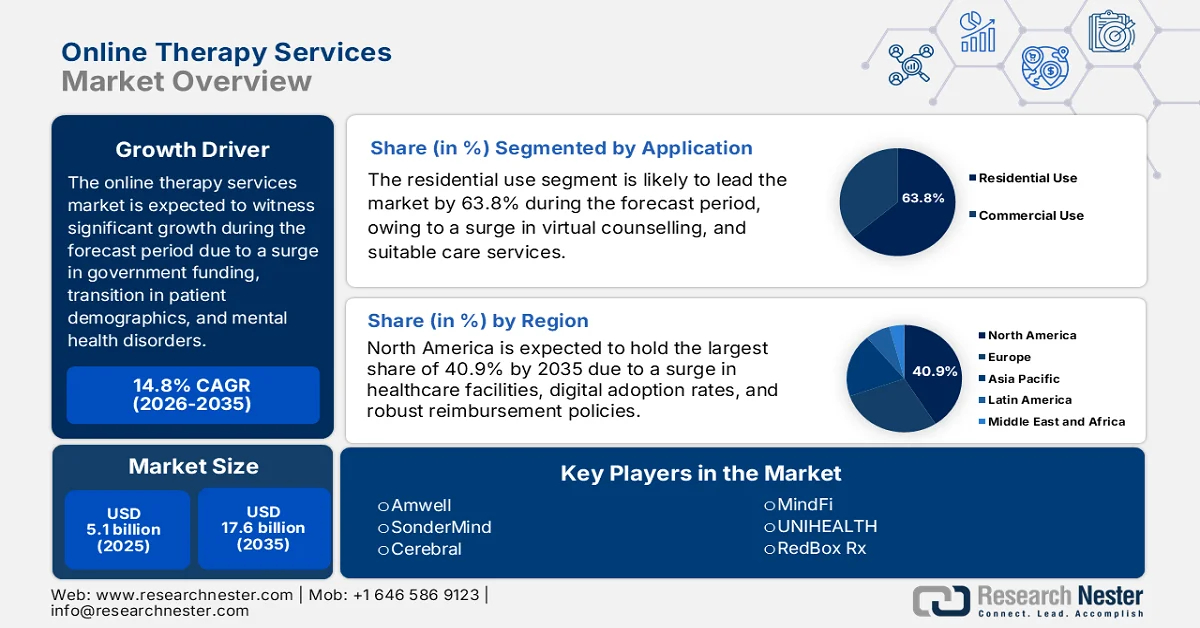
Online Therapy Services Market size was valued at over USD 5.1 billion in 2025 and is expected to reach USD 17.6 billion by the end of 2035, growing at a CAGR of 14.8% during the forecast period, i.e., 2026-2035. In 2026, the industry size of online therapy services is evaluated at USD 5.8 billion.
The worldwide online therapy services market is significantly growing, highly driven by regulatory frameworks, generous government funding, regional economic dynamics, clinical evidence validation, a shift in patient demographics, and workforce economics. According to official statistics published by the World Health Organizations (WHO) in September 2025, over 1 billion people current reside with mental health diseases, with specific conditions, including depression and anxiety. Besides, median government spending on mental health remains at only 2% of overall health budgets. In this regard, high-income nations usually spend almost USD 65 per person on mental health, while low-income countries spend less than USD 0.04. Moreover, the global median number of mental health workers account for 13 per 100,000 people. Besides, the increased prevalence of mental illness across different countries is also positively impacting the market expansion and development.
Mental Illness Prevalence Among adults in the U.S. (2022)
|
Gender |
Age |
Race and Ethnicity |
|||
|
Overall |
23.1% |
18 to 25 years |
36.2% |
Hispanic |
21.4% |
|
Female |
26.4% |
26 to 49 years |
29.4% |
White |
24.6% |
|
Male |
19.7% |
Over 50 years |
13.9% |
Black or White |
19.7% |
|
- |
- |
- |
- |
AI/AN |
19.6% |
|
- |
- |
- |
- |
Asia-based |
16.8% |
|
- |
- |
- |
- |
Others |
35.2% |
Source: NIH
Furthermore, the passive monitoring technology, biometric integration, the presence of niche platforms, vertical specialization, and the existence of text-based and asynchronous therapy models are a few trends that are responsible for bolstering the online therapy services market globally. As stated in an article published by NLM in June 2025, the worldwide wearables shipments, such as hearables, fitness trackers, and smartwatches, has significantly exceeded 543 million units, thus reflecting a 6.1% surge. Additionally, smartwatch users alone are effectively expected to reach 740 million across different regions. Moreover, with over 500 million wearables in utilization globally, the overall data footprint for the ecosystem has successfully reached into trillions of data points every year, thereby making it suitable for uplifting the market growth and demand.
Key Online Therapy Services Market Insights Summary:
Regional Highlights:
- North America online therapy services market is projected to hold a dominant 40.9% share by 2035, supported by advanced healthcare infrastructure, rising digital adoption, and robust telehealth reimbursement frameworks.
- Asia Pacific is anticipated to witness the fastest growth through 2035, propelled by expanding smartphone penetration, increasing mental health awareness, and supportive government-led digital health initiatives.
Segment Insights:
- In the online therapy services market, the residential use segment is expected to account for a leading 63.8% share by 2035, attributed to rising engagement in virtual counselling and the shift toward accessible and comfortable mental healthcare environments.
- The mobile device apps sub-segment is forecasted to secure the second-largest share over the 2026-2035 period, fueled by increasing reliance on digital tools to enhance accessibility, engagement, and effectiveness of mental health services.
Key Growth Trends:
- Expansion in insurance reimbursement and clinical evidence
- Focus on workforce economics
Major Challenges:
- Clinician shortages and workforce burnout
- Data privacy, security and ethical compliance risks
Key Players: BetterHelp (U.S.), Talkspace (U.S.), Teladoc Health (U.S.), Lyra Health (U.S.), MDLIVE (U.S.), Amwell (U.S.), SonderMind (U.S.), Cerebral (U.S.), Calmerry (U.S.), 7 Cups (U.S.), Thrive Talk (U.S.), Mindstrong Health (U.S.), ifeel (Spain), Kry (Livi) (Sweden), HelloBetter (Germany), Amano (UK), Doctor On Demand (U.S.), Wysa (India), MindFi (Singapore), UNIHEALTH (South Korea), RedBox Rx (U.S.), Talkiatry (U.S.).
Global Online Therapy Services Market Forecast and Regional Outlook:
Market Size & Growth Projections:
- 2025 Market Size: USD 5.1 billion
- 2026 Market Size: USD 5.8 billion
- Projected Market Size: USD 17.6 billion by 2035
- Growth Forecasts: 14.8% CAGR (2026-2035)
Key Regional Dynamics:
- Largest Region: North America (40.9% Share by 2035)
- Fastest Growing Region: Asia Pacific
- Dominating Countries: United States, China, Germany, United Kingdom, Japan
- Emerging Countries: India, Brazil, South Korea, Indonesia, Mexico
Last updated on : 1 April, 2026
Online Therapy Services Market - Growth Drivers and Challenges
Growth Drivers
- Expansion in insurance reimbursement and clinical evidence: The maturation of randomized controlled trials demonstrates the non-inferiority of online therapy in comparison to face-to-face treatment has fundamentally fueled the online therapy services market. According to official statistics published by NLM in March 2025, based on the 32% of healthcare expenditure in low- and middle-income nations, the WHO has estimated that the out-of-pocket medical expenditure, particularly in India, is extremely high as 65.1% of the present health spending. Besides, 3.5% of the population in the country resides below the poverty line, while 5% of households witness catastrophic health costs. However, to combat this, insurance companies effectively increased premiums by 40% to 70% for the majority of health covers, which is suitable for driving the online therapy services market exposure.
- Focus on workforce economics: The fundamental mismatch between patient demand and mental health provider supply creates a structural demand for digital alternatives in the online therapy services market globally. Based on government estimates published by the Ministry of Health and Family Welfare in November 2025, the mental health risk burden in India accounts for 2,443 disability-adjusted life years (DALYs) per 1,000 population, along with the adjusted suicide rate per 100,000 population is 21:1. Besides, the country’s economic loss, owing to mental health conditions is projected to be worth USD 1.0 trillion by the end of 2030. Moreover, the lifetime prevalence of mental disorders is 13.7%, thus enhancing the patient demand for therapeutic services.
- Increase in the aging population: The worldwide aging population is gradually increasing, with an increase in the prevalence of anxiety disorders, cognitive, and depression, which is positively fueling the online therapy services market. As per an article published by Our World in Data Organization in November 2024, at present there are nearly 830 million people aged over 65 years globally, which further predicted to increase to 1.7 billion by the end of 2054. Simultaneously, the working-age population is expected to grow only by 20% within the same duration. Therefore, online therapy delivered to this population is suitable through simple tablet interfaces with large-scale voice and text-activated navigation that directly caters to mental health gaps, which denotes an optimistic outlook for the online therapy services market development.
Challenges
- Clinician shortages and workforce burnout: The global mental health workforce deficit poses an existential constraint on the online therapy services market growth. Even with digital delivery, online therapy platforms cannot scale beyond the finite pool of licensed practitioners. The paradox is acute: while demand surges, the supply of qualified therapists remains stagnant due to rigid educational pathways, lengthy licensing processes, and high rates of clinician burnout. Many practitioners report that the shift to online platforms has intensified caseloads without corresponding compensation adjustments. This churn disrupts continuity of care, a critical factor in treatment efficacy, and erodes consumer trust.
- Data privacy, security and ethical compliance risks: Online therapy platforms handle the most sensitive category of personal health information, making them prime targets for cybersecurity breaches and regulatory scrutiny. Compliance with overlapping frameworks, such as HIPAA in the U.S., GDPR in Europe, and emerging data localization laws in Asia, demands significant investment in encryption, access controls, and audit trails. A single breach can result in regulatory fines, irreversible reputational damage, and loss of consumer confidence. Beyond technical security, ethical risks abound the utilization of AI for diagnostic support raises questions about algorithmic bias and informed consent, thus creating a negative impact on the online therapy services market globally.
Online Therapy Services Market Size and Forecast:
| Report Attribute | Details |
|---|---|
|
Base Year |
2025 |
|
Forecast Year |
2026-2035 |
|
CAGR |
14.8% |
|
Base Year Market Size (2025) |
USD 5.1 billion |
|
Forecast Year Market Size (2035) |
USD 17.6 billion |
|
Regional Scope |
|
Online Therapy Services Market Segmentation:
Application Segment Analysis
The residential use segment, part of the application, is anticipated to grab the largest share of 63.8% in the online therapy services market by the end of 2035. The segment’s upliftment is primarily driven by severe engagement in virtual counselling, which has evolved as an essential component of modernized mental healthcare. In addition, its importance originates from the break down of conventional gaps to providing suitable care services, along with a comfortable and safe environment to ensure patient engagement. According to official statistics published by NLM in December 2025, as proclaimed by WHO, it has been estimated that 1 in 7 adolescents aged between 10 and 19 years, which accounts for 14%, witness disabling mental health challenges. Besides, there has been a significant rise in mental health risks among Dutch young people, aged from 12 to 18 years, thus driving the market growth.
Tools Segment Analysis
During the forecast period, the mobile device apps sub-segment, which is part of the tools segment, is projected to garner the second-largest share in the online therapy services market. The sub-segment’s growth is highly fueled by its emergence as a crucial component for effectively enhancing the engagement, effectiveness, and accessibility of mental health care. As per an article published by Journal of Medical Internet Research in 2024, a clinical study was conducted on 950 individuals, of which 38% demonstrated the utilization of self-directed and digitalized mental health resources. Meanwhile, 24.7% utilized both 1:1 and self-directed modalities, thus combining devices and offline therapy services. Besides, almost 25% of adults witness a mental disorder, and less than 21.7% deliberately receive suitable treatment from a licensed mental health clinician, thereby denoting a huge growth opportunity for the sub-segment.
End user Segment Analysis
Based on end user, the adults (18-64 years) segment in the online therapy services market is expected to account for the third-largest share by the end of the stipulated timeline. The segment’s development is highly propelled by a strong preference for digital-native engagement, adults aged utilizing telemental health services exclusively, compared to significantly lower rates among older populations. The adoption disparity is heavily influenced by socioeconomic factors, with college graduates more likely to use teletherapy than those without a high school diploma, while higher-income adults demonstrate greater utilization than individuals below the poverty level. Besides, urban residents similarly exhibit higher adoption rates in comparison to their rural counterparts. Notably, the prevalence of depression is highest among younger adults, affecting individuals aged 12 to 19 years and declining with age, creating a huge market demand.
Our in-depth analysis of the online therapy services market includes the following segments:
|
Segment |
Subsegments |
|
Application |
|
|
Tools |
|
|
End user |
|
|
Type |
|
|
Industrial Vertical |
|
|
Business Model |
|

Vishnu Nair
Head - Global Business DevelopmentCustomize this report to your requirements — connect with our consultant for personalized insights and options.
Online Therapy Services Market - Regional Analysis
North America Market Insights
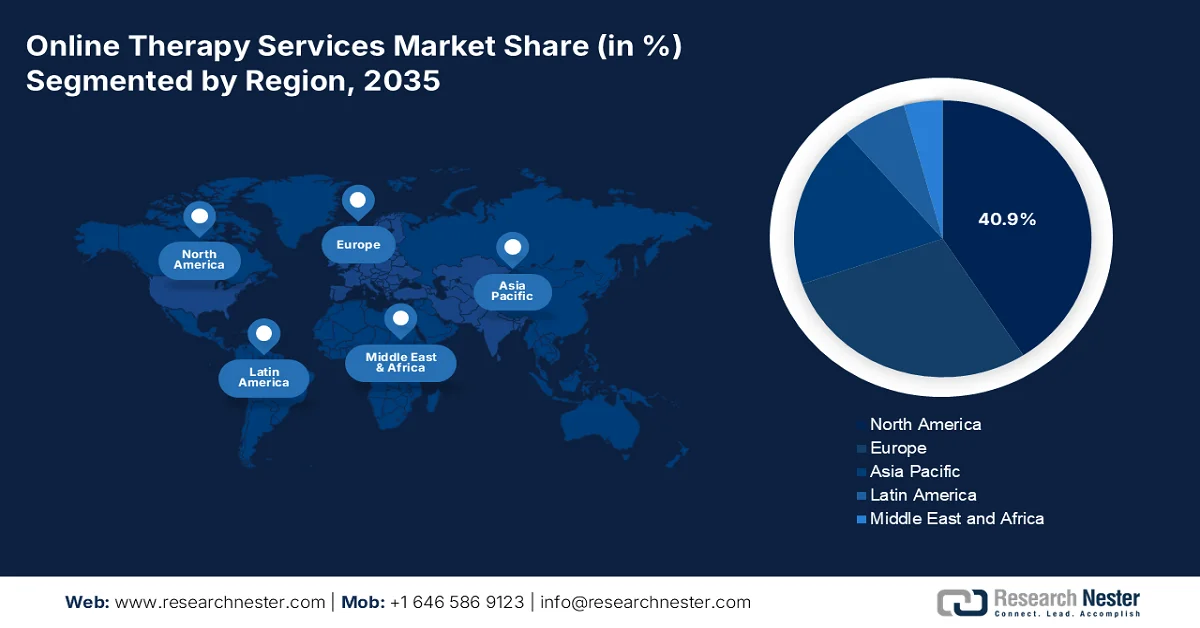
North America in the online therapy services market is anticipated to grab the highest share of 40.9% by the end of 2035. The market’s upliftment in the region is primarily attributed to the presence of advanced healthcare infrastructure, an increase in digitalized adoption rates, strong insurance reimbursement frameworks for telehealth services, and the existence of employer-based wellness programs. According to official statistics published by the CIVHC Organization in February 2025, telehealth services with suitable care providers in the U.S. peaked at 69 services per 1,000 people every month during the pandemic period, and this has presently stabilized to an estimated 15 services per 1,000 regional people. Additionally, telehealth services with behavioral health professionals effectively dominated telehealth visits, with averaging nearly 35 services per 1,000 people. Moreover, the presence of people with mental health disorders is also making it suitable for bolstering the market expansion in the region.
Yearly Rise in Mental Health Disorders and Telehealth Services in the U.S. (2019-2023)
|
Telehealth Services Adoption |
Mental Health Diagnoses |
||
|
2019 |
29% |
Generalized Anxiety Disorder |
18% |
|
2020 |
47% |
Major Depressive Disorders |
9% |
|
2021 |
59% |
Post-Traumatic Stress Disorder |
6% |
|
2022 |
56% |
Adjustment Disorder |
5% |
|
2023 |
58% |
Anxiety Disorder |
5% |
Source: CIVHC Organization
The online therapy services market in the U.S. is growing significantly, owing to an increase AI-driven tools by clinicians for automated note-taking, insurance billing simplification, and diagnostic assistance, reduction in administrative burdens, a huge focus on patient care solutions, and the presence of employer-sponsored mental health programs. As per an article published by NLM in April 2023, 1 in 5 adults and youth aged more than 9 years, along with 1 in 6 children aged between 2 and 8 years witness mental illness every year in the country. Moreover, 20% to 30% of young adults aged between 18 and 29 years reported experiencing severe psychological distress. Besides, 44% of high school students in the country experienced hopelessness, while 5% of young adults aged from 18 to 29 years observed serious psychological distress, thereby enhancing the market demand.
The provincial leadership in virtual care funding, public reimbursement for secured messaging services, secured digitalized platforms, federal government funding, the establishment of learning health systems, and suitable mental health services are readily driving the online therapy services market in Canada. Based on government estimates published by the Government of Canada in April 2024, the Budget 2024 proposed a generous investment of USD 500 million for the newest Youth Mental Health Fund. This investment assists healthcare organizations to offer increased care services for the young population in the country with standardized services. Additionally, the federal government declared its USD 0 billion health care plan and also signed bilateral healthcare deals across 13 territories and provinces, thus denoting an optimistic outlook for the market growth.
APAC Market Insights
The Asia Pacific in the online therapy services market is expected to emerge as the fastest-growing region during the forecast period. The market’s development in the region is effectively propelled by the rapid extension in smartphone penetration, a rise in mental health awareness, proactive governmental digital health strategies, and the existence of large-scale public telehealth programs, along with AI-based mental health technologies. According to official statistics published by WHO in July 2025, approximately 289 million people reside with a neurological, mental, and substance use condition, particularly in South-East Asia. In addition, almost 208,000 people lose their lives due to suicide every year, while 60% of people live with disability, owing to migraine, depression, schizophrenia, and anxiety, thereby enhancing the market demand in the overall region.
The online therapy services market in China is gaining increased traction, owing to an increase in the internet user base, a surge in mental health awareness, particularly among the urban population, the establishments of regulatory pathways for digitalized therapeutics, a substantial share of digitalized therapy product pipelines, and the massive demand for digital alternatives. As stated in an article published by NLM in May 2025, a clinical study was conducted, comprising 96 clinical trials on digital therapeutics in the country, with 22% of cognitive diseases and 21% of diabetes. This is further followed by 8% of cardiovascular diseases, and 6% of sleeping disorders and smoking cessation. Besides, the domestic digital therapeutics industry was worth USD 0.5 billion as of 2023, which is further expected to reach USD 2.9 billion by the end of 2030, along with a 28.7% growth rate, thus ensuring market demand to cater to mental illness.
The aspects of the government’s Tele-MANAS strategy, which is a tele-mental health program, as well as the allocation of generous funding for digital mental health facility, digital solutions for primary accessibility pathway, and an upsurge in smartphone user base are certain factors that are responsible for bolstering the online therapy services market in India. Based on government estimates published by the Ministry of Health and Family Welfare Government of India in February 2026, under the Manpower Development Scheme A Centers of Excellence in Mental health, 10 existing mental health institutes have been upgraded, along with the provision of almost USD 3.5 million to each center for renovating equipment, retention, faculty induction, and capital work, and 25 mental health facilities are readily funded for development. Therefore, with such developments, there is a huge growth opportunity for the market in the country.
Europe Market Insights
Europe in the online therapy services market is projected to witness considerable growth by the end of the stipulated timeline. The market’s growth in the region is highly driven by an increase in accepting digitalized mental health solutions, proactive governmental strategies, wide-ranging telemedicine reimbursement pathways, and an escalation in digital health transformation. According to official statistics published by NLM in February 2024, 250 million people in the region have been in lockdown, since public health measures have been launched to close non-essential services and businesses with the objective of limiting person-to-person contact. Besides, 78% of generalized practice patients in the UK are satisfied with the required mental care for catering to the welfare of their health conditions, thereby making it suitable for fueling the market development in the overall region.
The online therapy services market in Germany is gaining increased exposure, owing to the successful establishment of innovative reimbursement pathway for digitalized mental health applications, the provision of digital health applications, reimbursement offering by statutory health insurers, and robust policy alignment with population health demands. As stated in an article published by NLM in December 2024, mental diseases are complicated disorders that readily affect 28% of the adult population, which is almost 17.8 million people, in the country every year. Besides, the country’s largest statutory health insurance organization, Techniker Krankenkasse, has demonstrated that 20% of overall absences at work tend to attribute to mental disorders. Therefore, with the increase in mental disorders and insurance facilities, the market is continuously expanding in the overall country.
The tactical shift toward digital-first primary care models, a suitable framework for digitalized suppliers to provide platforms for primary care networks on standardized terms, generous funding across traditional and digital providers, and the presence of central reimbursement model are factors bolstering the online therapy services market in the UK. As per an article published by the UK Government in June 2022, more than 8 million people in the country have the NHS application, with over 40 million people comprising NHS login, and the majority of NHS trusts constitute an electronic patient record system in place. This is readily positioned at top of unprecedented investment, which includes USD 198.5 million in funding for digitalized adoption. Moreover, USD 2.6 billion of funding has been provided to support electronic patient records and assist more than 500,000 people to utilize digital tools, thus driving the online therapy services market expansion.
Key Online Therapy Services Market Players:
- BetterHelp (U.S.)
- Talkspace (U.S.)
- Teladoc Health (U.S.)
- Lyra Health (U.S.)
- MDLIVE (U.S.)
- Amwell (U.S.)
- SonderMind (U.S.)
- Cerebral (U.S.)
- Calmerry (U.S.)
- 7 Cups (U.S.)
- Thrive Talk (U.S.)
- Mindstrong Health (U.S.)
- ifeel (Spain)
- Kry (Livi) (Sweden)
- HelloBetter (Germany)
- Amano (UK)
- Doctor On Demand (U.S.)
- Wysa (India)
- MindFi (Singapore)
- UNIHEALTH (South Korea)
- RedBox Rx (U.S.)
- Talkiatry (U.S.)
- Company Overview
- Business Strategy
- Key Product Offerings
- Financial Performance
- Key Performance Indicators
- Risk Analysis
- Recent Development
- Regional Presence
- BetterHelp operates as the world's largest online therapy platform, connecting users with a vast network of licensed therapists through a subscription-based model. The company has significantly shaped consumer expectations around accessibility and convenience in digital mental health services.
- Talkspace has differentiated itself through strong integration with employer-sponsored programs and health insurance networks, making therapy accessible through workplace benefits. The platform offers a flexible hybrid model combining asynchronous messaging with live video sessions.
- Teladoc Health provides integrated virtual care across primary care, chronic condition management, and mental health services through its comprehensive platform. The company leverages its scale and existing health plan relationships to cross-sell online therapy services within a broader telehealth ecosystem.
- Lyra Health focuses exclusively on the employer market, offering curated networks of therapists and AI-powered matching to connect employees with appropriate mental health providers. The company emphasizes evidence-based care pathways and outcomes measurement to demonstrate return on investment for corporate clients.
- MDLIVE, a subsidiary of Evernorth, delivers integrated virtual care including behavioral health services through partnerships with major health plans and employers. The platform streamlines access by allowing members to schedule therapy appointments alongside medical and dermatology consultations within a single digital interface.
Here is a list of key players operating in the global online therapy services market:
The online therapy services market is highly competitive, led by major U.S. platforms. BetterHelp, the world’s largest online therapy provider, operates a network of licensed therapists globally. Simultaneously, Talkspace and Teladoc Health are prominent publicly traded competitors while, MDLIVE, a subsidiary of Evernorth, serves consumers through health plan partnerships. Key strategic initiatives include AI integration, with Lyra Health leveraging its AI-powered platform to serve people globally, and expansion into employer-sponsored mental health solutions, which has become a primary growth channel. Besides, in September 2024, Talkiatry and BetterHelp entered into a strategic partnership for offering in-network telepsychiatry services and medical management solutions to business clients. This partnership expanded accessibility to care coordination and telepsychiatry between BetterHelp’s 30,000 therapists and Talkiatry’s 300 licensed psychiatrists, thus driving the online therapy services industry globally.
Corporate Landscape of the Online Therapy Services Market:
Recent Developments
- In April 2025, Teladoc Health successfully acquired UpLift, which is a tech-enabled and an innovative provider of virtual mental health therapy, medical management, and psychiatry services to support the enhancement of its leadership in virtual mental health services.
- In January 2025, Talkspace launched Insights, which is regarded the latest feature for enhancing therapeutic care by assisting organizational providers to prepare for sessions and offer standard guidance for client care.
- In July 2024, RedBox Rx introduced online talk therapy solutions on its platform for expanding suitable accessibility to mental healthcare treatment services, particularly for adults aged more than 18 years.
- Report ID: 8494
- Published Date: Apr 01, 2026
- Report Format: PDF, PPT
- Explore a preview of key market trends and insights
- Review sample data tables and segment breakdowns
- Experience the quality of our visual data representations
- Evaluate our report structure and research methodology
- Get a glimpse of competitive landscape analysis
- Understand how regional forecasts are presented
- Assess the depth of company profiling and benchmarking
- Preview how actionable insights can support your strategy
Explore real data and analysis
Frequently Asked Questions (FAQ)
About this Report
Connect with our Expert


Report, 2026-2035



Copyright @ 2026 Research Nester. All Rights Reserved.
