Nuclear Medicine Market - Regional Analysis
North America Market Insights
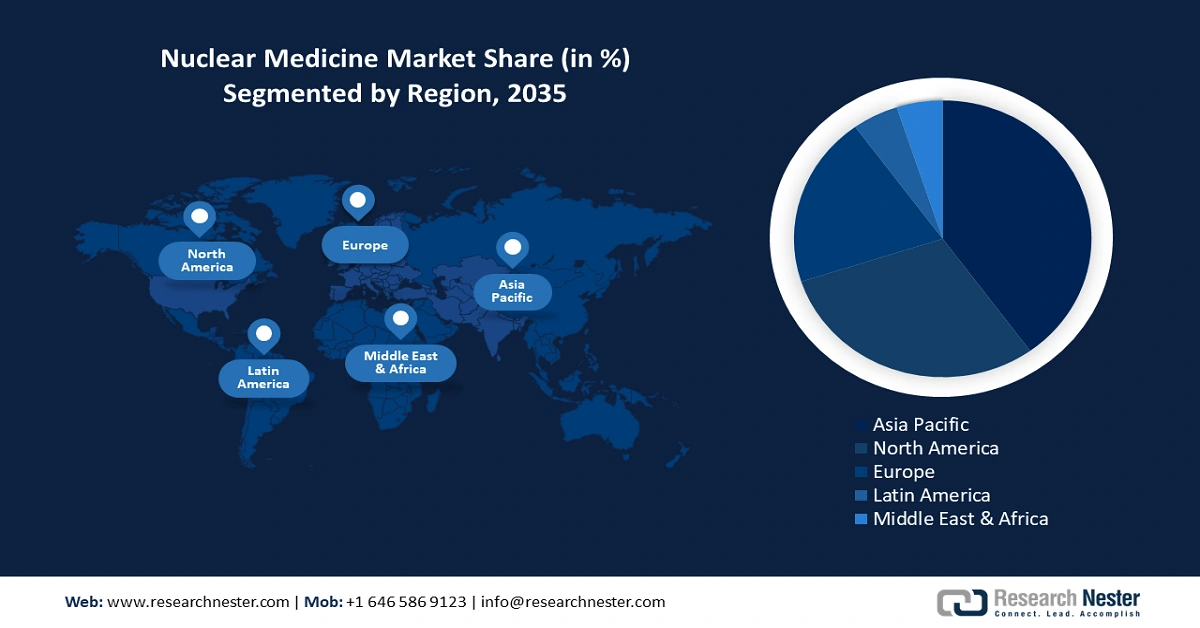
North America is anticipated to capture the highest share of 43% in the global market by the end of 2035. The growth is led by the presence of an advanced healthcare system and a heavy focus on early detection and personalized medicine. Because of significant research and development funding, the region is also seeing massive innovation with its radiopharmaceuticals and theranostic treatment models for cancer and neurological diseases. Robust reimbursement policies at the federal government level for procedures/billings under Medicare and Medicaid will allow more patients to access nuclear medicine diagnostics. With a working supply chain for nuclear medicine and radioisotopes, and advanced technology imaging tools (like PET and SPECT) also being more available to the usual healthcare practitioner than in the past.
It is predicted that the U.S. will have a large corner of the world's market share by 2035 due to its advanced healthcare delivery system and its emphasis on innovative diagnostic imaging and the development of radiopharmaceuticals. With Federal support from Medicare and Medicaid, providers in the oldest hospitals in the world now have access to and use the latest nuclear medicine technology. With the dramatic increase of chronic illnesses, mainly due to increased cancers and neurological diseases, there is a great demand for early and accurate diagnostics. In addition, as a region, we also have a robust infrastructure of medicinal isotopes and even higher utilization of PET and SPECT imaging as a region. This allows the U.S. market to be a leader in the world of nuclear medicine as well.
Government funding at the federal and provincial levels is driving growth in nuclear medicine in Canada. The public healthcare system in Canada supports the uptake of nuclear medicine procedures. Ongoing funding increases by provinces, including Ontario and British Columbia, have added infrastructure for PET/CT and SPECT imaging. Several research institutions are currently in collaboration with industry partners to develop new technologies, processes, and clinical trials. This will further enhance and strengthen the market. Together with increasing chronic disease incidence, all of these attributes will likely allow Canada to maintain a substantive share of the global market by 2035.
Europe Market Insights
Throughout the projection period, Europe is anticipated to experience a strong CAGR in the global nuclear medicine market associated with a stable research environment, a favorable regulatory environment, and growing investment to enhance innovation in radiopharmaceuticals. Germany, France, and the UK are making significant investments in precision diagnostics and target radioligand therapies. This is further facilitated as the region is equipped with a well-established healthcare infrastructure to enhance accessibility infrastructure for imaging modalities such as PET/CT and SPECT/CT. Additionally, there are collaborative partnerships between governmental health agencies, research institutions, and private pharmaceutical firms moving necessary clinical trials and developing radiotracers.
Germany is expected to account for a significant share of the global nuclear medicine market by 2035, owing to its technologically advanced medical care system, emphasis on cancer diagnostics. This country has several research institutions and industry participants that spur the development of radiopharmaceuticals and theranostic products. The existence of public-private partnerships and government money in the sector are stimulating the adoption and development of both PET/CT and SPECT/CT technologies. In October 2024, GE HealthCare (GEHC) announced a partnership with University Medicine Essen in Germany for the development of a new Theranostics Center of Excellence. According to GEHC, the facility will promote the application of theranostics in clinical settings and further studies on more individualized methods of cancer treatment. The vendor will also install a new Omni Legend 32cm PET/CT scanner, a SIGNA PET/MR scanner, and several SPECT/CT systems, including StarGuide, NM/CT 870 DR, and NM 830.
By 2035, France is forecasted to account for a significant share of the global nuclear medicine market due to its large pharmaceutical manufacturing capacity, strong research and development capacity in the field of radiopharmaceuticals. France has dynamic organizations such as Curium, which is the world's preeminent provider of diagnostic radioisotopes. France's national health care system also permits access to nuclear imaging services by a wide swath of the population, permitting higher procedural volumes. Public funding that France is providing for the modernization of diagnostic equipment and the production of radio tracers will also help support the market's expansion. The future demand for molecular imaging will be strong, particularly with an aging society, in addition to a significant rise in lifestyle-associated chronic diseases.
APAC Market Insights
Asia Pacific is expected to have a substantial CAGR in the global nuclear medicine market during the forecast period due to the rapid development of healthcare infrastructure, growing adoption of advanced diagnostic technologies, and the increasing incidences of cancer and cardiovascular diseases. Countries such as China, India, Japan, and South Korea are investing in nuclear medicine facilities, PET/SPECT imaging, and domestic radioisotope production to be less reliant on imports. The government programs accelerate the expansion of improved early disease detection and provide momentum for market adoption. The rise of the middle-class populations will continue to increase healthcare spending will also contribute to the demand for precision diagnostics. The overall strategic collaboration between global players and regional capital and funding institutions strengthens, develops, and commercializes advanced radiopharmaceuticals and provides solid, sustained growth in nuclear medicine across the region.
Given the increasing healthcare systems, government's increasing support anticipated that India will capture a large portion of the global nuclear medicine market by 2035. The Department of Atomic Energy (DAE) and Bhabha Atomic Research Centre (BARC) are actively involved in funding the domestic development of vital medical isotopes that would allow for less reliance on imports. The increase in the number of cases of cardiovascular diseases and the increase in cancer cases increasingly demand accurate and early diagnosis. For instance, as per the National Institutes of Health, the crude incidence rate and anticipated number of cancer cases in India for 2022 were 14,61,427, with a higher estimated number of female cases than male cases.
By 2035, China is anticipated to dominate the Asia-Pacific nuclear medicine market, fuelled by robust government support, a large number of potential patient growth, and a significant commitment to renewing diagnostic imaging infrastructure. China has also bolstered its domestic capacity for radioisotope production, connected to nuclear energy programs supported by the government. Its growing population of elders, bears a greater burden of chronic disease than other emerging nations in the region, yet, the government policies favour new innovation in the health care sectors, thus are poised to carve out a share in the total global nuclear medicine market.