Net Zero Energy Buildings Market Outlook:
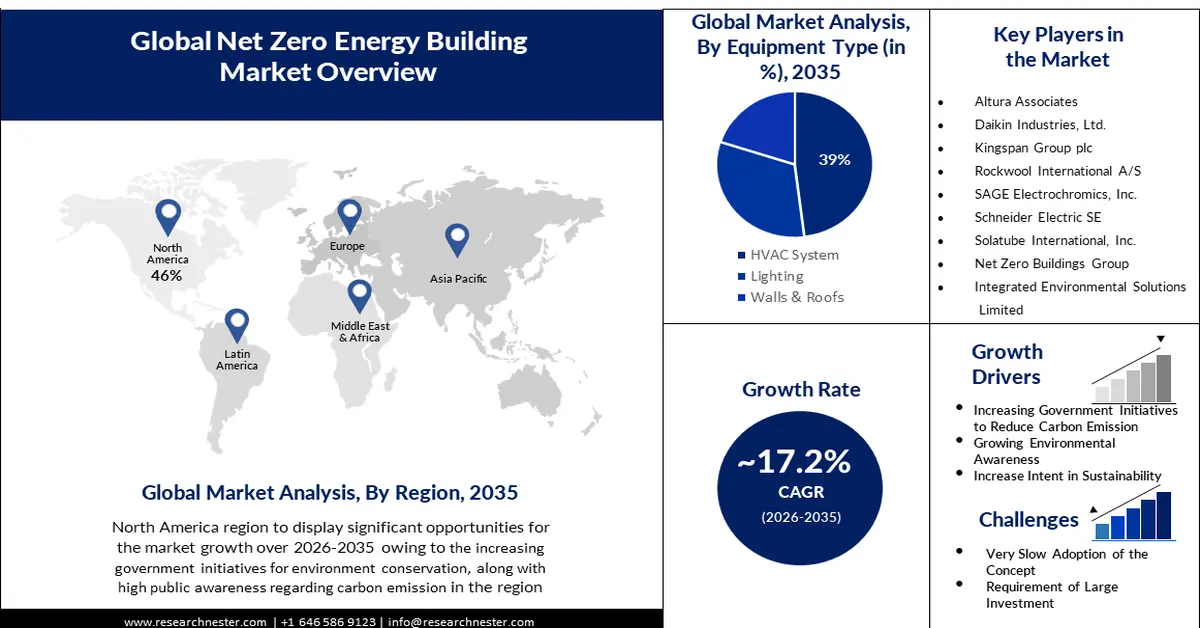
Net Zero Energy Buildings Market size was valued at USD 60.21 billion in 2025 and is set to exceed USD 294.4 billion by 2035, registering over 17.2% CAGR during the forecast period i.e., between 2026-2035. In the year 2026, the industry size of net zero energy buildings is evaluated at USD 69.53 billion.
The rapid urbanization across the globe, expansion of the building and construction sector and high energy requirements in modern buildings and infrastructure have raised concerns about energy consumption and environmental degradation. To cater to these issues, several nations and governments are focused on developing net zero energy buildings that use a combination of energy efficiency and renewable energy. These buildings offer several benefits, including reduced energy costs and environmental impact, enhanced energy security as well as increased comfort for occupants. According to the United Nations report, China, the U.S., and India have set ambitious net-zero targets for 2050. For this, the global warming needs to be under control and emissions to be reduced to 45% by 2030. This has resulted in growing inclination towards green buildings and net zero energy solutions.
The energy prices worldwide are rapidly increasing due to geopolitical instability, supply and demand imbalance. This has encouraged construction businesses and home owners to shift to financially viable solutions, including net zero energy buildings. These energy efficient buildings depend on renewable energy solutions such as solar, wind, and battery storage to reduce energy consumption through smart systems, lowering monthly bills. In July 2021, Johnson Controls launched OpenBlue Net Zero Buildings as a Service to provide a one-stop solution for companies willing to achieve net zero carbon and renewable energy goals.