Multi-core Processor Market Outlook:
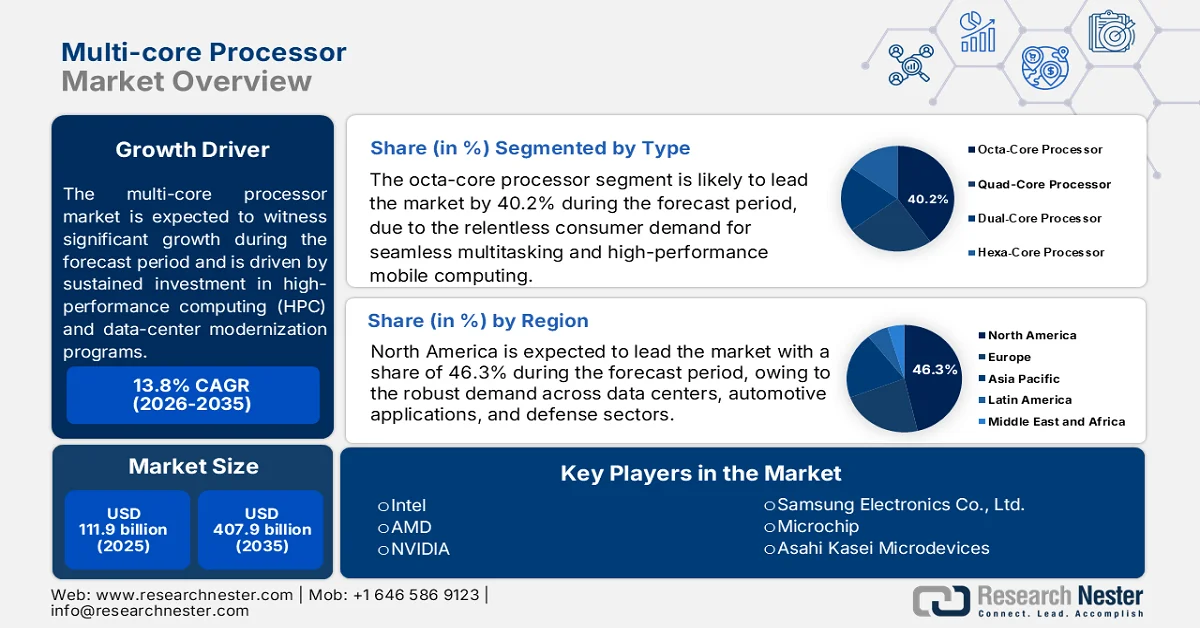
Multi-core Processor Market size was valued at USD 111.9 billion in 2025 and is projected to account for USD 407.9 billion by the end of 2035, rising at a CAGR of 13.8% during the forecast period, i.e., 2026-2035. In 2026, the industry size of multi-core processor is estimated at USD 127.4 billion.
The multi-core processor market is being supported by sustained investment in high-performance computing (HPC), artificial intelligence (AI), and data-center modernization programs led by governments and public research institutions. The OLCF April 2024 data reported that the Frontier supercomputer at Oak Ridge National Laboratory surpassed 1.102 exaflops of sustained performance, highlighting the growing requirement for advanced processor architectures capable of managing large-scale parallel workloads. Public-sector demand is also expanding through federally funded research and AI infrastructure initiatives. The National Science Foundation (NSF) continues to support advanced computing resources and AI research programs that require greater processing density and efficient compute performance.
In addition, organizations across sectors are increasing investments in cloud computing, digital engineering, simulation, and data analytics platforms that rely on multi-core processors to improve throughput and workload management. According to the Semiconductor Industry Association (SIA), global semiconductor sales reached USD 627.6 billion in 2024, reflecting strong demand across computing, communications, automotive, and industrial applications. As enterprises process larger datasets and deploy increasingly complex software environments, procurement priorities are shifting toward processors with higher core counts, virtualization capabilities, and improved power efficiency. These factors are strengthening demand for multi-core processors across servers, workstations, networking equipment, and embedded systems.
Key Multi-core Processor Market Insights Summary:
Regional Highlights:
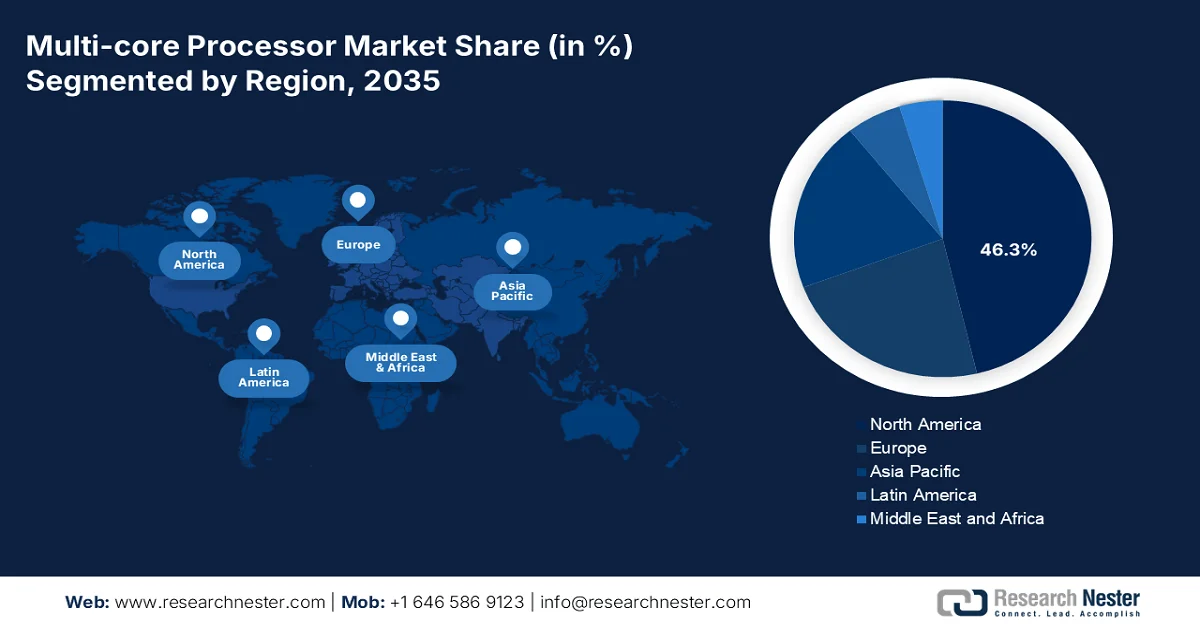
- In the multi-core processor market, North America is anticipated to capture 46.3% of regional revenue by 2035, underpinned by robust demand across data centers, automotive applications, and defense sectors
- Asia Pacific is set to witness notable expansion throughout 2026-2035, bolstered by massive consumer electronics production and rapid digital transformation across the region
Segment Insights:
- The octa-core processor segment is projected to account for 40.2% of the multi-core processor market by 2035, supported by relentless consumer demand for seamless multitasking and high-performance mobile computing
- The consumer electronics segment is expected to maintain its leading position during 2026-2035, fueled by the relentless innovation cycle in personal devices
Key Growth Trends:
- Expansion of government-funded semiconductor manufacturing programs
- Defense modernization investments
Major Challenges:
- High R&D costs
- Complex manufacturing processes
Key Players: Intel (U.S.), AMD (U.S.), NVIDIA (U.S.), Samsung Electronics Co., Ltd. (South Korea), Microchip (U.S.), Asahi Kasei Microdevices (Japan).
Global Multi-core Processor Market Forecast and Regional Outlook:
Market Size & Growth Projections:
- 2025 Market Size: USD 111.9 billion
- 2026 Market Size: USD 127.4 billion
- Projected Market Size: USD 407.9 billion by 2035
- Growth Forecasts: 13.8% CAGR (2026-2035)
Key Regional Dynamics:
- Largest Region: North America (46.3% Share by 2035)
- Fastest Growing Region: Asia Pacific
- Dominating Countries: United States, China, Japan, South Korea, Germany
- Emerging Countries: India, Vietnam, Taiwan, Singapore, Malaysia
Last updated on : 14 July, 2026
Multi-core Processor Market - Growth Drivers and Challenges
Growth Drivers
- Expansion of government-funded semiconductor manufacturing programs: Government investment in domestic semiconductor production is a major demand driver for multi-core processors. The U.S. Department of Treasury October 2024 data announced more than USD 36 billion in proposed CHIPS Act incentives to support semiconductor manufacturing and supply chain resilience. These investments are accelerating the establishment of advanced fabrication facilities and packaging operations that will increase processor production capacity and support next-generation multi-core designs. Increased local production also reduces supply-chain vulnerabilities, enabling faster deployment of advanced processors across critical sectors including telecommunications, defense, automotive, and scientific computing.
- Defense modernization investments: Defense agencies are increasingly procuring advanced computing platforms to support intelligence analysis, autonomous systems, cybersecurity operations, and mission planning. The U.S. Department of Defense April 2024 data requested approximately USD 17.2 billion for science and technology activities, including investments in advanced computing technologies. Modern defense systems generate large volumes of sensor and operational data that require rapid processing capabilities. Multi-core processors enable efficient execution of complex analytics, simulation, and command-and-control applications. Similar investments are being observed across NATO countries as governments strengthen digital defense infrastructure and cyber resilience.
Challenges
- High R&D costs: Developing advanced multi-core architectures demands massive investment in research, design, and validation. Companies like Intel and AMD continuously allocate billions to stay competitive. This financial barrier limits new entrants, as sustained funding is essential for innovation and keeping pace with rapidly evolving technological demands.
- Complex manufacturing processes: Producing multi-core processors requires extreme precision at nanometer scales. Foundries like TSMC and Samsung face immense challenges in yield optimization and defect management. New manufacturers struggle to achieve acceptable production yields, making entry prohibitively difficult without established expertise and advanced fabrication facilities.
Multi-core Processor Market Size and Forecast:
| Report Attribute | Details |
|---|---|
|
Base Year |
2025 |
|
Forecast Year |
2026-2035 |
|
CAGR |
13.8% |
|
Base Year Market Size (2025) |
USD 111.9 billion |
|
Forecast Year Market Size (2035) |
USD 407.9 billion |
|
Regional Scope |
|
Multi-core Processor Market Segmentation:
Type Segment Analysis
Under the type segment, the octa-core processor is leading and is poised to hold the share value of 40.2% by the end of 2035. The segment is driven by the relentless consumer demand for seamless multitasking and high-performance mobile computing. According to the Samsung January 2022 data, the company introduced Exynos 2200. This processor integrates Arm's latest Armv9 CPU cores, delivering substantial improvements over Armv8 in both security and performance areas critically important for modern mobile communications. Its tri-cluster octa-core structure features a powerful Cortex-X2 flagship core for peak performance, three Cortex-A710 big-cores for balanced efficiency, and four power-efficient Cortex-A510 little-cores. As Arm's Rene Haas noted, such processors leverage Arm's Total Compute strategy and security features like Memory Tagging Extension to enable future mobile experiences.
End user Segment Analysis
The consumer electronics sector stands as the dominant end user in the multi-core processor market, driven by the relentless innovation cycle in personal devices. This segment encompasses smartphones, tablets, smartwatches, laptops, and gaming consoles, all of which demand increasingly powerful yet power-efficient processing solutions. The proliferation of AI-enabled features, high-resolution displays, and immersive entertainment experiences has intensified the need for advanced multi-core architectures capable of handling complex parallel workloads. This segment's vast scale and diverse application requirements shape the strategic direction of chip designers, compelling them to deliver versatile, high-performance solutions that cater to evolving consumer expectations and usage patterns.
Application Segment Analysis
Computers remain a vital application segment for multi-core processors, encompassing desktops, laptops, and workstations that demand high-performance computing capabilities. The PIB February 2026 data depicts that the government's expansion of the Electronics Components Manufacturing Scheme (ECMS) to ₹40,000 crore signals a strategic push to strengthen domestic computer hardware production and reduce import dependencies. This substantial investment aims to build a robust ecosystem for manufacturing critical components, including advanced multi-core processors that power modern computing systems. Such policy support is expected to accelerate local production, create economies of scale, and make computers more accessible across enterprise and consumer markets.
Our in-depth analysis of the multi-core processor market includes the following segments:
|
Segment |
Subsegments |
|
Type |
|
|
End user |
|
|
Application |
|

Vishnu Nair
Head - Global Business DevelopmentCustomize this report to your requirements — connect with our consultant for personalized insights and options.
Multi-core Processor Market - Regional Analysis
North America Market Insights
North America is dominating the multi core processor market and is expected to hold the regional revenue share of 46.3% by the end of 2035. The region is driven by the robust demand across data centers, automotive applications, and defense sectors. The region benefits from a mature technology ecosystem, significant R&D investments, and strong government support for semiconductor innovation. Leading companies continuously push performance boundaries while addressing power efficiency and security requirements. The growing adoption of AI workloads, autonomous systems, and edge computing fuels processor demand across commercial and industrial applications. Collaborative initiatives between industry and academia accelerate architectural advancements, while supply chain resilience efforts gain momentum. The region's focus on custom silicon development and heterogeneous computing positions it for sustained market relevance.
The growing investments in artificial intelligence, cloud computing, defense modernization, and domestic semiconductor manufacturing is shaping the multi-core processor market in the U.S. Federal support for advanced chip production is strengthening the country’s processor ecosystem and encouraging deployment of high-performance computing infrastructure. A notable example is the CHIPS and Science Act, which continues to support semiconductor capacity expansion across the nation. According to the NIST January 2025, the CHIPS Program Office announced more than USD 36 billion in proposed funding awards for semiconductor manufacturing projects as of 2024, accelerating investments in advanced processor technologies and supporting demand from data centers, enterprise computing, telecommunications, and government research applications.
The significant government support for semiconductor manufacturing and innovation is shaping the multi-core processor market in Canada. In April 2024, the Prime Minister of Canada depicted that the Government of Canada announced a USD 59.9 million Strategic Innovation Fund investment for IBM Canada and the MiQro Innovation Collaborative Centre (C2MI) to expand semiconductor packaging capacity, strengthen supply chains, and advance quantum technology research. The supported projects, valued at CAD 226.5 million, are expected to create more than 280 highly skilled jobs in Quebec’s Bromont region. Additionally, Canada’s semiconductor ecosystem includes over 500 companies, more than 100 design firms, and five manufacturing facilities, reinforcing the country’s position as a growing hub for advanced processor and microchip development.
APAC Market Insights
The Asia Pacific is projected to emerge during the assessed period, 2026 to 2035 in the multi core processor market. The region is driven by the massive consumer electronics production and rapid digital transformation across the region. Countries like China, Japan, South Korea, and India serve as manufacturing powerhouses while simultaneously developing domestic semiconductor capabilities. The region benefits from robust government initiatives promoting local chip design and fabrication, reducing import dependencies. Expanding middle-class populations fuel smartphone adoption, while automotive and industrial automation sectors increasingly demand advanced processing solutions. The presence of leading foundries and fabless chip designers creates a dynamic ecosystem.
The growth in data centers, artificial intelligence, telecommunications, consumer electronics, and the government’s push for domestic semiconductor manufacturing is driving the multi-core processor market in India. Increasing digitalization across industries and rising demand for high-performance computing are encouraging adoption of advanced processor technologies. The PIB March 2025 data, under which the Government of India approved semiconductor projects with a cumulative investment of over ₹1.52 lakh crore (approximately USD 18 billion), aimed at strengthening the country’s chip fabrication, packaging, and ecosystem capabilities. These investments are expected to boost processor demand across computing, networking, automotive, and industrial applications.
The strong investments in semiconductor manufacturing, artificial intelligence, cloud computing, and digital infrastructure is shaping multi-core processor market in China. The country’s large electronics manufacturing base and growing demand for high-performance computing are driving adoption of advanced processor technologies across consumer, industrial, and enterprise applications. According to the Global Times April 2025 data, the country produced 451.4 billion integrated circuits in 2024, an increase of 22.2% compared with the previous year, reflecting substantial growth in semiconductor manufacturing activity. This expanding production capacity is strengthening domestic supply chains and supporting increased deployment of multi-core processors across key technology sectors.
Europe Market Insights
Europe maintains a significant position in the multi-core processor market, characterized by strong automotive electronics, industrial automation, and telecommunications infrastructure demands. The region prioritizes energy-efficient processor architectures aligned with sustainability goals and stringent environmental regulations. European research institutions actively collaborate on open-source RISC-V architectures and edge AI processor development. The region focuses on reducing semiconductor import dependence through strategic investments in domestic fabrication capabilities. Industrial IoT, smart manufacturing initiatives, and defense modernization programs further stimulate demand for reliable, secure multi-core processing solutions across diverse applications.
The strong demand from industrial automation, automotive electronics, artificial intelligence, and advanced manufacturing sectors is driving the multi-core processor market in Germany. As Europe’s largest industrial economy, Germany continues to invest in semiconductor capacity and digital infrastructure to strengthen technological competitiveness and supply-chain resilience. The European Commission August 2024 data reported that the German Federal Ministry for Economic Affairs and Climate Action (BMWK) approved state aid of approximately EUR 5 billion for semiconductor projects under the European Chips Act framework, aimed at expanding chip production and innovation capabilities. These investments are expected to accelerate adoption of advanced multi-core processors across data centers, Industry 4.0 applications, automotive systems, and research computing environments.
The investments in artificial intelligence, advanced computing, semiconductor research, and digital infrastructure modernization is driving the multi-core processor market in the UK. Demand is increasing across data centers, telecommunications, financial services, and industrial automation sectors that require greater processing performance and efficiency. Government support is also strengthening the domestic semiconductor ecosystem through innovation and R&D initiatives. According to the UK Government’s May 2023 data shows that the National Semiconductor Strategy launched includes up to £1 billion in funding over the next decade to enhance semiconductor design, research, and commercialization capabilities. This investment is expected to support processor innovation and expand adoption across high-growth technology applications.
Key Multi-core Processor Market Players:
- Intel (U.S.)
- AMD (U.S.)
- NVIDIA (U.S.)
- Samsung Electronics Co., Ltd. (South Korea)
- Microchip (U.S.)
- Asahi Kasei Microdevices (Japan)
- Company Overview
- Business Strategy
- Key Product Offerings
- Financial Performance
- Key Performance Indicators
- Risk Analysis
- Recent Development
- Regional Presence
- SWOT Analysis
- Intel remains a foundational force in the multi-core processor market, driving performance standards for desktops and servers. Their focus on hybrid architectures balances power and efficiency, catering to high-demand computing environments and ensuring robust processing capabilities for diverse enterprise applications.
- AMD has reshaped the multi-core processor market with its innovative chiplet designs, delivering exceptional multi-threaded performance. Their competitive edge lies in offering high core counts at accessible price points, making advanced parallel processing widely available for gamers, creators, and data centers seeking superior value.
- NVIDIA’s influence in the multi-core processor market is defined by its high-performance GPUs, which utilize thousands of cores for parallel processing. This architecture drives breakthroughs in AI, deep learning, and scientific simulations, positioning NVIDIA as a leader in accelerating complex computational workloads.
- Samsung is a key player in the multi-core processor market, specializing in ARM-based Exynos SoCs for mobile devices. Their designs focus on power efficiency and integrated connectivity, enabling seamless multitasking and high-performance graphics for the next generation of smartphones and wearable technology.
- Microchip addresses the multi-core processor market with a focus on embedded and real-time applications. Their microprocessors are designed for industrial and automotive systems, prioritizing deterministic performance and low power consumption to manage critical tasks in highly reliable and constrained environments.
Here is a list of key players operating in the global multi-core processor market:
The global multi-core processor market is highly consolidated, dominated by a few vertically integrated semiconductor giants that control both design and fabrication. The competitive landscape is defined by an intense technological arms race focused on process node miniaturization (sub-5nm), core count scaling, and power efficiency, particularly for data center and AI workloads. U.S.-based leaders maintain their supremacy through massive R&D budgets and proprietary x86 and ARM architectures, while Asian manufacturers leverage high-volume production capabilities to serve the consumer electronics and IoT segments. Key differentiators include integrated AI accelerators, security features, and ecosystem lock-in through software optimization.
Corporate Landscape of the Multi-core Processor Market:
Recent Developments
- In April 2026, Intel® unveiled its new Intel Core™ Series 3 mobile processors, bringing advanced performance, exceptional battery life, and AI-ready value to buyers of commercial and essential edge devices.
- In April 2026, AMD released the AMD Ryzen™ 9 9950X3D2 Dual Edition processor, the first processor that brings dual AMD 3D V-Cache™ technology to the desktop, unlocking a new level of performance for developers, creators and gamers.
- In March 2026, NVIDIA launched the NVIDIA Vera CPU, the world’s first processor purpose-built for the age of agentic AI and reinforcement learning, delivering results with twice the efficiency and 50% faster than traditional rack-scale CPUs.
- Report ID: 7081
- Published Date: Jul 14, 2026
- Report Format: PDF, PPT
- Explore a preview of key market trends and insights
- Review sample data tables and segment breakdowns
- Experience the quality of our visual data representations
- Evaluate our report structure and research methodology
- Get a glimpse of competitive landscape analysis
- Understand how regional forecasts are presented
- Assess the depth of company profiling and benchmarking
- Preview how actionable insights can support your strategy
Explore real data and analysis
Frequently Asked Questions (FAQ)
About this Report
Connect with our Expert


Report, 2026-2035



Copyright @ 2026 Research Nester. All Rights Reserved.
