Mobility as a Service Market - Regional Analysis
North America Market Insights
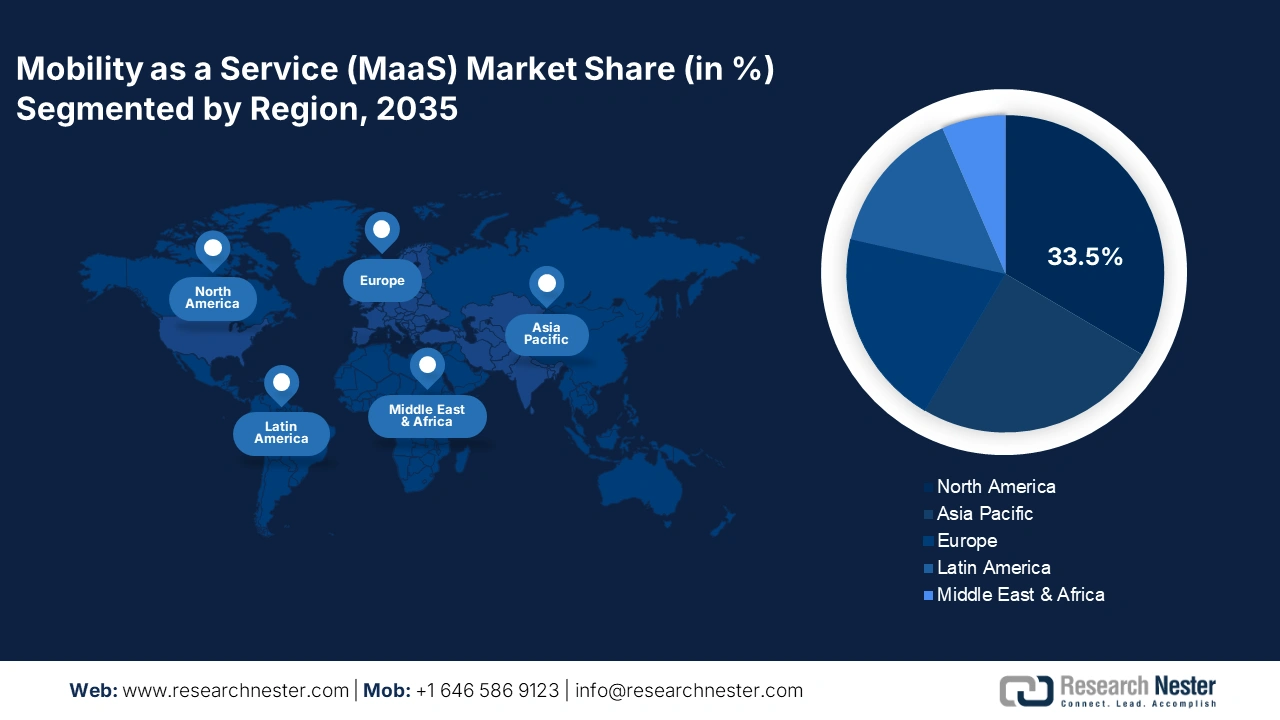
The North America mobility as a service (MaaS) market is anticipated to hold 33.5% of the global revenue share by 2035. The prime factors fueling mobility as a service solution sales are the rise in digital transportation policies and increasing investments in connected mobility. Supportive government policies and spending are also expected to increase the production and commercialization of MaaS solutions in the years ahead. The growth in 5G infrastructure is further set to drive seamless connectivity in MaaS solutions.
The U.S. is expected to witness a swift rise in the sales of MaaS solutions during the foreseeable period. The government-led initiatives and advancements in digital infrastructure are contributing to the increasing MaaS demand. Government support for 5G network expansion and smart city projects is generating profitable opportunities for MaaS producers. The Federal Communications Commission (FCC) allocation of nearly USD 9.0 billion to the 5G Fund for Rural America has also accelerated the deployment of vehicle-to-everything (V2X) communication and expanded the reach of connected mobility solutions. These initiatives are anticipated to uplift the position of the U.S. in the global market.
The MaaS solution sales in Canada are set to increase at a high pace in the coming years due to the favorable public plans and robust advancements in the wireless connectivity networks. The smart city projects are fueling innovation in urban mobility and further accelerating the demand for integrated transportation solutions. The rise in government spending on smart mobility is expected to create a profitable environment for MaaS producers.
APAC Market Insights
The Asia Pacific market is projected to increase at a 19.7% CAGR between 2026 and 2035. The increasing demand for autonomous vehicles is opening fruitful doors for the MaaS manufacturers. Growing investments in smart transportation are likely to increase the adoption of MaaS solutions in the coming years. China and India are projected to emerge as win-win markets, owing to the strong presence of end users. Further, the know-how tactics are anticipated to drive innovations in the Japan and South Korea markets.
Sales of MaaS solutions are estimated to increase at a rapid pace in China, due to the large-scale urbanization and advancements in regional transportation. Government backing and consistent public-private investment strategies are expected to fuel the demand for innovative MaaS solutions in the coming years. The International Energy Agency (IEA) reports that China led the world in electric car sales in 2024, with nearly half of all cars sold there being electric. The 11 million electric cars sold in the country last year were more than the total global electric car sales two years earlier. The robust rise in smart mobility sales is creating lucrative space for key players.
The market in India is projected to exhibit the fastest CAGR throughout the forecast period. The rise in digital infrastructure expansion and investments in public transit is driving the attention of Maas technology investors. The India Brand Equity Foundation (IBEF) reported that the Ministry of Heavy Industries started the PM E-DRIVE Scheme with around USD 1.28 billion to support India’s electric vehicle (EV) industry. The scheme aims to encourage electric transportation and reduce the use of fossil fuels. This is also increasing the number of new companies in the MaaS business. Thus, mobile-first MaaS solutions are estimated to hold a dominant share throughout the study period.
Europe Market Insights
The Europe market is foreseen to account for a large global revenue share throughout the forecast period. The convergence of sustainability mandates and digital adoption is propelling the sales of mobility as a service solutions. The rise in public-private partnerships for public transit, e-scooters, bike-sharing, and ride-hailing is further creating a high-earning environment for key players. The European Union’s Green Deal and Fit for 55 targets are some of the major drivers for the overall market growth.
Germany leads the sales of MaaS, owing to its strong automotive base and advanced digital infrastructure. The federal support for sustainable mobility is likely to fuel the adoption of MaaS solutions. The infrastructure modernization of rail and other public transit is accelerating the trade of MaaS. The mobility options, such as e-scooters and car-sharing, are most popular in the country, creating a high application environment for MaaS.
The U.K. market is projected to be driven by the dense urban population and the strong demand for public transport systems. The supportive government policies and funding are increasing the sales of MaaS. The smart mobility initiatives to reduce urban congestion and meet its net-zero by 2050 target are also contributing to the overall market growth. Furthermore, the EV infrastructure expansion is set to attract several international companies in the years ahead.