Mid and High-Level Precision GPS Receiver Market Outlook:
Mid and High-Level Precision GPS Receiver Market size was over USD 3.8 billion in 2025 and is poised to cross USD 8.9 billion by the end of 2035, witnessing more than 8.9% CAGR during the forecast period i.e., between 2026-2035. In 2026, the industry size of mid and high-level precision GPS receiver is estimated at USD 4.1 billion.
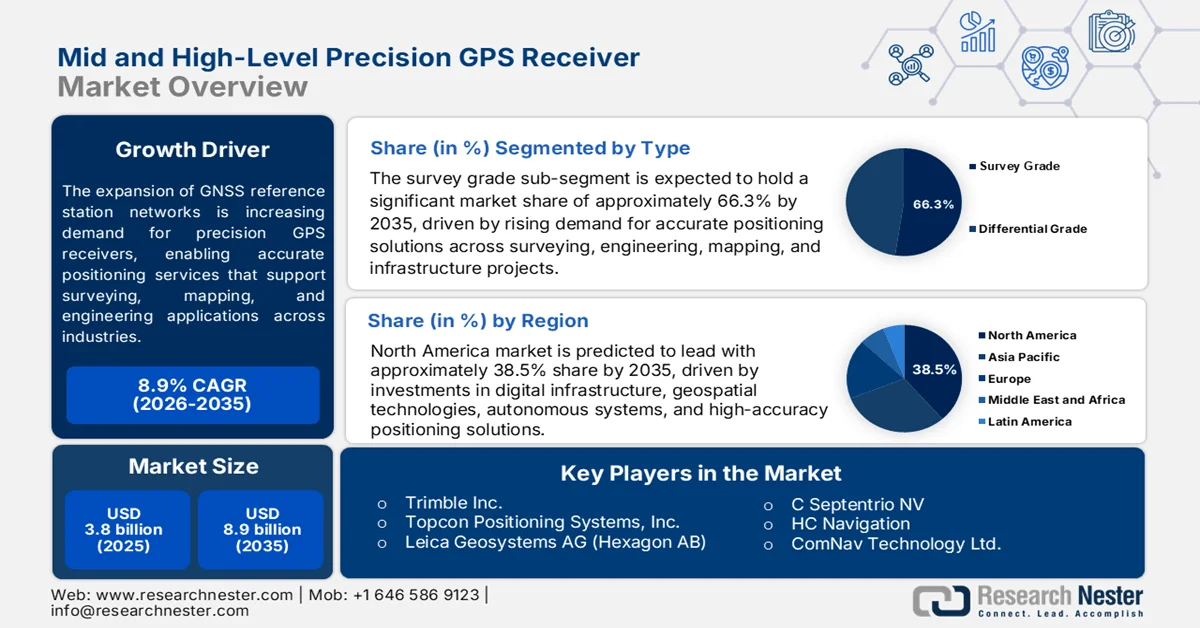
The global mid and high-level precision GPS receiver market is primarily driven by the rising implementation of precision positioning technologies across surveying, infrastructure development, construction, agriculture, and defense applications. Where governments and private organizations are increasing investments in digital infrastructure and geospatial technologies to improve mapping accuracy, project planning, and operational efficiency. Besides this, it is stated by the U.S. National Geodetic Survey (NGS) that the National Spatial Reference System (NSRS) serves as the official coordinate system for the United States and supports positioning activities for millions of surveying, engineering, mapping, transportation, and construction projects nationwide. The growing trust in accurate positioning data is creating strong demand for precision GPS receivers across professional applications.
Furthermore, continuous improvements in satellite navigation systems, multi-constellation GNSS technology, and real-time correction services are increasing the performance of precision GPS receivers. Moreover, according to the U.S. Space Force, which was updated in 2023, the Global Positioning System operates 31 operational satellites that provide positioning, navigation, and timing services globally. This progress is improving positioning accuracy, signal consistency, and operational efficiency, which is supporting the long-term implementation of mid and high-level precision GPS receivers across surveying, construction, agriculture, and other professional applications.
Key Mid and High-Level Precision GPS Receiver Market Insights Summary:
Regional Insights:
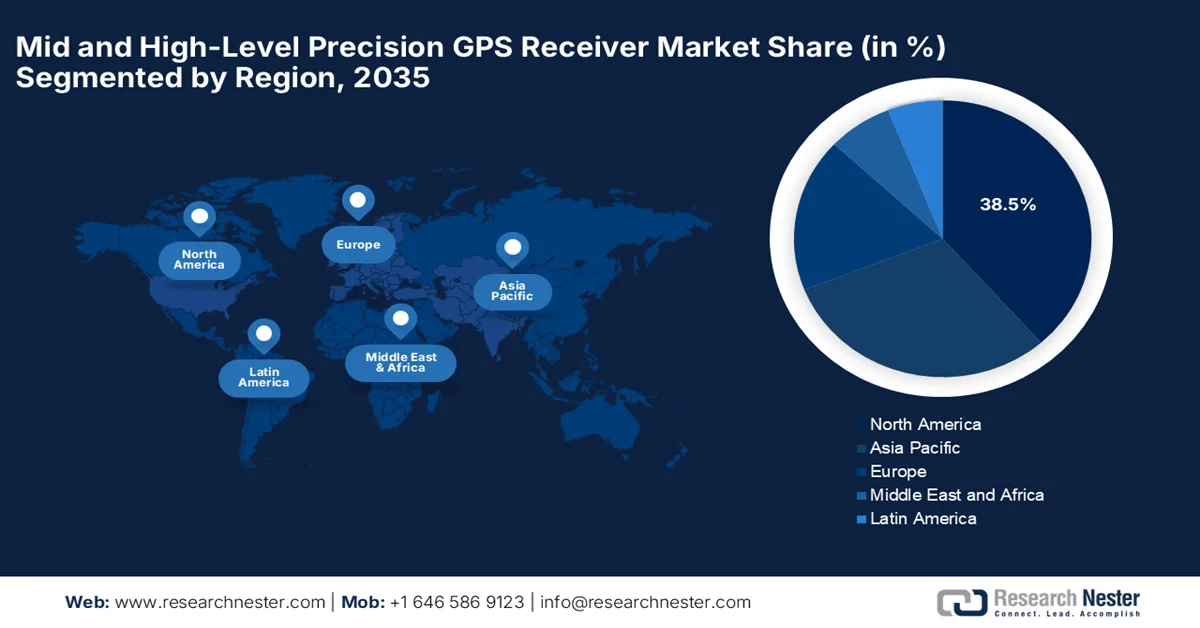
- North America is projected to capture approximately 38.5% share by 2035 in the mid and high-level precision GPS receiver market, underpinned by the rising implementation of precision positioning technologies across construction, agriculture, transportation, and defense applications
- Europe is expected to witness steady growth throughout 2026-2035, fueled by growing investments in digital infrastructure, intelligent transportation systems, precision agriculture, and geospatial technologies
Segment Insights:
- Mid and High-Level Precision GPS Receiver Market survey grade sub-segment is projected to account for approximately 66.3% share by 2035, propelled by the rising use of highly accurate positioning equipment across land surveying, engineering, infrastructure development, and mapping projects
- The agriculture sub-segment is anticipated to secure a significant share market by 2035, supported by the growing adoption of precision farming practices for field mapping, automated machinery guidance, and crop management
Key Growth Trends:
- Growing precision agriculture
- Expansion of GNSS reference station networks
Major Challenges:
- Signal interference and accuracy limitations
- High cost of precision positioning solutions
Key Players: Trimble Inc.,Topcon Positioning Systems, Inc.,Leica Geosystems AG (Hexagon AB),CHC Navigation (Shanghai Huace Navigation Technology Co., Ltd.),Septentrio NV,ComNav Technology Ltd.
Global Mid and High-Level Precision GPS Receiver Market Forecast and Regional Outlook:
Market Size & Growth Projections:
- 2025 Market Size: USD 3.8 billion
- 2026 Market Size: USD 4.1 billion
- Projected Market Size: USD 8.9 billion by 2035
- Growth Forecasts: 8.9% CAGR (2026-2035)
Key Regional Dynamics:
- Largest Region: North America (38.5% Share by 2035)
- Fastest Growing Region: Asia Pacific
- Dominating Countries: United States, China, Germany, Japan, Canada
- Emerging Countries: India, South Korea, Australia, Brazil, Singapore
Last updated on : 24 July, 2026
Mid and High-Level Precision GPS Receiver Market - Growth Drivers and Challenges
Growth Drivers
- Growing precision agriculture: Farmers are using high-accuracy positioning systems to improve field operations, improve fertilizer and pesticide application, and increase overall farm productivity. As accuracy in farming becomes more common, the need for reliable positioning equipment continues to grow. The growing use of precision agriculture is helping drive demand for mid and high-level precision GPS receivers. Therefore, according to the Food and Agriculture Organization (FAO), agriculture will need to produce approximately 50% more food by 2050 to meet the needs of the increasing global population. This is encouraging the implementation of precision farming technologies that depend on accurate positioning systems.
- Expansion of GNSS reference station networks: These networks support accurate positioning for activities that include surveying, mapping, engineering, and other field operations. The increase in Global Navigation Satellite System (GNSS) reference station networks is helping meet the demand for mid and high-level precision GPS receivers. As more organizations depend on centimetre-level positioning, the use of professional-grade GPS receivers continues to increase across commercial and government projects. Moreover, according to the U.S. National Geodetic Survey (NOAA), the NOAA Continuously Operating Reference Stations (CORS) Network is a cooperative network that is supported by 247 organizations, with 1,806 operational GNSS reference stations across the United States.
- Growing LiDAR mapping activities: LiDAR surveys depend on accurate positioning information to produce consistent elevation models that is used in infrastructure planning, flood management, land surveying, and environmental monitoring. The increasing use of LiDAR mapping is supporting the demand for mid and high-level precision GPS receivers. As governments continue increasing national mapping programs, the need for high-precision GPS equipment is also rising. Besides this, according to the U.S. Geological Survey (USGS), 3D Elevation Program data were available or were in progress for approximately 98.3% of the United States by the end of 2024, that showcase the constant development of nationwide elevation mapping projects that rely on accurate positioning technologies.
Challenges
- Signal interference and accuracy limitations: High-precision GPS receivers depend on uninterrupted satellite signals to deliver centimetre-level positioning accuracy. However, in dense urban environments, mountainous terrain, heavy vegetation, and atmospheric disturbances can weaken or block GNSS signals, which reduces positioning consistency. Signal interference and multipath effects can also affect surveying, construction, and precision agriculture applications, which is one of the reasons for not receiving high- accuracy positioning in such operating environments.
- High cost of precision positioning solutions: Mid and high-level precision GPS receivers involve higher purchase costs than standard positioning devices due to their advanced GNSS chipsets, multi-frequency capabilities, and real-time correction technologies. Moreover, organizations usually need to invest in GNSS reference station subscriptions, software incorporation, and skilled personnel for positioning and maintenance. These higher implementation costs can limit use among small and medium-sized enterprises, especially in markets with tight budgets.
Mid and High-Level Precision GPS Receiver Market Size and Forecast:
| Report Attribute | Details |
|---|---|
|
Base Year |
2025 |
|
Forecast Year |
2026-2035 |
|
CAGR |
8.9% |
|
Base Year Market Size (2025) |
USD 3.8 billion |
|
Forecast Year Market Size (2035) |
USD 8.9 billion |
|
Regional Scope |
|
Mid and High-Level Precision GPS Receiver Market Segmentation:
Type Segment Analysis
The survey grade sub-segment under the type segment is anticipated to hold the largest share in the mid and high-level precision GPS receiver market approximately 66.3% by the end of 2035. The sub-segment’s growth is mainly attributed to the rising use of highly accurate positioning equipment among land surveying, engineering, infrastructure development, and mapping projects, where precise location data is essential for daily operations. Furthermore, according to the U.S. National Geodetic Survey (NOAA), the National Spatial Reference System (NSRS) serves as the official coordinate system for the United States that provides the base for surveying, mapping, engineering, transportation, and many other geospatial activities nationwide. The growing need for reliable and accurate positioning information is helping the larger adoption of survey-grade GPS receivers among the professional applications.
Industry Segment Analysis
For the industry segment, the agriculture sub-segment is projected to register a significant share in the mid and high-level precision GPS receiver market by the end of 2035. Its growth is mainly attributed to the growing use of precision farming practices for field mapping, automated machinery guidance, and crop management. High-accuracy GPS receivers help farmers improve operational efficiency while helping more precise agricultural activities. Moreover, according to the U.S. Department of Agriculture (USDA) Census of Agriculture, the United States had 1.9 million farms covering approximately 880.1 million acres of farmland in 2022, that highlights the large agricultural base where accurate positioning technologies continue to find large application.
Frequency Segment Analysis
The dual frequency sub-segment under the frequency segment is expected to witness the highest market revenue in the market by the end of 2035. The sub-segment’s development is mainly credited to its ability to provide more reliable positioning by reducing atmospheric signal errors, which is suitable for surveying, construction, mapping, and other precision-based applications. Therefore, it is stated by the European Space Agency (ESA), each Galileo satellite broadcasts 10 navigation signals, with the Open Service helping dual-frequency positioning through the E1 and E5a signals for improved ionospheric error correction. The rising availability of dual-frequency satellite services is supporting the larger adoption of dual-frequency precision GPS receivers across professional applications.
Our in-depth analysis of the mid and high-level precision GPS receiver market includes the following segments:
|
Segment |
Subsegments |
|
Type |
|
|
Frequency |
|
|
Industry |
|

Vishnu Nair
Head - Global Business DevelopmentCustomize this report to your requirements — connect with our consultant for personalized insights and options.
Mid and High-Level Precision GPS Receiver Market - Regional Analysis
North America Market Insights
The North America mid and high-level precision GPS receiver market is anticipated to hold the largest share of approximately 38.5% by the end of the forecast period, determined by the rising implementation of precision positioning technologies across construction, agriculture, transportation, and defense applications. The region continues to benefit from strong investments in digital infrastructure, autonomous systems, and smart transportation projects that needed highly accurate positioning solutions. Moreover, it is recorded by the U.S. National Geodetic Survey (NGS), that the National Spatial Reference System (NSRS) serves as the official aligning framework for the United States, supporting surveying, engineering, mapping, and infrastructure projects nationwide, creating sustained demand for high-precision GPS receivers.
The U.S. market is expected to register strong growth due to increasing deployment of drones, infrastructure modernization projects, and precision surveying activities. Industries are adopting high-accuracy GPS receivers to improve mapping, inspection, and construction efficiency while supporting autonomous operations. Therefore, it is stated by the Federal Aviation Administration, that more than 1 million drones were registered in the United States in 2025, with commercial operations continuing to enhanced across surveying, construction, agriculture, and infrastructure inspection, increasing the demand for professional-grade precision GPS receivers.
The market in Canada is projected to register a stable growth due to the country's excessive use of geospatial technologies for natural resource management, environmental monitoring, and land surveying. High-precision placement has become important for mapping large and remote areas which support mining, forestry, and public infrastructure projects. Furthermore, by the Natural Resources Canada, that the Canadian Geodetic Survey expanded the number of GNSS stations distributing data from 156 in FY 2024–2025 to 183 in FY 2025–2026, improving the availability of high-precision positioning services across the country. This expansion is expected to support the demand for professional-grade precision GPS receivers.
Europe Market Insights
The Europe mid and high-level precision GPS receiver market is anticipated to register steady growth during the forecast period due to growing investments in digital infrastructure, intelligent transportation systems, precision agriculture, and geospatial technologies. The region is also enhancing the use of high-accuracy positioning solutions to help infrastructure modernization, autonomous systems, and industrial automation. Moreover, by the European Union Agency for the Space Programme (EUSPA), that the EU Space Programme 2025 continues to strengthen Galileo and EGNOS services, which is helping the broad adoption of high-precision positioning technologies across commercial and public-sector applications.
The market is gaining momentum as precision positioning is becoming an essential part of large-scale infrastructure development and railway modernization project in Germany. Precision GPS receivers are increasingly being used to improve project accuracy and operational efficiency across infrastructure and industrial applications. Beside this it is stated that the German Bundestag (2025), a federal viability study estimated that around EUR 8 billion in federal funding will be required for the digitalization of Germany's railway network by 2029 to fast-track railway digitalization through modern positioning, signaling, and automation technologies, creating additional demand for precision GNSS solutions.
The France market is projected to witness stable growth due to the country's strong participation in satellite navigation technologies and GNSS research. The country continues to reinforce its geospatial capabilities through investments in satellite navigation and Earth observation programmes, that inspire the implementation of high-accuracy GNSS equipment across professional applications. Moreover, according to the French Space Agency (CNES), France continues to participate in the European Galileo satellite navigation programme. This is encouraging the large use of accurate positioning technologies in surveying, transportation, mapping, and other professional applications, that supports the need for mid and high-level precision GPS receivers.
APAC Market Insights
The Asia Pacific mid and high-level precision GPS receiver market is anticipated to dominate during the forecast period owing to the increasing adoption of precision positioning technologies across construction, agriculture, transportation, mining, and infrastructure development. Across the region, countries are continuing to strengthen satellite navigation capabilities while enhancing the use of GNSS-enabled equipment for professional applications. Therefore, according to the European Union Agency for the Space Programme (EUSPA) GNSS and EO Market Report 2024, the global connected base of GNSS devices is projected to exceed 10 billion by 2033, with Asia-Pacific remaining one of the fastest-growing regions for GNSS-enabled applications. This growing implementation is supporting the need for mid and high-level precision GPS receivers.
The market in Japan is expected to witness significant growth due to the country's continuous efforts to improve satellite-based positioning services. Moreover, it is stated by the Cabinet Office of Japan, the Quasi-Zenith Satellite System (QZSS) is being expanded from 4 satellites to a 7-satellite constellation, that will improve positioning accuracy and ensuring constant navigation coverage over Japan and surrounding regions. This expansion is encouraging the large use of precision GPS receivers across surveying, intelligent transportation, and construction applications.
The country is continuously increasing the commercial application of satellite navigation to improve operational efficiency across multiple industries. Due to the increasing use of precision positioning technologies across surveying, intelligent transportation, precision agriculture, and infrastructure development, China market is projected to witness strong growth. Besides this, according to the BeiDou Navigation Satellite System, more than 2 billion terminals were using BeiDou positioning services by 2024, that showcase the growing implementation of high-accuracy satellite navigation technologies across transportation, agriculture, logistics, and other professional sectors. This increasing deployment is helping the demand for mid and high-level precision GPS receivers.
Key Mid and High-Level Precision GPS Receiver Market Players:
- Trimble Inc. (U.S.)
- Topcon Positioning Systems, Inc. (Japan)
- Leica Geosystems AG (Hexagon AB) (Switzerland)
- CHC Navigation (Shanghai Huace Navigation Technology Co., Ltd.) (China)
- Septentrio NV (Belgium)
- ComNav Technology Ltd. (China)
- Company Overview
- Business Strategy
- Key Product Offerings
- Financial Performance
- Key Performance Indicators
- Risk Analysis
- Recent Development
- Regional Presence
- SWOT Analysis
- Trimble provides high-precision GNSS receivers and positioning solutions for surveying, construction, agriculture, and geospatial industries, that help surveyor get accurate results.
- Topcon is recognized for its positioning systems that support professional users in surveying, construction automation, and machine control operations. The company develops combined solutions that help contractors and surveyors get higher efficiency, at sites.
- Leica Geosystems serves engineering, mapping, surveying, and infrastructure industries with advanced GNSS-based measurement technologies. They designed to provide dependable positioning results, helping professionals to handle complex projects that needed accurate information.
- CHC Navigation has built its portfolio around affordable yet reliable GNSS equipment for industries which include surveying, agriculture, construction, and marine operations.
- Septentrio has positioned itself as a technology provider for industries where reliable positioning is crucial, that includes autonomous systems, industrial automation, and professional surveying, its offerings through advanced GNSS receiver designs that can support strong signal tracking, multi-frequency processing, and consistent accuracy in challenging operating conditions, which helps in being different in market.
- ComNav Technology operates in the accurate GNSS market by providing receivers and positioning solutions for surveying, construction, agriculture, and machine guidance. The company is enhancing its global footprint through product enhancements, competitive pricing strategies, and solutions designed for professional field applications.
Here is a list of key players operating in the global mid and high-level precision GPS receiver market:
The global mid and high-level precision GPS receiver market is moderately competitive, with companies paying attention on improving positioning accuracy, reliability, and overall receiver performance for professional applications. Manufacturers are also highly developing advanced GNSS solutions with multi-frequency and multi-constellation capabilities for delivering better performance in complex situations. Market players are enhancing their product to support in surveying, construction, agriculture, mapping, and infrastructure applications. Moreover, companies are strengthening their market position through product launches, technological advancements, strategic partnerships, and increase of distribution networks. Constant investment in research and development remains an important area for maintaining competitiveness in the accurate positioning industry.
Corporate Landscape of the Market:
Recent Developments
- In May 2026, Topcon launched the HiPer XR GNSS receiver, which features expanded communication range, improved TILT compensation, and multi-GNSS support for accurate positioning in challenging environments.
- In March 2025, ComNav continued enhancing its GNSS innovation portfolio with new aligning solutions, that includes laser RTK technology and advanced surveying products.
- In October 2025, Septentrio introduced new mosaic-G5 ultra-compact GNSS receiver modules designed for drones, robotics, GIS, and other size-forced industrial applications.
- Report ID: 8692
- Published Date: Jul 24, 2026
- Report Format: PDF, PPT
- Explore a preview of key market trends and insights
- Review sample data tables and segment breakdowns
- Experience the quality of our visual data representations
- Evaluate our report structure and research methodology
- Get a glimpse of competitive landscape analysis
- Understand how regional forecasts are presented
- Assess the depth of company profiling and benchmarking
- Preview how actionable insights can support your strategy
Explore real data and analysis
Frequently Asked Questions (FAQ)
About this Report
Connect with our Expert


Report, 2026-2035



Copyright @ 2026 Research Nester. All Rights Reserved.
