Global Cyclopentanone (CPN)-based Negative Photosensitive Polyimide (PSPI) Market
1. An Outline of the Global Cyclopentanone (CPN)-based Negative Photosensitive Polyimide (PSPI) Market
1.1. Market Definition and Segmentation
1.2. Study Assumptions and Abbreviations
2. Research Methodology & Approach
2.1. Primary Research
2.2. Secondary Research
2.3. Data Triangulation
2.4. SPSS Methodology
3. Executive Summary
4. Growth Drivers
5. Major Roadblocks
6. Opportunities
7. Prevalent Trends
8. Government Regulation
9. Growth Outlook
10. Competitive White Space Analysis – Identifying Untapped Market Gaps
11. Risk Overview
12. SWOT
13. Technological Advancement
14. Technology Maturity Matrix for the Cyclopentanone (CPN)-based Negative Photosensitive Polyimide (PSPI) Market: Recent News
15. Regional Demand
16. Global Cyclopentanone (CPN)-based Negative Photosensitive Polyimide (PSPI) by Geography – Strategic Comparative Analysis
17. Strategic Segment Analysis: Cyclopentanone (CPN)-based Negative Photosensitive Polyimide (PSPI) Demand Landscape
18. Cyclopentanone (CPN)-based Negative Photosensitive Polyimide (PSPI) Demand Trends Driven by rising production of advanced semiconductor packaging, high-performance electronics, and AI and high-bandwidth memory. (2027-2036)
19. Root Cause Analysis (RCA) for discovering problems of the Cyclopentanone (CPN)-based Negative Photosensitive Polyimide (PSPI) Market
20. Porter Five Forces
21. PESTLE
22. Comparative Positioning
23. Global Cyclopentanone (CPN)-based Negative Photosensitive Polyimide (PSPI) – Key Player Analysis (2036)
24. Competitive Landscape: Key Suppliers/Players
25. Competitive Model: A Detailed Inside View for Investors
26. Company Market Share, 2036 (%)
26.1. Asahi Kasei Corporation
26.2. Eternal Materials Co., Ltd.
26.3. FUJIFILM Corporation
26.4. HD MicroSystems, Ltd.
26.5. Hubei Dinglong Co., Ltd.
26.6. PI Advanced Materials Co., Ltd.
26.7. TORAY Industries, Inc.
27. Global Cyclopentanone (CPN)-based Negative Photosensitive Polyimide (PSPI) Market Outlook
27.1. Market Overview
27.1.1. Market Revenue by Value (USD Million), by Volume (Tons), and Compound Annual Growth Rate (CAGR)
27.2. Cyclopentanone (CPN)-based Negative Photosensitive Polyimide (PSPI) Market Segmentation Analysis (2027-2036)
27.2.1. By Application
27.2.1.1. Chip Packaging, Market Value (USD Million), and CAGR, 2027-2036F
27.2.1.2. Memory, Market Value (USD Million), and CAGR, 2027-2036F
27.2.1.3. Display Panel, Market Value (USD Million), and CAGR, 2027-2036F
27.2.1.4. Printed Circuit Board, Market Value (USD Million), and CAGR, 2027-2036F
27.2.1.5. Others, Market Value (USD Million), and CAGR, 2027-2036F
27.2.2. Regional Synopsis, Value (USD Million), 2027-2036
27.2.2.1. North America Market Value (USD Million) and CAGR & Y-o-Y Growth Trend, 2027-2036F
27.2.2.2. Europe Market Value (USD Million) and CAGR & Y-o-Y Growth Trend, 2027-2036F
27.2.2.3. Asia Pacific, excluding Japan Market Value (USD Million) and CAGR & Y-o-Y Growth Trend, 2027-2036F
27.2.2.4. Latin America Market Value (USD Million) and CAGR & Y-o-Y Growth Trend, 2027-2036F
27.2.2.5. Middle East and Africa Market Value (USD Million) and CAGR & Y-o-Y Growth Trend, 2027-2036F
28. North America Market
28.1. Overview
28.1.1. Market Value (USD Million), Current and Future Projections, 2027-2036
28.1.2. Increment $ Opportunity Assessment, 2027-2036
28.2. Segmentation (USD Million), 2027-2036, By
28.2.1. By Application
28.2.1.1. Chip Packaging, Market Value (USD Million), and CAGR, 2027-2036F
28.2.1.2. Memory, Market Value (USD Million), and CAGR, 2027-2036F
28.2.1.3. Display Panel, Market Value (USD Million), and CAGR, 2027-2036F
28.2.1.4. Printed Circuit Board, Market Value (USD Million), and CAGR, 2027-2036F
28.2.1.5. Others, Market Value (USD Million), and CAGR, 2027-2036F
28.2.2. Country Level Analysis, Value (USD Million)
28.2.2.1. U.S. Market Value (USD Million) and CAGR & Y-o-Y Growth Trend, 2027-2036F
28.2.2.2. Canada Market Value (USD Million) and CAGR & Y-o-Y Growth Trend, 2027-2036F
29. Europe Market
29.1. Overview
29.1.1. Market Value (USD Million), Current and Future Projections, 2027-2036
29.1.2. Increment $ Opportunity Assessment, 2027-2036
29.2. Segmentation (USD Million), 2027-2036, By
29.2.1. By Application
29.2.1.1. Chip Packaging, Market Value (USD Million), and CAGR, 2027-2036F
29.2.1.2. Memory, Market Value (USD Million), and CAGR, 2027-2036F
29.2.1.3. Display Panel, Market Value (USD Million), and CAGR, 2027-2036F
29.2.1.4. Printed Circuit Board, Market Value (USD Million), and CAGR, 2027-2036F
29.2.1.5. Others, Market Value (USD Million), and CAGR, 2027-2036F
29.2.2. Country Level Analysis, Value (USD Million)
29.2.2.1. UK Market Value (USD Million) and CAGR & Y-o-Y Growth Trend, 2027-2036F
29.2.2.2. Germany Market Value (USD Million) and CAGR & Y-o-Y Growth Trend, 2027-2036F
29.2.2.3. France Market Value (USD Million) and CAGR & Y-o-Y Growth Trend, 2027-2036F
29.2.2.4. Italy Market Value (USD Million) and CAGR & Y-o-Y Growth Trend, 2027-2036F
29.2.2.5. Spain Market Value (USD Million) and CAGR & Y-o-Y Growth Trend, 2027-2036F
29.2.2.6. Netherlands Market Value (USD Million) and CAGR & Y-o-Y Growth Trend, 2027-2036F
29.2.2.7. Russia Market Value (USD Million) and CAGR & Y-o-Y Growth Trend, 2027-2036F
29.2.2.8. Switzerland Market Value (USD Million) and CAGR & Y-o-Y Growth Trend, 2027-2036F
29.2.2.9. Poland Market Value (USD Million) and CAGR & Y-o-Y Growth Trend, 2027-2036F
29.2.2.10. Belgium Market Value (USD Million) and CAGR & Y-o-Y Growth Trend, 2027-2036F
29.2.2.11. Rest of Europe Market Value (USD Million) and CAGR & Y-o-Y Growth Trend, 2027-2036F
30. Asia Pacific, excluding Japan Market
30.1. Overview
30.1.1. Market Value (USD Million), Current and Future Projections, 2027-2036
30.1.2. Increment $ Opportunity Assessment, 2027-2036
30.2. Segmentation (USD Million), 2027-2036, By
30.2.1. By Application
30.2.1.1. Chip Packaging, Market Value (USD Million), and CAGR, 2027-2036F
30.2.1.2. Memory, Market Value (USD Million), and CAGR, 2027-2036F
30.2.1.3. Display Panel, Market Value (USD Million), and CAGR, 2027-2036F
30.2.1.4. Printed Circuit Board, Market Value (USD Million), and CAGR, 2027-2036F
30.2.1.5. Others, Market Value (USD Million), and CAGR, 2027-2036F
30.2.2. Country Level Analysis, Value (USD Million)
30.2.2.1. China Market Value (USD Million) and CAGR & Y-o-Y Growth Trend, 2027-2036F
30.2.2.2. India Market Value (USD Million) and CAGR & Y-o-Y Growth Trend, 2027-2036F
30.2.2.3. South Korea Market Value (USD Million) and CAGR & Y-o-Y Growth Trend, 2027-2036F
30.2.2.4. Australia Market Value (USD Million) and CAGR & Y-o-Y Growth Trend, 2027-2036F
30.2.2.5. Indonesia Market Value (USD Million) and CAGR & Y-o-Y Growth Trend, 2027-2036F
30.2.2.6. Malaysia Market Value (USD Million) and CAGR & Y-o-Y Growth Trend, 2027-2036F
30.2.2.7. Vietnam Market Value (USD Million) and CAGR & Y-o-Y Growth Trend, 2027-2036F
30.2.2.8. Thailand Market Value (USD Million) and CAGR & Y-o-Y Growth Trend, 2027-2036F
30.2.2.9. Singapore Market Value (USD Million) and CAGR & Y-o-Y Growth Trend, 2027-2036F
30.2.2.10. New Zealand Market Value (USD Million) and CAGR & Y-o-Y Growth Trend, 2027-2036F
30.2.2.11. Rest of Asia Pacific Excluding Japan Market Value (USD Million) and CAGR & Y-o-Y Growth Trend, 2027-2036F
31. Latin America Market
31.1. Overview
31.1.1. Market Value (USD Million), Current and Future Projections, 2027-2036
31.1.2. Increment $ Opportunity Assessment, 2027-2036
31.1.3. Year-on-Year Growth Forecast (%)
31.2. Segmentation (USD Million), 2027-2036, By
31.2.1. By Application
31.2.1.1. Chip Packaging, Market Value (USD Million), and CAGR, 2027-2036F
31.2.1.2. Memory, Market Value (USD Million), and CAGR, 2027-2036F
31.2.1.3. Display Panel, Market Value (USD Million), and CAGR, 2027-2036F
31.2.1.4. Printed Circuit Board, Market Value (USD Million), and CAGR, 2027-2036F
31.2.1.5. Others, Market Value (USD Million), and CAGR, 2027-2036F
31.2.2. Country Level Analysis, Value (USD Million)
31.2.2.1. Brazil Market Value (USD Million) and CAGR & Y-o-Y Growth Trend, 2027-2036F
31.2.2.2. Argentina Market Value (USD Million) and CAGR & Y-o-Y Growth Trend, 2027-2036F
31.2.2.3. Mexico Market Value (USD Million) and CAGR & Y-o-Y Growth Trend, 2027-2036F
31.2.2.4. Rest of Latin America Market Value (USD Million) and CAGR & Y-o-Y Growth Trend, 2027-2036F
32. Middle East & Africa Market
32.1. Overview
32.1.1. Market Value (USD Million), Current and Future Projections, 2027-2036
32.1.2. Increment $ Opportunity Assessment, 2027-2036
32.1.3. Year-on-Year Growth Forecast (%)
32.2. Segmentation (USD Million), 2027-2036, By
32.2.1. By Application
32.2.1.1. Chip Packaging, Market Value (USD Million), and CAGR, 2027-2036F
32.2.1.2. Memory, Market Value (USD Million), and CAGR, 2027-2036F
32.2.1.3. Display Panel, Market Value (USD Million), and CAGR, 2027-2036F
32.2.1.4. Printed Circuit Board, Market Value (USD Million), and CAGR, 2027-2036F
32.2.1.5. Others, Market Value (USD Million), and CAGR, 2027-2036F
32.2.2. Country Level Analysis, Value (USD Million)
32.2.2.1. Saudi Arabia Market Value (USD Million) and CAGR & Y-o-Y Growth Trend, 2027-2036F
32.2.2.2. UAE Market Value (USD Million) and CAGR & Y-o-Y Growth Trend, 2027-2036F
32.2.2.3. Israel Market Value (USD Million) and CAGR & Y-o-Y Growth Trend, 2027-2036F
32.2.2.4. Qatar Market Value (USD Million) and CAGR & Y-o-Y Growth Trend, 2027-2036F
32.2.2.5. Kuwait Market Value (USD Million) and CAGR & Y-o-Y Growth Trend, 2027-2036F
32.2.2.6. Oman Market Value (USD Million) and CAGR & Y-o-Y Growth Trend, 2027-2036F
32.2.2.7. South Africa Market Value (USD Million) and CAGR & Y-o-Y Growth Trend, 2027-2036F
32.2.2.8. Rest of Middle East & Africa Market Value (USD Million) and CAGR & Y-o-Y Growth Trend, 2027-2036F
33. Japan Market
33.1. Overview
33.1.1. Market Value (USD Million), Current and Future Projections, 2027-2036
33.1.2. Increment $ Opportunity Assessment, 2027-2036
33.1.3. Year-on-Year Growth Forecast (%)
33.2. Segmentation (USD Million), 2027-2036, By
33.2.1. By Application
33.2.1.1. Chip Packaging, Market Value (USD Million), and CAGR, 2027-2036F
33.2.1.2. Memory, Market Value (USD Million), and CAGR, 2027-2036F
33.2.1.3. Display Panel, Market Value (USD Million), and CAGR, 2027-2036F
33.2.1.4. Printed Circuit Board, Market Value (USD Million), and CAGR, 2027-2036F
33.2.1.5. Others, Market Value (USD Million), and CAGR, 2027-2036F
34. Global Economic Scenario
34.1. World Economic Outlook
35. About Research Nester
35.1. Our Global Clientele
35.2. We Serve Clients Across World
Cyclopentanone (CPN)-based Negative Photosensitive Polyimide (PSPI) Market Outlook:
Cyclopentanone (CPN)-based Negative Photosensitive Polyimide (PSPI) Market Size is valued at USD 231.42 million in 2026 and is projected to reach USD 1.16 billion by 2036, growing at a CAGR of 17.69% during the forecast period, i.e., 2027-2036. In 2027, the industry size of cyclopentanone (CPN)-based negative photosensitive polyimide (PSPI) is assessed at USD 269.51 million.
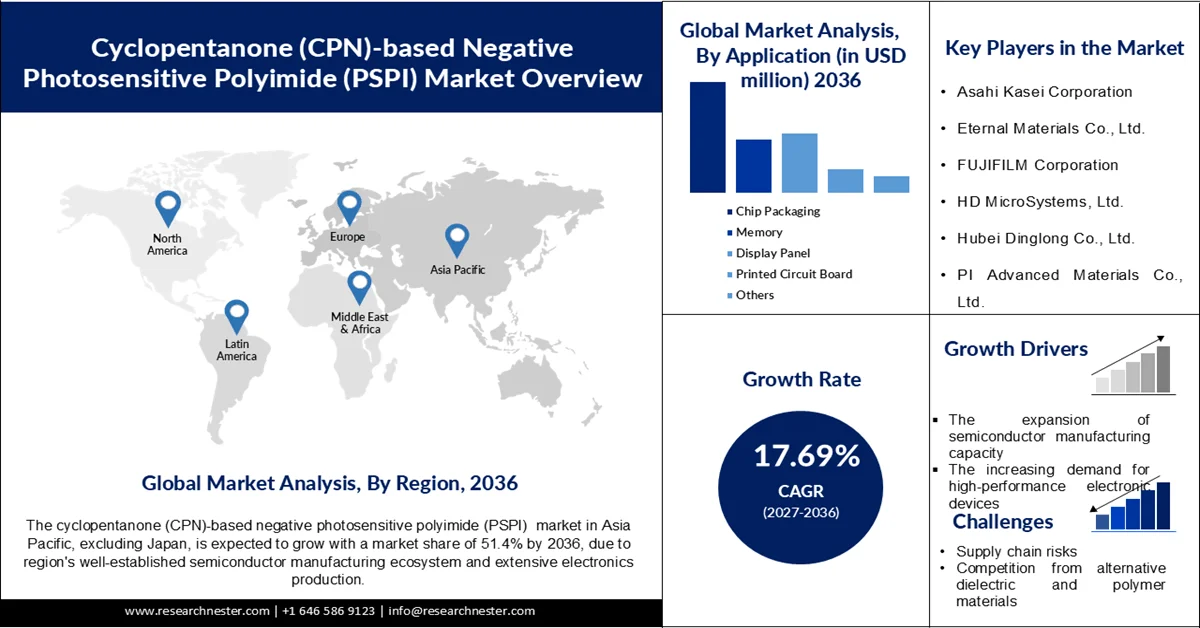
The rapid expansion of semiconductor manufacturing capacity worldwide is propelling the sales of cyclopentanone-based negative photosensitive polyimide. The volume of the cyclopentanone (CPN)-based negative photosensitive polyimide (PSPI) market is expected to increase from 758.76 tons in 2026 to 3,206.88 tons by 2036. The increasing investments in public-private investments in semiconductor research and advanced packaging are set to propel the application of cyclopentanone-based negative photosensitive polyimide materials.
The Semiconductor Industry Association (SIA) estimates that global semiconductor sales reached USD 120.6 billion in May 2026. This was 9.2% higher than April 2026’s USD 110.5 billion and more than double the USD 59.1 billion recorded in May 2025, reflecting a 104.1% year-on-year increase. The high-potential economies, including Asia Pacific, Latin America, and MEA, are anticipated to boost the cyclopentanone (CPN)-based negative photosensitive polyimide (PSPI) market growth in the years ahead.
Semiconductor Month-to-Month Sales
|
Market |
Last Month |
Current Month |
% Change |
|
Americas |
39.44 |
42.85 |
8.6% |
|
Europe |
6.62 |
7.10 |
7.3% |
|
Japan |
4.31 |
4.58 |
6.4% |
|
China |
28.88 |
31.97 |
10.7% |
|
Asia Pacific/All Other |
31.23 |
34.10 |
9.2% |
|
Total |
110.48 |
120.61 |
9.2% |
Source: SIA
Semiconductor Year-to-Year Sales
|
Market |
Last Year |
Current Month |
% Change |
|
Americas |
18.46 |
42.85 |
132.2% |
|
Europe |
4.42 |
7.10 |
60.7% |
|
Japan |
3.70 |
4.58 |
23.8% |
|
China |
16.93 |
31.97 |
88.8% |
|
Asia Pacific/All Other |
15.58 |
34.10 |
118.9% |
|
Total |
59.09 |
120.61 |
104.1% |
Source: SIA
Semiconductor Three-Month-Moving Average Sales
|
Market |
December/January/February |
March/April/May |
% Change |
|
Americas |
29.84 |
42.85 |
43.6% |
|
Europe |
5.72 |
7.10 |
24.1% |
|
Japan |
3.78 |
4.58 |
21.3% |
|
China |
23.73 |
31.97 |
34.7% |
|
Asia Pacific/All Other |
26.16 |
34.10 |
30.4% |
|
Total |
89.23 |
120.61 |
35.2% |
Source: SIA
Key Cyclopentanone (CPN)-based Negative Photosensitive Polyimide (PSPI) Market Insights Summary:
Regional Highlights:
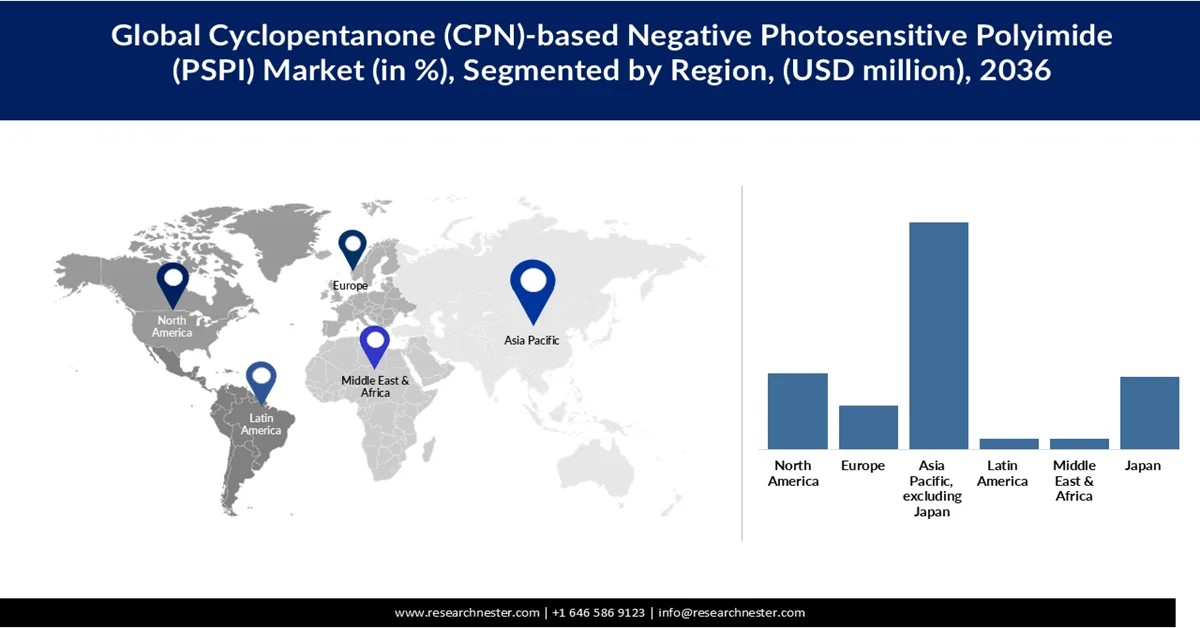
- Asia Pacific excluding Japan is projected to command a 51.4% share by 2036 in the cyclopentanone (CPN)-based negative photosensitive polyimide (PSPI) market, underpinned by its well-established semiconductor manufacturing ecosystem and extensive electronics production base
- Japan is anticipated to expand at a 16.80% CAGR during 2027-2036, with its leadership in semiconductor manufacturing and consumer electronics strengthening the sales of cyclopentanone-based negative photosensitive polyimide materials
- Japan is projected to capture nearly 16.4% of the global cyclopentanone (CPN)-based negative photosensitive polyimide (PSPI) market share by 2036, supported by continuous technological advancements and leadership in electronics trade.
Segment Insights:
- The chip packaging segment in the cyclopentanone (CPN)-based negative photosensitive polyimide (PSPI) market is projected to account for 41.12% share and reach 1,320.91 tons by 2036, fueled by the increasing requirement for high-performance dielectric materials offering electrical insulation and long-term reliability in advanced semiconductor packages
Key Growth Trends:
- Increasing demand for high-performance electronic devices
- Adoption of glass substrates
Major Challenges:
- Supply chain risks
- Competition from alternative dielectric and polymer materials
Key Players: Asahi Kasei Corporation, Eternal Materials Co., Ltd., FUJIFILM Corporation, HD MicroSystems, Ltd., Hubei Dinglong Co., Ltd., PI Advanced Materials Co., Ltd., and TORAY Industries, Inc.
Global Cyclopentanone (CPN)-based Negative Photosensitive Polyimide (PSPI) Market Forecast and Regional Outlook:
Market Size & Growth Projections:
- 2026 Market Size: USD 231.42 million
- 2027 Market Size: USD 269.51 million
- Projected Market Size: USD 1.16 billion by 2036
- Growth Forecasts: 17.69% CAGR (2027-2036)
Key Regional Dynamics:
- Largest Region: Asia Pacific excluding Japan (51.4% Share by 2036)
- Fastest Growing Region: Japan
- Dominating Countries: China, Japan, South Korea, United States, Germany
- Emerging Countries: India, Australia, France, Netherlands, Italy
Last updated on : 7 September, 2026
Cyclopentanone (CPN)-based Negative Photosensitive Polyimide (PSPI) Market - Growth Drivers and Challenges
Growth Drivers
- Increasing demand for high-performance electronic devices: The growing demand for high-performance electronic devices is expected to fuel the application of cyclopentanone-based negative photosensitive polyimide materials. The Observatory of Complexity (OEC) reveals that in 2024, worldwide trade in electrical machinery and electronics reached USD 3.43 trillion, a 4.1% rise from the USD 3.29 trillion recorded in 2023. High use of semiconductors in smartphones, tablets, laptops, and big devices is directly fueling the consumption of cyclopentanone-based negative photosensitive polyimide materials.
- Adoption of glass substrates: The growing adoption of glass substrates in artificial intelligence (AI) accelerators and high-bandwidth memory (HBM) packaging is propelling the sales of cyclopentanone-based negative photosensitive polyimide materials. In July 2026, a Sumitomo Chemical subsidiary announced that it is setting up a joint venture with Samsung Electro-Mechanics focused on the glass core substrate business. The partnership aims to jointly develop and promote next-generation core substrates for advanced semiconductor packaging. The high investments in glass substrate technologies are anticipated to propel the trade of cyclopentanone-based negative photosensitive polyimide materials in the coming years.
- Rising demand for automotive semiconductors: The rapid growth of automotive electronics is creating substantial demand for cyclopentanone-based negative photosensitive polyimide materials. The Automotive Component Manufacturers Association of India estimates that as cars increasingly include more sensors and electronic control units, the share of electronics in a vehicle’s total cost is expected to rise to 45% by 2030. The increasing adoption of electric vehicles and autonomous driving platforms is boosting the use of cyclopentanone-based negative photosensitive polyimide materials.
Challenges
- Supply chain risks: The limited availability of high-purity raw materials and ongoing supply chain risks associated with specialty chemicals are hampering the sales of cyclopentanone (CPN)-based negative photosensitive polyimides. The environmental factors and trade restrictions mainly hamper the supply of raw materials. Strategic partnerships and collaborations with raw material suppliers and manufacturers are expected to aid key players in overcoming this issue.
- Competition from alternative dielectric and polymer materials: Competition from alternative dielectric and polymer materials is challenging the growth of the cyclopentanone (CPN)-based negative photosensitive polyimide (PSPI) market. Cost-effectiveness and easy availability of alternatives lower the adoption of CPN-based negative PSPIs. Large and small enterprises prefer investing in cost-effective alternatives to minimize their expenses. However, technological innovations and digital markets are expected to fuel the sales of advanced CPN-based negative PSPIs.
Cyclopentanone (CPN)-based Negative Photosensitive Polyimide (PSPI) Market Size and Forecast:
| Report Attribute | Details |
|---|---|
|
Base Year |
2026 |
|
Forecast Year |
2027-2036 |
|
CAGR |
17.69% |
|
Base Year Market Size (2026) |
USD 231.42 million |
|
Forecast Year Market Size (2036) |
USD 1.16 billion |
|
Regional Scope |
|
Cyclopentanone (CPN)-based Negative Photosensitive Polyimide (PSPI) Market Segmentation:
Application Segment Analysis
The chip packaging segment is expected to capture 41.12% of the global cyclopentanone (CPN)-based negative photosensitive polyimide (PSPI) market share and reach 1,320.91 tons by 2036. The main factor boosting the use of CPN-based negative PSPI in chip packaging is due to the fact that advanced semiconductor packages require high-performance dielectric materials that provide electrical insulation and long-term reliability. The Observatory of Economic Complexity (OEC) reported that in 2024, worldwide trade in integrated circuits reached USD 928 billion, a 16.9% increase from the USD 794 billion recorded in 2023. Fan-out wafer-level packaging (FOWLP), 2.5D and 3D integrated circuits, and others, some of the advanced packaging technologies witnessing robust adoption, are directly propelling the sales of high-quality PSPI materials.
Our in-depth analysis of the cyclopentanone (CPN)-based negative photosensitive polyimide (PSPI) market includes the following segments:
|
Segments |
Subsegments |
|
Application |
|

Vishnu Nair
Head - Global Business DevelopmentCustomize this report to your requirements — connect with our consultant for personalized insights and options.
Cyclopentanone (CPN)-based Negative Photosensitive Polyimide (PSPI) Market - Regional Analysis:
Asia Pacific excluding Japan Market Insights
Asia Pacific excluding Japan is projected to capture 51.4% of the global cyclopentanone (CPN)-based negative photosensitive polyimide (PSPI) market share through 2036. The region's well-established semiconductor manufacturing ecosystem and extensive electronics production base are supporting the market growth. The rise in production of 5G infrastructure, electric vehicles, and consumer electronics is directly fueling the sales of CPN-based negative PSPI materials. China, India, South Korea, and Australia are some of the key marketplaces for CPN-based negative PSPI companies.
China is set to lead the sales of cyclopentanone-based negative photosensitive polyimide materials throughout the forecast period. The country's strategic focus on strengthening semiconductor self-sufficiency is contributing to the increasing sales of cyclopentanone-based negative photosensitive polyimide materials. According to SIA, China is the world’s biggest manufacturing center, making about 36% of all electronics globally. Continuous investments in research and pilot production are set to drive the demand for cyclopentanone-based negative photosensitive polyimide materials.
India is emerging as a promising market for cyclopentanone-based negative photosensitive polyimide companies owing to its expanding semiconductor manufacturing ecosystem. Robust EV adoption is supporting the trade of CPN-based PSPI materials. The India Brand Equity Foundation (IBEF) estimates that, increasing at a CAGR of 54.94%, the domestic EV market is set to reach USD 191.04 billion by 2034. Further supportive public-private strategies are estimated to propel the overall market growth.
Japan Market Insights
The Japan cyclopentanone (CPN)-based negative photosensitive polyimide (PSPI) market is estimated to be valued at USD 47.33 billion in 2027, expanding at a CAGR of 16.80% during the forecast period (i.e., 2027-2036). The country’s leadership in semiconductor manufacturing and consumer electronics is projected to propel the sales of cyclopentanone-based negative photosensitive polyimide materials. According to the International Trade Administration (ITA), Japan holds nearly 88% of the global market for semiconductor coater/developer systems, 53% for silicon wafers, and 50% for photoresists. The precision manufacturing capabilities of Japan are directly supporting the trade of cyclopentanone-based negative photosensitive polyimide materials.
Japanese semiconductor manufacturers are increasingly focusing on advanced packaging, image sensors, and automotive electronics. These products are heavily dependent on dielectric materials, which directly fuels the application of cyclopentanone-based negative photosensitive polyimide materials. The Japan Electronics and Information Technology Industries Association (JEITA) disclosed that the domestic electronics production stood at nearly USD 78.0 billion (JPY 11.7 trillion) in 2025. Continuous innovations in electronics components and devices are expected to fuel the sales of cyclopentanone-based negative photosensitive polyimide materials in the years ahead.
Japan Cyclopentanone (CPN)-based Negative Photosensitive Polyimide (PSPI) Market Size and Forecast
|
Report Attribute |
Details |
|
Base Year Market Size and Volume (2026) |
USD 40.94 million; 5.29 million tons |
|
Forecast Year Market Size and Volume (2036) |
USD 191.55 million; 6.51 million tons |
|
CAGR (2026-2036) |
16.80% |
North America Market Insights
North America is estimated to hold 17.2% of the global cyclopentanone (CPN)-based negative photosensitive polyimide (PSPI) market share throughout the study period. The market growth is supported by significant investments in semiconductor manufacturing and advanced packaging technologies. The expansion of high-performance computing infrastructure is also propelling the sales of cyclopentanone-based negative photosensitive polyimide materials. The growth in 5G infrastructure, aerospace electronics, and defense systems is propelling the sales of cyclopentanone-based negative photosensitive polyimide materials.
The U.S. is anticipated to lead the sales of cyclopentanone-based negative photosensitive polyimide solutions owing to the presence of top semiconductor companies and advanced packaging developers. The U.S. Bureau of Labor Statistics reveals that in 2024, U.S. semiconductor exports were valued at USD 70.1 billion, up 6.3% from 2023. The top six exporting states accounted for 74.2% of this total. Continuous investments in new wafer fabrication facilities and advanced packaging plants further contribute to the overall market growth.
Semiconductor Manufacturing Exports by State, 2024
|
State |
Exports (2024) |
Notes |
|
Texas |
Part of USD 32B total |
Ranked 1st |
|
Oregon |
Part of USD 32B total |
Ranked 2nd |
|
California |
USD 10.3 billion |
Ranked 3rd |
Source: U.S. Bureau of Labor Statistics
The Canada cyclopentanone (CPN)-based negative photosensitive polyimide (PSPI) market is expected to expand at a healthy pace from 2027 to 2036. The country's expanding semiconductor research capabilities and advanced electronics development are pushing the sales of cyclopentanone-based negative photosensitive polyimide materials. Canada's well-established specialty chemicals sector and strong focus on sustainable manufacturing practices also contribute to the overall market growth.
Europe Market Insights
Europe is estimated to account for 9.0% of the global cyclopentanone (CPN)-based negative photosensitive polyimide (PSPI) market by the end of 2036. The increasing investments in semiconductor manufacturing and advanced electronics are pushing the sales of cyclopentanone-based negative photosensitive polyimide materials. The European Union has intensified efforts to strengthen its semiconductor ecosystem, which is aiding cyclopentanone-based negative photosensitive polyimide manufacturers to earn more.
The UK cyclopentanone (CPN)-based negative photosensitive polyimide (PSPI) market growth is projected to be driven by rising investments in semiconductor innovation and compound semiconductors. According to the International Energy Agency (IEA), UK electric car sales rose by more than 25% in 2025, making up over one in three new cars sold, up from one in four in 2024. Thus, the rise in automotive electronics is projected to propel the application of cyclopentanone-based negative photosensitive polyimide materials in the years ahead.
Germany is also one of the key marketplaces for cyclopentanone-based negative photosensitive polyimide companies. The country’s strong semiconductor industry and advanced automotive manufacturing base are pushing the use of cyclopentanone-based negative photosensitive polyimide materials. Industry 4.0 automation and smart manufacturing systems are expected to propel the cyclopentanone (CPN)-based negative photosensitive polyimide (PSPI) market growth in the coming years.
Key Cyclopentanone (CPN)-based Negative Photosensitive Polyimide (PSPI) Market Players:
- Asahi Kasei Corporation (Japan)
- Eternal Materials Co., Ltd. (Taiwan)
- FUJIFILM Corporation (Japan)
- HD MicroSystems, Ltd. (U.S.)
- Hubei Dinglong Co., Ltd. (China)
- PI Advanced Materials Co., Ltd. (South Korea)
- TORAY Industries, Inc. (Japan)
- Company Overview
- Business Strategy
- Key Product Offerings
- Financial Performance
- Key Performance Indicators
- Risk Analysis
- Recent Development
- Regional Presence
- SWOT Analysis
- Asahi Kasei Corporation maintains a strong position in advanced semiconductor materials through its specialty chemicals and electronic materials businesses. The company develops photosensitive polymer materials used in semiconductor manufacturing and packaging, focusing on high-resolution patterning, thermal stability, and process compatibility. Its broad materials portfolio, established R&D capabilities, and relationships across the electronics industry support its competitiveness. Continued investment in semiconductor-related materials strengthens its participation in the PSPI market.
- Eternal Materials Co., Ltd. is a Taiwan-based specialty chemical manufacturer with expertise in electronic materials, including photosensitive and high-performance polymer solutions. The company serves semiconductor and electronics manufacturers with materials designed for demanding fabrication and packaging processes. Its competitive position is supported by application-specific product development, technical expertise, and proximity to Taiwan's semiconductor manufacturing ecosystem. Continued development of advanced packaging materials provides opportunities for expanding its PSPI-related business.
- FUJIFILM Corporation has established a significant presence in semiconductor materials through its electronic materials business, supplying advanced materials for semiconductor fabrication and packaging. The company emphasizes high-purity formulations, process reliability, and advanced lithographic performance to meet evolving semiconductor requirements. Its global manufacturing and R&D network enables close collaboration with chipmakers and packaging companies. Expansion of semiconductor material capabilities and investment in next-generation packaging technologies strengthen FUJIFILM's competitive position.
- HD MicroSystems, Ltd. specializes in high-performance polyimide materials for semiconductor and electronic applications and is a notable participant in the photosensitive polyimide market. The company focuses on polyimide solutions offering thermal resistance, mechanical reliability, electrical insulation, and fine-patterning capabilities. Its strong technical expertise and established relationships with semiconductor manufacturers support its market position. Continued development of materials for advanced packaging, wafer-level processing, and high-density interconnect applications supports future growth.
- Hubei Dinglong Co., Ltd. is a China-based electronic materials manufacturer expanding its presence across semiconductor materials and related chemical products. The company develops materials for semiconductor manufacturing and packaging, supporting China's growing drive toward domestic supply-chain development. Its competitive strategy centers on product localization, R&D investment, and expansion of production capabilities. Growing demand for domestic semiconductor materials and advanced packaging solutions provides Dinglong with opportunities to strengthen its position in the PSPI market. PI Advanced Materials Co., Ltd., and TORAY Industries, Inc.
Below is the list of the key players, among several others, operating in the global cyclopentanone (CPN)-based negative photosensitive polyimide (PSPI) market:
The strong presence of regional and international companies characterizes the global cyclopentanone (CPN)-based negative photosensitive polyimide (PSPI) market. Leading companies are investing heavily in research and development activities to introduce next-gen solutions. They are also entering into strategic partnerships with others to enhance their product offerings. Some gigantic companies are exploring opportunities across high-potential economies to earn lucrative returns. Both organic and inorganic marketing strategies are projected to double the revenues of key players during the study timeframe.
Corporate Landscape of the Global Cyclopentanone (CPN)-based Negative Photosensitive Polyimide (PSPI) Market:
Recent Developments
- In March 2026, Toray Industries announced that it is set to start large-scale production of its STF-1000 photosensitive polyimide solution. This advanced product results from the company’s continued work on its own negative-type photosensitive technology. It enables the creation of fine patterns with an aspect ratio of 36 for films as thick as 500 micrometres. High-aspect-ratio patterning allows the formation of microstructures that are both narrow and tall.
- In May 2024, Zeon Corporation received the Special Technology Prize at the 56th JCIA Technology Awards, presented by the Japan Chemical Industry Association. The company was honored for creating a new, more efficient way to produce Cyclopentanone and for building a business around five-membered ring compounds.
- Report ID: 8755
- Published Date: Sep 07, 2026
- Report Format: PDF, PPT
- Explore a preview of key market trends and insights
- Review sample data tables and segment breakdowns
- Experience the quality of our visual data representations
- Evaluate our report structure and research methodology
- Get a glimpse of competitive landscape analysis
- Understand how regional forecasts are presented
- Assess the depth of company profiling and benchmarking
- Preview how actionable insights can support your strategy
Explore real data and analysis
Frequently Asked Questions (FAQ)
About this Report
Connect with our Expert


Report, 2027-2036



Copyright @ 2026 Research Nester. All Rights Reserved.
