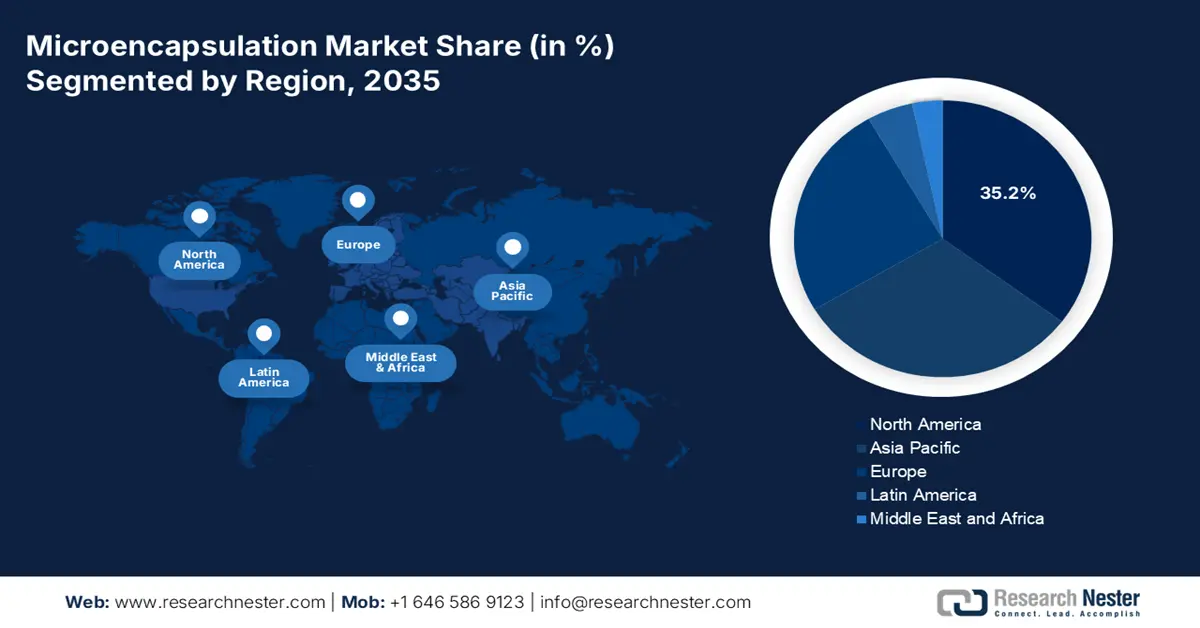
Microencapsulation Market - Regional Analysis
North America Market Insights
North America in the microencapsulation market is anticipated to garner the highest share of 35.2% by the end of 2035. The market’s upliftment in the region is highly attributed to the technologically advanced and mature pharmaceutical industry, strict regulatory frameworks for incentivizing safe development, and generous federal investments in advanced manufacturing and materials. According to an article published by the IFPMA in 2025, the combined share of commercial clinical trials has varied in the region, from 28% in 2013 to 23% in 2023. This has resulted in changes in developing vaccines and manufacturing, which is positively impacting the market’s growth in the region. Besides, there have been 75 cross-sector active collaborations in the region between advanced pharmaceutical organizations and their partners, which is also responsible for fueling the market’s expansion.
Historical Commercial Clinical Trials in America (2013-2023)
|
Year |
Trial Prevalence |
|
2013 |
28% |
|
2018 |
26% |
|
2019 |
25% |
|
2020 |
24% |
|
2021 |
23% |
|
2022 |
24% |
|
2023 |
23% |
Source: IFPMA
The U.S. in the microencapsulation market is growing significantly, owing to an increase in the demand for drug delivery to optimize efficiency and diminish side effects, which has created an ongoing pipeline for progressive encapsulation technologies. According to an article published by the EPA Government in February 2025, children's exposure to carbamates decreased by 70%. In addition, tomatoes with detectable organophosphate pesticide residues also reduced from 37% to 9%, which led to the restricting of organophosphates. Therefore, this further resulted in sustainability and regulatory policy, based on which the Environmental Protection Agency (EPA) has readily promoted the Integrated Pest Management (IPM). This is heavily dependent on controlled-release formulations to reduce pesticide volume and environmental impact, which is driving the market’s upliftment in the country.
Canada in the microencapsulation market is also growing due to the strong presence of the public and private research ecosystem, a tactical focus on natural resource valorization, and advanced regulatory frameworks. Besides, as per an article published by the OECD STIP Compass in August 2025, an estimated three-quarters of CIHR's CAD 1.1 billion budget has been utilized to support investigator-based research. This particular fund is offered initially through competitive research grants, including the Project Grant program and the Foundation Grant program. Besides, the remaining one-quarter of the budget actively supports priority-based research strategies, which are designed to cater to specific areas needed. Meanwhile, the presence of massive natural products and the agricultural industry is also driving the microencapsulation market in the country to provide the newest raw commodities.
Europe Market Insights
Europe in the microencapsulation market is projected to emerge as the fastest-growing region, owing to the presence of a strict regulatory environment, along with world-leading cosmetic and pharmaceutical sectors. Additionally, the robust alignment with the Green Deal strategy and its Circular Economy Action Plan has pushed regional industries to create sustainable materials. According to the January 2025 Europe Environment Agency report, the recycled material accounted for 11.8% of materials utilization as of 2023, denoting a surge of 1.1%. Moreover, the region’s circular economy action plan has aimed to reduce natural resources and double its circular material use rate (CMUR). However, the continuous growth in the CMUR from 10.7% to 11.8% in 2023 is also poised to increase waste recycling efforts, which is further driven by Member States to cater to the regional recycling targets.
Germany in the microencapsulation market is gaining increased traction, owing to the existence of tactical government-based partnerships as well as an unparalleled industrial base. Besides, the country’s High-Tech Strategy 2025 directly offers generous grants, particularly for sustainable industry and personalized medicine. As per an article published by the ITA in August 2025, the country’s healthcare expenditure is continuously growing, and employs an estimated 6.1 million people. In addition, the nation’s medical device market accounts for approximately EUR 38 billion (USD 44 billion) in revenue every year, which makes up almost 26.5% of the region’s market. Further, the yearly economic footprint has generated EUR 775 billion (USD 838 billion), which constitutes 12.8% of the country’s gross domestic product (GDP), which in turn is suitable for developing the overall market in the country.
Poland in the microencapsulation market is also developing due to its presence as the tactical manufacturing center, along with significant funding inflows, and an increasingly modernized regional industry. As per an article published by the Research in Poland Organization in 2025, the National Centre for Research and Development tends to perform tasks of the Smart Growth Operational Programme, which has allocated over PLN 50 billion for ensuring effective innovation, along with research and development. Based on this, 56 beneficiaries have successfully received PLN 1.4 billion through the Bridge Alfa Program that comprises NCBR Investment Fund ASI S.A. The yearly investment budget for the fund is more than PLN 100 million, and the valuation of a single investment is PLN 3 million to PLN 64 million, thus extremely suitable for bolstering the market in the country.
APAC Market Insights
The Asia Pacific in the microencapsulation market is expected to grow steadily, owing to the robust mixture of an increase in disposable incomes, huge manufacturing capacity, and tactical government strategies that are pushing industrial upgradation. In addition, the explosive growth of the nutraceutical as well as pharmaceutical sectors, especially in China and India, is continuously growing, wherein encapsulation has become critical for stabilizing cost-effective generic and nutritional drugs. According to a report published by the MOFPI Government in August 2025, the nutraceutical industry in the region is valued at USD 45 billion as of 2024, which is exhibited by an upsurge in expansion, fueled by an increase in health awareness and a modification in dietary patterns. In addition, this accounts for 23% of the regional share, which is positively impacting the overall market’s growth.
The microencapsulation market in China is gaining increased exposure, owing to its enduring legacy of Made in China 2025 industrial policy and the Dual Circulation strategy, both of which have prioritized the development of innovative materials and high-value pharmaceuticals. The Ministry of Industry and Information Technology (MIIT), along with the National Development and Reform Commission (NDRC), offers direct subsidies as well as tax incentives for national innovation in functional and green chemicals. As stated in an article published by the International Review of Economics & Finance in October 2025, the country has successfully covered notable enterprises by utilizing trading mechanisms and quota allocation to gain an average yearly emission reduction of more than 150 million carbon dioxide, thus ensuring both economic and environmental governance efficacy.
The microencapsulation market in India is also growing due to the presence of proactive government policy, huge foreign direct investment, and an increase in the domestic customer market. Besides, the actual cornerstone is the Production Linked Incentive (PLI) Scheme, which is suitable for the food and pharmaceutical processing sectors, directly incentivizing the integration of innovative technologies, such as microencapsulation, to enhance domestic value addition and enhance export. As per an article published by the IBEF Organization in October 2025, the country is projected to triple the petrochemicals and chemicals demand, which is expected to reach USD 1 trillion by the end of 2040. In addition, exports of chemicals effectively reached USD 9,194 million. Meanwhile, the country’s green chemicals industry is anticipated to grow more than 10% and exceed USD 15 billion, thereby suitable for boosting the market.