Microbiome Modulators Market Outlook:
Microbiome Modulators Market size was valued at USD 12.2 billion in 2025 and is anticipated to exceed USD 56.1 billion by the end of 2035, registering over 16.5% CAGR during the forecast period i.e., between 2026-2035. In 2026, the industry size of microbiome modulators is estimated at USD 14.2 billion.
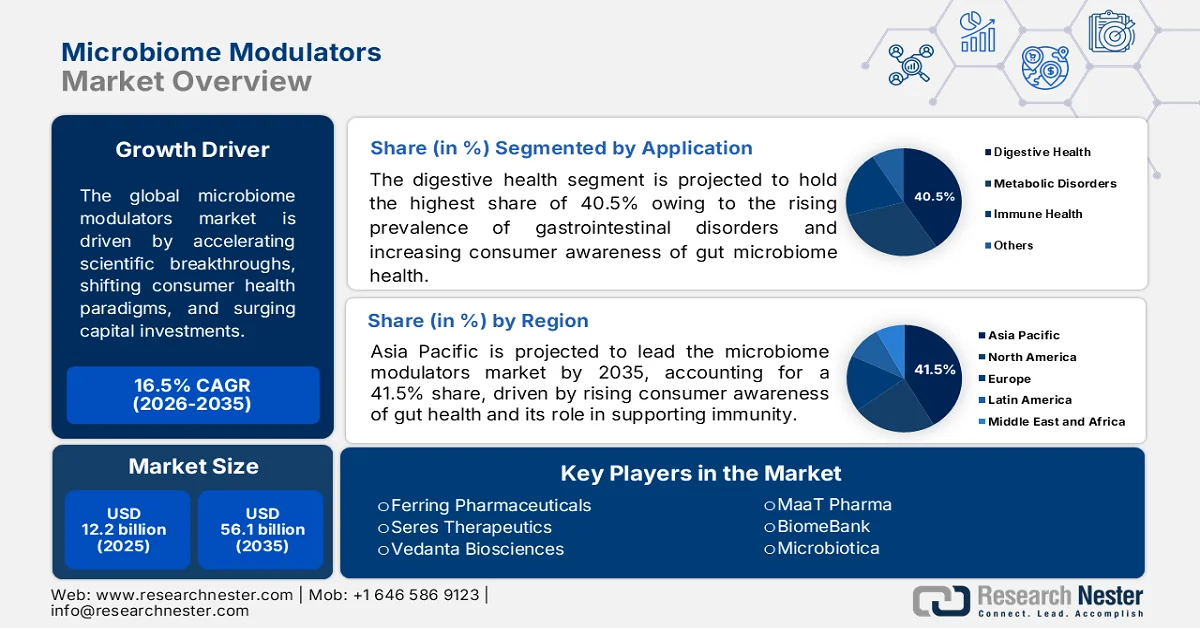
The global microbiome modulators market is positioned for long-term expansion, majorly attributed to accelerating scientific breakthroughs, shifting consumer health paradigms, and surging capital investments. In addition, rising worldwide awareness regarding the critical axis connecting gut health to systemic wellness, i.e., immunity, metabolic function, and mental health, is fueling mainstream consumer demand for preventive lifestyle solutions. In January 2023, researchers from University Hospitals Cleveland Medical Center and Case Western Reserve University reported that a study demonstrated microbiome data can guide the development of targeted probiotic formulations by identifying beneficial microbes that help restore gut microbial balance. The formulation showed positive effects on gut health and digestive symptoms in human studies, thus underscoring the potential of data-driven probiotic innovation for personalized wellness support.
In parallel, biotechnology and pharmaceutical innovators are focused on advancing from generic, broad-spectrum supplements toward highly targeted, precision-engineered formulations. This strategic evolution is supported by expanding technological integration of artificial intelligence in strain discovery, and a diversifying product pipeline which is structured around infant nutrition, animal health, and therapeutic clinical applications. In March 2024, for instance, BIOHM Health partnered with Virginia Tech to enhance its AI-powered Symbiont™ platform by using machine learning and one of the world's largest bacterial and fungal microbiome datasets to accelerate the development of targeted dietary supplement formulations. This particular collaboration aims to improve biomarker discovery and optimize ingredient selection for condition-specific microbiome products, thus benefiting the overall market.
Key Microbiome Modulators Market Insights Summary:
Regional Highlights:
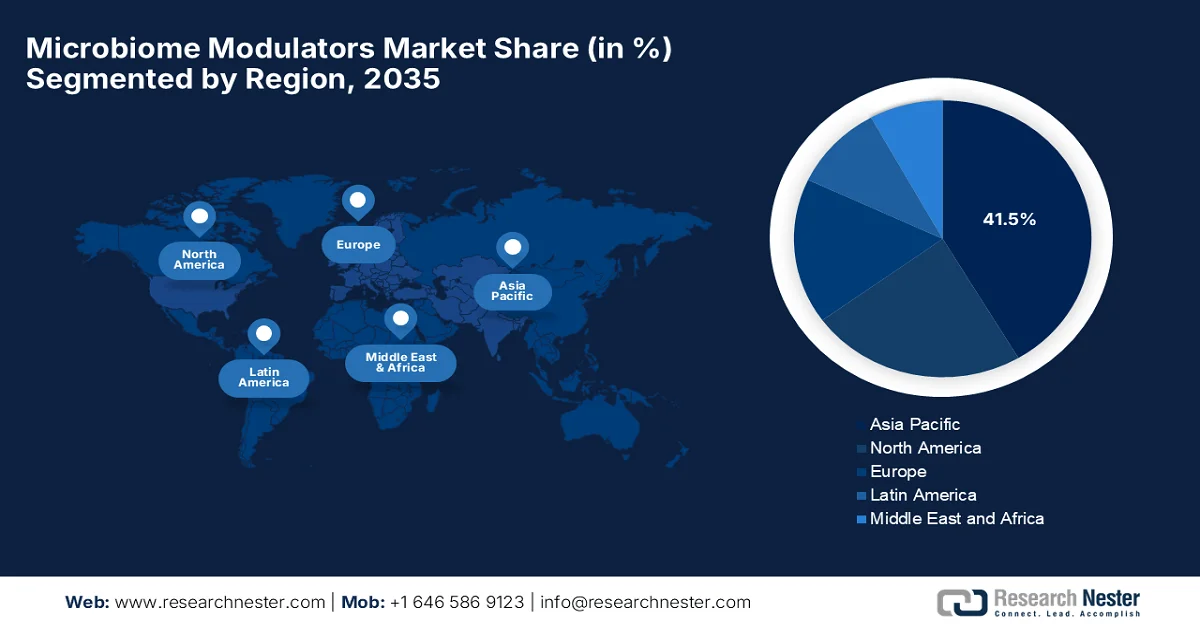
- By 2035, the Asia Pacific microbiome modulators market is expected to secure a 41.5% share, reinforced by growing consumer awareness of gut health and its role in supporting overall immunity
- North America is poised for notable expansion in the market throughout 2026-2035, bolstered by a mature consumer base that prioritizes holistic wellness and preventive medicine
Segment Insights:
- The digestive health segment is projected to command a 40.5% share of the microbiome modulators market by 2035, stimulated by rising prevalence of gastrointestinal disorders, increasing consumer awareness of gut microbiome health, and growing adoption of probiotics and prebiotics
- The capsules segment is anticipated to hold a significant share of the market during 2026-2035, catalyzed by superior stability, accurate dosage delivery, and the ability to protect sensitive microbial strains from degradation
Key Growth Trends:
- Surging biotech capital investments
- Cross-industry commercial applications
Major Challenges:
- High manufacturing complexity
- High patient variability
Key Players: Ferring Pharmaceuticals (Switzerland), Seres Therapeutics (U.S.), Vedanta Biosciences (U.S.), MaaT Pharma (France), BiomeBank (Australia), Microbiotica (UK), EnteroBiotix (UK), Microbiome Therapeutics Innovation Group (U.S.), Nestlé Health Science (Switzerland), MRM Health (Belgium).
Global Microbiome Modulators Market Forecast and Regional Outlook:
Market Size & Growth Projections:
- 2025 Market Size: USD 12.2 billion
- 2026 Market Size: USD 14.2 billion
- Projected Market Size: USD 56.1 billion by 2035
- Growth Forecasts: 16.5% CAGR (2026-2035)
Key Regional Dynamics:
- Largest Region: Asia Pacific (41.5% Share by 2035)
- Fastest Growing Region: North America
- Dominating Countries: United States, China, Japan, Germany, United Kingdom
- Emerging Countries: India, South Korea, Singapore, Australia, Canada
Last updated on : 29 July, 2026
Microbiome Modulators Market - Growth Drivers and Challenges
Growth Drivers
- Surging biotech capital investments: The abundant financial inflows from worldwide capital firms, large-scale institutional investors, and pharmaceutical giants are rapidly accelerating the market drug discovery pipelines. This funding amounts allow biotechnology firms to upgrade high-throughput screening technologies and expand large-scale manufacturing facilities, propelling the surging growth of the market. In April 2024, EnteroBiotix secured a total of USD 34 million in financing from new and existing investors, including Thairm Bio, Kineticos Life Sciences, Scotland’s National Investment Bank, and Enterprise. The funding will support a Phase 2 clinical trial of its lead microbiome therapeutic, i.e., EBX-102-02, indicated for irritable bowel syndrome, while advancing additional microbiome-based programs targeting liver cirrhosis and hepatic encephalopathy.
- Cross-industry commercial applications: The high-end diversification of microbial applications other than standard dietary supplements into infant nutrition, disease management, functional skincare, and animal health is significantly broadening the market reach. Major food, agricultural, and cosmetic conglomerates are proactively integrating active microbiome modulators into different types of consumer product portfolios to capture new demographic segments. In November 2024, the National Institutes of Health (NIH) stated that an analysis of 858 clinical trials reflected that research on microbiome modulators for infectious diseases has expanded significantly, with trial activity reaching its highest level in 2021. With almost 563 completed trials, the findings denote increasing clinical validation and the expanding therapeutic potential of microbiome-based treatments for infectious diseases.
Challenges
- High manufacturing complexity: Scaling up the production of living microbial strains is presenting severe technological and infrastructure bottlenecks for contract manufacturing organizations. Most therapeutic microbiome modulators require strictly anaerobic fermentation, which needs highly specialized engineering controls to eliminate all oxygen exposure during manufacturing. In addition, multi-strain bacterial consortia force producers to manage individual microbial growth windows and delicate ecological cross-feeding dynamics simultaneously. Maintaining strain viability, purity, and consistency during large-scale manufacturing is hard, increasing production costs and limiting the growth of the market.
- High patient variability: A major scientific hurdle in the market is the immense heterogeneity and baseline variability of human microbial ecosystems. Every individual possesses a highly unique, dynamic microbiome baseline which is shaped by distinct genetics, geographic location, lifelong dietary habits, age, and past antibiotic exposures. The presence of this inherent natural diversity, a specific probiotic strain or prebiotic compound that successfully triggers a positive metabolic or immune response in one cohort may be completely rejected, outcompeted, or rendered inert in another. This extreme biological variability makes it nearly impossible for life science companies to develop one-size-fits-all broad-spectrum therapies, causing obstacles to market exposure.
Microbiome Modulators Market Size and Forecast:
| Report Attribute | Details |
|---|---|
|
Base Year |
2025 |
|
Forecast Period |
2026-2035 |
|
CAGR |
16.5% |
|
Base Year Market Size (2025) |
USD 12.2 billion |
|
Forecast Year Market Size (2035) |
USD 56.1 billion |
|
Regional Scope |
|
Microbiome Modulators Market Segmentation:
Application Segment Analysis
The digestive health segment is projected to hold the highest share of 40.5% in the microbiome modulators market during the forecast period. The segment’s dominant position is driven mainly by rising prevalence of gastrointestinal disorders, increasing consumer awareness of gut microbiome health, and growing adoption of probiotics and prebiotics. In addition, strong clinical evidence linking the gut microbiome to digestive function, immune regulation, and metabolic health has further accelerated product uptake. NIH in March 2023 disclosed that the global burden of digestive diseases is substantial, which accounted for almost 88.99 million disability-adjusted life years and 3.51% of total global DALYs in a year across 204 countries and territories. It also mentioned that digestive diseases continue to impose significant healthcare and economic challenges, thus underscoring the need for effective preventive and therapeutic approaches.
Form Segment Analysis
On the basis of form, the capsules segment is anticipated to grow, holding a significant share of the microbiome modulators market. The segment’s growth is effectively propelled by their superior stability, accurate dosage delivery, and ability to protect sensitive microbial strains from degradation. Also, their convenience, extended shelf life, ease of transportation, and high patient compliance support widespread adoption. In September 2024, Evonik expanded its oral drug delivery portfolio with the launch of EUDRACAP® colon, which is a ready-to-fill capsule especially designed for targeted delivery of sensitive therapeutics, including live biotherapeutic products, to the ileo-colonic region. This particular innovation simplifies oral formulation development, accelerates time to market, and solidifies the company’s advanced drug delivery platform for microbiome-based and other complex therapeutics.
Product Type Segment Analysis
Probiotics product type is predicted to attain a significant share in the microbiome modulators market from 2026 to 2035. The segment’s growth is effectively propelled by increasing consumer awareness of gut health and expanding clinical evidence supporting the therapeutic advantages of beneficial microorganisms. In addition, the growing demand for preventive healthcare and the widespread incorporation of probiotics into dietary supplements and functional foods are driving adoption across both consumer wellness and clinical applications. In November 2024, Nestlé Health Science expanded its Garden of Life microbiome supplement portfolio in the UK and Ireland by launching six high-potency probiotic formulations through 600+ Holland & Barrett stores and online. This new range of products possesses shelf-stable, once-daily products containing 10–50 billion CFU and up to 16 live bacterial strains, thus enhancing consumer access to advanced microbiome health solutions.
Our in-depth analysis of the microbiome modulators market includes the following segments:
|
Segment |
Subsegments |
|
Application |
|
|
Form |
|
|
Product Type |
|
|
End user |
|
|
Distribution Channel |
|

Vishnu Nair
Head - Global Business DevelopmentCustomize this report to your requirements — connect with our consultant for personalized insights and options.
Microbiome Modulators Market - Regional Analysis
APAC Market Insights
Asia Pacific microbiome modulators market is projected to capture the highest share of 41.5% during the forecast period. The region's leadership is primarily driven by growing consumer awareness of gut health and its role in supporting overall immunity. In addition, rising disposable incomes, expanding middle-class populations, and a growing aging demographic across key nations such as China, Japan, and India are significantly fueling the adoption of these products. In November 2023, BiomeBank opened a GMP manufacturing facility in Adelaide to expand production of its approved microbiome-based therapy and accelerate the development of next-generation cultured microbiome products. The facility also consists of an R&D laboratory, enhancing the company's manufacturing capabilities and creating a strong opportunity for future growth in the market.
The presence of a massive consumer base becoming highly proactive about preventive healthcare, digestive wellness, and immune support is fueling growth of the market in China. Growth is also being driven by supportive government policies such as the Healthy China blueprint, which encourages healthier dietary habits and chronic disease prevention. For instance, in November 2023, Xbiome received IND approval from China’s National Medical Products Administration to initiate a Phase 2 clinical trial of AUP-16 for diabetic foot ulcers. This supports the advancement of genetically engineered microbiome-based therapies for chronic wound treatment and thus accelerates the clinical development of live biotherapeutic products.
The India market is unfolding remarkable expansion opportunities, which are facilitated by a shift toward preventive healthcare and a rising awareness of the gut-brain axis and metabolic wellness. In addition, rising urban populations and escalating lifestyle-related health conditions are encouraging consumers to opt for dietary choices that support immunity and digestive health. As stated by the Press Information Bureau (PIB) in March 2026, the 16th India Probiotic Symposium highlighted the importance of gut microbiome and probiotic science in preventive healthcare, precision medicine, and population health. On the other hand, this event discussed advances in microbiome-based therapeutics, synthetic biology, and clinically validated probiotics, thereby encouraging stronger collaboration among academia, industry, and regulators to accelerate innovation and improve public health outcomes.
North America Market Insights
The North America microbiome modulators market is anticipated to grow considerably during the assessed timeframe. The region’s upliftment in this field is mainly driven by a mature consumer base that prioritizes holistic wellness and preventive medicine. The region benefits from a robust clinical research infrastructure and intense biopharmaceutical investment, which fuels the development of highly targeted, science-backed formulations. In July 2026, Metabolon reported the expansion of its Microbiome Panel in order to screen for more than 800 microbiome-associated metabolites, thereby enhancing researchers’ ability to study host–microbiome interactions and disease mechanisms. It also mentioned that this upgraded panel supports biomarker discovery, drug development, clinical trials, and multiomic research by providing a proper understanding of the functional activity of the microbiome.
Expanding clinical research on the role of the microbiome in digestive, metabolic, immune, and neurological health is driving growth of the U.S. market. The country’s market is characterized by rapid innovation, in which heavy venture capital funding and advanced biopharmaceutical research yield highly specialized, shelf-stable, and clinically validated strains. For instance, in July 2026, the UC San Diego Center for Microbiome Innovation and Chiba University’s cSIMVa established a research collaboration to advance microbiome-based vaccines, diagnostics, and therapeutics. Besides, this partnership will promote joint research, data sharing, clinical development, and international collaboration with the main goal of accelerating innovation in microbiome science and improving treatments for infectious and chronic diseases.
In Canada, the market is strongly expanding on account of a clean and well-defined regulatory environment for natural health products, which helps build high consumer trust in product safety and efficacy labels. In addition, growth is accelerated by the availability of fortified functional foods, premium dietary supplements, and infant nutrition products across both major grocery chains and specialized e-commerce platforms. In September 2025, the University of Alberta stated that a research team is conducting clinical trials of an AI-based gut microbiome test that analyzes microbial activity to generate personalized dietary recommendations for improving gut health. It also stated that this precision nutrition tool has shown reliable results in increasing remission rates among patients affected with inflammatory bowel disease and is being evaluated across seven clinical sites in Canada.
Europe Market Insights
The Europe microbiome modulators market is expected to progress, owing to the presence of a well-informed consumer base that is highly focused on preventive healthcare and healthy aging. The market benefits from intensive clinical research, academic partnerships, and a strong corporate focus on sustainability and clean-label, plant-based formulations. In May 2024, DSM-Firmenich and Lallemand Health Solutions entered into a partnership to develop synbiotic solutions combining human milk oligosaccharides with clinically validated probiotics to support early-life microbiome development. This particular collaboration aims to improve infant gut health, immune function, and overall development by bringing infant formula closer to the functional benefits of breast milk, thus contributing to the market’s expansion.
The shifting consumer lifestyles and strong scientific infrastructure are reshaping the growth dynamics of the market in Germany. The demand in the country is being met by a domestic biotechnology sector that provides clinically validated, strain-specific solutions, which are distributed through Germany's pharmacies, mainstream drugstores, along with expanding direct-to-consumer digital subscription platforms. For instance, in April 2026, mbiomics announced the expansion of its Series A financing to USD 35.1 million with a main goal to accelerate the development of microbiome-based therapeutics and advance its lead candidate MBX-116 toward clinical evaluation. This funding will support GMP manufacturing and the company's AI-based platform for developing scalable live biotherapeutic products.
In the UK, the market is gaining enhanced traction, which is primarily due to the popularity of the clean-label movement and a booming plant-based food sector, which naturally complement prebiotic, probiotic, and emerging postbiotic innovations. The market is also being accelerated by advanced retail ecosystems attracting more players to establish their footprint in the UK’s industry. In June 2023, for instance, Clasado Biosciences and Probi AB formed a strategic partnership to develop scientifically validated synbiotic solutions by combining Clasado’s prebiotic expertise with Probi’s probiotic portfolio. This collaboration ultimately aims to accelerate research, product development, and commercialization of microbiome-based nutrition solutions targeting specific health benefits, thus indicating a positive market outlook.
Key Microbiome Modulators Market Players:
- Ferring Pharmaceuticals (Switzerland)
- Seres Therapeutics (U.S.)
- Vedanta Biosciences (U.S.)
- MaaT Pharma (France)
- BiomeBank (Australia)
- Microbiotica (UK)
- EnteroBiotix (UK)
- Microbiome Therapeutics Innovation Group (U.S.)
- Nestlé Health Science (Switzerland)
- MRM Health (Belgium)
- Company Overview
- Business Strategy
- Key Product Offerings
- Financial Performance
- Key Performance Indicators
- Risk Analysis
- Recent Development
- Regional Presence
- SWOT Analysis
- Ferring Pharmaceuticals is a foundational player in this sector that benefits from expertise in gastroenterology and microbiome-based therapeutics. The company is strengthening its microbiome franchise through investments in clinical development, manufacturing capabilities, and strategic collaborations.
- Seres Therapeutics is yet another major pioneer in developing live biotherapeutic medicines especially designed to modulate the human microbiome for treating serious diseases. The firm has gained significant recognition for commercializing microbiome therapeutics and continues to advance a robust clinical pipeline focused on improving patient outcomes.
- Vedanta Biosciences is a specialist player in the development of defined bacterial consortia as live biotherapeutic products for immune-mediated and gastrointestinal diseases. The company’s pipeline is supported by strategic partnerships and continued investment in microbiome research and clinical innovation.
- MaaT Pharma is a clinical-stage biotechnology company that is focused on developing microbiome ecosystem therapies for oncology and immune-related diseases. The company has strengthened its footprint across Europe by advancing multiple clinical trials and leveraging its in-house manufacturing capabilities.
- BiomeBank is an Australia-based biotechnology company dedicated to the development and manufacture of regulated microbiome therapies for gastrointestinal diseases. The company continues to expand its pipeline through proprietary microbiome technologies, clinical research, and strategic collaborations.
Here is a list of key players operating in the global market:
The microbiome modulators market is considered to be a fragmented landscape that hosts a combination of well-established biotechnology companies and emerging microbiome-focused innovators that are developing finished microbiome therapeutics and live biotherapeutic products. Competition in this sector is highly structured around proprietary microbial platforms, clinical-stage pipelines, regulatory approvals, and manufacturing capabilities for microbiome-based medicines. For instance, Ferring Pharmaceuticals and PharmaBiome in December 2023 entered into a research and exclusive licensing agreement to develop next-generation donor-independent microbiome-based therapeutics for gastroenterology. Under this collaboration, Ferring secured rights to develop, manufacture, and commercialize therapies which are arising from PharmaBiome’s defined bacterial consortium technology.
Corporate Landscape of the Market:
Recent Developments
- In May 2026, Microbiotica reported positive Phase 1b results for MB097, which is an oral precision microbiome therapy, demonstrating safety and encouraging early efficacy when combined with pembrolizumab in advanced melanoma patients resistant to anti-PD-1 therapy.
- In April 2026, the Microbiome Therapeutics Innovation Group announced that Nestlé Health Science has joined its coalition of companies advancing FDA-approved microbiome therapeutics and microbiome-based products. The addition strengthens MTIG with Nestlé Health Science’s expertise in commercializing microbiome therapies.
- Report ID: 8708
- Published Date: Jul 29, 2026
- Report Format: PDF, PPT
- Explore a preview of key market trends and insights
- Review sample data tables and segment breakdowns
- Experience the quality of our visual data representations
- Evaluate our report structure and research methodology
- Get a glimpse of competitive landscape analysis
- Understand how regional forecasts are presented
- Assess the depth of company profiling and benchmarking
- Preview how actionable insights can support your strategy
Explore real data and analysis
Frequently Asked Questions (FAQ)
About this Report
Connect with our Expert


Report, 2026-2035


Copyright @ 2026 Research Nester. All Rights Reserved.
