Metaverse Market - Regional Analysis
North America Market Insights
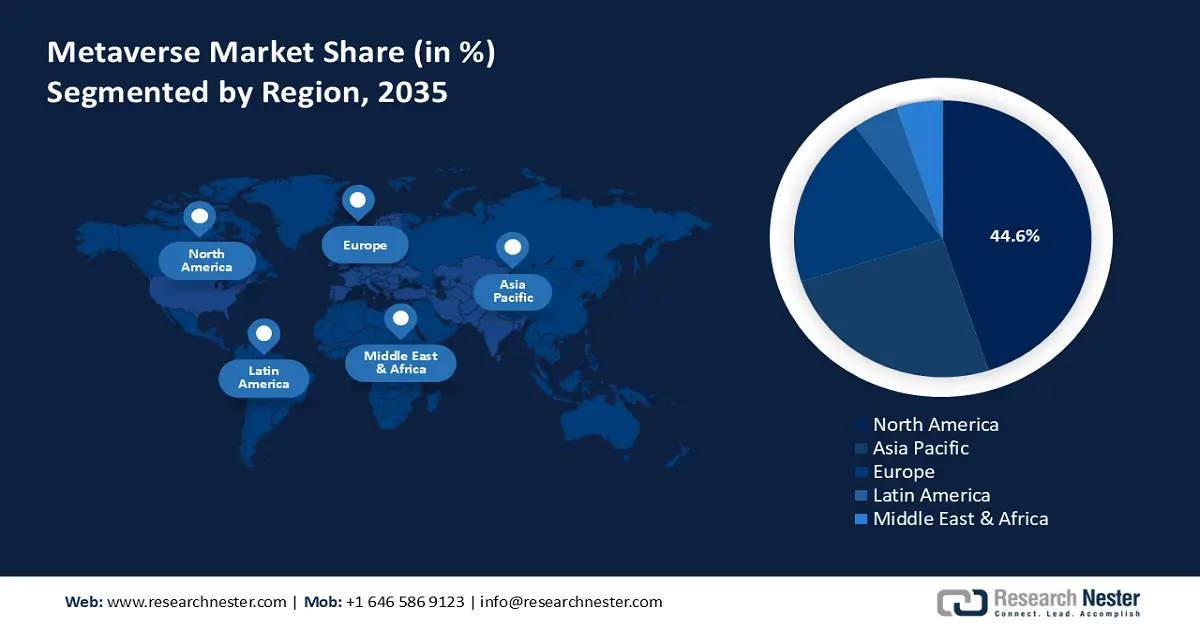
The North America metaverse market is expected to hold a 44.6% revenue share by the end of 2035, supported by the rising consumer adoption across the region. A well-established digital infrastructure supports an improved consumer experience. Two major policies in the region bolstering the market are the U.S. CHIPS Act and Canada's proactive investment in broadband connectivity via ISED. Moreover, the presence of an industry leader, i.e., Meta Platforms Inc., boosts the regional sector.
The U.S. metaverse market is fueled by supportive government policies and tech giants in the past decade, laying the groundwork for further expansion in the current decade. In 2024, Meta and Apple launched advanced VR headsets, Quest Pro and Vision Pro, respectively, which changed the course of immersive tech. Furthermore, the National Science Foundation (NSF) reported investments exceeding USD 2.0 million in AI are likely to drive innovations in AR/VR tech. Throughout the forecast period, the entertainment sector is poised to register the largest application of the metaverse.
The Canada metaverse market is expected to register sustained growth during the anticipated timeline. The Entertainment Software Association of Canada estimated that the video gaming industry generated around CAD 5.0 billion in 2023, creating a favorable demand for platforms compatible with the metaverse. The government is supporting the growth curve, with ISED proactively investing CAD 3.2 billion in initiatives to improve connectivity and make the country digitally self-reliant. In addition to entertainment, the country has focused on developing virtual healthcare solutions by leveraging VR/AR.
APAC Market Insights
The APAC metaverse market is estimated to register the fastest growth rate of 41.2% during the forecast timeline. A key factor of the market’s expansion is smartphones' large-scale penetration and the expansion of digital economies. Recent initiatives in the market are from the Japan Metaverse Initiative and South Korea’s push for a digital economy. The two countries have implemented national policies supporting the development of virtual spaces, creating a favorable ecosystem for the market. Additionally, the most vital factor of APAC’s growth is the presence of a strong gaming culture supported by multiple gaming companies, which are expected to be the leading forces in the continued expansion of the market in the region.
The China metaverse market is poised to lead in APAC. The China Metaverse Development Plan highlights the country’s ambition to establish itself as a leader globally in the market. Additionally, its well-developed digital economy and an extensive consumer base are creating lucrative segments within the market. The government reports that the country’s gaming industry earned about USD 4.07 billion in sales in 2023, growing by 46.08% compared to the previous year. This indicates that the booming gaming industry is likely to double the revenues of metaverse technology producers in the coming years.
A key facet of the India metaverse market is an extremely large user base and the rise in disposable income. For instance, the Ministry of Communications estimates that the total number of internet users in India grew from 954.4 million in March 2024 to 969.1 million in March 2025. This shows a yearly growth rate of 1.54%. Companies such as Reliance Jio are steadily venturing into AR/VR technologies, whilst the gaming industry of India, although at its nascent stage, promises lucrative opportunities within the market. Additionally, nationwide initiatives such as the Digital India program support the development of advanced technologies, which in turn create a favorable ecosystem for innovations in virtual environments.
Europe Market Insights
The Europe market is estimated to capture the second-largest revenue share through 2035, owing to the robust rise in digital commerce activities and the strong presence of early adopters. The European Commission has also acknowledged the metaverse as a strategic digital priority, which is directly influencing the market growth. The robust expansion of wireless connectivity networks is accelerating the adoption of metaverse technologies.
Germany is expected to lead the sales of metaverse solutions due to its strong industrial base and digital transformation agenda. The robust automation trend in the manufacturing, automotive, and healthcare sectors is also propelling the sales of metaverse solutions. The German automakers are investing heavily in digital twins for product design, which is set to boost the revenues of key players.
The U.K. market is projected to be influenced by its strong financial services sector and advanced digital economy. Many BFSI companies are also investing in metaverse platforms for virtual client interactions and smooth workflow efficiency. The government’s UK Digital Strategy and investments in AI, 5G, and immersive technologies are creating profitable environment for key players.