Medical Imaging Workstations Market Outlook:
Medical Imaging Workstations Market size was valued at over USD 2.2 billion in 2025 and is expected to reach USD 4.9 billion by the end of 2035, growing at a CAGR of 9.4% during the forecast period, i.e., 2026-2035. In 2026, the industry size of medical imaging workstations is evaluated at USD 2.4 billion.
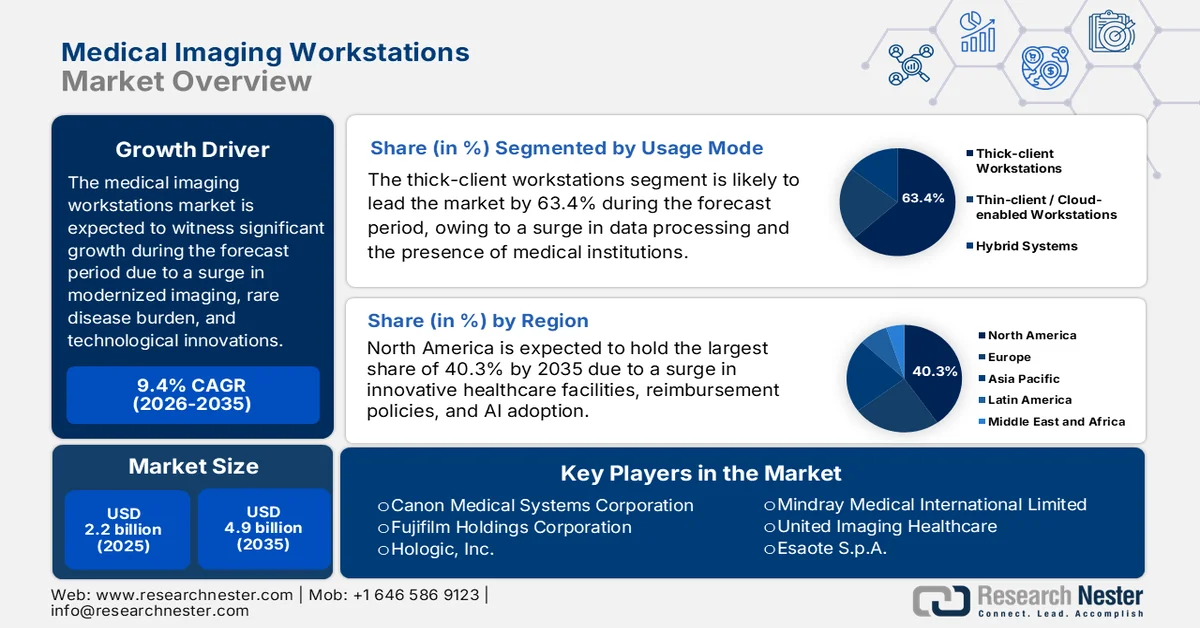
The worldwide medical imaging workstations market is presently undergoing a significant transformation, fueled by the convergence of operational, demographic, and technological forces that are reshaping the role of diagnostic imaging in modernized healthcare. In addition, the aging population and an increase in chronic disease burden are also responsible for driving the market growth. According to official statistics published by NLM in February 2024, the approximate expense of chronic disorders is predicted to reach USD 47 trillion globally by the end of 2030. Based on government estimates published by the CDC Government in August 2025, 90% of the U.S.’s USD 4.9 trillion in yearly health spending has been allocated for people with mental and chronic health conditions. Besides, over 843,000 people die due to stroke or heart disease every year, which is over 1 in 4 deaths, thereby enhancing the demand for the medical imaging workstations market globally.
Furthermore, the automated AI- integrated workflows, the presence of zero-footprint and cloud-based architectures, 3D/4D post-processing through advanced visualization, the enterprise-wide and multi-modality integration, and a shift towards managed subscription-based service models are a few trends that are bolstering the medical imaging workstations. As stated in an article published by NLM in February 2026, the 3D printing demonstration in pre-operative planning diminishes medical operation duration by 19.8%, along with interoperative blood reduction by 25.7%, and fluoroscopy utilization by 23.8%. These particular reductions carry generous financial implications, with effective resource expenses ranging between USD 36 and USD 150 per minute, depending on complexity and facility type, thereby denoting an optimistic outlook for the market expansion.
Key Medical Imaging Workstations Market Insights Summary:
Regional Highlights:
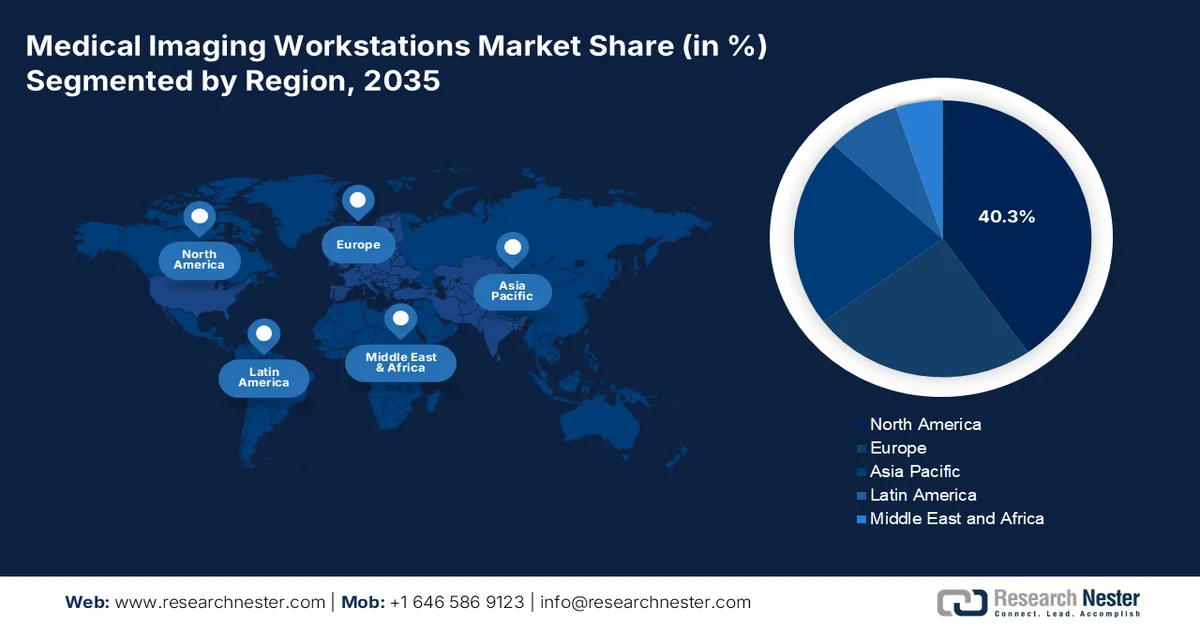
- North America in the medical imaging workstations market is projected to command a 40.3% share by 2035, supported by advanced healthcare infrastructure and rising AI-based imaging adoption alongside strong reimbursement systems
- Asia Pacific is expected to witness the fastest expansion over the forecast period, fueled by rapid healthcare digitalization and increasing government investments in medical infrastructure
Segment Insights:
- The thick-client workstations segment in the medical imaging workstations market is projected to capture a 63.4% share by 2035, attributed to the growing need for localized data processing over centralized systems.
- The hospitals sub-segment is anticipated to secure the second-largest share during the forecast period, reinforced by increasing patient volumes and expanding hospital infrastructure worldwide.
Key Growth Trends:
- Technological innovations in imaging modalities
- Expansion in outpatient-based imaging
Major Challenges:
- GPU supply chain constraints and component shortages
- Escalating trade tariffs and geopolitical tensions
Key Players: GE HealthCare (U.S.), Koninklijke Philips N.V. (Netherlands), Siemens Healthineers (Germany), Canon Medical Systems Corporation (Japan), Fujifilm Holdings Corporation (Japan), Hologic, Inc. (U.S.), Carestream Health, Inc. (U.S.), Samsung Medison (South Korea), Hitachi Medical Corporation (Japan), Shimadzu Corporation (Japan), Mindray Medical International Limited (China), United Imaging Healthcare (China), Esaote S.p.A. (Italy), Sectra AB (Sweden), INFINITT Healthcare Co., Ltd. (South Korea), Neusoft Medical Systems (China), Carl Zeiss Meditec AG (Germany), Ampronix, LLC (U.S.), Agfa-Gevaert Group (Belgium), Planmed Oy (Finland).
Global Medical Imaging Workstations Market Forecast and Regional Outlook:
Market Size & Growth Projections:
- 2025 Market Size: USD 2.2 billion
- 2026 Market Size: USD 2.4 billion
- Projected Market Size: USD 4.9 billion by 2035
- Growth Forecasts: 9.4% CAGR (2026-2035)
Key Regional Dynamics:
- Largest Region: North America (40.3% Share by 2035)
- Fastest Growing Region: Asia Pacific
- Dominating Countries: United States, Germany, Netherlands, China, Japan
- Emerging Countries: India, Brazil, South Korea, Mexico, Indonesia
Last updated on : 30 March, 2026
Medical Imaging Workstations Market - Growth Drivers and Challenges
Growth Drivers
- Technological innovations in imaging modalities: The continuous advancement in imaging hardware is developing a parallel demand for more suitable workstations, which is positively impacting the medical imaging workstations market globally. According to official statistics published by The Lancet Regional Health- Southeast Asia in April 2024, at present, there are radiologists for a population of 1.4 billion to support technological advancements. Besides, in India, the eSanjeevani program, which is a national roll-out at 155,00 health as well as wellness facilities across rural locations by the Ministry of Health and Family Welfare under the Ayushman Bharat Scheme, thereby positively impacting the medical imaging workstations market growth and expansion.
- Expansion in outpatient-based imaging: The presence of healthcare systems globally is transitioning imaging services from expensive hospital-specific settings to low-cost outpatient infrastructures, which is also driving the medical imaging workstations market. As per an article published by OECD in November 2025, the utilization of PET, MRI, and CT diagnostic evaluations has been highest in Portugal, France, Austria, Korea, and Luxembourg, all of which constituted a combined overall of more than 370 tests per 1,000 population as of 2023. Besides, there are huge variations in the utilization of CT scanners and MRI units, with a current analysis in Norway demonstrating almost 50% of geographical variation in utilizing outpatient diagnostic imaging evaluations for the musculoskeletal system, thus denoting a huge growth opportunity for the market.
- Focus on workforce optimization and burnout mitigation: The aspect of healthcare organizations is increasingly indicating that investing in advanced workstations is one of the critical strategies for combating clinician burnout and optimizing retention. As per an article published by the World Bank Organization in December 2025, the World Bank Group and the Global Fund to Fight AIDS, Tuberculosis and Malaria successfully signed a memorandum of understanding to assist developing nations in building robust and resilient health and medical systems by investing USD 2 billion for over 3 years. In addition, the purpose is to achieve sustainable funding for primary health services, and also help in overcoming malaria, tuberculosis, and HIV, thereby denoting an optimistic outlook for the medical imaging workstations market development.
Challenges
- GPU supply chain constraints and component shortages: The aspect of semiconductor supply constraints has emerged as a critical bottleneck throttling the medical imaging workstations market, with GPU availability representing the most acute vulnerability. Besides, modern imaging workstations, particularly those supporting photon-counting CT and AI-enabled reconstruction, require high-performance graphics processing units capable of managing exponentially increasing raw data volumes. Meanwhile, the concentration of advanced semiconductor manufacturing in geographically restricted regions exposes the supply chain to geopolitical disruptions, natural disasters, and capacity constraints that directly impact workstation lead times, thus negatively impacting market growth.
- Escalating trade tariffs and geopolitical tensions: The implementation of U.S.-based tariff measures has introduced profound cost escalation pressures across the medical imaging workstation value chain, fundamentally altering procurement economics. These tariff policies increase the landed cost of imported imaging components, including high-performance processing units, specialized detectors, high-resolution diagnostic display systems, and ancillary hardware manufactured in key supply hubs such as Japan and Taiwan. For healthcare providers, the financial impact translates directly to increased capital expenditures for diagnostic imaging infrastructure, potentially delaying technology refresh cycles and reducing overall medical imaging workstations market accessibility.
Medical Imaging Workstations Market Size and Forecast:
| Report Attribute | Details |
|---|---|
|
Base Year |
2025 |
|
Forecast Year |
2026-2035 |
|
CAGR |
9.4% |
|
Base Year Market Size (2025) |
USD 2.2 billion |
|
Forecast Year Market Size (2035) |
USD 4.9 billion |
|
Regional Scope |
|
Medical Imaging Workstations Market Segmentation:
Usage Mode Segment Analysis
The thick-client workstations segment in the medical imaging workstations market is anticipated to garner the largest share of 63.4% by the end of 2035. The segment’s upliftment is largely driven by the need to perform data processing locally, rather than relying on a centralized server. Additionally, this segment is experiencing strong demand from government healthcare institutions and medical organizations. Besides, according to official statistics published by NLM in September 2025, teleradiology is one such workstation that has evolved as the ultimate cornerstone of modernized radiology practice, with 85.6% of radiologists, especially from the U.S., being deliberately engaged in remote reading and evaluation. Besides, an estimated 65% of medical institutions deployed home-specific workstations, and 74% shifted to routine daytime shifts to internal teleradiology, thus bolstering the segment growth.
End user Segment Analysis
The hospitals sub-segment, which is part of the end user segment, is projected to account for the second-largest share in the medical imaging workstations market during the forecast period. The sub-segment’s growth is highly fueled by several structural and operational factors that uniquely position hospitals as the primary consumers of advanced imaging technology. Hospitals perform the vast majority of diagnostic imaging procedures globally, handling complex cases that require high-end workstations. Additionally, this particular sub-segment captures significant market share owing to the rising number of hospitals and increasing patient visits worldwide. This extensive installed base creates sustained demand for both initial workstation installations and ongoing upgrade services, thereby denoting a huge growth opportunity for the market across different regions.
Component Segment Analysis
By the end of the stipulated timeline, the visualization software sub-segment, part of the component segment, is expected to grab the third-largest share in the medical imaging workstations market. The sub-segment’s development is highly propelled by its importance in transforming complicated patient data as well as 3D imaging into actionable insights, leading to facilitating rapid diagnosis, optimizing surgical accuracy, and enhancing patient monitoring. Regarding this, and as per an article published by NLM in September 2025, BioDigital Human is regarded as an interactive software platform that has been specifically designed for healthcare professionals and effectively features more than 1,200 anatomical and disease-based 3D models. Therefore, with the presence of such standard software, the sub-segment is continuously gaining increased exposure globally.
Our in-depth analysis of the medical imaging workstations market includes the following segments:
|
Segment |
Subsegments |
|
|
|
End user |
|
|
Component |
|
|
Application |
|
|
Modality |
|
|
Clinical Specialty |
|

Vishnu Nair
Head - Global Business DevelopmentCustomize this report to your requirements — connect with our consultant for personalized insights and options.
Medical Imaging Workstations Market - Regional Analysis
North America Market Insights
North America in the medical imaging workstations market is anticipated to garner the highest share of 40.3% by the end of 2035. The market’s upliftment in the region is primarily attributed to the existence of advanced healthcare infrastructure, an increase in the adoption of AI-based imaging technologies, strong reimbursement frameworks, and generous federal funding through FDA approvals and the NIH. According to official statistics published by NLM in 2023, the federal government’s responsibility is to make sure that the total population comprises a suitable healthcare coverage, which is readily categorized into 36% single government program, along with a 26% mixture of private and government programs. Besides, the regional insurance overhead was worth USD 301.4 billion, which includes USD 252 billion for private insurers, denoting nearly 12% of premiums in comparison to 1.6% of the single payer system in Canada and 2.2% in conventional Medicare, thereby making it suitable for boosting the market.
The medical imaging workstations market in the U.S. is growing significantly, owing to the rising aging population, a surge in chronic disease burden, suitable reimbursement policies, AI integration, and an expansion in outpatient imaging. As per an article published by NLM in February 2025, the imaging utilization is expected to increase in the country from 16.9% to 26.9% by the end of 2055, in comparison to 2023, deliberately reflecting suitable differences by modality. Moreover, the population growth in the nation is continuing to grow from 73% to 88% of utilization, which has increased across domestic modalities. Additionally, the aging population in the country is expected to surge from 12% to 27%, with average utilization differentiated by insurance type, thereby denoting an optimistic outlook for the market’s growth in the overall country.
The reduction in waiting duration, public sector investment, an increase in the rare disease prevalence, focus on equity, and AI implementation are certain factors that are uplifting the medical imaging workstations market in Canada. As per an article published by Medtech Canada in 2025, the country has readily pledged almost USD 100 million in grants to commercialize research advancements. Besides, the country has also declared more than USD 3.4 million as investment in the East Ontario life sciences industry. Likewise, in terms of automation, over USD 11 billion has been provided to support the AI adoption in Quebec. Meanwhile, the government in Alberta invested USD 5.5 million in cancer screening, while the Budget in Manitoba has aimed at the redevelopment of healthcare with a record 14.2% upsurge, thus positively impacting the market growth in the overall country.
APAC Market Insights
The Asia Pacific in the medical imaging workstations market is expected to emerge as the fastest-growing region during the forecast period. The market’s development in the region is highly propelled by rapid digitalization in healthcare, significant government investments in advancing the medical facility, and an upsurge in rare diseases, along with an increase in the aging population. According to official statistics published by the Open Access Government in July 2025, the region is projected to be home to 1.3 billion people aged more than 60 years by the end of 2050. Besides, the elderly population in the region is expected to grow from 77.4 million, which is 11.5%, to 173.3 million, which is 22.0% by the end of the same year. Furthermore, 62% of overall deaths in Southeast Asia, which is nearly 9 million people, are owing to chronic respiratory diseases, diabetes, cancer, and cardiovascular diseases, thus enabling the market demand.
The medical imaging workstations market in China is gaining increased traction, owing to the increasing acceptance of AI-based medical devices, continuous expansion in government spending on medical imaging, and a huge expansion of hospitals across Tier-2 and Tier-3 cities. As per an article published by the World Health Organization in 2022, the country’s overall health spending reached USD 855.1 billion, denoting a 3.3-fold increase. In addition, the total healthcare expenditure per capita equally increased from USD 190.1 to USD 613.0, demonstrating a 3.2-fold increase. Therefore, with such a continuous increase in investment opportunities, there is an immense patient volume for imaging procedures, which in turn, is positively impacting the medical imaging workstations market expansion in the overall country.
Total Healthcare Expenditure Analysis in China (2003-2022)
|
Year |
Healthcare Spending (USD Billion) |
CPI |
Health Institutions |
Health Personnel |
|
2003 |
940.5 |
438.7 |
806,243 |
621.7 |
|
2004 |
1,084.3 |
455.8 |
849,140 |
633.3 |
|
2005 |
1,237.1 |
464.0 |
882,206 |
644.7 |
|
2006 |
1,406.1 |
471.0 |
918,097 |
668.1 |
|
2007 |
1,653.4 |
493.6 |
912,263 |
696.4 |
|
2008 |
2,076.4 |
522.7 |
891,480 |
725.2 |
|
2009 |
2,505.9 |
519.0 |
891,480 |
725.2 |
|
2010 |
2,854.3 |
536.1 |
936,927 |
820.7 |
|
2011 |
3,477.9 |
565.0 |
954,389 |
861.6 |
|
2012 |
4,017.0 |
579.7 |
950,297 |
911.5 |
|
2013 |
4,524.1 |
594.8 |
974,398 |
979.0 |
|
2014 |
5,044.6 |
606.7 |
981,432 |
1,023.4 |
|
2015 |
5,853.5 |
615.2 |
983,528 |
1,069.3 |
|
2016 |
6,620.7 |
627.5 |
983,394 |
1,117.2 |
|
2017 |
7,514.0 |
637.5 |
986,649 |
1,174.9 |
|
2018 |
8,445.9 |
650.9 |
997,433 |
1,230.0 |
|
2019 |
9,405.9 |
669.8 |
1,007,579 |
1,292.8 |
|
2020 |
10,310.7 |
686.5 |
1,022,922 |
1,347.5 |
|
2021 |
10,977.8 |
692.7 |
1,030,935 |
1,398.5 |
|
2022 |
12,189.6 |
706.6 |
1,032,918 |
1,441.0 |
Source: ACM Organization
The aspects of governmental strategies for increasing healthcare expenses, suitable development in medical imaging facilities, improvement in diagnostics in urban and rural areas, the demand for portable and affordable workstations, and an increase in medical devices are certain trends that are positively impacting the medical imaging workstations market growth in India. Based on government estimates published by the Ministry of Health and Family Welfare in October 2024, the National Health Policy has recommended the availability of 2 beds per 1,000 population, and meanwhile, as per the Health Dynamics of India, an overall 8,18,661 beds are significantly available at different medical institutions in the country as of 2023. Moreover, based on India Public Health Services norms, the primary health center comprises 6 indoor beds for covering 20,000 to 30,000 population, based on which there is continuous inflow of generous investments in domestic healthcare, which is driving the market development in the country.
Government Healthcare and Medical Spending Analysis in India (2017-2022)
|
Year |
Government Spending |
|
2017-2018 |
USD 27.8 billion |
|
2018-2019 |
USD 29.1 billion |
|
2019-2020 |
USD 32.7 billion |
|
2020-2021 |
USD 38.1 billion |
|
2021-2022 |
USD 52.3 billion |
Source: Ministry of Health and Family Welfare
Europe Market Insights
Europe in the medical imaging workstations market is projected to witness considerable growth by the end of the stipulated timeline. The market’s growth in the region is highly driven by significant government-based digitalized health strategies, increased emphasis on technological advancements, strong public funding for healthcare modernization, a demographic shift with an aging population, and a proactive regulatory environment. According to official statistics published by Digital Europe Organization in April 2022, almost 2.5% of regional and national health budgets are dedicated to digital health. In addition, it is compulsory that 100% of citizens in the region are expected to have suitable accessibility to electronic health records for managing cross-border data. Besides, the availability of easy-to-utilize eID services, along with a simple common consent form, is essential for maintaining these medical records, thus fueling the market growth.
The medical imaging workstations market in Germany is gaining increased exposure, owing to the existence of a dominant industrial base, significant funding strategies for making advancements in healthcare facilities, and the sudden shift towards patient-centric and personalized medicine. As stated in an article published by Deutschland in May 2025, medical innovation is considered a laborious process of approximately investigating 10,000 substances for combating barriers for a period of 8 to 12 years. Moreover, with the existence of 524 industry -based clinical studies, the country has grabbed the fourth position globally, just behind Spain, the U.S., and China as of 2022. Besides, nearly 3 quarters of 30 drugs with the addition of the latest active ingredients have been placed in the country as of 2023 for targeting immunological diseases, cancer, and infectious disorders, thereby proliferating the medical imaging workstations market development.
The centralized investment approach for resolving systematic capacity constraints, the replacement of aging scanners, the successful establishment of network communities and diagnostic centers, and the enhanced demand for high-throughput workstations are responsible for boosting the medical imaging workstations market in the UK. Based on government estimates published by the UK Government in March 2024, the community diagnostic center program in the country is significantly backed by USD 30.6 billion as capital investment in diagnostic transformation. In addition, these centers have delivered over 7 million tests, scans, and checks in England. Based on this, currently, there are 155 open diagnostic centers for delivering these medical services. Therefore, based on all these facilities, there is a huge growth opportunity for the market in the country.
Key Medical Imaging Workstations Market Players:
- GE HealthCare (U.S.)
- Koninklijke Philips N.V. (Netherlands)
- Siemens Healthineers (Germany)
- Canon Medical Systems Corporation (Japan)
- Fujifilm Holdings Corporation (Japan)
- Hologic, Inc. (U.S.)
- Carestream Health, Inc. (U.S.)
- Samsung Medison (South Korea)
- Hitachi Medical Corporation (Japan)
- Shimadzu Corporation (Japan)
- Mindray Medical International Limited (China)
- United Imaging Healthcare (China)
- Esaote S.p.A. (Italy)
- Sectra AB (Sweden)
- INFINITT Healthcare Co., Ltd. (South Korea)
- Neusoft Medical Systems (China)
- Carl Zeiss Meditec AG (Germany)
- Ampronix, LLC (U.S.)
- Agfa-Gevaert Group (Belgium)
- Planmed Oy (Finland)
- Company Overview
- Business Strategy
- Key Product Offerings
- Financial Performance
- Key Performance Indicators
- Risk Analysis
- Recent Development
- Regional Presence
- GE HealthCare focuses on delivering cloud-native, AI-integrated imaging platforms that unify enterprise imaging workflows across modalities. The company emphasizes interoperability and zero-footprint viewing solutions to support radiologists in remote and on-premise settings.
- Koninklijke Philips N.V. specializes in advanced visualization software and vendor-neutral echocardiography solutions designed to streamline cardiology and radiology workflows. The company prioritizes AI-powered image reconstruction and spectral imaging capabilities to enhance diagnostic confidence in complex clinical environments.
- Siemens Healthineers integrates deep-learning AI into its imaging chain to optimize image quality and operational efficiency across interventional and diagnostic applications. The company focuses on delivering high-performance workstations that support advanced modalities such as photon-counting CT and high-field MRI.
- Canon Medical Systems Corporation develops the medical imaging workstations market with a strong emphasis on ultra-high-resolution imaging and AI-assisted post-processing tools. The company leverages its expertise in detector technology to deliver systems that support rapid reconstruction and streamlined workflow automation.
- Fujifilm Holdings Corporation offers comprehensive enterprise imaging platforms that combine advanced visualization, AI tools, and robust data management capabilities. The company focuses on seamless integration with existing PACS and VNA infrastructure to support scalable, multi-site radiology operations.
Here is a list of key players operating in the global medical imaging workstations market:
The competitive landscape of the medical imaging workstations market is concentrated, with leading players, such as GE HealthCare, Siemens Healthineers, and Philips dominating through integrated hardware-software ecosystems. The key strategic shift for the market is the move toward AI-native and cloud-based platforms. For instance, GE HealthCare launched its Genesis cloud-native workspace, while Philips focuses on vendor-neutral echocardiography software to enhance workflow efficiency. Besides, in August 2025, Samsung collaborated with NeuroLogica and unveiled its cutting-edge mobile CT product portfolio in India. This has been particularly designed to transform interventional and diagnostic radiology in the country by combining AI-driven efficiency with mobility, and patient-centric design for empowering healthcare professionals in delivering quality care, thus making it suitable for bolstering the medical imaging workstations industry globally.
Corporate Landscape of the Medical Imaging Workstations Market:
Recent Developments
- In November 2025, Royal Philips launched the Philips Image Management 5, which is the next-generation of Philips Vue PACS that includes a zero-footprint and a web diagnostic viewer for transforming radiologists’ accessibility and interpreting medical images.
- In March 2025, GE HealthCare collaborated with NVIDIA and expanded its existing relationship by focusing on pioneering advancements in autonomous imaging by commencing with autonomous X-ray technologies, along with autonomous applications in ultrasound.
- In November 2023, Konica Minolta, Inc. escalated its efforts to deploy its remote monitoring solution for disaster risk mitigation. Based on this acceleration, the organization began a proof-of-concept demonstration of its AI-specific reservoir monitoring solution by cooperating with the Nagano Prefectural Government.
- Report ID: 8483
- Published Date: Mar 30, 2026
- Report Format: PDF, PPT
- Explore a preview of key market trends and insights
- Review sample data tables and segment breakdowns
- Experience the quality of our visual data representations
- Evaluate our report structure and research methodology
- Get a glimpse of competitive landscape analysis
- Understand how regional forecasts are presented
- Assess the depth of company profiling and benchmarking
- Preview how actionable insights can support your strategy
Explore real data and analysis
Frequently Asked Questions (FAQ)
About this Report
Connect with our Expert


Report, 2026-2035



Copyright @ 2026 Research Nester. All Rights Reserved.
