Global Magnesium Hydroxide Flame Retardant Market
1. An Outline of the Global Magnesium Hydroxide Flame Retardant Market
1.1. Market Definition and Segmentation
1.2. Study Assumptions and Abbreviations
2. Research Methodology & Approach
2.1. Primary Research
2.2. Secondary Research
2.3. Data Triangulation
2.4. SPSS Methodology
3. Executive Summary
4. Growth Drivers
5. Major Roadblocks
6. Opportunities
7. Prevalent Trends
8. Government Regulation
9. Growth Outlook
10. Competitive White Space Analysis – Identifying Untapped Market Gaps
11. Risk Overview
12. SWOT
13. Technological Advancement
14. Technology Maturity Matrix for the Magnesium Hydroxide Flame Retardant Market: Recent News
15. Regional Demand
16. Global Magnesium Hydroxide Flame Retardant by Geography – Strategic Comparative Analysis
17. Strategic Segment Analysis: Magnesium Hydroxide Flame Retardant Demand Landscape
18. Magnesium Hydroxide Flame Retardant Demand Trends Driven by increasing demand for eco-friendly additives and high application across electrical, automotive, construction, and industrial sectors. (2027-2036)
19. Root Cause Analysis (RCA) for discovering problems of the Magnesium Hydroxide Flame Retardant Market
20. Porter Five Forces
21. PESTLE
22. Comparative Positioning
23. Global Magnesium Hydroxide Flame Retardant – Key Player Analysis (2036)
24. Competitive Landscape: Key Suppliers/Players
25. Competitive Model: A Detailed Inside View for Investors
26. Company Market Share, 2036 (%)
26.1. Huber Engineered Materials
26.2. Garrison Minerals, LLC
26.3. ICL Group Ltd.
26.4. Nabaltec AG
26.5. Lehmann&Voss&Co. KG
26.6. MARTINSWERK GmbH
26.7. Kisuma Chemicals B.V.
26.8. Nedmag B.V.
26.9. Kyowa Chemical Industry Co., Ltd.
26.10. Konoshima Chemical Co., Ltd.
27. Global Magnesium Hydroxide Flame Retardant Market Outlook
27.1. Market Overview
27.1.1. Market Revenue by Value (USD Million), and Compound Annual Growth Rate (CAGR)
27.2. Magnesium Hydroxide Flame Retardant Market Segmentation Analysis (2027-2036)
27.2.1. By Type
27.2.1.1. Chemical Synthesis, Market Value (USD Million), and CAGR, 2027-2036F
27.2.1.2. Physical Smash, Market Value (USD Million), and CAGR, 2027-2036F
27.2.2. By Application
27.2.2.1. PVC, Market Value (USD Million), and CAGR, 2027-2036F
27.2.2.2. PE, Market Value (USD Million), and CAGR, 2027-2036F
27.2.2.3. Engineering Thermoplastics, Market Value (USD Million), and CAGR, 2027-2036F
27.2.2.4. Rubber, Market Value (USD Million), and CAGR, 2027-2036F
27.2.2.5. Others, Market Value (USD Million), and CAGR, 2027-2036F
27.2.3. Regional Synopsis, Value (USD Million), 2027-2036
27.2.3.1. North America Market Value (USD Million) and CAGR & Y-o-Y Growth Trend, 2027-2036F
27.2.3.2. Europe Market Value (USD Million) and CAGR & Y-o-Y Growth Trend, 2027-2036F
27.2.3.3. Asia Pacific, excluding Japan Market Value (USD Million) and CAGR & Y-o-Y Growth Trend, 2027-2036F
27.2.3.4. Latin America Market Value (USD Million) and CAGR & Y-o-Y Growth Trend, 2027-2036F
27.2.3.5. Middle East and Africa Market Value (USD Million) and CAGR & Y-o-Y Growth Trend, 2027-2036F
28. North America Market
28.1. Overview
28.1.1. Market Value (USD Million), Current and Future Projections, 2027-2036
28.1.2. Increment $ Opportunity Assessment, 2027-2036
28.2. Segmentation (USD Million), 2027-2036, By
28.2.1. By Type
28.2.1.1. Chemical Synthesis, Market Value (USD Million), and CAGR, 2027-2036F
28.2.1.2. Physical Smash, Market Value (USD Million), and CAGR, 2027-2036F
28.2.2. By Application
28.2.2.1. PVC, Market Value (USD Million), and CAGR, 2027-2036F
28.2.2.2. PE, Market Value (USD Million), and CAGR, 2027-2036F
28.2.2.3. Engineering Thermoplastics, Market Value (USD Million), and CAGR, 2027-2036F
28.2.2.4. Rubber, Market Value (USD Million), and CAGR, 2027-2036F
28.2.2.5. Others, Market Value (USD Million), and CAGR, 2027-2036F
28.2.3. Country Level Analysis, Value (USD Million)
28.2.3.1. U.S. Market Value (USD Million) and CAGR & Y-o-Y Growth Trend, 2027-2036F
28.2.3.2. Canada Market Value (USD Million) and CAGR & Y-o-Y Growth Trend, 2027-2036F
29. Europe Market
29.1. Overview
29.1.1. Market Value (USD Million), Current and Future Projections, 2027-2036
29.1.2. Increment $ Opportunity Assessment, 2027-2036
29.2. Segmentation (USD Million), 2027-2036, By
29.2.1. By Type
29.2.1.1. Chemical Synthesis, Market Value (USD Million), and CAGR, 2027-2036F
29.2.1.2. Physical Smash, Market Value (USD Million), and CAGR, 2027-2036F
29.2.2. By Application
29.2.2.1. PVC, Market Value (USD Million), and CAGR, 2027-2036F
29.2.2.2. PE, Market Value (USD Million), and CAGR, 2027-2036F
29.2.2.3. Engineering Thermoplastics, Market Value (USD Million), and CAGR, 2027-2036F
29.2.2.4. Rubber, Market Value (USD Million), and CAGR, 2027-2036F
29.2.2.5. Others, Market Value (USD Million), and CAGR, 2027-2036F
29.2.3. Country Level Analysis, Value (USD Million)
29.2.3.1. UK Market Value (USD Million) and CAGR & Y-o-Y Growth Trend, 2027-2036F
29.2.3.2. Germany Market Value (USD Million) and CAGR & Y-o-Y Growth Trend, 2027-2036F
29.2.3.3. France Market Value (USD Million) and CAGR & Y-o-Y Growth Trend, 2027-2036F
29.2.3.4. Italy Market Value (USD Million) and CAGR & Y-o-Y Growth Trend, 2027-2036F
29.2.3.5. Spain Market Value (USD Million) and CAGR & Y-o-Y Growth Trend, 2027-2036F
29.2.3.6. Netherlands Market Value (USD Million) and CAGR & Y-o-Y Growth Trend, 2027-2036F
29.2.3.7. Russia Market Value (USD Million) and CAGR & Y-o-Y Growth Trend, 2027-2036F
29.2.3.8. Switzerland Market Value (USD Million) and CAGR & Y-o-Y Growth Trend, 2027-2036F
29.2.3.9. Poland Market Value (USD Million) and CAGR & Y-o-Y Growth Trend, 2027-2036F
29.2.3.10. Belgium Market Value (USD Million) and CAGR & Y-o-Y Growth Trend, 2027-2036F
29.2.3.11. Rest of Europe Market Value (USD Million) and CAGR & Y-o-Y Growth Trend, 2027-2036F
30. Asia Pacific Market
30.1. Overview
30.1.1. Market Value (USD Million), Current and Future Projections, 2027-2036
30.1.2. Increment $ Opportunity Assessment, 2027-2036
30.2. Segmentation (USD Million), 2027-2036, By
30.2.1. By Type
30.2.1.1. Chemical Synthesis, Market Value (USD Million), and CAGR, 2027-2036F
30.2.1.2. Physical Smash, Market Value (USD Million), and CAGR, 2027-2036F
30.2.2. By Application
30.2.2.1. PVC, Market Value (USD Million), and CAGR, 2027-2036F
30.2.2.2. PE, Market Value (USD Million), and CAGR, 2027-2036F
30.2.2.3. Engineering Thermoplastics, Market Value (USD Million), and CAGR, 2027-2036F
30.2.2.4. Rubber, Market Value (USD Million), and CAGR, 2027-2036F
30.2.2.5. Others, Market Value (USD Million), and CAGR, 2027-2036F
30.2.3. Country Level Analysis, Value (USD Million)
30.2.3.1. China Market Value (USD Million) and CAGR & Y-o-Y Growth Trend, 2027-2036F
30.2.3.2. Japan Market Value (USD Million) and CAGR & Y-o-Y Growth Trend, 2027-2036F
30.2.3.3. India Market Value (USD Million) and CAGR & Y-o-Y Growth Trend, 2027-2036F
30.2.3.4. South Korea Market Value (USD Million) and CAGR & Y-o-Y Growth Trend, 2027-2036F
30.2.3.5. Australia Market Value (USD Million) and CAGR & Y-o-Y Growth Trend, 2027-2036F
30.2.3.6. Indonesia Market Value (USD Million) and CAGR & Y-o-Y Growth Trend, 2027-2036F
30.2.3.7. Malaysia Market Value (USD Million) and CAGR & Y-o-Y Growth Trend, 2027-2036F
30.2.3.8. Vietnam Market Value (USD Million) and CAGR & Y-o-Y Growth Trend, 2027-2036F
30.2.3.9. Thailand Market Value (USD Million) and CAGR & Y-o-Y Growth Trend, 2027-2036F
30.2.3.10. Singapore Market Value (USD Million) and CAGR & Y-o-Y Growth Trend, 2027-2036F
30.2.3.11. New Zealand Market Value (USD Million) and CAGR & Y-o-Y Growth Trend, 2027-2036F
30.2.3.12. Rest of Asia Pacific Excluding Japan Market Value (USD Million) and CAGR & Y-o-Y Growth Trend, 2027-2036F
31. Latin America Market
31.1. Overview
31.1.1. Market Value (USD Million), Current and Future Projections, 2027-2036
31.1.2. Increment $ Opportunity Assessment, 2027-2036
31.1.3. Year-on-Year Growth Forecast (%)
31.2. Segmentation (USD Million), 2027-2036, By
31.2.1. By Type
31.2.1.1. Chemical Synthesis, Market Value (USD Million), and CAGR, 2027-2036F
31.2.1.2. Physical Smash, Market Value (USD Million), and CAGR, 2027-2036F
31.2.2. By Application
31.2.2.1. PVC, Market Value (USD Million), and CAGR, 2027-2036F
31.2.2.2. PE, Market Value (USD Million), and CAGR, 2027-2036F
31.2.2.3. Engineering Thermoplastics, Market Value (USD Million), and CAGR, 2027-2036F
31.2.2.4. Rubber, Market Value (USD Million), and CAGR, 2027-2036F
31.2.2.5. Others, Market Value (USD Million), and CAGR, 2027-2036F
31.2.3. Country Level Analysis, Value (USD Million)
31.2.3.1. Brazil Market Value (USD Million) and CAGR & Y-o-Y Growth Trend, 2027-2036F
31.2.3.2. Argentina Market Value (USD Million) and CAGR & Y-o-Y Growth Trend, 2027-2036F
31.2.3.3. Mexico Market Value (USD Million) and CAGR & Y-o-Y Growth Trend, 2027-2036F
31.2.3.4. Rest of Latin America Market Value (USD Million) and CAGR & Y-o-Y Growth Trend, 2027-2036F
32. Middle East & Africa Market
32.1. Overview
32.1.1. Market Value (USD Million), Current and Future Projections, 2027-2036
32.1.2. Increment $ Opportunity Assessment, 2027-2036
32.1.3. Year-on-Year Growth Forecast (%)
32.2. Segmentation (USD Million), 2027-2036, By
32.2.1. By Type
32.2.1.1. Chemical Synthesis, Market Value (USD Million), and CAGR, 2027-2036F
32.2.1.2. Physical Smash, Market Value (USD Million), and CAGR, 2027-2036F
32.2.2. By Application
32.2.2.1. PVC, Market Value (USD Million), and CAGR, 2027-2036F
32.2.2.2. PE, Market Value (USD Million), and CAGR, 2027-2036F
32.2.2.3. Engineering Thermoplastics, Market Value (USD Million), and CAGR, 2027-2036F
32.2.2.4. Rubber, Market Value (USD Million), and CAGR, 2027-2036F
32.2.2.5. Others, Market Value (USD Million), and CAGR, 2027-2036F
32.2.3. Country Level Analysis, Value (USD Million)
32.2.3.1. Saudi Arabia Market Value (USD Million) and CAGR & Y-o-Y Growth Trend, 2027-2036F
32.2.3.2. UAE Market Value (USD Million) and CAGR & Y-o-Y Growth Trend, 2027-2036F
32.2.3.3. Israel Market Value (USD Million) and CAGR & Y-o-Y Growth Trend, 2027-2036F
32.2.3.4. Qatar Market Value (USD Million) and CAGR & Y-o-Y Growth Trend, 2027-2036F
32.2.3.5. Kuwait Market Value (USD Million) and CAGR & Y-o-Y Growth Trend, 2027-2036F
32.2.3.6. Oman Market Value (USD Million) and CAGR & Y-o-Y Growth Trend, 2027-2036F
32.2.3.7. South Africa Market Value (USD Million) and CAGR & Y-o-Y Growth Trend, 2027-2036F
32.2.3.8. Rest of Middle East & Africa Market Value (USD Million) and CAGR & Y-o-Y Growth Trend, 2027-2036F
33. Global Economic Scenario
33.1. World Economic Outlook
34. About Research Nester
34.1. Our Global Clientele
34.2. We Serve Clients Across World
Magnesium Hydroxide Flame Retardant Market Outlook:
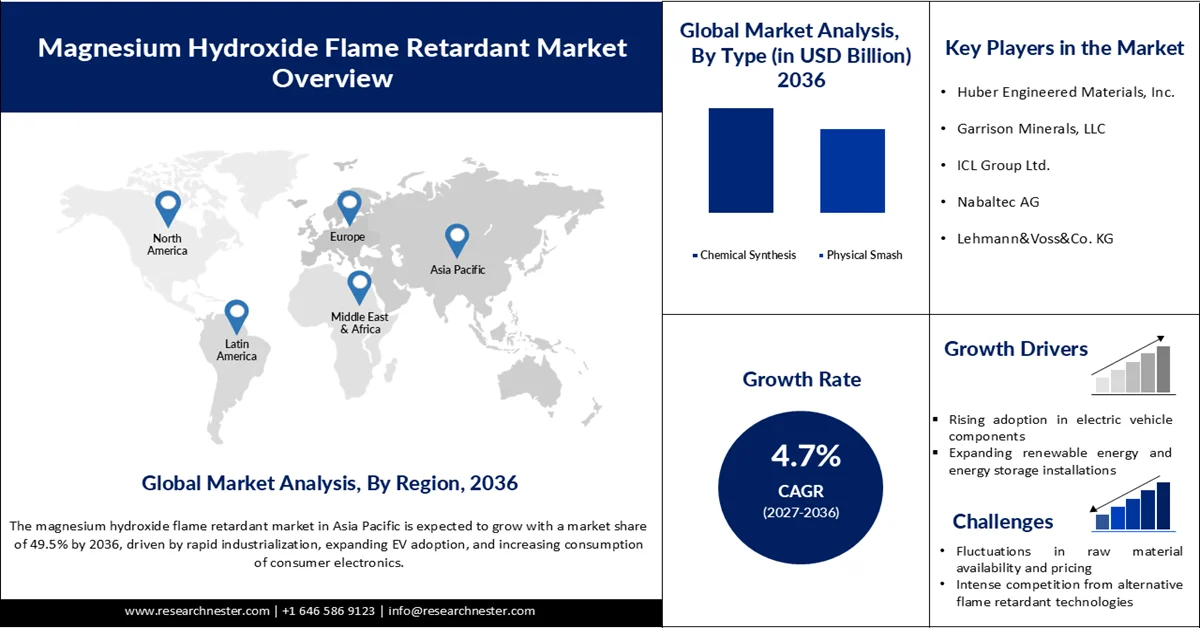
Magnesium Hydroxide Flame Retardant Market size is valued at USD 680.10 million in 2026 and is projected to reach USD 1.07 billion by 2036, growing at a CAGR of 4.7% during the forecast period, i.e., 2027-2036. In 2027, the industry size of magnesium hydroxide flame retardant is assessed at USD 712.06 million.
The rapid expansion of renewable energy infrastructure in both developed and developing economies is boosting the sales of magnesium hydroxide flame retardants. The International Energy Agency (IEA) reports that global energy investment hit a record USD 3.3 trillion in 2025, up 2% from the previous year. Around USD 2.2 trillion (two-thirds of the total) went into clean energy technologies such as renewables, grids, battery storage, and electric vehicles. Investment in fossil fuels, on the other hand, edged down to USD 1.1 trillion.
This continued shift toward clean energy is now being driven more by industrial strategy and energy security than post-pandemic recovery funds. The trend is further strengthened by rapidly rising electricity demand from electric vehicles, data centers, and artificial intelligence. Thus, this ongoing transition toward sustainable energy systems is expected to drive long-term growth in the adoption of magnesium hydroxide flame retardants.
Key Magnesium Hydroxide Flame Retardant Market Insights Summary:
Regional Highlights:
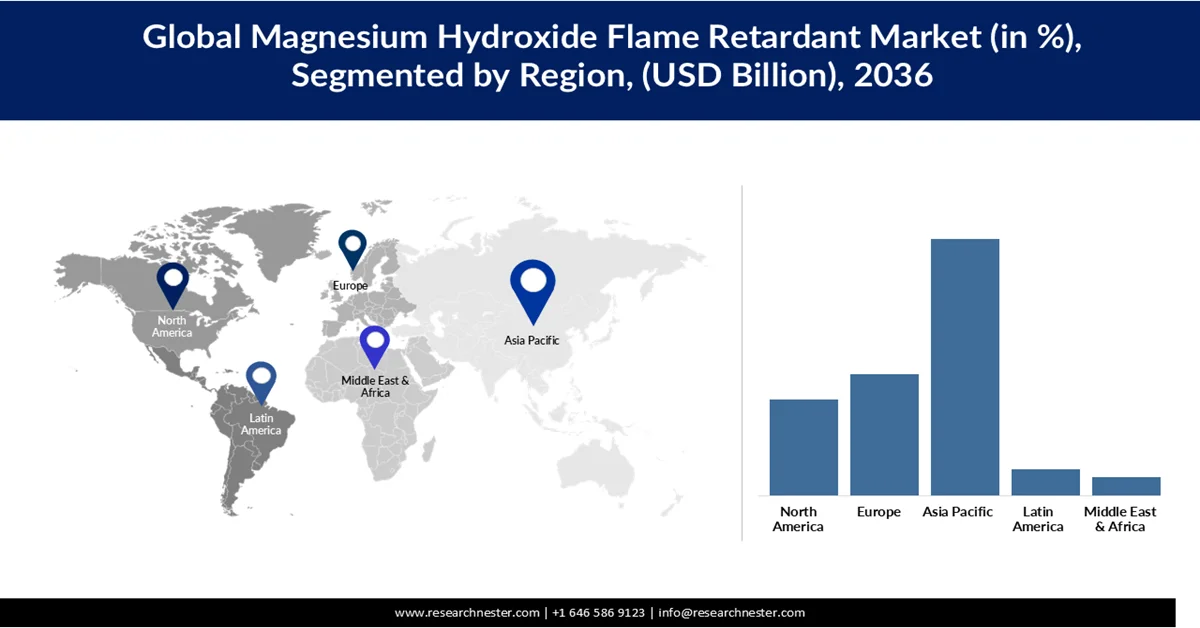
- Magnesium hydroxide flame retardant market Asia Pacific is anticipated to command 49.5% of the market share by 2036, bolstered by rapid industrialization, expanding manufacturing activities, and increasing implementation of fire safety regulations
- Europe is projected to account for 23.5% of the market share by 2036, fueled by high environmental standards and rising demand for sustainable flame-retardant solutions
- The U.S. is projected to account for 76.5% of the North America magnesium hydroxide flame retardant market share through 2036, mainly owing to its extensive industrial base
- Japan is poised to capture 12.5% of the Asia Pacific magnesium hydroxide flame retardant market by 2036, supported by technological advancement and strong end-user demand
Segment Insights:
- Magnesium hydroxide flame retardant market The PVC segment is projected to capture 35.5% of the market share by 2036, supported by robust growth in PVC manufacturing
- The Chemical Synthesis segment is expected to hold 55.5% of the global market share by 2036, reinforced by rising demand for halogen-free flame retardants and advanced polymer formulations
Key Growth Trends:
- Growth of the electrical and electronics industry
- Increasing construction and infrastructure development
Major Challenges:
- Fluctuations in raw material availability
- Intense competition from alternative flame retardants
Key Players: Huber Engineered Materials, Inc. (U.S.), Garrison Minerals, LLC (U.S.), ICL Group Ltd. (Israel), Nabaltec AG (Germany), Lehmann & Voss & Co. KG (Germany), MARTINSWERK GmbH (Germany), Kisuma Chemicals B.V. (Netherlands), Nedmag B.V. (Netherlands), Kyowa Chemical Industry Co., Ltd. (Japan), Konoshima Chemical Co., Ltd. (Japan).
Global Magnesium Hydroxide Flame Retardant Market Forecast and Regional Outlook:
Market Size & Growth Projections:
- 2026 Market Size: USD 680.10 million
- 2027 Market Size: USD 712.06 million
- Projected Market Size: USD 1.07 billion by 2036
- Growth Forecasts: 4.7% CAGR (2027-2036)
Key Regional Dynamics:
- Largest Region: Asia Pacific (49.5% share by 2036)
- Fastest Growing Region: Asia Pacific
- Dominating Countries: China, United States, Japan, Germany, South Korea
- Emerging Countries: India, Vietnam, Indonesia, Brazil, Mexico
Last updated on : 26 June, 2026
Magnesium Hydroxide Flame Retardant Market - Growth Drivers and Challenges
Growth drivers
- Growth of the electrical and electronics industry: The continuous expansion of electrical and electronics production is driving a high demand for magnesium hydroxide flame retardants. Consumer electronics, home appliances, telecommunications devices, and other industrial electrical systems are widely used globally, directly driving the adoption of magnesium hydroxide flame retardants. The Observatory of Economic Complexity disclosed that the global trade in electrical machinery and electronics reached USD 3.43 trillion in 2024, up 4.1% from 2023. Over the past five years, this sector has grown at an average annual rate of 5.6%. Thus, the growing adoption of electronic devices worldwide is expected to drive sales of magnesium hydroxide flame retardants during the forecast period.
- Increasing construction and infrastructure development: The robust rise in construction and infrastructure modernization activities worldwide is fueling the sales of magnesium hydroxide flame retardants. The rise in public-private investments towards residential, commercial, and public infra projects is directly fueling the application of magnesium hydroxide flame retardants. The Global Infrastructure Outlook estimates that the infrastructure investment at current trends is USD 79 trillion and needs USD 94 trillion. Thus, as infrastructure modernization continues globally, the demand for magnesium hydroxide-based flame retardants is expected to boom.
- Growing use in electric vehicle components: The swift rise in the adoption of electric vehicles is opening high-earning opportunities for magnesium hydroxide flame retardant manufacturers. The high-energy battery systems, complex wiring networks, and charging components drive a high demand for high-performance fire protection measures, such as magnesium hydroxide flame retardants. The International Energy Agency (IEA) reports that electric vehicle sales rose 20% worldwide in 2025, surpassing 20 million and accounting for one in four new cars. Europe led major EV markets, with sales up over 30% and EVs making up 28% of new car sales, driven by tougher EU CO2 standards. Thus, continuous growth in EV registrations is poised to propel the trade of magnesium hydroxide flame retardants in the years ahead.
Challenges
- Fluctuations in raw material availability: The fluctuations in the availability and pricing of raw materials are substantially challenging the growth of the magnesium hydroxide flame retardant market. The changing mining regulations and environmental restrictions lower the production and commercialization of raw materials, including brucite and magnesite. The significant disruptions in crude oil reported in the first half of 2026 are also hindering the overall supply chain ecosystem. The changing foreign policies and diplomacy are expected to restore the supply chain of raw materials and trade of magnesium hydroxide flame retardants in the years ahead.
- Intense competition from alternative flame retardants: The magnesium hydroxide flame retardant manufacturers are witnessing high competition from alternative flame-retardant technologies. The aluminum hydroxide flame retardants, phosphorus-based flame retardants, nitrogen-based systems, and other advanced synergistic formulations that offer similar results at cost-effective rates are limiting the adoption of magnesium hydroxide flame retardants to some extent. However, technological advancements and strategic collaborations are expected to aid key market players in boosting the sales of enhanced magnesium hydroxide flame retardants in the coming years.
Magnesium Hydroxide Flame Retardant Market Size and Forecast:
| Report Attribute | Details |
|---|---|
|
Base Year |
2026 |
|
Forecast Period |
2027-2036 |
|
CAGR |
4.7% |
|
Base Year Market Size (2026) |
USD 680.10 million |
|
Forecast Year Market Size (2036) |
USD 1.07 billion |
|
Regional Scope |
|
Magnesium Hydroxide Flame Retardant Market Segmentation:
Type Segment Analysis
The PVC segment is projected to capture 35.5% of the magnesium hydroxide flame retardant market share through 2036. The polyvinyl chloride formulations are widely demanded across construction, transportation, electrical, and industrial applications. In March 2026, Shintech Louisiana, LLC announced a USD 3.4 billion investment to expand its manufacturing capacity in the state. The project is expected to create over 800 jobs in the Capital Region and is set to incorporate advanced, lower-emission technologies, strengthening Louisiana’s position in global PVC production. The development is estimated to be carried out in phases, with the first phase targeted for completion by 2030. The robust growth in PVC manufacturing is expected to boost the consumption of magnesium hydroxide flame retardants.
Application Segment Analysis
The chemical synthesis segment is poised to hold 55.5% of the global magnesium hydroxide flame retardant market share throughout the forecast period. The chemical synthesis is highly popular due to its ability to produce high-purity and performance-enhanced magnesium hydroxide suitable for demanding industrial applications. The growing demand for halogen-free flame retardants and advanced polymer formulations is also strengthening the position of the chemical synthesis segment. Further, as industries seek materials that deliver superior fire protection, low smoke emissions, and consistent processing characteristics, chemically synthesized magnesium hydroxide is set to gain preference among manufacturers.
Our in-depth analysis of the magnesium hydroxide flame retardant market includes the following segments:
|
Segments |
Subsegments |
|
Type |
|
|
Application |
|

Vishnu Nair
Head - Global Business DevelopmentCustomize this report to your requirements — connect with our consultant for personalized insights and options.
Magnesium Hydroxide Flame Retardant Market - Regional Analysis
Asia Pacific Market Insights
Asia Pacific is estimated to account for 49.5% of the global magnesium hydroxide flame retardant market share by 2036. The market growth is supported by rapid industrialization and expanding manufacturing activities. The increasing implementation of fire safety regulations across key economies is also boosting the trade of magnesium hydroxide flame retardants. Further, the region's position as a global manufacturing hub for consumer electronics, electrical equipment, cables, and industrial products continues to drive the consumption of magnesium hydroxide flame retardants.
India is expected to capture 11.5% of the Asia Pacific magnesium hydroxide flame retardant market share throughout the study period. The rise in infrastructure modernization activities and expanding industrial production is fueling the consumption of magnesium hydroxide flame retardants. The India Brand Equity Foundation (IBEF) reports that the National Infrastructure Pipeline (NIP) has expanded from 6,835 to 9,142 projects across 34 sub-sectors. Of these, 2,476 projects are currently under development, with an estimated investment of USD 1.9 trillion. Nearly half of these projects are in the transportation sector, including 3,906 focused on roads and bridges. Additionally, around 3,500 projects worth USD 292 billion were added during FY25. Thus, this highlights that India is an investment-worthy market for magnesium hydroxide flame retardant manufacturers.
Japan’s market for magnesium hydroxide flame retardants is expected to increase at a healthy CAGR from 2027 to 2036. The country’s growing electrical and electronics manufacturing sector is boosting the application of magnesium hydroxide flame retardants. The rapidly expanding renewable energy sector is generating additional demand for flame-retardant materials. The government's focus on domestic manufacturing and industrial development is also contributing to the overall magnesium hydroxide flame retardant market growth.
Japan Market Insights
The Japan magnesium hydroxide flame retardant market is poised to witness healthy growth during the forecast period. The stringent fire safety regulations and high-quality manufacturing standards are boosting the trade of magnesium hydroxide flame retardants. The country’s strong construction and automotive sectors are propelling the consumption of magnesium hydroxide flame retardants.
The Japan Electronics and Information Technology Industries Association (JEITA) reveals that the domestic production of electronics totaled JPY 11.7 trillion in December 2025. Japan's globally competitive electronics industry remains a key consumer of magnesium hydroxide flame retardants. These materials are widely used in electrical components, connectors, cables, and electronic housings to improve fire resistance and reduce smoke generation. The country's advanced manufacturing capabilities and focus on high-performance materials continue to support demand for premium flame-retardant solutions.
Europe Market Insights
Europe is expected to capture 23.5% of the global magnesium hydroxide flame retardant market share through 2036. The market growth is driven by high environmental standards and increasing demand for sustainable flame-retardant solutions. The strong regulatory oversight is also driving manufacturers to adopt halogen-free flame retardants such as magnesium hydroxide. The growing emphasis on green building initiatives and sustainable infrastructure development is further supporting demand for flame-retardant materials.
The UK magnesium hydroxide flame retardant market growth is estimated to be driven by stringent fire safety regulations and increasing infrastructure investments. In March 2026, the government announced an expanded infrastructure pipeline outlining 734 planned projects, with a combined investment of nearly USD 920 billion (£718 billion) from both public and private sectors over the next decade, marking a notable increase compared to the earlier pipeline. Thus, the UK is the most profitable market for magnesium hydroxide flame retardant companies.
The Germany market for magnesium hydroxide flame retardants is poised to increase at a healthy CAGR throughout the study timeframe. The country’s strong industrial base and leadership in automotive manufacturing are boosting the sales of magnesium hydroxide flame retardants. The Observatory of Economic Complexity (OEC) reveals that Germany exported nearly USD 234 billion worth of chemical products in 2024. Thus, the country’s advanced chemical industry also creates a substantial demand for high-performance flame-retardant materials.
North America Market Insights
North America is anticipated to hold 18.5% of the global magnesium hydroxide flame retardant market throughout the forecast period. The stringent fire safety regulations and growing demand for halogen-free flame-retardant materials are driving the market growth. The established construction, electronics, and transportation industries are increasing the trade of magnesium hydroxide flame retardants. The ongoing investments in power transmission networks and telecommunications infrastructure are expected to generate high earning opportunities for magnesium hydroxide flame retardant manufacturers.
The U.S. market for magnesium hydroxide flame retardants is driven by its extensive industrial base and advanced manufacturing capabilities. The stringent fire safety standards are expected to boost the application of magnesium hydroxide flame retardants in several industries. The Federal Reserve Bank of St. Louis estimates that the total construction spending in the U.S. totaled nearly USD 2.17 trillion in April 2026. The rising construction activities are set to double the revenues of key players in the years ahead.
The Canada magnesium hydroxide flame retardant market is set to witness high growth from 2027 to 2036. The increasing construction activities and rising demand for environmentally friendly flame-retardant materials are creating a profitable space for key players. The expanding renewable energy investments are also poised to propel the sales of magnesium hydroxide flame retardants. Nearly USD 2.8 million (CAD 3.84 million) worth of power density improvements to a saltwater flow battery project were announced in 2025. Thus, investing in Canada is expected to double the revenue of magnesium hydroxide flame retardant manufacturers in the years ahead.
Key Magnesium Hydroxide Flame Retardant Market Players:
- Huber Engineered Materials, Inc. (U.S.)
- Garrison Minerals, LLC (U.S.)
- ICL Group Ltd. (Israel)
- Nabaltec AG (Germany)
- Lehmann&Voss&Co. KG (Germany)
- MARTINSWERK GmbH (Germany)
- Kisuma Chemicals B.V. (Netherlands)
- Nedmag B.V. (Netherlands)
- Kyowa Chemical Industry Co., Ltd. (Japan)
- Konoshima Chemical Co., Ltd. (Japan)
- Company Overview
- Business Strategy
- Key Product Offerings
- Financial Performance
- Key Performance Indicators
- Risk Analysis
- Recent Development
- Regional Presence
- SWOT Analysis
- Huber Engineered Materials holds a strong position in the magnesium hydroxide flame retardant market through its well-established portfolio of halogen-free additives. The company focuses on high-performance grades used in wire and cable, construction, and industrial polymers. Its competitive strength lies in advanced surface treatment technologies and consistent product quality. Huber also benefits from a strong global distribution network and long-term customer relationships, particularly in North America and Europe, where regulatory pressure supports demand for eco-friendly flame retardants.
- Garrison Minerals, LLC is a U.S.-based producer of magnesium hydroxide flame retardants, serving industries such as wire and cable, construction materials, plastics, and industrial compounds. The company focuses on supplying high-purity, environmentally friendly flame-retardant solutions that support stringent fire safety and regulatory requirements. Its competitive position is strengthened by specialized mineral processing capabilities, consistent product quality, and growing demand for halogen-free flame retardants across diverse end-use applications.
- ICL Group Ltd. is a key global player in specialty minerals and performance products, including flame retardant solutions. The company focuses on providing environmentally responsible additives for plastics, construction, and electrical applications. Its competitive positioning is supported by integrated raw material sourcing and large-scale production capabilities. ICL emphasizes sustainability-driven innovation, particularly in halogen-free flame retardants, aligning with global regulatory trends. Strong presence in Europe and North America enhances its ability to serve diverse industrial customers.
- Nabaltec AG is a leading specialist in environmentally friendly flame retardant additives, with a strong focus on aluminum hydroxide and magnesium hydroxide-based products. The company is highly regarded for its technical expertise in surface-modified hydroxide solutions used in wire and cable, electronics, and construction applications. Its competitive advantage lies in product customization, high-purity standards, and strong compliance with European environmental regulations. Nabaltec’s innovation-driven approach helps it maintain a solid position in high-value flame retardant segments.
- Lehmann&Voss&Co. KG operates as a specialty chemicals distributor and solution provider with a strong presence in flame retardant additives. The company’s competitive strength comes from its broad product portfolio and ability to tailor solutions for polymer manufacturers. It focuses on technical service, formulation support, and close customer collaboration rather than large-scale production alone. This positioning allows it to compete effectively in niche applications requiring customized magnesium hydroxide flame retardant systems, particularly in European industrial markets.
Below is the list of the key players operating in the global magnesium hydroxide flame retardant market:
The global magnesium hydroxide flame retardant market is characterized by the strong presence of established companies and the increasing expansion of new players. The leading companies are investing heavily in research and development activities to introduce next-generation solutions. They are entering into strategic partnerships with others to enhance their product offerings. The gigantic companies are also expanding their operations overseas to earn lucrative returns through trending opportunities. Both the organic and inorganic marketing strategies are poised to double the revenues of key players in the years ahead.
Corporate Landscape of the Global Magnesium Hydroxide Flame Retardant Market:
Recent Developments
- In October 2025, Kisuma Chemicals launched two new product solutions at K 2025 for halogen-free flame retardant (HFFR) polymer applications. These include KISUMA™ X, a next-generation magnesium hydroxide flame retardant designed to deliver strong performance at lower usage levels in polyolefin, EVA, and nylon compounds, and Zenthos™ FR, a new product range developed to partly or fully replace antimony trioxide (ATO) in flexible PVC.
- In May 2025, J.M. Huber Corporation announced the acquisition of The R.J. Marshall Company’s Alumina Trihydrate (ATH), antimony-free flame retardant, and molybdate-based smoke suppressant assets. This is set to be integrated into Huber Advanced Materials, strengthening its product range and reinforcing its position in the North American flame retardant and smoke suppression market.
- Report ID: 5181
- Published Date: Jun 26, 2026
- Report Format: PDF, PPT
- Explore a preview of key market trends and insights
- Review sample data tables and segment breakdowns
- Experience the quality of our visual data representations
- Evaluate our report structure and research methodology
- Get a glimpse of competitive landscape analysis
- Understand how regional forecasts are presented
- Assess the depth of company profiling and benchmarking
- Preview how actionable insights can support your strategy
Explore real data and analysis
Frequently Asked Questions (FAQ)
About this Report
Connect with our Expert


Report, 2027-2036



Copyright @ 2026 Research Nester. All Rights Reserved.
