Low Noise Amplifiers Market Outlook:
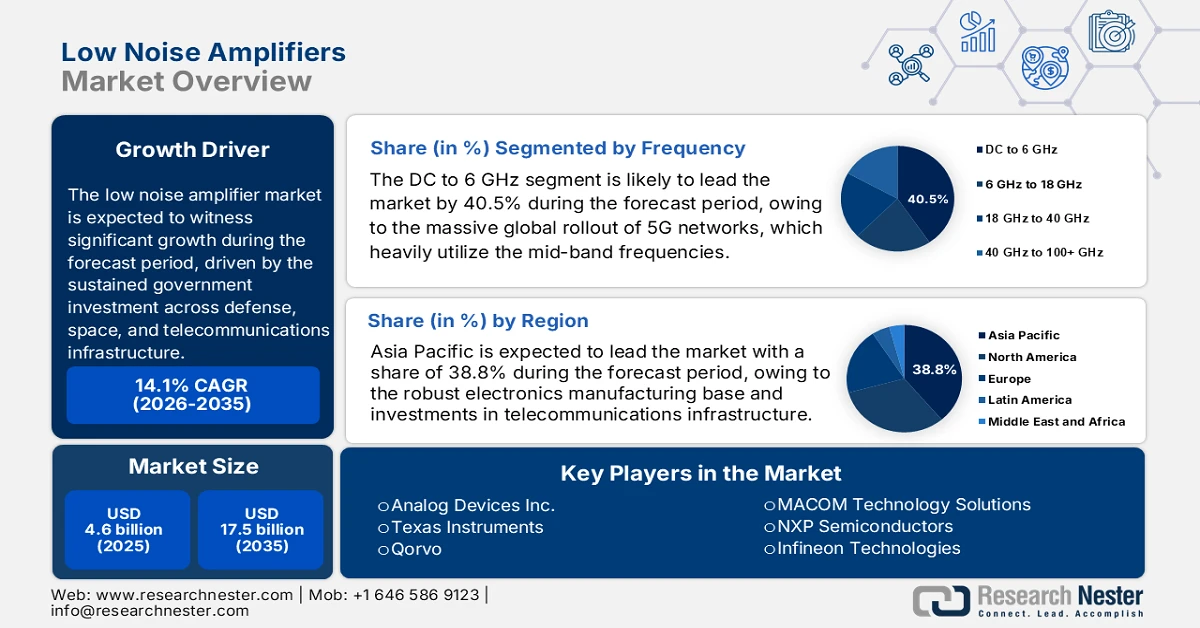
Low Noise Amplifiers Market size was valued at USD 4.6 billion in 2025 and is projected to reach USD 17.5 billion by the end of 2035, rising at a CAGR of 14.1% during the forecast period, i.e., 2026-2035. In 2026, the industry size of low noise amplifiers is assessed at USD 5.34 billion.
The public sector demand for the low noise amplifiers market is driven by sustained government investment across defense, space, telecommunications infrastructure, and scientific research programs. In defense and aerospace, RF front-end performance is directly tied to radar sensitivity, electronic warfare capability, satellite communications, and secure sensing platforms. According to the U.S. Department of Defense report in March 2023, the sector continuously prioritizes the dominance of spectrum and sensor modernization. The report depicts that nearly USD 145 billion is allocated towards the research, development, testing, and evaluation, a part of which is directed towards the RF microwave and satellite payload electronics, which are used in the airborne naval and space-based systems.
Similarly, NASA's investment emphasize on the Earth observation satellite mission and deep space communications, where the low noise signal chains are important to mission reliability, driving the low noise amplifiers market. Similar priorities are reflected in Europe via publicly funded radio astronomy projects and ESA-funded satellite programs that need ultra-low noise receiver architecture for high sensitivity measurements. On the other hand, the National Telecommunications and Information Administration in January 2025 reports that the federal investment reached USD 65 billion under the infrastructure and broadband deployment, indirectly supporting the demand for the RF components integrated into network equipment. Further, the atmospheric sensing networks and the radio telescopes, the large-scale research facilities are supported by the National Science Foundation, which depends on the low noise amplification to extract the weak signals from the high interference environments.