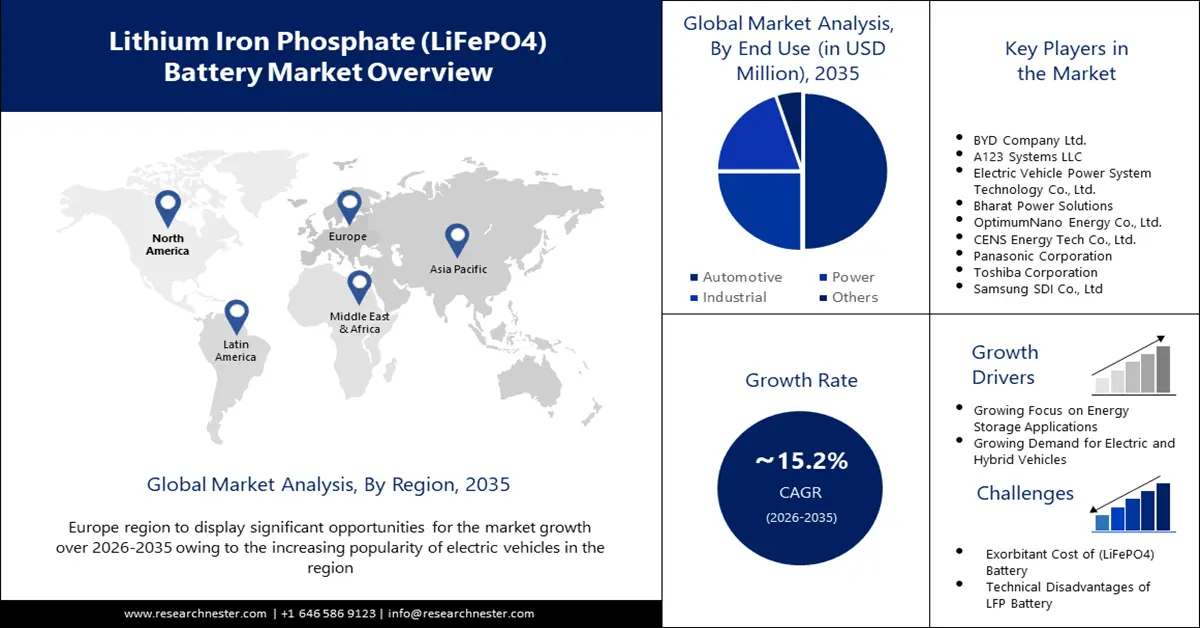
Lithium Iron Phosphate Battery Market Outlook:
Lithium Iron Phosphate Battery Market size was over USD 17.08 billion in 2025 and is anticipated to cross USD 84.23 billion by 2035, witnessing more than 17.3% CAGR during the forecast period i.e., between 2026-2035. In the year 2026, the industry size of lithium iron phosphate battery is assessed at USD 19.74 billion.
The pressing need for social and environmental sustainability is propelling innovation and accelerating the development of cutting-edge energy technologies and clean energy for transportation. Lithium batteries have emerged as the key to limiting GHGs by 30% for road transportation electric vehicles. According to the U.S. Department of Energy Office of Scientific and Technical Information’s (OSTI) Battery Performance and Cost Estimation (BatPaC) model, cathode amounts to over 50% of cell materials cost for lithium batteries. This has spurred interest in developing cathode materials that can balance affordability, energy efficiency, and environmental impact.
Lithium iron phosphate (LFP), lithium nickel cobalt aluminum oxide (NCA), and lithium nickel manganese cobalt oxide (NMC) comprise the key cathode materials used in lithium-ion batteries (LIB). All three compete for a significant lithium iron phosphate battery market share within utility-scale energy storage and EV battery subsectors. In conjunction with governmental support to strengthen the global supply chain and foster the development of lithium iron phosphate, it has gained attention in the EV battery industry during the past years. Recent innovations, including BYD’s Blade Battery, have further improved lithium iron phosphate batteries by optimizing structural design and space utilization at the module level and narrowing the energy density gap using higher-density alternatives.
Furthermore, in terms of cost advantage, LFP battery cells are roughly 30% more affordable than NCA and NMC batteries, which reached USD 95 per kWh in 2023. Despite NMC-based batteries currently dominating the global EV industry, LFP batteries have experienced a steady rise of 39% market share in 2024 from 34% in 2022. Environmentally, LFP batteries render more scalable manufacturing, lower carbon footprints, easier recyclability, and fewer regulatory concerns regarding sourcing critical materials such as nickel and cobalt. In terms of job opportunities, energy employment was approximately 67 million in 2022 and over half a million in clean energy, expanding by 3.4 million jobs over the pre-pandemic level. The fossil fuel workforce was surpassed by the clean energy segment. that of fossil fuels around 2021 to employ over 50% of total energy workers worldwide, a trend that remains true in most regions.
Total employment by sector by 2023 (in million workers)
|
Year |
Clean Energy |
Fossil Fuel |
|
2019 |
30.1 |
33.0 |
|
2020 |
30.0 |
30.6 |
|
2021 |
31.9 |
31.1 |
|
2022 |
34.8 |
31.7 |
|
2023 |
36.2 |
32.1 |
Source: IEA