In-building Wireless Market Outlook:
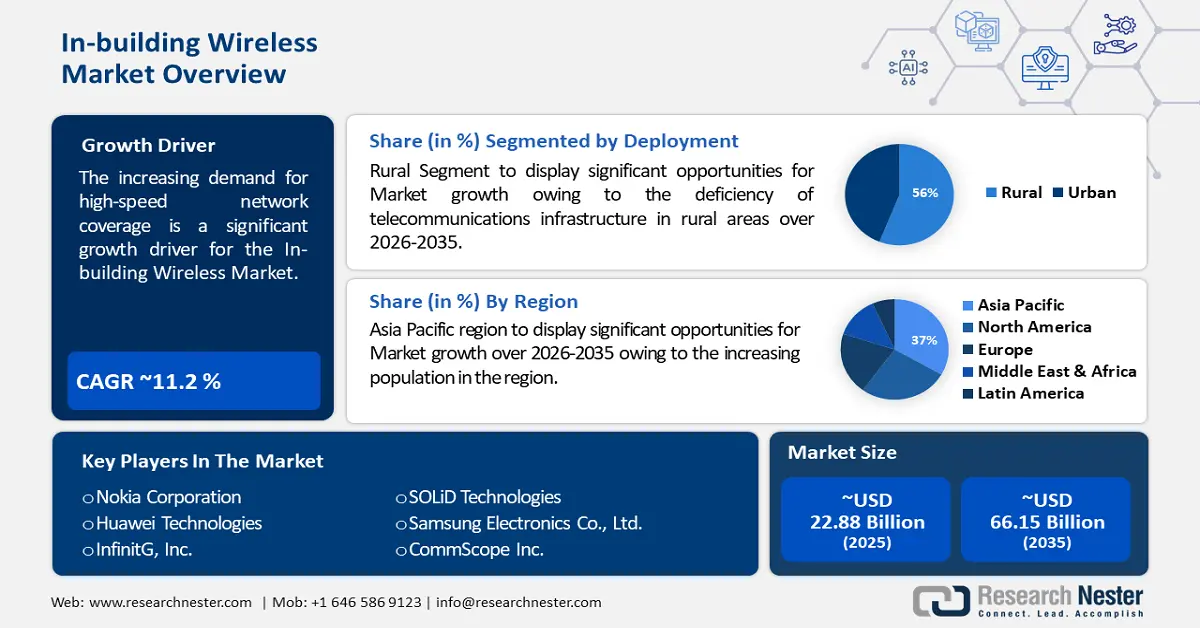
In-building Wireless Market size was over USD 22.88 billion in 2025 and is projected to reach USD 66.15 billion by 2035, growing at around 11.2% CAGR during the forecast period i.e., between 2026-2035. In the year 2026, the industry size of in-building wireless is evaluated at USD 25.19 billion.
To address the instability that cellular carrier networks have when activating data traffic in buildings like workplaces, hospitals, hotels, and retail malls, in-building wireless solutions are implemented. The MNOs/Mobile Virtual Network Operators (MVNOs) and neutral host providers are using in-building wireless solutions due to capacity concerns and a lack of coverage for indoor wireless networks. Therefore, the increasing demand for high-speed network coverage is accelerating the growth of the market. For instance, around 88% of the world's population was served by LTE in 2022, compared to about 35% by 5G, the newest mobile technology. Nonetheless, by 2028, 84% of the population is expected to be covered by 5G.
The significant improvement in building connectivity is the main advantage of IBRES. Consumers benefit from improved voice quality, quicker data rates, and fewer dropped calls, which improves their overall mobile communication experience. This is particularly important in the case of businesses, where seamless connectivity is an integral part of day-to-day operation.