Hybrid CRO Models and Tech-Enabled CRO Market Outlook:
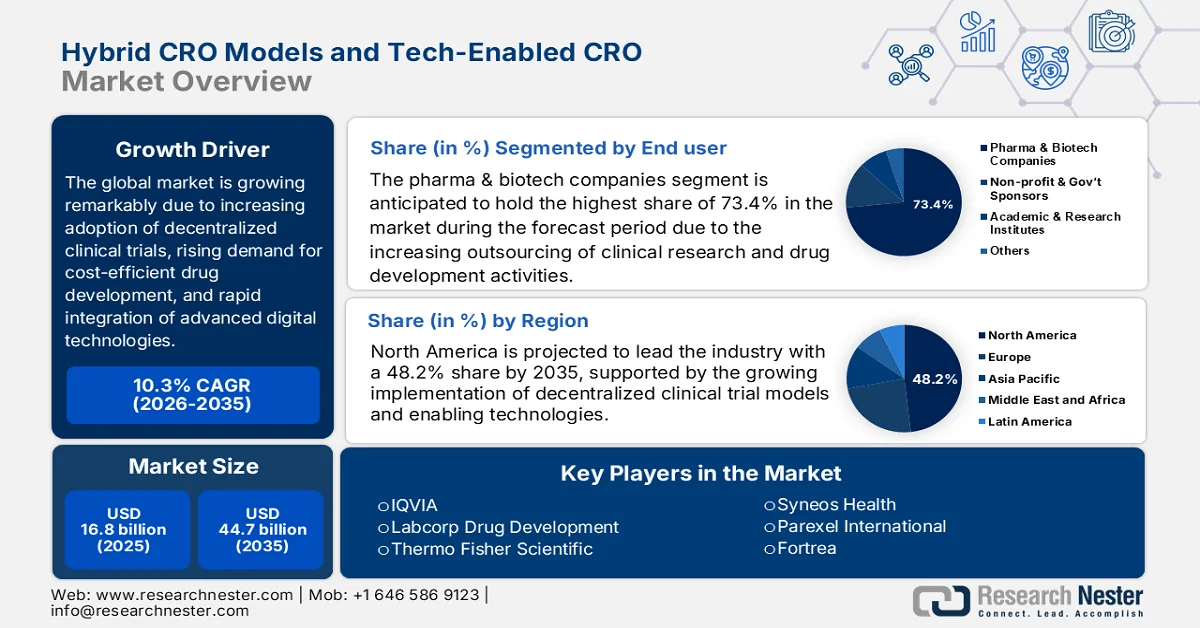
Hybrid CRO Models and Tech-Enabled CRO Market size was valued at USD 16.8 billion in 2025 and is projected to reach USD 44.7 billion by the end of 2035, registering around 10.3% CAGR during the forecast period i.e., between 2026-2035. In 2026, the industry size of hybrid CRO models and tech-enabled CRO is evaluated at USD 18.5 billion.
The hybrid CRO models and tech-enabled CRO market are gaining enhanced traction as it is emerging as a flexible approach that combines full-service outsourcing with functional service provider elements, thereby allowing sponsors to maintain greater control over critical trial functions, while still leveraging external expertise. Simultaneously, technology-enabled CROs are reshaping the clinical research landscape by integrating digital platforms, AI, and decentralized trial capabilities with the main goal of streamlining study design, patient recruitment, monitoring, and data management. As per an article which was published by Fast Data Science, outsourcing clinical trials in 2026 will be an extensively adopted strategy that offers sponsors access to specialized CRO knowledge, worldwide site networks, and operational flexibility that can improve efficiency and allow internal teams to focus on core research and innovation. Simultaneously, it also introduces problems such as reduced oversight, dependency on external vendors, and risks to cost control and quality if governance is weak. As a result, many sponsors are making a shift toward hybrid and tech-enabled outsourcing models that combine internal understanding with external execution and data-driven tools to balance efficiency.
Furthermore, the hybrid CRO models and tech-enabled CRO market are being effectively propelled by the integration of AI, cloud-based data aggregation pipelines, and remote monitoring tools, which streamline trial timelines as well as optimize data clarity. The regulatory bodies establish clearer frameworks for digital health technologies; therefore, CROs that possess technology foundations and flexible workforce models are dominating the competitive landscape. The U.S. Food & Drug Administration (FDA) issued draft guidance in May 2023 with the main goal of advancing decentralized clinical trials, thereby allowing trial activities to occur outside traditional research sites. The article also outlined that it enables remote visits, telemedicine, and local lab testing, and these trials aim to reduce barriers and expand participation. The guidance has been built on earlier recommendations during the COVID-19 pandemic, which reflects the role of digital health technologies in data collection. Thus, ultimately, decentralized approaches are expected to improve diversity, efficiency, and accessibility in medical product development.
Key Hybrid CRO Models and Tech-Enabled CRO Market Insights Summary:
Regional Highlights:
- By 2035, North America is projected to capture 48.2% share in the hybrid cro models and tech-enabled cro market, supported by the accelerating adoption of decentralized clinical trials and decentralized trial technologies
- Across 2026-2035, Asia Pacific is poised to register the fastest expansion in the market, fueled by diverse patient populations and an accelerating push toward digital healthcare infrastructure
Segment Insights:
- By 2035, the Pharma & Biotech Companies segment is anticipated to account for 73.4% share in the hybrid cro models and tech-enabled cro market, underpinned by increasing outsourcing of clinical research and drug development activities, rising R&D expenditures, growing demand for cost-effective and accelerated clinical trial processes, and expanding adoption of AI, data analytics, and decentralized trial platforms
- By the end of the forecast period, Clinical Trial Management is expected to secure a notable market share, stimulated by increasing adoption of decentralized and hybrid clinical trial models, rising demand for real-time data monitoring and analytics, enhanced patient recruitment and retention strategies, and the need for improved operational efficiency, regulatory compliance, and faster clinical study execution across pharmaceutical and biotechnology companies
Key Growth Trends:
- Rising complexity of clinical trials
- Growth in R&D outsourcing by pharma companies
Major Challenges:
- Data integration and interoperability issues
- Regulatory complexity and compliance variability
Key Players: IQVIA (U.S.),Labcorp Drug Development (U.S.),Thermo Fisher Scientific (U.S.),Syneos Health (U.S.),Parexel International (U.S.),Fortrea (U.S.),Medpace (U.S.),Charles River Laboratories (U.S.),ICON plc (Ireland),Ergomed plc (UK),SGS SA (Switzerland),Evotec SE (Germany),CMIC Holdings Co., Ltd. (Japan),EPS Holdings, Inc. (Japan),ObvioHealth (U.S.),Worldwide Clinical Trials (U.S.),Catalyst Clinical Research (U.S.),Shin Nippon Biomedical Laboratories (SNBL) (Japan),Novotech (Australia),LSK Global Pharma Services (South Korea),Lambda Therapeutic Research (India),Veeda Clinical Research (India),Clinical Research Malaysia (CRM) (Malaysia).
Global Hybrid CRO Models and Tech-Enabled CRO Market Forecast and Regional Outlook:
Market Size & Growth Projections:
- 2025 Market Size: USD 16.8 billion
- 2026 Market Size: USD 18.5 billion
- Projected Market Size: USD 44.7 billion by 2035
- Growth Forecasts: 10.3% CAGR (2026-2035)
Key Regional Dynamics:
- Largest Region: North America (48.2% Share by 2035)
- Fastest Growing Region: Asia Pacific
- Dominating Countries: United States, China, Germany, Japan, Canada
- Emerging Countries: India, Indonesia, Malaysia, Singapore, South Korea
Last updated on : 4 June, 2026
Hybrid CRO Models and Tech-Enabled CRO Market - Growth Drivers and Challenges
Growth Drivers
- Rising complexity of clinical trials: The modern clinical trials consist of complex protocols and multi-design studies, and different patient populations. This, in turn, increases operational burden for sponsors, which in turn drives growth in the market. Hybrid CRO models help to combine internal oversight with external expertise, whereas tech-enabled systems streamline data handling, improve coordination, and ensure higher accuracy in managing complex trials. As per an article published by the National Institute of Health (NIH) in February 2024, a large-scale study analyzed more than 16,000 clinical trials by using machine learning to quantify trial complexity through a trial complexity score. Besides, the study found that modern trials include more endpoints and study arms, reflecting rising design sophistication. These findings show that a 10% rise in complexity can extend trial timelines by roughly one-third, underscoring a direct operational impact on drug development speed.
- Growth in R&D outsourcing by pharma companies: Both the pharmaceutical and biotech companies are outsourcing clinical research to outsourcing clinical research to reduce costs and focus on core drug discovery. CRO partnerships provide scalability, global reach, and specialized expertise, whereas hybrid models allow sponsors to retain strategic control while outsourcing execution, improving flexibility, efficiency, and resource optimization across clinical development programs significantly. In April 2024, Parexel and Palantir announced a multi-year partnership to integrate AI into clinical trial processes with the main goal of enhancing efficiency and safety. This particular collaboration positions Parexel as the first CRO to leverage Palantir’s platforms at scale, reinforcing its digital transformation strategy, thus positively impacting the market’s growth.
Challenges
- Data integration and interoperability issues: One of the major challenges in the market is the absence of seamless data integration across multiple clinical trial systems. Modern trials generate data from different sources, such as electronic health records, wearables, eCOA platforms, and decentralized trial tools, but these systems need to operate in terms of incompatible formats and standards. This creates major barriers to real-time data aggregation and analysis, as well as regulatory submission. CROs need to make investments in interoperable platforms and cloud infrastructure, but integration is complex and costly. In addition, data fragmentation can lead to inconsistencies in terms of trial outcomes and delays in decision-making. Furthermore, ensuring standardized data frameworks across global trials is still an ongoing industry-wide challenge negatively impacting market growth.
- Regulatory complexity and compliance variability: Regulatory complexity is another major challenge for the hybrid CRO and tech-enabled CRO providers, as clinical trials span multiple geographies with changing compliance frameworks. Agencies across different regions sometimes have changing requirements for decentralized trial components, digital endpoints, and AI-based analytics. This absence of harmonization creates operational uncertainty and slows trial approvals in the market. In addition, the continuously changing regulations around data privacy, such as GDPR and emerging health data laws, complicate cross-border trials. In this context, CROs need to adapt compliance systems and documentation processes, thereby increasing operational burden and cost. Maintaining regulatory alignment along with scaling hybrid and tech-enabled trial models is a persistent challenge in the market.
Hybrid CRO Models and Tech-Enabled CRO Market Size and Forecast:
| Report Attribute | Details |
|---|---|
|
Base Year |
2025 |
|
Forecast Year |
2026-2035 |
|
CAGR |
10.3% |
|
Base Year Market Size (2025) |
USD 16.8 billion |
|
Forecast Year Market Size (2035) |
USD 44.7 billion |
|
Regional Scope |
|
Hybrid CRO Models and Tech-Enabled CRO Market Segmentation:
End user Segment Analysis
In terms of end user pharma & biotech companies segment is anticipated to hold the highest share of 73.4% in the hybrid CRO models and tech-enabled CRO market during the forecast period. The segment’s dominance is largely attributable to the increasing outsourcing of clinical research and drug development activities, rising R&D expenditures, and growing demand for cost-effective and accelerated clinical trial processes. In addition, the adoption of advanced digital technologies such as AI, data analytics, and decentralized trial platforms to improve operational efficiency and reduce time-to-market for new therapies is also propelling the segment’s dominance. In October 2024, Medable entered into a partnership with Google Cloud to bring its digital clinical trials platform to the Google Cloud Marketplace by combining advanced AI with secure cloud infrastructure. This collaboration enables life sciences companies to accelerate trial design, execution, and data management while benefiting from streamlined procurement and consolidated billing, thus denoting a wider segment scope.
Service Type Segment Analysis
By the end of the forecast duration, clinical trial management is expected to grow with a notable share in the hybrid CRO models and tech-enabled CRO market. The segment’s upliftment is effectively propelled by the increasing adoption of decentralized and hybrid clinical trial models, rising demand for real-time data monitoring and analytics. Also, the enhanced patient recruitment and retention strategies, and the need for improved operational efficiency, regulatory compliance, and faster clinical study execution across pharmaceutical and biotechnology companies are propelling the segment’s growth. In May 2023, the U.S. FDA released new draft recommendations to advance decentralized clinical trials, thereby allowing trial activities to occur outside traditional research sites. By incorporating elements such as telemedicine and local lab testing, DCTs aim to reduce barriers to participation and expand diversity in clinical research, hence positively impacting the segment’s growth.
Phase Segment Analysis
On the basis of phase, the phase III segment is forecasted to grow with a considerable revenue share in the market. The large-scale nature of pivotal studies, extensive patient enrollment requirements across multiple geographies, and heightened regulatory scrutiny before product approval are certain factors boosting the segment’s leadership in this field. In addition, sponsors are engaging hybrid and technology-enabled CROs to manage operational complexities, ensure protocol adherence, and optimize recruitment timelines. In July 2024, aTyr Pharma completed enrollment in its global pivotal Phase 3 EFZO-FIT study of efzofitimod in pulmonary sarcoidosis by enrolling 268 patients across 85 centers in 9 countries. This marks the largest interventional study ever conducted in sarcoidosis, whereas the therapy, derived from tRNA synthetase and designed to resolve inflammation without immune suppression, has received orphan drug and Fast Track designations.
Our in-depth analysis of the hybrid CRO models and tech-enabled CRO includes the following segments:
|
Segment |
Subsegments |
|
End user |
|
|
Service Type |
|
|
Phase |
|
|
Therapeutic Area |
|

Vishnu Nair
Head - Global Business DevelopmentCustomize this report to your requirements — connect with our consultant for personalized insights and options.
Hybrid CRO Models and Tech-Enabled CRO Market - Regional Analysis
North America Market Insights
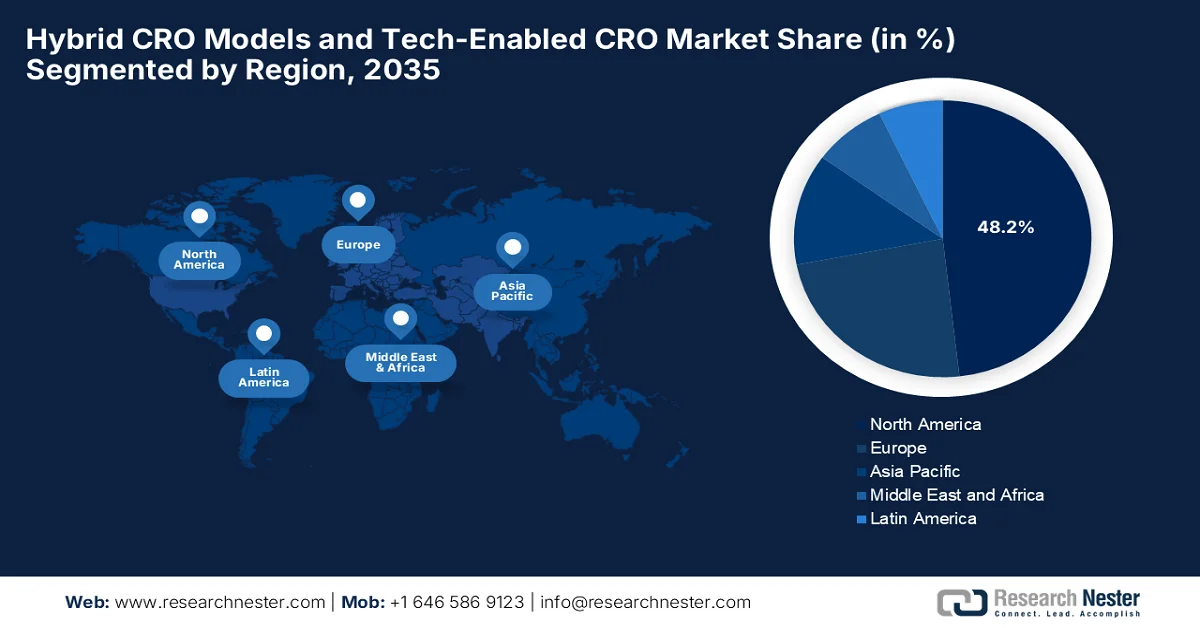
North America hybrid CRO models and tech-enabled CRO market is anticipated to garner the highest share of 48.2% by the conclusion of the forecast period. The region’s dominance is effectively propelled by the accelerating adoption of decentralized clinical trials and decentralized trial technologies. Pharmaceutical, biotechnology, and medical device companies are partnering with these technologically advanced CROs to streamline data management, optimize clinical workflows, and significantly reduce operational timelines. As per an article published by the National Institute of Health (NIH) in February 2025, its All of Us Research Program has expanded its dataset to include over 633,000 participants, which marks a 50% increase from the previous release. This particular update also boosts the genomic dataset by nearly 70%, wherein more than 414,000 whole genome sequences and 1.2 billion genetic variants were identified, including 200 million previously unreported.
Sponsors prioritize patient-centricity and decentralized clinical trial methodologies, which are the main factors driving the U.S. hybrid CRO models and tech-enabled CRO market. Instead of relying on legacy paper systems or siloed databases, tech-enabled CROs' deployment is focused on single-instance software ecosystems that synchronize electronic data capture with wearable sensor feeds in real-time. In June 2024, Thermo Fisher Scientific announced a total of USD 47.8 million expansion of its PPD clinical research laboratory operations in northern Kentucky, which is nearly doubling its footprint and creating over 250 jobs. This new 65,000-square-foot Covington facility will enhance sample management and biorepository capabilities, complementing its existing Highland Heights site. Hence, such instances reflect the increasing adoption of technology-enabled clinical research capabilities across the U.S. market.
In Canada, the market is showcasing immense growth, which is propelled by the country's unique geography and universal healthcare system, forcing a reliance on remote monitoring to reach dispersed populations. Most of the clinical centers are concentrated in distant urban hubs, and tech-enabled CROs in Canada focus heavily on overcoming geographic isolation through decentralized technologies that connect remote participants to centralized research networks. The country’s government in January 2023 announced its largest-ever investment in clinical trials, supporting one consortium, seven training platforms, and 22 research projects under the Biomanufacturing and Life Sciences Strategy. Besides, the USD 39 million Accelerating Clinical Trials Consortium will expand networks nationwide to improve collaboration and trial efficiency. In addition, over USD 32 million will fund training platforms to prepare the next generation of researchers, thus making it suitable for standard market growth.
APAC Market Insights
Asia Pacific hybrid CRO models and tech-enabled CRO market is projected to grow at the fastest rate from 2026 to 2035. The region’s upliftment in this field is highly propelled by diverse patient populations and an accelerating push toward digital healthcare infrastructure. The region relies on hybrid models to bridge the gap between sophisticated urban medical hubs and underserved rural communities, utilizing mobile health applications and localized telehealth to boost clinical trial recruitment and retention. Based on the government data, Australia’s Clinical Trials Activity initiative made a generous investment of USD 750 million over 10 years, which started in 2024–25 to expand national and international trial activity. This program focuses on rare cancers, rare diseases, and unmet needs, while also supporting investigator-led international trials and effective health interventions. Hence, such instances denote an encouraging opportunity for hybrid CRO models and tech-enabled CRO in the region.
A highly centralized digital ecosystem and a regulatory push toward domestic innovation in clinical development are certain factors responsibly boosting China hybrid CRO models and tech-enabled CRO market. The country’s tech-enabled CROs focus on navigating stringent data localization laws, ensuring all clinical trial data generated within the country is processed and stored on domestic servers. In November 2023, Senti Biosciences announced a strategic collaboration with Celest Therapeutics to advance the clinical development of SENTI-301A in China by targeting GPC3-expressing hepatocellular carcinoma. Under this agreement, Celest will lead clinical operations and manufacturing, with the first patient expected to be enrolled in 1H 2024, thus suitable for standard market growth.
In Japan, the hybrid CRO models and tech-enabled CRO market are being reshaped by a rapidly aging demographic and a deeply embedded traditional medical culture that is steadily adapting to digital healthcare. Hybrid models in Japan are highly focused on reducing the physical burden on elderly participants by utilizing home nursing visits paired with remote digital health technologies to maintain high compliance rates. As per an article published by the National Institute of Health (NIH) in November 2024, Japan’s Pharmaceuticals and Medical Devices Agency (PMDA) introduced new measures to reduce drug lag and drug loss by promoting multi-regional clinical trials and clarifying when Phase I studies in Japan’s subjects are not required. These updated guidelines allow earlier participation in MRCTs, particularly for rare diseases, pediatric conditions, and therapies with high unmet medical needs. The PMDA also established a consultation center to support orphan and pediatric drug development, thus denoting a positive market outlook.
Europe Market Insights
The Europe hybrid CRO models and tech-enabled CRO market is defined by a highly fragmented cross-border regulatory landscape as well as strict cross-border data protection frameworks. Hybrid models across the region are highly focused on harmonizing clinical workflows across diverse sovereign healthcare systems, utilizing decentralized technologies to pool patient cohorts from multiple countries, thereby accommodating localized language and medical practice requirements. As per an article published by NIH in May 2023, the new EU clinical trials regulation and the launch of the clinical trials information system have registered themselves as a major step toward transparency in clinical research. Besides, it streamlines trial authorization and mandates broader data disclosure, and the CTR aims to strengthen public trust, reduce duplication of trials, and support innovation through access to raw data for advanced analysis.
A deeply decentralized healthcare structure and exceptionally strict national data sovereignty laws are propelling the upliftment of Germany market. Tech-enabled CROs in the country need to navigate through rigorous federal data protection standards along with the scrutiny of state-level ethics committees, which demand the deployment of advanced data-masking techniques and localized cloud storage solutions. In May 2023, Bicycle Therapeutics announced a collaboration with the country’s Cancer Research Center (DKFZ) to advance wholly owned Bicycle radio conjugates for oncology. Preclinical studies have shown superior tumor uptake when compared to antibody-based approaches, and the alliance aims to accelerate candidates into clinical development. Hence, such instances boost the market growth by strengthening distributed, technology-enabled clinical development models that improve efficiency in transitioning from preclinical research to early clinical trials.
The UK hybrid CRO models and tech-enabled CRO market is growing remarkably on account of the close integration with the centralized National Health Service and a progressive regulatory stance on clinical innovation. Hybrid models in the UK leverage unified electronic health record databases across the NHS network to rapidly identify, screen, and recruit diverse patient cohorts from a single centralized data source. Consequently, the market is representing efficient public-private partnerships wherein the digital health platforms are designed to reduce the operational burden on overstretched hospital sites. In November 2023, AstraZeneca announced the launch of Evinova, which is a new health-tech business designed to accelerate innovation in clinical trials and improve patient outcomes. The company also outlined that Evinova will operate independently and will deliver globally scaled digital solutions already proven in AstraZeneca’s trials across 40 countries, reducing costs and timelines while easing burdens on health systems.
Key Hybrid CRO Models and Tech-Enabled CRO Market Players:
- IQVIA (U.S.)
- Labcorp Drug Development (U.S.)
- Thermo Fisher Scientific (U.S.)
- Syneos Health (U.S.)
- Parexel International (U.S.)
- Fortrea (U.S.)
- Medpace (U.S.)
- Charles River Laboratories (U.S.)
- ICON plc (Ireland)
- Ergomed plc (UK)
- SGS SA (Switzerland)
- Evotec SE (Germany)
- CMIC Holdings Co., Ltd. (Japan)
- EPS Holdings, Inc. (Japan)
- ObvioHealth (U.S.)
- Worldwide Clinical Trials (U.S.)
- Catalyst Clinical Research (U.S.)
- Shin Nippon Biomedical Laboratories (SNBL) (Japan)
- Novotech (Australia)
- LSK Global Pharma Services (South Korea)
- Lambda Therapeutic Research (India)
- Veeda Clinical Research (India)
- Clinical Research Malaysia (CRM) (Malaysia)
- Company Overview
- Business Strategy
- Key Product Offerings
- Financial Performance
- Key Performance Indicators
- Risk Analysis
- Recent Development
- SWOT Analysis
- IQVIA is the most dominant player, which is leveraging its real-world data assets and advanced analytics ecosystem. The company deliberately integrates AI-based patient recruitment, predictive trial modeling, and large-scale healthcare data platforms to support end-to-end clinical development.
- ICON plc has emerged as a strong hybrid trial leader with remarkable investments in terms of decentralized clinical trial infrastructure. The company is highly focused on hybrid site-virtual models, home healthcare services, and digital patient engagement tools.
- Labcorp Drug Development benefits from its integration with a large diagnostics network, which enables access to lab data and real-world clinical understandings. Besides, the company is expanding its decentralized trial capabilities and automation platforms, particularly in diagnostics-linked clinical research, allowing it a strong edge in precision medicine and oncology trials.
- Parexel International is a central force in this field, which focuses on flexible outsourcing models, particularly functional service provider and hybrid delivery structures. The company is making heavy investments in regulatory technology, AI-based document processing, and decentralized trial support systems.
- Syneos Health differentiates itself through a completely integrated biopharma solutions model that combines clinical development with commercialization services. In addition, the firm is embedding AI and advanced analytics into trial design, feasibility studies, and market access strategies.
Here is a list of key players operating in the global market:
The hybrid CRO models and tech-enabled CRO market is an extremely consolidated landscape that hosts global leaders such as IQVIA, ICON, and Labcorp, driving scale through integrated data platforms, AI-based trial optimization, and decentralized clinical trial capabilities. On the other hand, mid-tier and regional CROs such as CMIC, Novotech, and Lambda Therapeutic Research are expanding aggressively through niche therapeutic expertise as well as flexible hybrid models. Strategic collaborations, mergers & acquisitions, and AI-based automation are central aspects of this landscape. In March 2026, Thermo Fisher Scientific announced the completion of its USD 8.875 billion acquisition of Clario Holdings to integrate its endpoint data solutions into Thermo Fisher’s Laboratory Products and Biopharma Services segment. The deal enhances Thermo Fisher’s clinical research capabilities by enabling digital collection and analysis of patient data, supporting faster and more confident trial decisions.
Corporate Landscape of the Market:
Recent Developments
- In February 2026, ObvioHealth announced a tactical licensing agreement with Novotech to deploy its ObvioGo platform across multiple clinical trials. This collaboration enables Novotech to standardize participant-facing digital workflows, accelerate the study start-up, and ensure consistency across regions and therapeutic areas.
- In January 2026, Worldwide Clinical Trials entered a definitive agreement to acquire Catalyst Clinical Research to strengthen its oncology expertise and expand global site reach. This strategic combination positions Worldwide as a differentiated, oncology-focused CRO, thereby accelerating trial delivery and bringing therapies to patients more efficiently.
- Report ID: 8605
- Published Date: Jun 04, 2026
- Report Format: PDF, PPT
- Explore a preview of key market trends and insights
- Review sample data tables and segment breakdowns
- Experience the quality of our visual data representations
- Evaluate our report structure and research methodology
- Get a glimpse of competitive landscape analysis
- Understand how regional forecasts are presented
- Assess the depth of company profiling and benchmarking
- Preview how actionable insights can support your strategy
Explore real data and analysis
Frequently Asked Questions (FAQ)
About this Report
Connect with our Expert


Report, 2026-2035



Copyright @ 2026 Research Nester. All Rights Reserved.
