High Temperature Fiber Market Outlook:
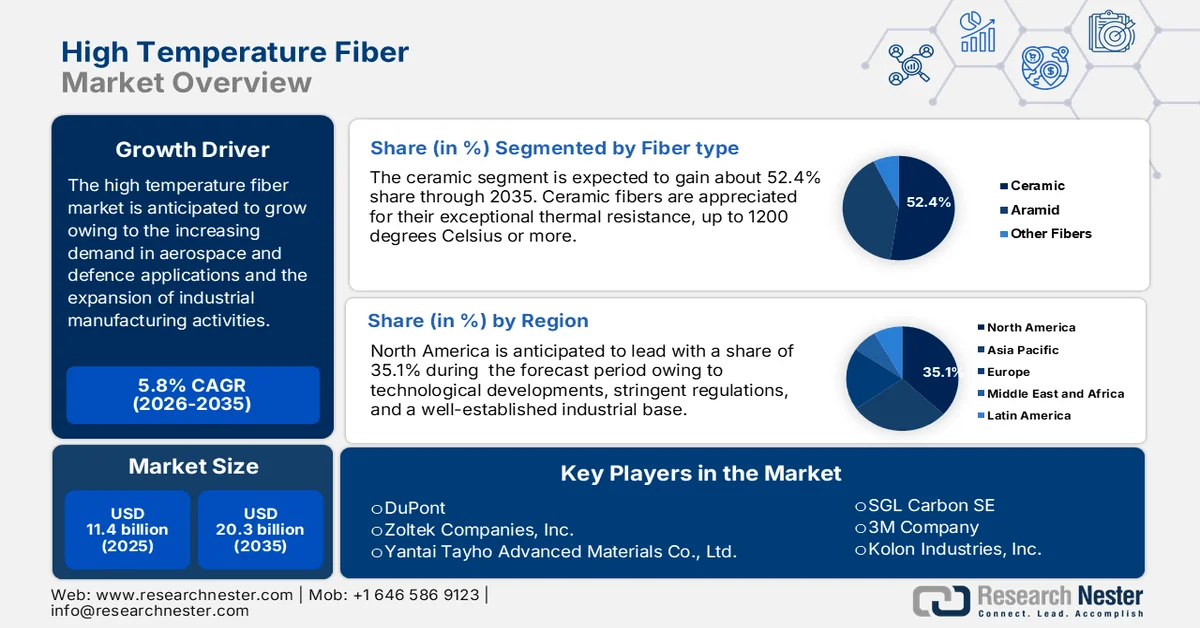
High Temperature Fiber Market size was over USD 11.4 billion in 2025 and is projected to reach USD 20.03 billion by 2035, growing at around 5.8% CAGR during the forecast period i.e., between 2026-2035. In the year 2026, the industry size of high temperature fiber is evaluated at USD 12 billion.
High temperature fibers such as carbon and aramid fibers offer outstanding mechanical strength and thermal stability while being suggestively lighter than traditional materials such as metals. This makes them ideal for applications wherever heat resistance and strength are required without adding extra weight. With the growth of electric vehicles (EVs), which demand efficient thermal management for battery systems, the usage of high temperatures fibers is becoming vital. These fibers help generate high heat by batteries and electric motors while reducing the vehicle’s weight, and improving performance. Companies such as Tesla and General Motors are progressively integrating lightweight, high temperature materials into their EV designs.
The rising demand for materials that can withstand extreme thermal conditions in industries such as aerospace, energy, automotive, manufacturing, and so on. For instance, in January 2023, NASA Artemis mission, purpose to human's first return to the lunar surface in more than 50 years. This includes spacecraft exposed to extreme heat temperatures throughout the launch and re-entry. High temperature fibers are critical for structural components and insulation in these missions safeguarding that spacecraft and their systems function effectively without degradation.
Key High Temperature Fiber Market Insights Summary:
Regional Highlights:
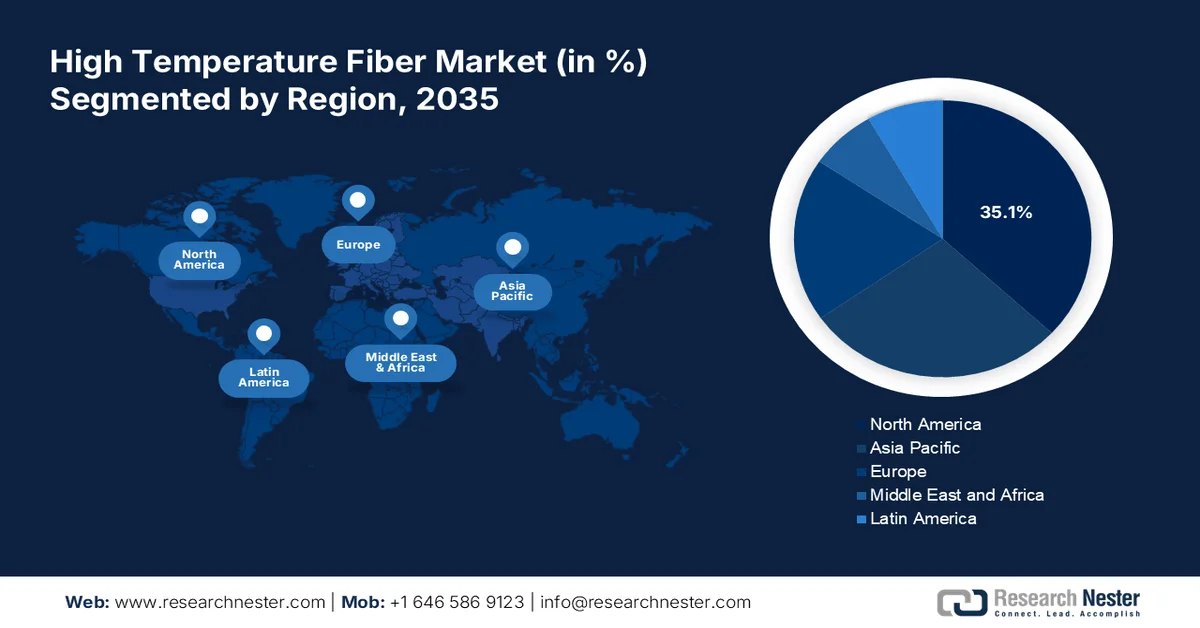
- North America is poised to secure over 35.1% revenue share of the high temperature fiber market by 2035, impelled by technological advancements, rigorous environmental regulations, and a well-established industrial base emphasizing worker safety standards.
- Asia Pacific is expected to witness a stable CAGR during the forecast period 2026–2035, stimulated by expanding infrastructure development, accelerating industrialization, and robust growth across aerospace and automotive sectors.
Segment Insights:
- The Ceramic segment is projected to account for over 52.4% of the high temperature fiber market share by 2035, propelled by rising demand for advanced thermal insulation solutions supported by the development of low bio-persistent fibers enhancing regulatory compliance.
- The Straight Form segment is anticipated to capture around 46.6% revenue share by 2035, driven by its widespread adoption in aerospace and automotive applications requiring precision and consistent heat resistance.
Key Growth Trends:
- Growing demand in aerospace and defense applications
- Expansion of industrial manufacturing activities
Major Challenges:
- Restricted availability of raw materials
- Achieving uniform fiber properties
Key Players: Excelerate Energy, Inc., New Fortress Energy Inc., HÖEGH LNG AS, Samsung Heavy Industries, and Cedar LNG Partners LP.
Global High Temperature Fiber Market Forecast and Regional Outlook:
Market Size & Growth Projections:
- 2025 Market Size: USD 11.4 billion
- 2026 Market Size: USD 12 billion
- Projected Market Size: USD 20.03 billion by 2035
- Growth Forecasts: 5.8% CAGR (2026-2035)
Key Regional Dynamics:
- Largest Region: North America (35.1% Share by 2035)
- Fastest Growing Region: Asia Pacific
- Dominating Countries: United States, Japan, Germany, China, South Korea
- Emerging Countries: China, Japan, South Korea, India, Germany
Last updated on : 25 February, 2026
High Temperature Fiber Market - Growth Drivers and Challenges
Growth Drivers
- Growing demand in aerospace and defense applications: High temperature fibers are important for components that are exposed to high heat and mechanical stress including fuselage components, protective gear, aircraft engines, and missile casings. The ability of these fibers to endure temperatures beyond 300 degrees Celsius along with their lightweight properties makes them ideal for modern aerospace and defense technologies.
In aerospace applications, the growing adoption of fuel-efficient and light-weight aircraft is boosting the usage of advanced materials. High temperature fibers are crucial for manufacturing components such as heat shields, structural panels, and turbine blades which face extreme temperatures during engine operation and flight. The advancement of hypersonic and supersonic aircraft which were exposed to high temperatures owing to air resistance and friction at extreme speeds has increased the demand for these materials. Companies such as Hermeus and Boom Supersonic are leading supersonic jet designs that rely on high temperature fibers for optimal performance.
In defense applications, temperature-resistant fibers play an important role in improving the performance and protection of military equipment. For example, aramid fibers such as Kevlar are widely used in helmets, body armor, and other personal protective equipment owing to their high heat and ballistic resistance. In April 2023, DuPont declared plans to expand its aramid fiber manufacturing capacity for Kelar at its Richmond, Virginia facility to meet rising demand in aerospace, defense, and industrial applications. - Expansion of industrial manufacturing activities: High temperature fibers such as polyphenylene sulfide (PPS) and aramid fibers are extensively used in filtration systems, particularly in industries dealing with gases, molten metals, and chemicals. For instance, in June 2023, Kureha Corporation announced a new heat-resistant PPS fiber exactly designed for industrial filtration systems, reflecting the ongoing invention in this field. EV generates substantial heat in their power systems and batteries necessitating materials that can handle high temperatures without compromising performance. For example, Zoltek Companies Inc., expanded its carbon fiber production to meet the increasing needs of the automotive sector when carbon fiber composites are used for heat-resistant and lightweight components such as motor insulation and battery casings.
Challenges
- Restricted availability of raw materials: As it directly impacts supply chain stability, production costs, and High temperature fiber market growth. Several high temperature fibers such as carbon, aramid, and ceramic fibers rely on specialized raw materials that are not only expensive, but also subject to supply restrictions due to mining regulations, geopolitical tensions, and environmental concerns. For example, carbon fibers require polyacrylonitrile (PAN) while aramid fibers rely on petrochemical-derived products both of which are contingent on fluctuations in availability and price owing to the volatility of oil markets.
The energy crisis due to geopolitical tensions has exacerbated the raw material shortages for industries dependent on oil and gas derivatives. High temperature fiber production particularly carbon and aramid fibers which rely on petrochemical-based raw materials has been impacted. In 2023, the European Chemical Industry Council (Cefic) warned that natural gas shortages in Europe were causing a ripple effect across chemical supply chains which led to higher production costs for aramid and carbon fiber manufacturers. - Achieving uniform fiber properties: Producing fibers with uniform thermal, chemical, and mechanical properties is difficult owing to the complexity of the manufacturing process, variability in raw material quality, and the necessity for precise control over production parameters. In July 2023, Hexcel Corporation reported production delays for a major aerospace contract owing to issues with uniformity in its high temperature carbon fiber materials. The company cited difficulties in maintaining consistent fiber properties across different production batches leading to increased costs and time-consuming quality control measures. This has led to a ripple effect; an inconsistent fiber can lead to defects in fiber composite products used in critical aerospace components such as turbine blades and fuselage structures.
High Temperature Fiber Market Size and Forecast:
| Report Attribute | Details |
|---|---|
|
Base Year |
2025 |
|
Forecast Year |
2026-2035 |
|
CAGR |
5.8% |
|
Base Year Market Size (2025) |
USD 11.4 billion |
|
Forecast Year Market Size (2035) |
USD 20.03 billion |
|
Regional Scope |
|
High Temperature Fiber Market Segmentation:
Fiber Type (Ceramic, Aramid, Other Fibers)
Ceramic segment is expected to account for high temperature fiber market share of more than 52.4% by the end of 2035. Ceramic fibers are valued for their exceptional thermal resistance, up to 1200 degrees Celsius or more. They are broadly used in automotive, aerospace, and power generation industries, where high-temperature insulation is critical. For example, manufacturers have been evolving low bio-persistent (LBP) ceramic fibers, which have decreased the health risks and enhanced environmental compliance, particularly in North America and Europe where strict health and safety regulations are being imposed. This shift is projected to boost demand for ceramic fibers in several industrial applications.
Form (Straight Form, Deformed Form, Hooked Form, Other Form)
In high temperature fiber market, straight form segment is projected to capture revenue share of around 46.6% by the end of 2035. Straight form fibers recognized for their ease of use and uniformity are heavily used in industrial materials, particularly in the aerospace and automotive industries where precision and consistency in heat resistance are vital.
In response to rising environmental concerns, manufacturers have been advancing sustainable straight form fibers. For example, Insul-Fab declared the launch of eco-friendly straight form fibers made from recyclable materials precisely targeting industries requiring greener high temperature insulation solutions. This inclination aligns with the growing global demand for sustainable products mainly in regions with strict environmental regulations such as the European Union.
Our in-depth analysis of the high temperature fiber market includes the following segments
|
Fiber Type
|
|
|
Form |
|
|
Application |
|

Vishnu Nair
Head - Global Business DevelopmentCustomize this report to your requirements — connect with our consultant for personalized insights and options.
High Temperature Fiber Market - Regional Analysis
North America Market Analysis
North America in high temperature fiber market is poised to capture over 35.1% revenue share by 2035 owing to technological development, stringent regulations, and a well-established industrial base regarding environmental standards and worker safety.
The U.S. is a major contributor to the high temperature fiber market due to high demand from sectors such as aerospace, automotive, defense, and energy. The growing adoption of high temperature ceramic and aramid fibers in advanced defense applications such as heat-resistant gear and body armor as well as in the aerospace industry for thermal insulation.
In Canada, the High temperature fiber market is expected to register rapid revenue CAGR between 2026 and 2035 owing to rising demand for materials that can withstand extreme temperatures in automobiles, aerospace, and other industrial sectors, and high focus on producing eco-friendly products and solutions.
Asia Pacific Market Analysis
Asia Pacific High temperature fiber market is expected to experience a stable CAGR during the forecast period due to increasing infrastructure, rapid industrialization, and growing aerospace and automotive sectors. China, India, South Korea and Japan are some of the largest revenue-generating countries in the APAC. Key players in the region are focused on developing advanced products by investing in R&D activities and adopting strategic alliances to partner with other companies.
China leads in the production of high temperature fiber market mainly for use in high performance textiles, automotive, and construction applications. In October 2024, China saw substantial investments in manufacturing high temperature aramid and basalt fibers with applications in renewable energy has exceeded USD 100 billion.
Japan has been concentrating on high temperature fiber inventions for automotive and aerospace applications driven by the country's reputation for technological management. For example, in October 2023, Mitsubishi Chemical extended its carbon fiber production capacity in Japan to cater to rising demand from the wind energy and aerospace sectors. This extension also includes progressions in fiber recycling technologies.
High Temperature Fiber Market Players:
- DuPont
- Company Overview
- Business Strategy
- Key Product Offerings
- Financial Performance
- Key Performance Indicators
- Risk Analysis
- Recent Development
- Regional Presence
- SWOT Analysis
- 3M Company
- Zoltek Companies, Inc.
- SGL Carbon SE
- Kolon Industries, Inc.
- Yantai Tayho Advanced Materials Co., Ltd.
The global high temperature fiber market is highly competitive, comprising key players operating at global and regional levels. These companies are focused on enhancing their product base and global presence with several strategic alliances such as partnerships, innovation, and expansion into developing markets. These companies are heavily capitalizing on research and development to introduce progressive high temperature fibers with enhanced durability sustainability and thermal resistance.
Here are some leading players in the high temperature fiber market:
Recent Developments
- In June 2023, Actelis Networks, Inc. announced the launch of nine new high-performance 10gbps fiber optic product series.
- In April 2023, Toray Group recognized circular economy as an important issue under its Medium-Term Management Program, Project AP-G 2022. A good example of Toray Industries has been set by companies of Toray group in Japan propagating the circular economy concept in Malaysia.
- Report ID: 6652
- Published Date: Feb 25, 2026
- Report Format: PDF, PPT
- Explore a preview of key market trends and insights
- Review sample data tables and segment breakdowns
- Experience the quality of our visual data representations
- Evaluate our report structure and research methodology
- Get a glimpse of competitive landscape analysis
- Understand how regional forecasts are presented
- Assess the depth of company profiling and benchmarking
- Preview how actionable insights can support your strategy
Explore real data and analysis
Frequently Asked Questions (FAQ)
About this Report
Connect with our Expert


Report, 2026-2035



Copyright @ 2026 Research Nester. All Rights Reserved.
