Global High Speed Blower Market
- An Outline of the Global High Speed Blower Market
- Market Definition and Segmentation
- Study Assumptions and Abbreviations
- Research Methodology & Approach
- Primary Research
- Secondary Research
- Data Triangulation
- SPSS Methodology
- Executive Summary
- Growth Drivers
- Major Roadblocks
- Opportunities
- Prevalent Trends
- Government Regulation
- Growth Outlook
- Competitive White Space Analysis – Identifying Untapped Market Gaps
- Risk Overview
- SWOT
- Technological Advancement
- Technology Maturity Matrix for High Speed Blower
- Recent News
- Regional Demand
- Global High Speed Blower by Geography – Strategic Comparative Analysis
- Strategic Segment Analysis: High Speed Blower Demand Landscape
- Global High Speed Blower Demand Trends Driven by Sustainability, Veganism and Long Lasting Impact (2026-2036)
- Root Cause Analysis (RCA) for discovering problems of the High Speed Blower Porter Five Forces
- PESTLE
- Comparative Positioning
- High Speed Blower– Key Player Analysis (2036)
- Competitive Landscape: Key Suppliers/Players
- Competitive Model: A Detailed Inside View for Investors
- Company Market Share, 2036 (%)
- Business Profile of Key Enterprise
- Aerzener Maschinenfabrik GmbH
- APG-Neuros
- Atlas Copco AB
- Fuji Electric Corp. of America
- Gardner Denver (Ingersoll Rand)
- Hitachi Industrial Products, Ltd
- Piller Blowers & Compressors GmbH
- RAETTS Intelligent Equipment (Guangdong) Co., Ltd
- Sulzer Ltd
- SHANDONG ZHANGQIU BLOWER CO., LTD
- Business Profile of Key Enterprise
- Global High Speed Blower Market Outlook
- Market Overview
- Market Revenue by Value (USD Thousand), Volume (Thousand Tons), and Compound Annual Growth Rate (CAGR)
- Global Segmentation High Speed Blower Analysis (2026-2036)
- By Technology
- Airfoil Bearing, Market Value (USD Thousand), and CAGR, 2026-2036F
- Magnetic Bearing, Market Value (USD Thousand), and CAGR, 2026-2036F
- Gear Driven Turbo, Market Value (USD Thousand), and CAGR, 2026-2036F
- By Volume Flow
- Up to 1,000 m³/h, Market Value (USD Thousand), and CAGR, 2026-2036F
- 1,000 – 10,000 m³/h, Market Value (USD Thousand), and CAGR, 2026-2036F
- 10,000 – 15,000 m³/h, Market Value (USD Thousand), and CAGR, 2026-2036F
- 15,000 – 20,000 m³/h, Market Value (USD Thousand), and CAGR, 2026-2036F
- 20,000 – 30,000 m³/h, Market Value (USD Thousand), and CAGR, 2026-2036F
- By Pressure
- (< 0.5 bar, Market Value (USD Thousand), and CAGR, 2026-2036F
- 0.5 – 1 bar, Market Value (USD Thousand), and CAGR, 2026-2036F
- 1 – 1.3 bar, Market Value (USD Thousand), and CAGR, 2026-2036F
- 1.3 – 4 bars, Market Value (USD Thousand), and CAGR, 2026-2036F
- 4 – 10 bars, Market Value (USD Thousand), and CAGR, 2026-2036F
- By Application
- Wastewater Aeration, Market Value (USD Thousand), and CAGR, 2026-2036F
- HVAC / Building Pressurization, Market Value (USD Thousand), and CAGR, 2026-2036F
- Pneumatic Conveying (Light Solids), Market Value (USD Thousand), and CAGR, 2026-2036F
- Combustion/Boiler Support, Market Value (USD Thousand), and CAGR, 2026-2036F
- Industrial Process Air (Drying, Heat-treat), Market Value (USD Thousand), and CAGR, 2026-2036F
- Others, Market Value (USD Thousand), and CAGR, 2026-2036F
- Regional Synopsis, Value (USD Thousand), 2026-2036
- North America Market Value (USD Thousand) and CAGR & Y-o-Y Growth Trend, 2026-2036F
- Europe Market Value (USD Thousand) and CAGR & Y-o-Y Growth Trend, 2026-2036F
- Asia Pacific Market Value (USD Thousand) and CAGR & Y-o-Y Growth Trend, 2026-2036F
- Latin America Market Value (USD Thousand) and CAGR & Y-o-Y Growth Trend, 2026-2036F
- Middle East and Africa Market Value (USD Thousand) and CAGR & Y-o-Y Growth Trend, 2026-2036F
- By Technology
- Market Overview
- North America Market
- Overview
- Market Value (USD Thousand), Current and Future Projections, 2026-2036
- Increment $ Opportunity Assessment, 2026-2036
- Segmentation (USD Thousand), 2026-2036, By
- By Technology
- Airfoil Bearing, Market Value (USD Thousand), and CAGR, 2026-2036F
- Magnetic Bearing, Market Value (USD Thousand), and CAGR, 2026-2036F
- Gear Driven Turbo, Market Value (USD Thousand), and CAGR, 2026-2036F
- By Volume Flow
- Up to 1,000 m³/h, Market Value (USD Thousand), and CAGR, 2026-2036F
- 1,000 – 10,000 m³/h, Market Value (USD Thousand), and CAGR, 2026-2036F
- 10,000 – 15,000 m³/h, Market Value (USD Thousand), and CAGR, 2026-2036F
- 15,000 – 20,000 m³/h, Market Value (USD Thousand), and CAGR, 2026-2036F
- 20,000 – 30,000 m³/h, Market Value (USD Thousand), and CAGR, 2026-2036F
- By Pressure
- (< 0.5 bar, Market Value (USD Thousand), and CAGR, 2026-2036F
- 0.5 – 1 bar, Market Value (USD Thousand), and CAGR, 2026-2036F
- 1 – 1.3 bar, Market Value (USD Thousand), and CAGR, 2026-2036F
- 1.3 – 4 bars, Market Value (USD Thousand), and CAGR, 2026-2036F
- 4 – 10 bars, Market Value (USD Thousand), and CAGR, 2026-2036F
- By Application
- Wastewater Aeration, Market Value (USD Thousand), and CAGR, 2026-2036F
- HVAC / Building Pressurization, Market Value (USD Thousand), and CAGR, 2026-2036F
- Pneumatic Conveying (Light Solids), Market Value (USD Thousand), and CAGR, 2026-2036F
- Combustion/Boiler Support, Market Value (USD Thousand), and CAGR, 2026-2036F
- Industrial Process Air (Drying, Heat-treat), Market Value (USD Thousand), and CAGR, 2026-2036F
- Others, Market Value (USD Thousand), and CAGR, 2026-2036F
- Country Level Analysis, Value (USD Thousand)
- U.S. Market Value (USD Thousand) and CAGR & Y-o-Y Growth Trend, 2026-2036F
- Canada Market Value (USD Thousand) and CAGR & Y-o-Y Growth Trend, 2026-2036F
- By Technology
- Overview
- Europe Market
- Overview
- Market Value (USD Thousand), Current and Future Projections, 2026-2036
- Increment $ Opportunity Assessment, 2026-2036
- Segmentation (USD Thousand), 2026-2036, By
- By Technology
- Airfoil Bearing, Market Value (USD Thousand), and CAGR, 2026-2036F
- Magnetic Bearing, Market Value (USD Thousand), and CAGR, 2026-2036F
- Gear Driven Turbo, Market Value (USD Thousand), and CAGR, 2026-2036F
- By Volume Flow
- Up to 1,000 m³/h, Market Value (USD Thousand), and CAGR, 2026-2036F
- 1,000 – 10,000 m³/h, Market Value (USD Thousand), and CAGR, 2026-2036F
- 10,000 – 15,000 m³/h, Market Value (USD Thousand), and CAGR, 2026-2036F
- 15,000 – 20,000 m³/h, Market Value (USD Thousand), and CAGR, 2026-2036F
- 20,000 – 30,000 m³/h, Market Value (USD Thousand), and CAGR, 2026-2036F
- By Pressure
- (< 0.5 bar, Market Value (USD Thousand), and CAGR, 2026-2036F
- 0.5 – 1 bar, Market Value (USD Thousand), and CAGR, 2026-2036F
- 1 – 1.3 bar, Market Value (USD Thousand), and CAGR, 2026-2036F
- 1.3 – 4 bars, Market Value (USD Thousand), and CAGR, 2026-2036F
- 4 – 10 bars, Market Value (USD Thousand), and CAGR, 2026-2036F
- By Application
- Wastewater Aeration, Market Value (USD Thousand), and CAGR, 2026-2036F
- HVAC / Building Pressurization, Market Value (USD Thousand), and CAGR, 2026-2036F
- Pneumatic Conveying (Light Solids), Market Value (USD Thousand), and CAGR, 2026-2036F
- Combustion/Boiler Support, Market Value (USD Thousand), and CAGR, 2026-2036F
- Industrial Process Air (Drying, Heat-treat), Market Value (USD Thousand), and CAGR, 2026-2036F
- Others, Market Value (USD Thousand), and CAGR, 2026-2036F
- Country Level Analysis, Value (USD Thousand)
- UK Market Value (USD Thousand) and CAGR & Y-o-Y Growth Trend, 2026-2036F
- Germany Market Value (USD Thousand) and CAGR & Y-o-Y Growth Trend, 2026-2036F
- France Market Value (USD Thousand) and CAGR & Y-o-Y Growth Trend, 2026-2036F
- Italy Market Value (USD Thousand) and CAGR & Y-o-Y Growth Trend, 2026-2036F
- Spain Market Value (USD Thousand) and CAGR & Y-o-Y Growth Trend, 2026-2036F
- Netherlands Market Value (USD Thousand) and CAGR & Y-o-Y Growth Trend, 2026-2036F
- Russia Market Value (USD Thousand) and CAGR & Y-o-Y Growth Trend, 2026-2036F
- Switzerland Market Value (USD Thousand) and CAGR & Y-o-Y Growth Trend, 2026-2036F
- Poland Market Value (USD Thousand) and CAGR & Y-o-Y Growth Trend, 2026-2036F
- Belgium Market Value (USD Thousand) and CAGR & Y-o-Y Growth Trend, 2026-2036F
- Rest of Europe Market Value (USD Thousand) and CAGR & Y-o-Y Growth Trend, 2026-2036F
- By Technology
- Overview
- Asia Pacific excluding Japan Market
- Overview
- Market Value (USD Thousand), Current and Future Projections, 2026-2036
- Increment $ Opportunity Assessment, 2026-2036
- Segmentation (USD Thousand), 2026-2036, By
- By Technology
- Airfoil Bearing, Market Value (USD Thousand), and CAGR, 2026-2036F
- Magnetic Bearing, Market Value (USD Thousand), and CAGR, 2026-2036F
- Gear Driven Turbo, Market Value (USD Thousand), and CAGR, 2026-2036F
- By Volume Flow
- Up to 1,000 m³/h, Market Value (USD Thousand), and CAGR, 2026-2036F
- 1,000 – 10,000 m³/h, Market Value (USD Thousand), and CAGR, 2026-2036F
- 10,000 – 15,000 m³/h, Market Value (USD Thousand), and CAGR, 2026-2036F
- 15,000 – 20,000 m³/h, Market Value (USD Thousand), and CAGR, 2026-2036F
- 20,000 – 30,000 m³/h, Market Value (USD Thousand), and CAGR, 2026-2036F
- By Pressure
- (< 0.5 bar, Market Value (USD Thousand), and CAGR, 2026-2036F
- 0.5 – 1 bar, Market Value (USD Thousand), and CAGR, 2026-2036F
- 1 – 1.3 bar, Market Value (USD Thousand), and CAGR, 2026-2036F
- 1.3 – 4 bars, Market Value (USD Thousand), and CAGR, 2026-2036F
- 4 – 10 bars, Market Value (USD Thousand), and CAGR, 2026-2036F
- By Application
- Wastewater Aeration, Market Value (USD Thousand), and CAGR, 2026-2036F
- HVAC / Building Pressurization, Market Value (USD Thousand), and CAGR, 2026-2036F
- Pneumatic Conveying (Light Solids), Market Value (USD Thousand), and CAGR, 2026-2036F
- Combustion/Boiler Support, Market Value (USD Thousand), and CAGR, 2026-2036F
- Industrial Process Air (Drying, Heat-treat), Market Value (USD Thousand), and CAGR, 2026-2036F
- Others, Market Value (USD Thousand), and CAGR, 2026-2036F
- Country Level Analysis, Value (USD Thousand)
- China Market Value (USD Thousand) and CAGR & Y-o-Y Growth Trend, 2026-2036F
- India Market Value (USD Thousand) and CAGR & Y-o-Y Growth Trend, 2026-2036F
- South Korea Market Value (USD Thousand) and CAGR & Y-o-Y Growth Trend, 2026-2036F
- Australia Market Value (USD Thousand) and CAGR & Y-o-Y Growth Trend, 2026-2036F
- Indonesia Market Value (USD Thousand) and CAGR & Y-o-Y Growth Trend, 2026-2036F
- Malaysia Market Value (USD Thousand) and CAGR & Y-o-Y Growth Trend, 2026-2036F
- Vietnam Market Value (USD Thousand) and CAGR & Y-o-Y Growth Trend, 2026-2036F
- Thailand Market Value (USD Thousand) and CAGR & Y-o-Y Growth Trend, 2026-2036F
- Singapore Market Value (USD Thousand) and CAGR & Y-o-Y Growth Trend, 2026-2036F
- New Zealand Market Value (USD Thousand) and CAGR & Y-o-Y Growth Trend, 2026-2036F
- Rest of Asia Pacific Excluding Japan Market Value (USD Thousand) and CAGR & Y-o-Y Growth Trend, 2026-2036F
- By Technology
- Overview
- Latin America Market
- Overview
- Market Value (USD Thousand), Current and Future Projections, 2026-2036
- Increment $ Opportunity Assessment, 2026-2036
- Year-on-Year Growth Forecast (%)
- Segmentation (USD Thousand), 2026-2036, By
- By Technology
- Airfoil Bearing, Market Value (USD Thousand), and CAGR, 2026-2036F
- Magnetic Bearing, Market Value (USD Thousand), and CAGR, 2026-2036F
- Gear Driven Turbo, Market Value (USD Thousand), and CAGR, 2026-2036F
- By Volume Flow
- Up to 1,000 m³/h, Market Value (USD Thousand), and CAGR, 2026-2036F
- 1,000 – 10,000 m³/h, Market Value (USD Thousand), and CAGR, 2026-2036F
- 10,000 – 15,000 m³/h, Market Value (USD Thousand), and CAGR, 2026-2036F
- 15,000 – 20,000 m³/h, Market Value (USD Thousand), and CAGR, 2026-2036F
- 20,000 – 30,000 m³/h, Market Value (USD Thousand), and CAGR, 2026-2036F
- By Pressure
- (< 0.5 bar, Market Value (USD Thousand), and CAGR, 2026-2036F
- 0.5 – 1 bar, Market Value (USD Thousand), and CAGR, 2026-2036F
- 1 – 1.3 bar, Market Value (USD Thousand), and CAGR, 2026-2036F
- 1.3 – 4 bars, Market Value (USD Thousand), and CAGR, 2026-2036F
- 4 – 10 bars, Market Value (USD Thousand), and CAGR, 2026-2036F
- By Application
- Wastewater Aeration, Market Value (USD Thousand), and CAGR, 2026-2036F
- HVAC / Building Pressurization, Market Value (USD Thousand), and CAGR, 2026-2036F
- Pneumatic Conveying (Light Solids), Market Value (USD Thousand), and CAGR, 2026-2036F
- Combustion/Boiler Support, Market Value (USD Thousand), and CAGR, 2026-2036F
- Industrial Process Air (Drying, Heat-treat), Market Value (USD Thousand), and CAGR, 2026-2036F
- Others, Market Value (USD Thousand), and CAGR, 2026-2036F
- Country Level Analysis, Value (USD Thousand)
- Brazil Market Value (USD Thousand) and CAGR & Y-o-Y Growth Trend, 2026-2036F
- Argentina Market Value (USD Thousand) and CAGR & Y-o-Y Growth Trend, 2026-2036F
- Mexico Market Value (USD Thousand) and CAGR & Y-o-Y Growth Trend, 2026-2036F
- Rest of Latin America Market Value (USD Thousand) and CAGR & Y-o-Y Growth Trend, 2026-2036F
- By Technology
- Overview
- Middle East & Africa Market
- Overview
- Market Value (USD Thousand), Current and Future Projections, 2026-2036
- Increment $ Opportunity Assessment, 2026-2036
- Year-on-Year Growth Forecast (%)
- Segmentation (USD Thousand), 2026-2036, By
- By Technology
- Airfoil Bearing, Market Value (USD Thousand), and CAGR, 2026-2036F
- Magnetic Bearing, Market Value (USD Thousand), and CAGR, 2026-2036F
- Gear Driven Turbo, Market Value (USD Thousand), and CAGR, 2026-2036F
- By Volume Flow
- Up to 1,000 m³/h, Market Value (USD Thousand), and CAGR, 2026-2036F
- 1,000 – 10,000 m³/h, Market Value (USD Thousand), and CAGR, 2026-2036F
- 10,000 – 15,000 m³/h, Market Value (USD Thousand), and CAGR, 2026-2036F
- 15,000 – 20,000 m³/h, Market Value (USD Thousand), and CAGR, 2026-2036F
- 20,000 – 30,000 m³/h, Market Value (USD Thousand), and CAGR, 2026-2036F
- By Pressure
- (< 0.5 bar, Market Value (USD Thousand), and CAGR, 2026-2036F
- 0.5 – 1 bar, Market Value (USD Thousand), and CAGR, 2026-2036F
- 1 – 1.3 bar, Market Value (USD Thousand), and CAGR, 2026-2036F
- 1.3 – 4 bars, Market Value (USD Thousand), and CAGR, 2026-2036F
- 4 – 10 bars, Market Value (USD Thousand), and CAGR, 2026-2036F
- By Application
- Wastewater Aeration, Market Value (USD Thousand), and CAGR, 2026-2036F
- HVAC / Building Pressurization, Market Value (USD Thousand), and CAGR, 2026-2036F
- Pneumatic Conveying (Light Solids), Market Value (USD Thousand), and CAGR, 2026-2036F
- Combustion/Boiler Support, Market Value (USD Thousand), and CAGR, 2026-2036F
- Industrial Process Air (Drying, Heat-treat), Market Value (USD Thousand), and CAGR, 2026-2036F
- Others, Market Value (USD Thousand), and CAGR, 2026-2036F
- Country Level Analysis, Value (USD Thousand)
- Saudi Arabia Market Value (USD Thousand) and CAGR & Y-o-Y Growth Trend, 2026-2036F
- UAE Market Value (USD Thousand) and CAGR & Y-o-Y Growth Trend, 2026-2036F
- Israel Market Value (USD Thousand) and CAGR & Y-o-Y Growth Trend, 2026-2036F
- Qatar Market Value (USD Thousand) and CAGR & Y-o-Y Growth Trend, 2026-2036F
- Kuwait Market Value (USD Thousand) and CAGR & Y-o-Y Growth Trend, 2026-2036F
- Oman Market Value (USD Thousand) and CAGR & Y-o-Y Growth Trend, 2026-2036F
- South Africa Market Value (USD Thousand) and CAGR & Y-o-Y Growth Trend, 2026-2036F
- Rest of Middle East & Africa Market Value (USD Thousand) and CAGR & Y-o-Y Growth Trend, 2026-2036F
- By Technology
- Overview
- Global Economic Scenario
- World Economic Outlook
- About Research Nester
- Our Global Clientele
- We Serve Clients Across World
High Speed Blowers Market Outlook:
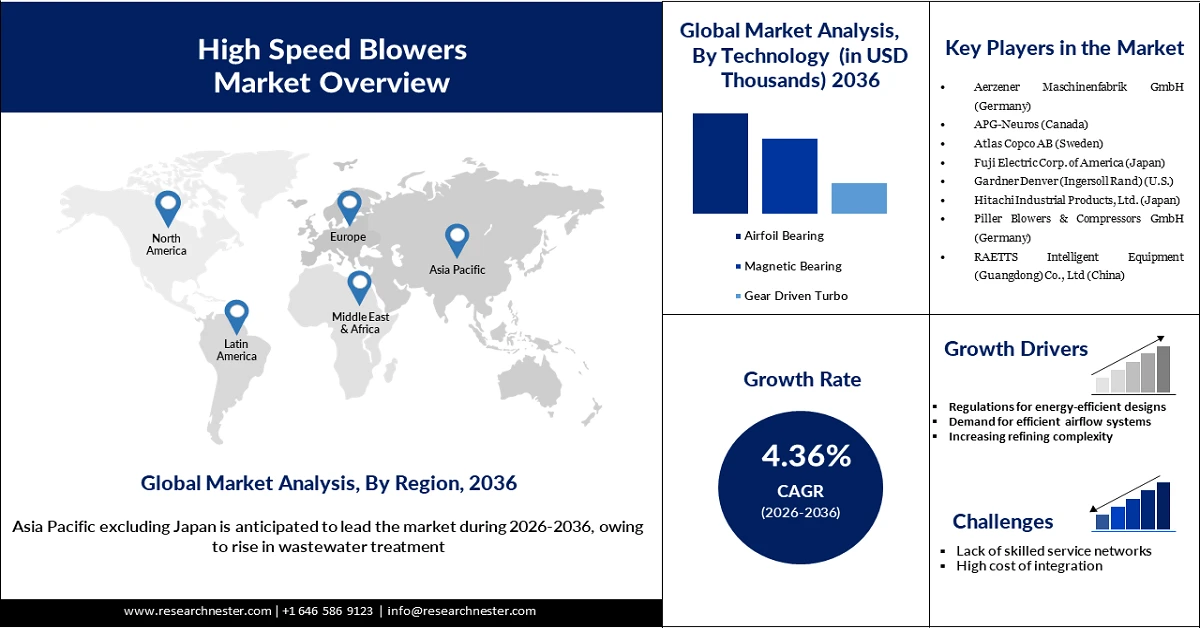
High Speed Blowers Market size is valued at USD 852.59 million in 2025 and is expected to grow to USD 1.35 billion by the end of 2036, registering at a CAGR of 4.36% during the forecast period, i.e., 2026-2036. In 2026, the industry size of high speed blowers is assessed at USD 882.51 million.
Rapid industrialization in emerging economies is driving the growth of the high speed blowers market, as manufacturing plants and warehouses increasingly deploy these systems to improve ventilation and maintain adequate oxygen levels within facilities. Ventilation is recognized by regulatory bodies such as the U.S. Occupational Safety and Health Administration (OSHA) as one of the most important engineering controls for maintaining air quality in industrial work environments, particularly where airborne contaminants are present. Effective ventilation systems are mandated under OSHA standards like 29 CFR 1910.94 for general industry and 29 CFR 1926.57 for construction, which specify minimum exhaust airflow volumes and air exchange criteria to control dusts, fumes, mists, vapors, and gases. For example, in local exhaust systems used for grinding operations, minimum exhaust air volumes and duct velocities are defined to ensure contaminants are effectively removed, and worker exposure limits are not exceeded.
In manufacturing units, high-capacity HVAC systems use high-speed blowers to deliver sufficient airflow and regulate temperature effectively, while also meeting these regulatory airflow standards. In chemical manufacturing in particular, HVAC systems play a critical role not only in enhancing internal air circulation but also in removing hazardous gases through engineered ventilation. High-speed ventilation blowers generate the strong suction needed to maintain proper airflows and ensure that toxic substances are efficiently extracted from workspaces in accordance with engineering controls recognized by OSHA and industrial ventilation manuals.
Key High Speed Blowers Market Insights Summary:
Regional Highlights:
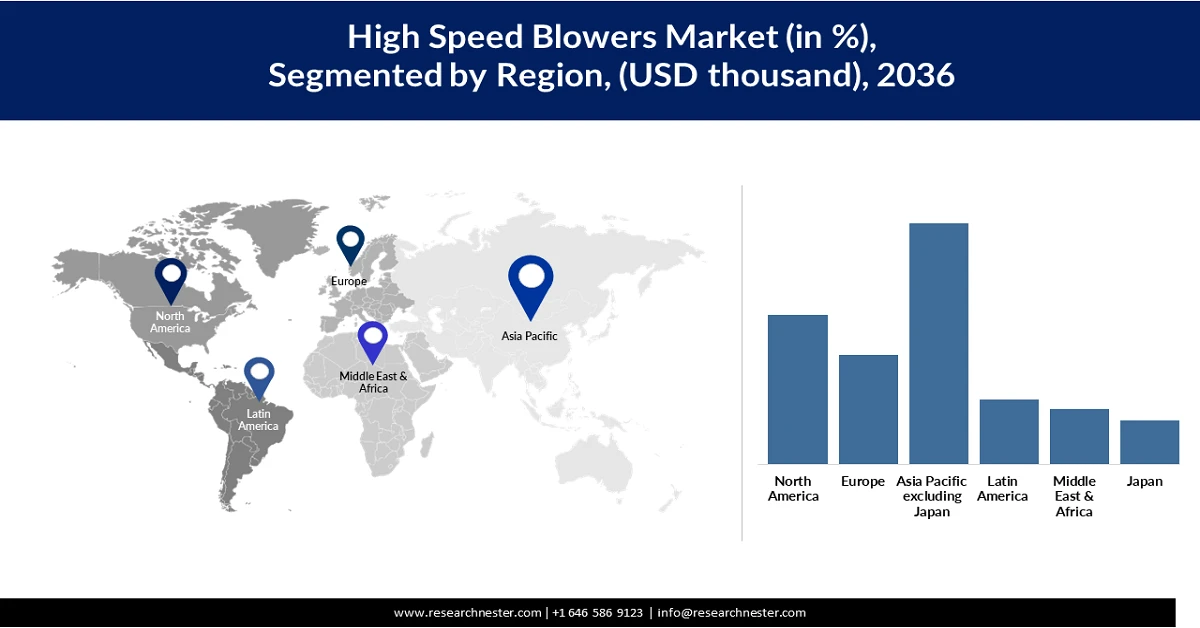
- Asia Pacific excluding Japan is expected to account for around 38.78% share of the high speed blowers market by 2036, underpinned by large-scale electrical and component manufacturing along with expanding petrochemical, semiconductor, data center, and wastewater infrastructure investments.
- North America is projected to capture nearly 24.07% market share by 2036, reinforced by stringent water regulations, rising wastewater treatment funding, expanding EV production, and growing adoption of energy-efficient industrial HVAC and ventilation systems.
Segment Insights:
- The airfoil bearing segment is projected to account for a dominant 48.36% share of the high speed blowers market by 2036, supported by its lubricant-free design that lowers operating costs and enhances adoption across chemical, pharmaceutical, and wastewater treatment facilities.
- The 1,000–10,000 m³/h volume flow segment is anticipated to capture 35.93% market share by 2036, benefiting from its suitability for both domestic and industrial applications through reduced energy consumption and efficient aeration and vacuum generation.
Key Growth Trends:
- Regulations for energy-efficient designs
- Demand for efficient airflow systems in critical infrastructure
Major Challenges:
- Lack of skilled service network
- High cost of integration and installation
Key Players: Aerzener Maschinenfabrik GmbH (Germany), APG-Neuros (Canada), Atlas Copco AB (Sweden), Fuji Electric Corp. of America (Japan), Gardner Denver (Ingersoll Rand) (U.S.), Hitachi Industrial Products, Ltd. (Japan), Piller Blowers & Compressors GmbH (Germany), RAETTS Intelligent Equipment (Guangdong) Co., Ltd (China), Sulzer Ltd (Switzerland), SHANDONG ZHANGQIU BLOWER CO., LTD (China).
Global High Speed Blowers Market Forecast and Regional Outlook:
Market Size & Growth Projections:
- 2025 Market Size: USD 852.59 million
- 2026 Market Size: USD 882.51 million
- Projected Market Size: USD 1.35 billion by 2036
- Growth Forecasts: 4.36% CAGR (2026-2036)
Key Regional Dynamics:
- Largest Region: Asia Pacific excluding Japan (38.78% Share by 2036)
- Fastest Growing Region: Asia Pacific excluding Japan
- Dominating Countries: United States, China, Germany, Japan, South Korea
- Emerging Countries: India, Vietnam, Indonesia, Mexico, Poland
Last updated on : 4 February, 2026
High Speed Blowers Market - Growth Drivers and Challenges
Growth Drivers
- Regulations for energy-efficient designs: Growing emphasis on energy-efficient system design is driving the global high speed blowers market, as industrial and commercial facilities are increasingly required to lower energy consumption without compromising performance. Government-backed building energy codes and efficiency standards referenced by the U.S. Department of Energy and the Whole Building Design Guide mandate that HVAC and ventilation systems meet stringent efficiency benchmarks, often aligned with ANSI/ASHRAE Standard 90.1. These requirements encourage the adoption of advanced air-movement technologies capable of delivering higher airflow with reduced power input. At the same time, standards developed by organizations such as the Air Movement and Control Association define efficiency classifications and testing procedures for fans and blowers, pushing manufacturers to design high-speed blowers with improved aerodynamics, variable speed drives, and optimized motors. Compliance with these energy-efficiency frameworks is prompting end users to upgrade from conventional equipment to high-speed, energy-optimized blowers, thereby supporting market growth across industrial HVAC, chemical processing, and manufacturing sectors.
- Demand for efficient airflow systems in critical infrastructure: The growing need for highly efficient airflow systems in critical infrastructure such as data centers, hospitals, power plants, and other mission-critical facilities is strengthening demand for advanced high-speed blowers globally because reliable, controlled airflow is integral to the safety, performance, and continuity of these operations. For example, in digital infrastructure like data centers, efficient airflow and HVAC systems are essential to manage heat loads, control humidity, prevent equipment overheating, and reduce energy use, with data center HVAC systems alone accounting for a large share of total energy consumption and requiring optimized airflow management to maintain uptime and equipment reliability. U.S. government guidance for data centers highlights airflow optimization as a key strategy to improve HVAC performance and energy efficiency in these facilities.
Similarly, workplace ventilation standards from the U.S. Occupational Safety and Health Administration (OSHA) emphasize the importance of ensuring sufficient airflow to remove airborne contaminants and maintain indoor air quality for health and safety, particularly in environments with high occupancy or airborne hazards. In hospitals and health care settings, HVAC design tools promoted by the U.S. Environmental Protection Agency (EPA) stress that mechanical ventilation systems must provide adequate outdoor air and filtration to support indoor air quality and occupant safety. Because critical infrastructure environments demand precise control of temperature, humidity, and contaminant levels, blowers that can reliably deliver efficient, high-volume airflow are prioritized. This drives facility upgrades and new installations of high-speed blower systems engineered for resilience, accuracy, and energy efficiency, thereby supporting growth in the global high speed blowers market.
- Increasing refining complexes: The expansion of refinery complexes worldwide is becoming an important driver of growth in the global high speed blowers market because modern refineries require robust ventilation and air-handling systems to support increasingly complex and large-scale operations. As many regions, notably in Asia, the Middle East, and India, expand refining capacity to process higher volumes of crude and meet energy demand, facilities are adding more process units such as distillation columns, cracking units, and hydro processing units that demand precise control over airflow, heat management, and contaminant removal. Global regulatory frameworks governing air quality in refineries, such as the U.S. EPA’s National Emission Standards for Hazardous Air Pollutants (NESHAP) and the Clean Air Act standards, require significant controls on toxic emissions and volatile organic compounds, which in turn necessitate advanced ventilation and air-handling solutions to capture, move, and treat process air safely and effectively. In addition, occupational safety standards like OSHA’s industrial ventilation requirements mandate proper ventilation in areas handling flammable or hazardous materials to maintain safe working environments. Because high-speed blowers deliver the high airflow rates and consistent pressure needed to meet these performance and safety criteria in large refinery settings, the increase in refining complexes and upgrades to existing facilities directly drives demand for these blower systems across the global market.
Challenges
- Lack of skilled service network: High-speed blowers require servicing and assembling of magnetic bearing and sensor-rich systems from skilled technicians. In emerging countries, the after-sales service is still improving, which increases the prevalence of system downtime and delayed servicing, creating a barrier to the adoption of high-speed blowers.
- High cost of integration and installation: Aeration systems, including high-speed blowers, are often expensive, which restricts the emerging and small-scale manufacturers from utilizing these systems. Ducting modifications, electric loading work, and automation compatibility further elevate the cost of the uptake, leading to a decline in the adoption.
High Speed Blowers Market Size and Forecast:
| Report Attribute | Details |
|---|---|
|
Base Year |
2025 |
|
Forecast Period |
2026-2036 |
|
CAGR |
4.36% |
|
Base Year Market Size (2025) |
USD 852.59 million |
|
Forecast Year Market Size (2036) |
USD 1.35 billion |
|
Regional Scope |
|
High Speed Blowers Market Segmentation:
Technology Segment Analysis
The airfoil bearing segment will hold the largest high speed blowers market share of 48.36% by the end of 2036 because of its lubricant-free mechanism that significantly reduces cost and is widely used in industrial facilities such as chemical and pharmaceutical manufacturing. Airfoil bearing is also used in water treatments and continuous duty applications that demand stable and low-pressure, energy-efficient air. The compact size and minimal vibrations increase the demand from industrial as well as domestic settings. Other segments, such as magnetic bearing, will also hold a significant share, owing to the high-speed propulsion used in cold storage and preservation centres. Construction sites often employ these high-pressure aeration systems to limit dust pollution.
Volume Flow Segment Analysis
The 1,000 – 10,000 m³/h segment will hold the largest market share of 35.93% as it suits domestic and industrial needs. The energy consumption in this air flow volume is less owing to the lightweight components and the minimum voltage. The segment is commonly used in aeration and vacuum generation. The advanced design, including digital monitoring and tri-lobe rotors, tends to reduce noise and ensure efficient air flow. The 10,000 – 15,000 m³/h segment will also hold significant opportunities in the future owing to its use in the large-scale industries. The high-speed blower systems of this volume flow require less maintenance and have high efficiency.
Application Segment Analysis
The wastewater aeration system is expected to hold the highest market share of 44.86% due to its widespread use in wastewater treatment. Across regions, wastewater aeration is becoming a common practice that is sustainable in nature and cleans water at minimal cost. The process employs high-speed blowers that release oxygen into the water and reduce the contamination level, ensuring an organic procedure. The wastewater systems consume less energy than other conventional systems and propel the market of high-speed blowers. Other segments, such as industrial process air, will also hold a positive growth owing to the rising manufacturing units across the regions that require high-speed blowers in ventilation and heat management.
Our in-depth analysis of the market includes the following segments:
|
Segments |
Subsegments |
|
Technology |
|
|
Volume Flow |
|
|
Pressure |
|
|
Application |
|

Vishnu Nair
Head - Global Business DevelopmentCustomize this report to your requirements — connect with our consultant for personalized insights and options.
High Speed Blowers Market - Regional Analysis
Asia Pacific excluding Japan Market Insights
The region is expected to hold approximately 38.78% because of large-scale electrical and component manufacturing, allowing competitors to obtain materials at low cost and develop energy-efficient high-speed blowers. The region is experiencing a surge in the petrochemical industry, which is growing at 5% every year, enhancing the demand for HVAC systems and heat management systems. Demand is also driven by the manufacturing sector as the region is scaling its semiconductor market, which is driving direct demand for high-speed blowers.
India Brand Equity Foundation claimed that it added 859 MW of data centre capacity with a projection of doing 3000-3700 MW by 2030, which is accelerating the demand for high-speed HVAC. Delhi is planning to expand the wastewater treatment capacity with a supported investment of 374 million, which is significantly boosting the demand for high-speed blowers.
Japan is ahead of sustainability, which has planned for effective mitigation of wastewater and aquatic cleaning. The business is encouraging the growth of wastewater blowers that can eliminate toxins and clean water. Application-specific and advanced engineered blowers have strengthened the demand for innovative HVAC systems that can be employed for various purposes.
North America Market Insights
The region is expected to hold a market share of 24.07% owing to the stringent water regulations laid by the government, which pressure manufacturers to develop energy-efficient high-speed blowers to effectively reduce water contamination. Demand is also driven by the industrial needs, where high-speed blowers are installed to enhance ventilation and minimize the heat within the factories and manufacturing units. The region is also experiencing a rise in electric vehicle production, which employs low-pressure HVAC systems to increase the cooling of the engines.
In the U.S., governments are under pressure to conserve aquatic life, which is accelerating the demand for water treatment through wastewater aeration management. The U.S. EPA has invested more than USD 50 billion under its infrastructure investment and Jobs Act, which includes an investment of USD 11.7 billion for wastewater treatment via CWSRF. The steady demand for water treatment is successfully enhancing the demand for energy-efficient high-speed blowers.
In Canada, the demand for high-speed blowers is growing steadily alongside broader expansion in industrial HVAC and ventilation systems, driven by increased investment in energy-efficient infrastructure and modern manufacturing facilities. The Canadian industrial fans and blower segment is expanding as industries upgrade air handling and process ventilation to meet stricter energy and environmental standards, with centrifugal blowers seeing rising adoption in manufacturing, power, and wastewater applications. Government commitments to clean technology and renewable energy infrastructure also support this trend by encouraging efficient airflow solutions in critical sectors. As part of the wider North American context, Canada contributes to market growth with modernization efforts that prioritize performance, efficiency, and regulatory compliance in airflow systems.
Europe Market Insights
The region is predicted to hold 17.67% owing to the energy efficiency regulations laid by the government. It has mandated the industries to employ energy-efficient ventilation and heat management systems that consume less power and focus on sustainability. The EU Urban Wastewater Treatment Directive ensures nutrient and micropollutant removal and energy neutrality in water and air treatment. This has significantly improved the growth of high-speed blowers, which also brings sustainability. The stricter emissions of the region are successfully expanding the market and ensuring its consistent growth.
Germany is ahead in terms of sustainability, where it has focused on energy-efficient operations of industries, leading to the growth of energy-efficient and high-speed blowers. The government has mandated that businesses encourage sustainable practices that consume less energy. The chemical manufacturing companies are seeking energy-efficient blowers that would minimize the CO2 emissions. Further, the UK market is concentrated with players with international footprints that have set benchmarks in the market. Centri Force Engineering has advanced the potential of high-speed blowers, which are equipped with HAUS magnetic bearing, limiting the usage of oil-containing high-speed blowers and reducing the maintenance cost. The mechanism is a key element used in the treatment of water, which is highly sustainable.
Key High Speed Blowers Market Players:
- Aerzener Maschinenfabrik GmbH (Germany)
- APG-Neuros (Canada)
- Atlas Copco AB (Sweden)
- Fuji Electric Corp. of America (Japan)
- Gardner Denver (Ingersoll Rand) (U.S.)
- Hitachi Industrial Products, Ltd. (Japan)
- Piller Blowers & Compressors GmbH (Germany)
- RAETTS Intelligent Equipment (Guangdong) Co., Ltd (China)
- Sulzer Ltd (Switzerland)
- SHANDONG ZHANGQIU BLOWER CO., LTD (China)
- Company Overview
- Business Strategy
- Key Product Offerings
- Financial Performance
- Key Performance Indicators
- Risk Analysis
- Recent Development
- Regional Presence
- SWOT Analysis
- Atlas Copco AB, based in Switzerland, deals in industrial productivity solutions such as water pumps, industrial power tools, and assembly systems, which are integrated in automotive, construction, manufacturing, and electronics. The business has its geographical footprint in more than 80 countries.
- Hitachi Industrial Products, one of the largest industrial conglomerates of Japan, which focuses on industrial electrical sales, development, and manufacturing while maintaining traditional products such as pumps and compressors. The business is present in almost all major countries with a long legacy of consumer trust supporting its expansion.
- APG-Neuros, the Canadian business, focuses on high-speed blowers and aeration systems that are used in treating wastewater and its industrial applications. APG-Neuros is also considered to be one of the largest manufacturers of energy-efficient turbo blowers
- Sulzer Ltd is a leader in fluid engineering and also a supplier of pumps and separation systems supporting multiple industries, including wastewater treatment, chemical processing, and energy. Suzler has a global service network with manufacturing in almost all major countries.
Below is the list of the key players operating in the global high speed blowers market:
The players operating in the global high-speed market are expected to face intense competition during the forecast timeline. The market is associated with both established key players and new entrants. However, the market is moderately fragmented. New entrants impose immense competition for the existing players, prohibiting them from acquiring the majority of the revenue share. Specialised manufacturers maintain a competitive landscape in the market. Key players in the market are significantly supported by the governments for research and innovation.
Competitive Landscape of the Global High Speed Blowers Market:
Recent Developments
- In November 2025, Hitachi Industrial Equipment inaugurated its first manufacturing facility in Gujarat aimed towards the production of stationary oil-flooded screw air compressors to boost the local sales and operations.
- In November 2025, Atlast Copco AB acquired Anglian Compressor and Equipment Limited, which expanded its strength in sales of compressed air and other service offerings in the UK. The strategic initiative will enhance the business position in the entire UK primarily because of the long expertise.
- Report ID: 6840
- Published Date: Feb 04, 2026
- Report Format: PDF, PPT
- Explore a preview of key market trends and insights
- Review sample data tables and segment breakdowns
- Experience the quality of our visual data representations
- Evaluate our report structure and research methodology
- Get a glimpse of competitive landscape analysis
- Understand how regional forecasts are presented
- Assess the depth of company profiling and benchmarking
- Preview how actionable insights can support your strategy
Explore real data and analysis
Frequently Asked Questions (FAQ)
About this Report
Connect with our Expert


Report, 2026-2036



Copyright @ 2026 Research Nester. All Rights Reserved.
