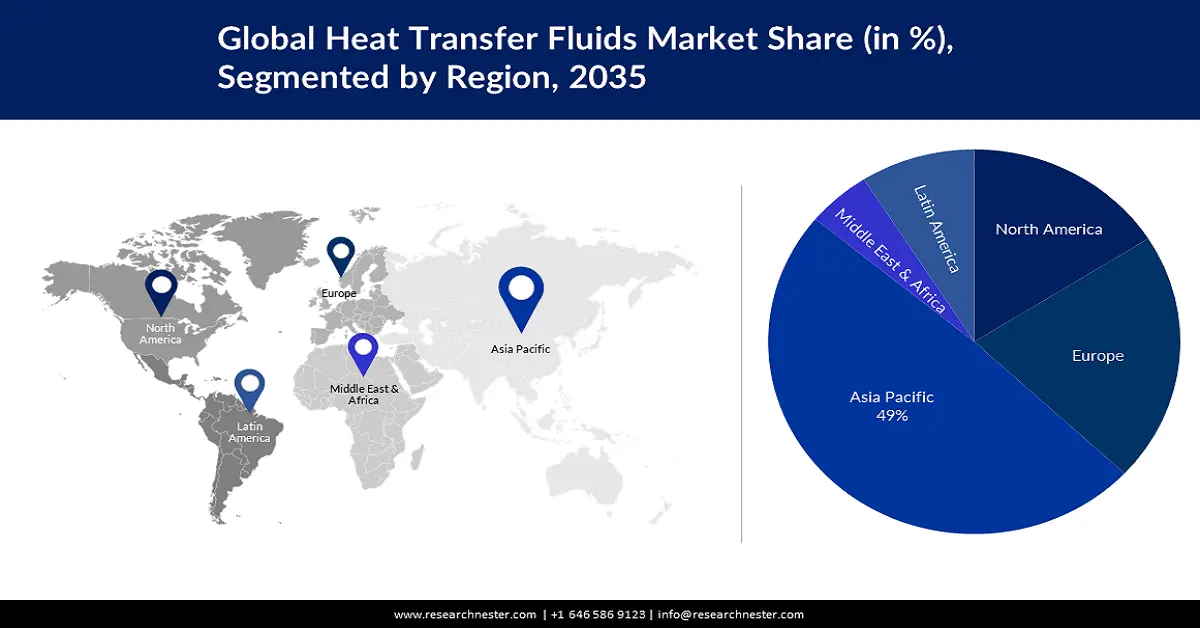
Heat Transfer Fluids Market Regional Analysis:
APAC Market Insights
Asia Pacific industry is predicted to account for largest revenue share of 46% by 2035. The regional market growth is expected to be led by China, while India, Japan, and South Korea should also contribute considerably to the development of the market. The rapid developments in industrialization, urbanization, and infrastructure in the region following the tremendous growth of the population are thought to be the major factors increasing the applications for heat transfer fluids. It is estimated that more than 59% of the world's population resides in the Asia Pacific as of current times. Further, about 70% of households in India are expected to be using air conditioning by 2040. This tremendous growth in the use of HVAC in India and many places in the region should also prove beneficial for the market.
Europe Market Insights
The European heat transfer fluids market is expected to be the second-largest market during the forecast period. The energy demand in Europe is estimated to increase remarkably to fulfill the demand of the growing population. The market growth in Europe is expected to be led by Germany and Spain. The developments in different industries in these places should help them hold the major shares in the regional market during the forecast period. Further, the infrastructure for solar energy production in the region is projected to grow remarkably in the coming years. Similarly, a mammoth increase of 49% was observed in solar power generation in the EU in 2022 compared to the previous year.
North American Market Insights
North America market is projected to register significant growth during the forecast period. The region houses a significant number of manufacturers and witness several efforts in research and development for innovative solutions in many applications. Further, the concern over carbon emission and the stringent government regulations to bring the emission rate and volume under control should contribute considerably to the regional market growth. For instance, the United States Environmental Protection Agency estimated that the total greenhouse gas emission in the U.S. in 2021 was equivalent to 5,586 million metric tons of carbon dioxide.