Genetically Modified (GMO) Food Market Outlook:
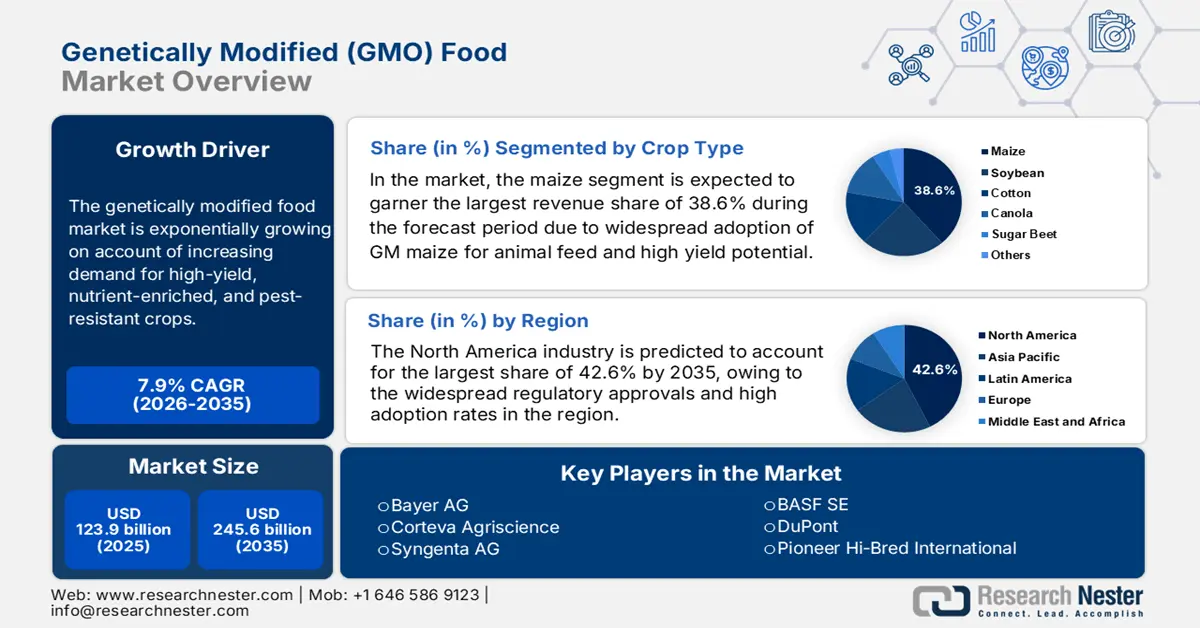
Genetically Modified (GMO) Food Market size was valued at USD 123.9 billion in 2025 and is projected to reach USD 245.6 billion by the end of 2035, rising at a CAGR of 7.9% during the forecast period, i.e., 2026-2035. In 2026, the industry size of genetically modified food at USD 133.6 billion.
The genetically modified food market is exponentially growing on account of increasing demand for high-yield, nutrient-enriched, and pest-resistant crops. Advancements in biotechnology are encouraging the development of foods with enhanced shelf life, improved nutritional profiles, and resistance to environmental stresses. In this regard, the USDA Biotechnology Risk Assessment Grants program in December 2025 reported that it provides funding to support research on the environmental risks and management of genetically engineered organisms, which include plants, animals, insects, and microorganisms. It also reported that in FY 2024, BRAG received 33 proposals, requested USD 18.4 million, and allocated USD 5.29 million to 11 projects, with an average grant size of USD 649,303, reflecting a 28% success rate. This funded research is focused mainly on gene transfer, environmental impacts, containment strategies, and advanced genetic technologies such as CRISPR, ensuring regulatory agencies have science-based data for risk assessment.
Furthermore, the regulatory landscape for the genetically modified food market and feed continues to evolve, with a steady stream of applications being reported for import, processing, and commercialization. Key crops such as maize, soybean, cotton, and oilseed rape dominate submissions, reflecting their critical role in international food, feed, and industrial supply chains. There have been many recently concluded approvals and withdrawn applications, illustrating the rigorous oversight applied by authorities such as EFSA. Leading agricultural biotechnology companies, as Bayer CropScience, Syngenta, BASF, and Corteva Agriscience, remain at the forefront of innovation, which are efficiently driving the development of traits such as herbicide tolerance, insect resistance, and yield enhancement. Hence, such instances of regulatory activities indicate both the sustained market demand for GM crops and the careful balance between technological advancement and compliance with food safety standards.
GM Food and Feed Applications and Renewal Status by Intended Use: Food, Feed, Import, and Processing (2022-2025)
|
GMO |
Applicant |
Status |
Year |
|
Soybean FG72 |
Syngenta |
Ongoing |
2025 |
|
Soybean 305423 |
Corteva Agriscience |
Ongoing |
2024 |
|
Maize NK603 x T25 |
Bayer CropScience |
Ongoing |
2023 |
|
Cotton T304-40 |
BASF |
Concluded |
2025 |
|
Cotton GHB614 x LLCotton25 |
BASF |
Concluded |
2025 |
|
Maize T25 |
BASF |
Concluded |
2025 |
|
Maize MON 87427 |
Bayer CropScience |
Concluded |
2025 |
|
Maize NK603 |
Bayer CropScience |
Concluded |
2025 |
|
Maize MON 87460 |
Bayer CropScience |
Ongoing |
2023 |
|
Soybean MON 87708 |
Bayer CropScience |
Concluded |
2025 |
|
Soybean MON 87705 |
Bayer CropScience |
Ongoing |
2023 |
|
Soybean MON 87769 |
Bayer CropScience |
Ongoing |
2023 |
|
Cotton MON 531 |
Bayer CropScience |
Withdrawn |
2023 |
|
Cotton MON 531 x MON 1445 |
Bayer CropScience |
Withdrawn |
2023 |
|
Cotton MON 1445 |
Bayer CropScience |
Withdrawn |
2023 |
|
Cotton MON 15985 |
Bayer CropScience |
Withdrawn |
2023 |
|
Oilseed rape MON 88302 |
Bayer CropScience |
Concluded |
2025 |
|
Maize MON 89034 x 1507 x NK603 |
Bayer CropScience & Corteva Agriscience |
Concluded |
2024 |
|
Maize MON 810 |
Bayer Agriculture BV |
Concluded |
2024 |
|
Maize MON 89034 x 1507 x MON 88017 x 59122 |
Bayer CropScience & Corteva Agriscience |
Concluded |
2024 |
|
Oilseed rape GT73 |
Bayer Agriculture BV |
Concluded |
2022 |
|
Oilseed rape GT73 |
Bayer Agriculture BV |
Concluded |
2022 |
|
Maize MIR162 |
Syngenta |
Concluded |
2022 |
|
Oilseed rape MS8, Rf3 and MS8 x Rf3 |
BASF |
Concluded |
2023 |
|
Soybean 40-3-2 |
Bayer Agriculture BV |
Concluded |
2023 |
|
Soybean MON87701 x MON89788 |
Bayer Agriculture BV |
Concluded |
2023 |
|
Soybean MON87701 |
Bayer Agriculture BV |
Concluded |
2023 |
|
Soybean A5547-127 |
BASF |
Concluded |
2022 |
|
Cotton 281-24-236 x 3006-210-23 |
Dow Agrosciences |
Concluded |
2023 |
Source: Biosafety Advisory Council