Genetically Modified (GMO) Food Market - Regional Analysis
North America Market Insights
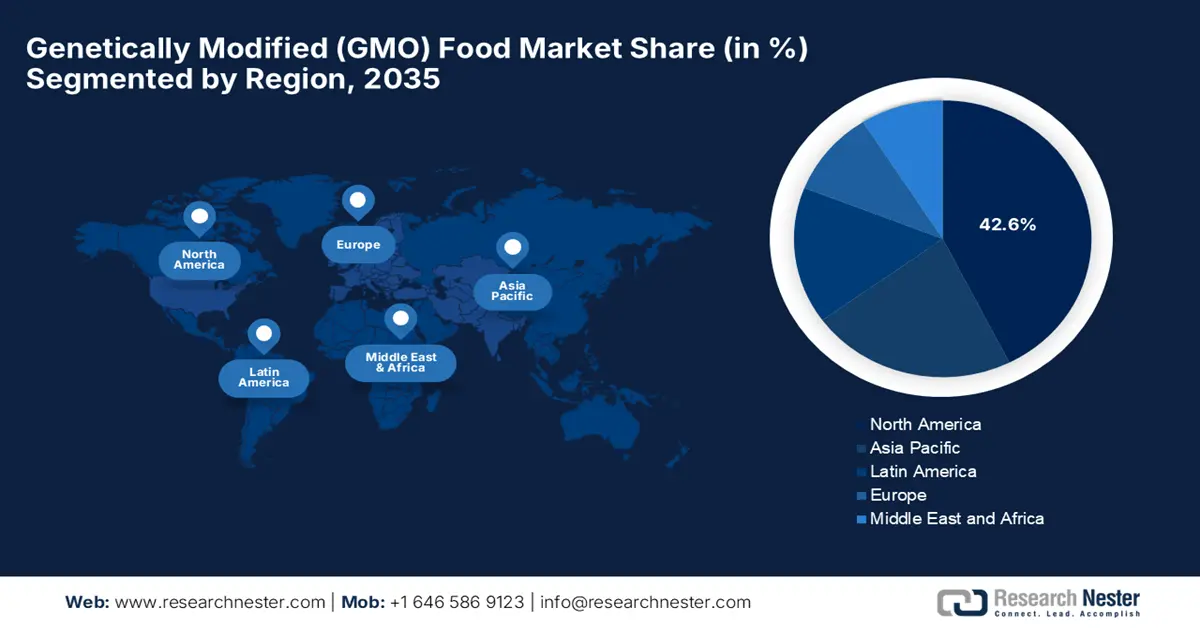
North America genetically modified food market is likely to maintain leadership, contributing to the largest 42.6% revenues by the end of 2035. The well-established agricultural biotechnology infrastructure, widespread regulatory approvals, and high adoption rates of genetically engineered crops are the key factors fueling the region’s leadership. As of the September 2024 data from the U.S. FDA, the common GMO crops include soybeans, corn, cotton, canola, sugar beets, alfalfa, papaya, potatoes, apples, and summer squash, with soybeans, corn, and cotton making up the majority of their respective plantings. Most GMO crops in the U.S. are used for animal feed or processed into ingredients such as oils, cereals, and snack foods, rather than appearing directly as fruits or vegetables in grocery stores. Further, the region also benefits from advanced seed R&D programs and integration of precision farming technologies, which promote continual trait innovation in commercial crops.
The presence of major biotech companies and universities are allowing crops with enhanced traits such as stress tolerance, optimized nutrient profiles, and reduced environmental inputs, driving business in the U.S. genetically modified food market. According to the article published by the U.S. Department of Agriculture in December 2025, the country has been witnessing 90% of corn, upland cotton, and soybean acres now planted with GE varieties. It also mentioned that by the conclusion of 2025, adoption of HT seeds reached 96% for soybeans, 93% for cotton, and 92% for corn, whereas the Bt traits covered 87% of corn and 91% of cotton acres, with stacked varieties increasingly dominating U.S. crop production. Furthermore, the regulatory framework supports streamlined evaluation and commercialization pathways that encourage both domestic deployment and export of GMO products, contributing to overall GMO food market growth.
Canada genetically modified food market is growing on account of a trait-based regulatory approach, which evaluates products on their characteristics rather than the development method. This policy has enabled the approval of markets for gene-edited crops along with traditional GM varieties, fostering a product pipeline of improved crops and increasing opportunities for farmers in the country. In this context, the GM Watch 2025 article reported that the country’s grocery stores sell only three genetically engineered fruits and vegetables: GM sweet corn, GM papaya, and a GM pink-fleshed pineapple, though these products are not widely available. It also mentioned that the federal government has begun exempting many new gene-edited foods from regulation, meaning most will reach the market without Health Canada's mandatory notification to consumers. Hence, such instances are driving market growth by expanding consumer options and increasing the adoption of biotech crops in fresh produce.
APAC Market Insights
The Asia Pacific genetically modified food market is considered to be the fastest growing, fueled by the expanding populations and rapid urbanization, which are elevating demand for efficient and sustainable food production systems. Governments and agricultural agencies across the region are making investments in biotechnology research, public–private partnerships, and capacity building to support the development and adoption of GMO crops. In July 2024, Japan’s Ministry of Agriculture, Forestry, and Fisheries (MAFF) confirmed that regular surveys of GM crop sites, which include rapeseed, soybean, corn, and cotton, showed no cross-contamination with nearby non-GM crops. Also, the aspect of strict protocols and continuous monitoring ensures that GM crops do not affect local biodiversity, addressing public concerns about accidental spillage. Hence, such instances of official assurance support consumer confidence and the safe adoption of GM crops in Japan’s agricultural sector.
The strategic focus on food security and self-sufficiency, regulatory authorities advancing biosafety evaluations for multiple genetically engineered crops, are the major driving factors for the China genetically modified food market. Simultaneously, the domestic biotech firms, often in collaboration with public research institutes, are accelerating the development of improved varieties to reduce reliance on imports. In this regard, Origin Agritech Ltd. in June 2025 reported that it advanced its biotechnology capabilities, which include progress on GMO corn hybrids, the BBL2-2 trait certification, the launch of the MIGC 20K gene chip, and partnerships with 12 major agricultural companies to drive smart corn breeding and gene editing initiatives. Origin also mentioned that it strengthened market presence through strategic collaborations, field demonstrations of around 300 corn varieties, and the development of R&D platforms in multiple provinces, positioning itself for long-term growth in the country’s market.
India genetically modified food market is backed by ongoing policy debates and regulatory reviews, particularly relating to genetically modified crops for food and feed. The country’s market also benefits from investments in genome editing research, capacity building, and state-led trials with a prime focus to align biotechnological innovation with local agronomic needs. In this regard, the country’s GM Info in May 2025 revealed that the coalition for a GM-Free India has demanded the immediate withdrawal of two recently released, untested gene-edited rice varieties, Kamala (DRR Dhan 100) and Pusa DST Rice 1, arguing that their release violates the law in the country, bypasses rigorous safety testing, and threatens environmental sustainability. The Coalition warns that SDN-1 and SDN-2 gene-editing techniques used to develop these varieties are imprecise, can create unintended genetic changes, potentially introduce foreign DNA, and pose risks of toxicity and loss of rice biodiversity. Therefore, releasing gene-edited rice varieties has the complete potential to drive GMO food market growth by promising higher yields that attract farmers and boost agricultural productivity.
Europe Market Insights
Europe genetically modified food market is progressing at a notable pace since it is governed by stringent regulatory frameworks that emphasize rigorous safety assessments and traceability. The continued imports and use in food and feed continue under strict oversight, fostering monitoring systems that inform policy decisions and consumer choice throughout the region. In December 2025, SOS reported that a qualified majority of EU Member States backed the deregulation of genetically modified plants produced using new genomic techniques, exempting them from risk assessments, labeling, and traceability requirements, but in turn allowing full patenting. In addition, the critics, including Save Our Seeds, state that this move favors biotech corporations rather than farmers, wherein such instances reduce the compliance costs, speeding up product commercialization, and encouraging more investment in biotech crop development.
The cautious regulatory implementation and active public engagement are the major driving factors for the Germany genetically modified food market. Research institutions conduct gene editing and trait development projects with a focus on sustainability and environmental impact, whereas policymakers balance innovation with precautionary risk assessments. In July 2025, the European Commission announced that it had approved a new genetically modified soybean for use in food and feed, which was followed by a scientific review and recommendation by the region’s food safety authority. It also mentioned that in Germany, as in other EU countries, the approval does not allow cultivation, and all products derived from this soybean must comply with strict labelling and traceability requirements. In addition, the authorization is valid for 10 years and ensures there is no risk to human or animal health or the environment, hence making it suitable for standard GMO food market growth.
The U.K. has redefined its regulatory framework to support innovation in genetic technologies, including gene editing. This updated landscape facilitates the development and approval of GMO and gene-edited crops that can support sustainable production in the U.K. genetically modified food market. In March 2023, the UK government reported that it had passed the Genetic Technology (Precision Breeding) Act, which deliberately enables the use of gene editing to develop crops and animals with traits, such as drought and disease resistance, while also maintaining strict GMO regulations. It also mentioned that this act introduces a science-based regulatory system to support research, innovation, and commercialization of precision-bred plants, with plans for animals, enhancing food security and climate resilience. Hence, this legislation positions the country as a predominant leader in agri-food innovation, thereby helping farmers produce even healthier, more resilient, and sustainable food.