Gastroenterology Disposables Market - Regional Analysis
North America Market Insights
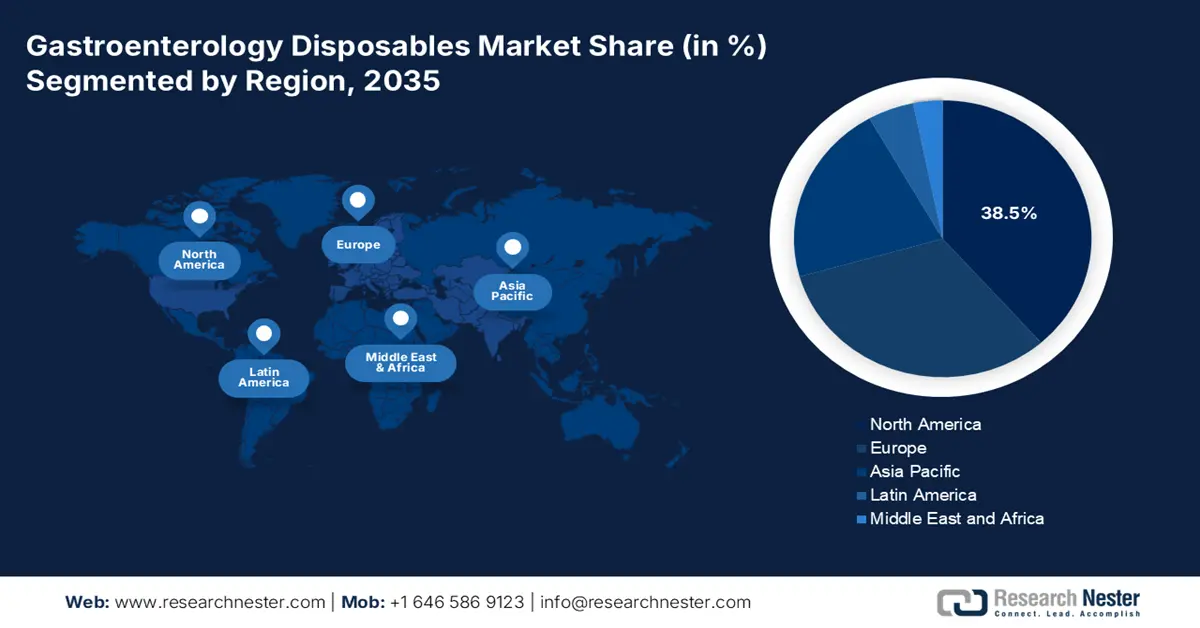
North America in the gastroenterology disposables market is anticipated to garner the highest share of 38.5% by the end of 2035. The market’s upliftment in the region is highly attributed to an increase in procedural volumes, strict infection control measures, and the presence of robust government reimbursement coverage. According to an article published by NIH in May 2022, a clinical study was conducted on 13,134 adults with Medicaid insurance coverage, and it was identified that 63.6% had insurance and received colonoscopy screening, thereby positively impacting the market.
The gastroenterology disposables industry in the U.S. is growing significantly, owing to a surge in procedural volumes with expansion in policy accessibility and preventive GI. As stated in the May 2025 Gastro Journal article, the healthcare spending for gastrointestinal diseases totaled USD 111.8 billion in the country. This included 14.5 million emergency department visits, along with 2.9 million hospital admissions. Besides, the country also witnessed 315,065 latest GI cancer diagnoses as well as 281,413 deaths, based on which the market is continuously gaining increased importance in the overall country.
The gastroenterology disposables market in Canada is also growing due to the aspect of federal budget allocation, provincial expenditure, and the existence of provincial health plans to cover GI-based endoscopic procedures and associated disposables. As per the 2024 Fraser Institute Organization data report, federal and provincial governments tend to spend USD 81.8 billion on interest payments as of 2024. Besides, residents of Labrador and Newfoundland observed the highest combined interest payments of USD 3,225 per person, while Manitoba accounts for USD 2,728 per person, thereby denoting a huge growth opportunity for the market in the country.
Federal and Current Expenditure in North America (2023-2024)
|
U.S. |
Canada |
|||
|
Quarters |
Billions of Dollars |
Cities |
Interest Costs (USD) |
Interest Costs in % Revenue |
|
Q2 2023 |
896.6 |
British Columbia |
3,257 million |
4.2 |
|
Q3 2023 |
968.3 |
Alberta |
3,157 million |
4.2 |
|
Q4 2023 |
1,030.7 |
Saskatchewan |
823 million |
4.2 |
|
Q1 2024 |
1,067.3 |
Manitoba |
2,193 million |
10.1 |
|
Q2 2024 |
1,096.7 |
Ontario |
13,449 million |
6.7 |
|
Q3 2024 |
1,116.9 |
Quebec |
9,867 |
6.6 |
|
Q4 2024 |
1,124.4 |
New Brunswick |
548 million |
4.4 |
|
|
|
Nova Scotia |
790 million |
5.3 |
Sources: FRED; Fraser Institute Organization
APAC Market Insights
Asia Pacific in the gastroenterology disposables market is expected to emerge as the fastest-growing region during the projected timeline. The market’s exposure in the region is highly fueled by an increase in gastrointestinal disorder cases, a sudden shift towards single-use devices for infection-based procedures, and government-based initiative screening programs. Japan and China are deliberately leading the market in the overall region due to massive volumes of procedures and an aging population. As indicated in the September 2024 Frontiers Organization article, there has been an upsurge in the public financial resources allocation to healthcare from 141.8 billion yuan to 2,254.2 billion yuan as of 2023. In addition, there has been an increase in healthcare spending at a 47.5% growth rate, thus suitable for the market’s growth.
The market in China is gaining increasing traction, owing to the existence of NMPA, government-specific expenditure on gastroenterology disposables, as well as the utilization of single-use hemostasis clips and biopsy valves. As per an article published by NLM in February 2024, a single cone-beam computed tomography (CBCT) imaging protocol tends to acquire almost 600 images within one C-arm rotation, based on the regional expertise for aiding pulmonary nodules, which, in turn, is deliberately contributing towards the overall market’s development in the country.
The gastroenterology disposables market in India is also developing due to the presence of governmental schemes to offer suitable healthcare coverage to the majority of citizens, an increase in diagnostic procedure accessibility, and generous private sector investments. As per the November 2023 NLM article, gastric cancer is considered the fifth most common cancer type, constituting 7.2% of overall cancer incidences. Besides, a clinical study was conducted on 1,033 patients to evaluate endoscopic procedures, which resulted in 59.7% of dyspepsia, 7% of chronic anemia, and 5.5% upper GI bleeding, thus catering to the market’s upliftment.
Europe Market Insights
Europe in the gastroenterology disposables market is expected to experience steady growth by the end of the projected duration. The market’s exposure in the overall region is highly subject to a rise in aging demographics, compulsory early colorectal cancer screening, along with standard infection control measures. In addition, the aspect of placing disposable medical instruments and regional governments' strategies is also driving the market’s development in the overall region. According to an article published by FFG in 2025, the ERA4Health, which was unveiled in 2022, readily focuses on enhancing the health of the overall population by achieving funds from 22 countries, which positively impacts the overall market’s growth.
The gastroenterology disposables industry in Germany is gaining increased exposure, owing to the largest market with an upsurge in expenditure for health and medical services. As stated in the 2024 Fresenius annual report, there has been an increase in group revenue, accounting for €21.5 billion as of 2024, denoting an 8% growth in the overall revenue. In addition, operational earnings rose by 10%, with a valuation of €2.5 billion, along with a further increase in operating cash flow by 16%, constituting €2.4 billion. Therefore, developments in pharma organizations in the country cater to huge growth opportunities for the overall market.
The gastroenterology disposables market in France is also growing due to the existence of a wide-ranging national health insurance system that tends to cover preventive care, an increase in government spending, and an effective focus on advanced medical devices to ensure improved patient outcomes. As per the 2024 Euro Health Observatory article, the statutory health insurance (SHI) system deliberately finances overall health and medical expenditure as well as complementary private health insurance (VHI), which caters to more than 95% of the population. Additionally, nearly 20% of the population benefits from VHI, which permits complete coverage of medicines and services, thus suitable for the market’s growth.
2023 Medical Instruments Export and Import in Europe
|
Countries |
Export |
Import |
|
Germany |
USD 18.4 billion |
USD 13.1 billion |
|
Netherlands |
USD 9.3 billion |
USD 14.1 billion |
|
Ireland |
USD 9.0 billion |
USD 1.9 billion |
|
Switzerland |
USD 4.5 billion |
USD 2.9 billion |
|
France |
USD 3.9 billion |
USD 6.4 billion |
|
Belgium |
USD 3.2 billion |
USD 4.5 billion |
|
Italy |
USD 3.1 billion |
USD 4.6 billion |
|
UK |
USD 3 billion |
USD 4.4 billion |
Source: OEC