Gallic Acid Market Outlook:
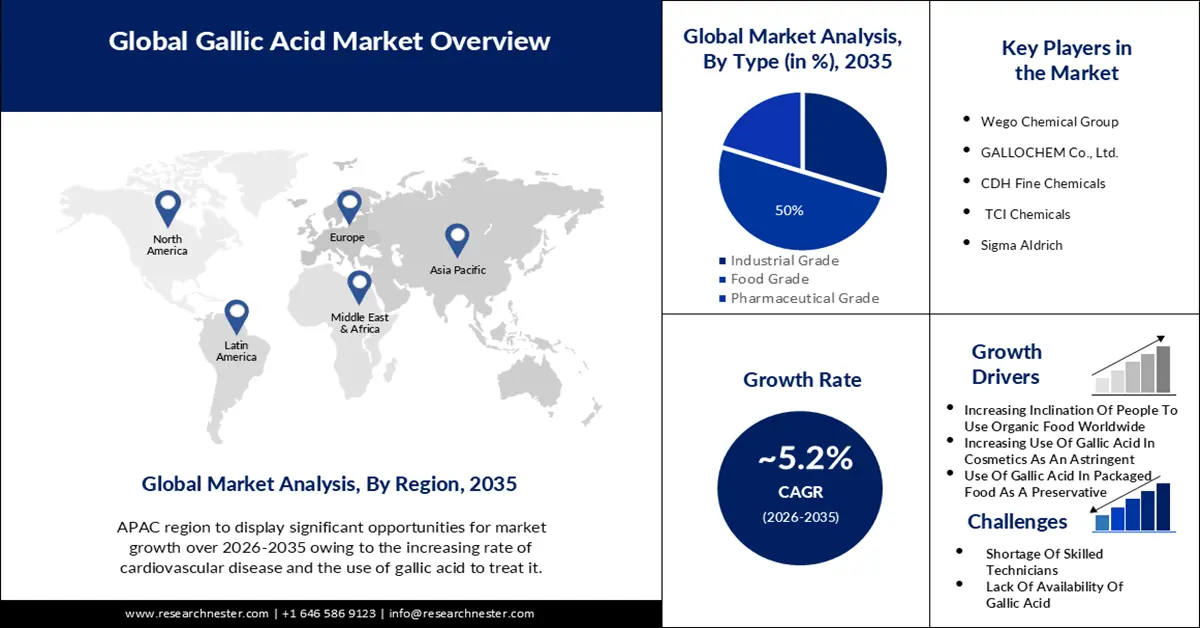
Gallic Acid Market size was over USD 88.93 million in 2025 and is poised to exceed USD 147.64 million by 2035, growing at over 5.2% CAGR during the forecast period i.e., between 2026-2035. In the year 2026, the industry size of gallic acid is estimated at USD 93.09 million.
The primary factor behind the huge growth of the gallic acid market is the increasing consumer inclination towards organic and natural food globally. The standardized wisdom test portrayed that a major part of respondents (62.0%) were obsessed with very low, low, and medium levels of wisdom, whereas 23.5 and 14.5% of plaintiffs had high and very high levels of wisdom concerning organic food. The utilization of organic materials has also been evident as applicable to public health, being acknowledged as an essential tool in commanding and avoiding different diseases that have seen a substantial increase in incidence over the years, like obesity and type 2 diabetes mellitus.
Another reason that will drive the gallic acid market by the end of 2036 is the increasing requirement for gallic acid in the food and beverage industry as an additive and preservative. Gallic acid has been utilized as a cross-linker to acquire chitosan-dependent components. Chitosan/GA coating demonstrated antioxidant and antimicrobial activity. Such components may be implemented to create a practical hindrance technology in the preservation of fresh pork, resulting in the modification of food protection and quality. Antimicrobial activity opposing Escherichia coli, Salmonella typhimurium, Listeria innocua, and Bacillus subtilis was evident for chitosan/GA films. The utilization of GA to develop chitosan-depended films also led to the modification of barrier properties and limitation of water vapor and oxygen penetrability. Moreover, high antioxidant activity with DPPH was noticed for chitosan/GA films after 4 days. With the transforming population and lifestyle, there are rising demands on food quality and texture. To increase the look, fragrance, taste, or retaining of food, extra components, generally named food additives, are usually implemented in the food industry.