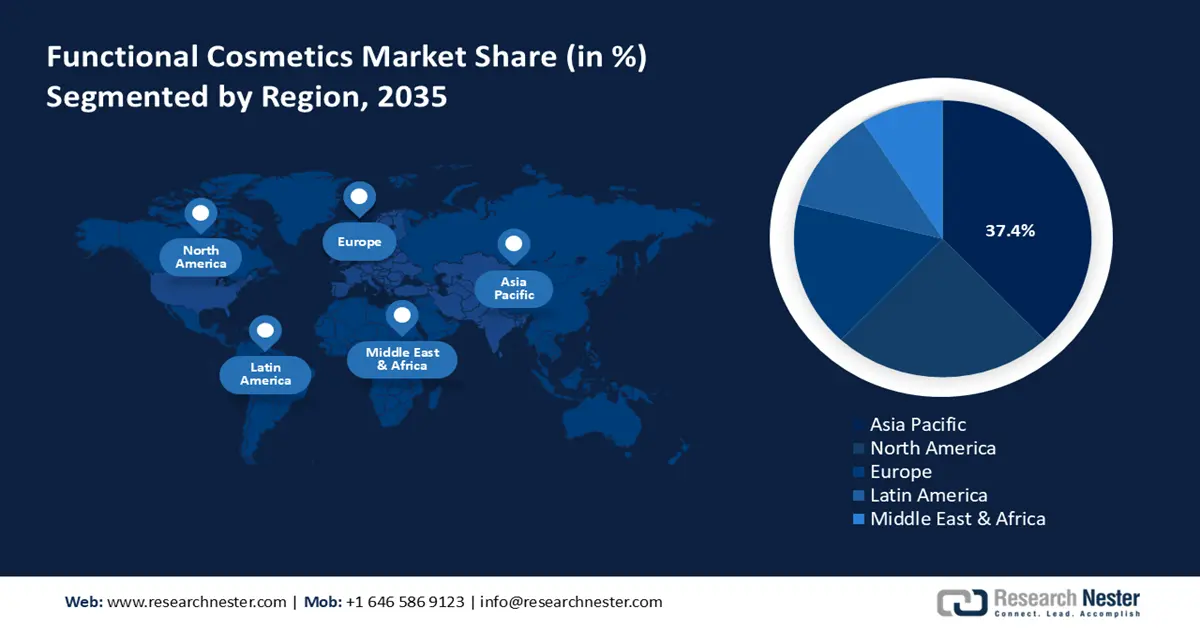
Functional Cosmetics Market - Regional Analysis
Asia Pacific Market Insights
By the year 2035, it is anticipated that the functional cosmetics market in the Asia-Pacific will account for 37.4% of global revenues. The primary factors contributing to this growth encompass heightened consumer awareness regarding skin health, a growing demand for multifunctional products, swift urbanization, an increase in disposable incomes, governmental backing for sustainable beauty innovations, and technological progress in bio-based ingredients and product formulations, especially in emerging markets such as China and India.
China's dominance in the functional cosmetics sector is attributed to significant investments in green chemistry, sustainable formulations, and an escalating urban demand for multifunctional skincare. Government backing through initiatives from the National Development and Reform Commission (NDRC) and ChemChina has fostered innovation. For instance, Proya Cosmetics has committed to eco-friendly research and development, introducing products that combine traditional Chinese botanicals with contemporary science to fulfill sustainability and performance standards.
On the other hand, India's 8.5% CAGR is driven by increasing income levels, a youth-oriented market demand, and government-supported innovations in green chemistry. National initiatives such as Startup India and DST funding are facilitating the development of cosmeceutical-grade products. Both nations are supported by robust manufacturing ecosystems, regulatory advancements, and a growing focus on biotech-driven cosmetic research, solidifying their roles as pivotal players in the APAC functional cosmetics sector.
Trade Volume of Skincare in 2023
|
Leading Exporter |
Global Share (%) |
Leading Importer |
Global Share (%) |
|
Italy |
17.6 |
U.S. |
10.6 |
|
France |
14.6 |
China |
8.78 |
|
U.S. |
10.3 |
Singapore |
5.04 |
|
Germany |
3.73 |
Japan |
4.55 |
|
UK |
2.5 |
South Korea |
3.94 |
|
Canada |
2.8 |
Canada |
3.58 |
Source: OEC
North America Market Insights
By 2035, it is projected that the functional cosmetics market in North America will attain a value of USD 5.9 billion, accounting for 25.4% of the global market share. This growth is fueled by consumer demand for multifunctional, anti-aging, and ethically produced products, especially among Generation Z and Millennials. There is a notable increase in popularity for items containing SPF, vitamins, and biotech-derived active ingredients.
The U.S. is expected to capture a significant portion of the global functional cosmetics market, propelled by advanced research and development in skincare, a high consumer demand for multifunctional and anti-aging products, and a strong emphasis on clean beauty. Additionally, the market is bolstered by regulatory support and technology-driven innovations. For instance, Neutrogena, a brand under Johnson & Johnson, utilizes dermatological research to formulate science-based products such as its Rapid Wrinkle Repair line, which includes retinol and hyaluronic acid.
Canada is also projected to secure a considerable share of the global functional cosmetics market, fueled by an increasing consumer preference for clean and multifunctional beauty products, robust regulatory standards, and a rising demand for plant-based and sustainable formulations. The nation's commitment to ethical sourcing and biotechnological innovation further enhances market expansion. For instance, DECIEM, the parent company of The Ordinary, employs science-driven, minimalist formulations that provide targeted skin benefits while ensuring affordability and transparency.
Europe Market Insights
By the year 2035, it is anticipated that the functional cosmetics market in Europe holding 18% revenue share, fueled by a growing consumer interest in multifunctional and sustainable skincare products. Contributing factors include heightened awareness regarding skin health, progress in bioactive ingredient technology, strict regulatory requirements, and a significant focus on environmentally friendly formulations. Additionally, the region's commitment to innovation and ethical beauty practices will further enhance market growth.
The UK is expected to capture a significant portion of the global functional cosmetics market, propelled by a rising consumer interest in clinically validated, multifunctional skincare, a robust commitment to sustainability, and advancements in biotech-driven formulations. Additionally, supportive regulatory environments and an increasing wellness culture contribute to the market's growth. For instance, REN Clean Skincare creates high-performance products utilizing bioactive components and zero-waste packaging, which aligns with both functional effectiveness and environmental stewardship.
Germany is projected to secure a considerable share of the global functional cosmetics market, influenced by a strong focus on natural and organic ingredients, cutting-edge research in dermatology, and rigorous regulatory standards that enhance product safety and effectiveness. The nation's dedication to sustainability and innovation fosters growth in multifunctional skincare. For instance, Dr. Hauschka is well-known for its certified organic, holistic products that merge natural botanicals with scientific research to provide effective, functional skincare solutions.